Gnats vs Sabres - 1965
The Sabre Slayers - When Skill Beat Technology
In 1965, India's tiny Folland Gnats took on Pakistan's American-supplied F-86 Sabres - and won. Flight Lieutenant Trevor Keelor scored the first kill. Squadron Leader A.B. Devayya died fighting an F-104 Starfighter. The IAF's redemption after 1962 came in the skies over Punjab.
The Sabre Slayers
September 3, 1965. The skies over Chhamb, Jammu and Kashmir.
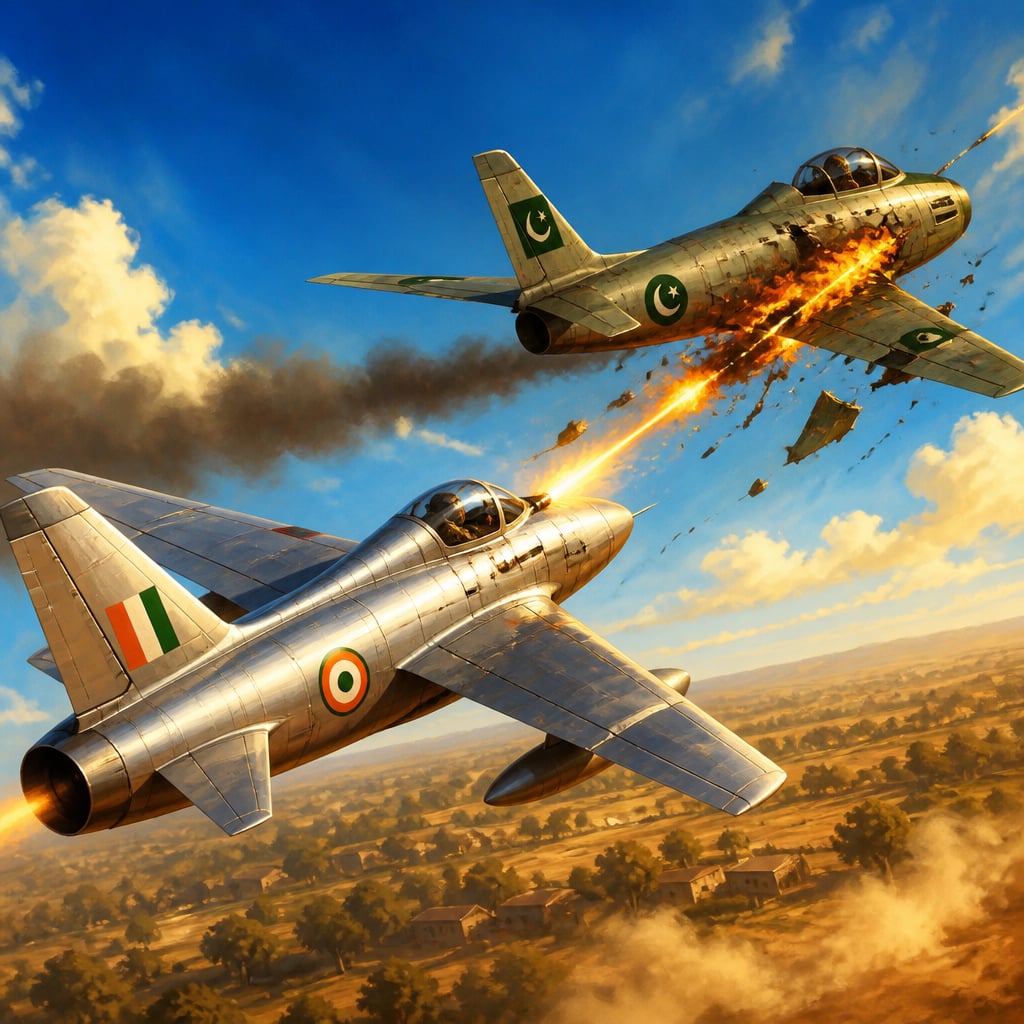
A Pakistani F-86 Sabre - American-made, Sidewinder-armed, the pride of the Pakistan Air Force - is running for its life.
Behind it, impossibly, is a Folland Gnat. The Gnat is half the size of the Sabre. It has no missiles, only guns. On paper, this should be a mismatch.
But the Gnat is in the hands of Flight Lieutenant Trevor Keelor, and Keelor isn't reading the paper.
He closes the distance. His gunsight locks on. He fires.
The Sabre disintegrates in mid-air - the first air-to-air kill of the 1965 war. The first Gnat kill in history. The moment the Indian Air Force proved that 1962 would not define it.
The age of the "Sabre Slayers" had begun.
The Backdrop
After 1962
The 1962 defeat against China haunted India. The Army had been humiliated. The Air Force - grounded by political decisions - had watched impotently.
But the defeat also sparked transformation. India modernized its military. New equipment was acquired. New doctrines were developed. And a new generation of pilots trained with one thought: never again.
When Pakistan launched Operation Gibraltar in August 1965, infiltrating fighters into Kashmir, India was ready. When Pakistan escalated with Operation Grand Slam on September 1 - a massive armored thrust toward Akhnur that could cut off Kashmir - India didn't just defend. It counter-attacked.
And this time, the Air Force flew.
The Mismatch on Paper
The Pakistan Air Force in 1965 was a formidable force. Its backbone was the F-86 Sabre - an American supersonic fighter that had proven itself in the Korean War. The Sabre was fast, well-armed, and - critically - equipped with AIM-9 Sidewinder heat-seeking missiles. It was the most advanced fighter in the subcontinent.
Pakistan also had F-104 Starfighters - Mach 2 interceptors that could outrun anything India had. These were the ultimate "silver bullet" - not many, but terrifyingly capable.
India's air force was a mix of aging British and French aircraft: Hunters, Mysteres, Vampires, Canberras. Good aircraft, but not clearly superior to what Pakistan had.
And then there was the Gnat.
The Gnat
The Folland Gnat was designed in Britain as a lightweight fighter - small, cheap, and incredibly maneuverable. The RAF had rejected it as a front-line fighter, considering it too small. India bought it anyway, and eventually built it under license at HAL Bangalore.
On paper, the Gnat looked outmatched:
| Specification | Gnat | F-86 Sabre |
|---|---|---|
| Wingspan | 6.7 m | 11.3 m |
| Max Speed | Mach 0.98 | Mach 1.0 |
| Armament | 2× 30mm cannons | 6× .50 cal guns + Sidewinders |
| Weight | 2,300 kg empty | 4,900 kg empty |
The Sabre was bigger, faster, and carried missiles. The Gnat had only guns. By every conventional measure, the Sabre should win.
But air combat isn't conducted on paper. It's conducted by pilots.
The First Kill
September 3, 1965
The war had escalated rapidly. Pakistani aircraft were attacking Indian positions in the Chhamb sector. Indian ground forces desperately needed air cover.
A formation of Gnats was scrambled to intercept. Among them was Flight Lieutenant Trevor Keelor, an Anglo-Indian pilot with a reputation for skill and cool under pressure.
The Gnats found their targets: Pakistani Sabres circling over Indian Army positions. The engagement began.
Keelor locked onto a Sabre. The Pakistani pilot, equipped with Sidewinder missiles, should have had the advantage. But in close-quarters maneuvering - the furball of a dogfight - the Gnat's agility began to tell.
The Gnat was tiny. It could turn inside the Sabre. Its small size made it hard to see and harder to track. Keelor stayed with his target, closing to gun range.
He fired.
The Sabre caught fire and disintegrated in mid-air. The pilot had no chance to eject.
It was the first air-to-air kill of the 1965 war. The first Gnat kill in history. And it had been achieved by a gun-armed fighter against a missile-armed opponent - a feat that rated at the very top of the air combat skill charts.
The Psychology Shifts
The impact was immediate.
PAF intelligence, which had dismissed the Gnat as a minor threat, rushed to upgrade its assessment to "most dangerous." Pakistani pilots, trained to expect easy kills against the small Indian fighter, suddenly found themselves in a different war.
The Gnat earned a nickname that would echo through history: "Sabre Slayer."
After Chhamb, PAF Sabre pilots began avoiding engagements with Gnats when possible. The tiny fighter had gotten into their heads.
The Keelor Brothers
Trevor Keelor wasn't the only Sabre killer in his family. His brother, Flight Lieutenant Denzil Keelor, also shot down a Sabre during the war.
Both brothers received the Vir Chakra - India's third-highest gallantry award - for the same feat: shooting down Pakistan Air Force F-86 Sabres. It was the first time in history that two brothers received Vir Chakras for the same type of action.
The Keelor brothers became legends. But they weren't the only heroes of 1965.
The Attack on Sargodha
September 6-7, 1965
As the ground war expanded, the IAF launched strikes against Pakistani air bases. The most important target was Sargodha - Pakistan's largest air base, home to most of its Sabre fleet.
If Sargodha could be neutralized, the PAF's offensive capability would be crippled.
On September 6 and 7, the IAF launched multiple strikes. Mystere fighters - French-built ground attack aircraft - carried the main punch. The missions were dangerous: Pakistani defenses were strong, and the PAF could be expected to intercept aggressively.
One pilot would earn immortality in these raids.
Squadron Leader A.B. Devayya
Ajjamada Boppayya Devayya was a senior flying instructor with No. 1 Squadron ("Tigers"). He wasn't supposed to fly the Sargodha mission - he was standby, scheduled to replace any aircraft that dropped out.
No aircraft dropped out. Devayya flew anyway.
His determination to join the fight would prove prophetic.
The Dogfight
On September 7, Devayya was part of a Mystere strike formation heading for Sargodha. Pakistani interceptors rose to meet them.

Devayya found himself engaged with an F-104 Starfighter - Pakistan's fastest and most advanced aircraft. The Starfighter was flown by Flight Lieutenant Amjad Hussain, an experienced PAF pilot.
The F-104 was a Mach 2 interceptor. The Mystere was a subsonic ground attack aircraft. By every logical measure, Devayya should have been an easy kill.
But Devayya wasn't flying logically. He was flying to win.
The dogfight that followed entered legend. Devayya, in his slower aircraft, somehow evaded Hussain's attacks repeatedly. When the Starfighter closed for what should have been a killing shot, Devayya turned into the attack.
The two aircraft exchanged fire. Both were hit.
Hussain ejected from his crippled Starfighter and parachuted safely. Squadron Leader Devayya did not survive. His Mystere crashed near Sargodha.
A subsonic fighter had shot down a Mach 2 interceptor. A ground attack aircraft had killed an air superiority fighter. It seemed impossible - but Devayya had made it happen.
Recognition Delayed
Devayya's sacrifice wasn't recognized for 23 years.
The dogfight happened over Pakistani territory. India didn't have confirmation of what had occurred. For decades, Devayya was listed simply as missing in action.
Then, in 1988, a British aviation writer - commissioned by the Pakistani military to write about the air war - uncovered the truth. Pakistani records confirmed that Hussain's F-104 had been shot down by an IAF Mystere. The pilot of that Mystere had been Devayya.
In 1988 - 23 years after his death - Squadron Leader A.B. Devayya was posthumously awarded the Maha Vir Chakra. It remains the only posthumous MVC the IAF has awarded.

His wife accepted the medal in a ceremony that honored a hero whose sacrifice had been forgotten for a generation.
The Lessons of 1965
Pilot Skill vs. Technology
The 1965 air war proved that pilot skill could overcome technological disadvantage.
The Gnat was smaller and less heavily armed than the Sabre - but it was more maneuverable, and IAF pilots knew how to exploit that advantage. The Mystere was no match for the F-104 on paper - but Devayya proved that paper doesn't fight wars.
This lesson shaped IAF doctrine for decades: invest in pilot training, not just in technology. The best aircraft is useless in the hands of an average pilot. An average aircraft becomes extraordinary in the hands of a great one.
Aggression Wins
The IAF's aggressive posture in 1965 - attacking Pakistani air bases, seeking combat rather than avoiding it - contrasted sharply with the passivity of 1962.
Trevor Keelor didn't wait for the Sabre to make a mistake. He attacked. Devayya didn't run from the Starfighter. He fought. This aggression, this willingness to take the fight to the enemy, characterized the IAF throughout the war.
The psychology of aggression matters. The PAF entered 1965 confident in its equipment and training. By the end, their pilots were avoiding engagements with Gnats. The Indians had gotten into their heads - and head games win wars.
The Redemption
For the IAF, 1965 was redemption.
After the frustration of 1962, where fighter pilots watched helplessly while their Army comrades died, 1965 offered the chance to prove what the Air Force could do. And it proved plenty.
The IAF flew over 4,000 sorties during the war. It achieved air superiority over most of the battlefield. It struck Pakistani air bases, interdicted supply lines, and provided close air support that turned battles.
The IAF's performance in 1965 didn't just contribute to the tactical outcome. It restored the service's self-confidence and established its reputation as a force that could fight and win.
The Heroes Remembered
Trevor Keelor's Legacy
Wing Commander Trevor Joseph Keelor served the IAF until retirement. His "Sabre Killer" reputation followed him throughout his career. He received the Vayu Sena Medal in 1964 (for a courageous forced landing) and the Vir Chakra in 1965.
He died in 2002, remembered as the man who drew first blood - who proved that the tiny Gnat could take on the mighty Sabre and win.
A.B. Devayya's Legacy
Squadron Leader Devayya's sacrifice was forgotten for decades - then remembered forever. The 2025 film "Sky Force" is based on the Sargodha raids and prominently features Devayya's story, introducing him to a new generation.
His Maha Vir Chakra citation notes that he "deliberately chose to engage a superior adversary" and "fought to the end." Those words capture a man who flew not by the odds, but by his own code.
The Gnat's Place in History
The Folland Gnat served with the IAF until 1978. It never lost its reputation as a Sabre Slayer. Its successor, the HAL Ajeet (an indigenously developed variant), continued the tradition until 1991.
Today, preserved Gnats stand at IAF bases and museums across India - monuments to an aircraft that proved that small and skilled beats big and slow.
What They Taught Us
On Facing Superior Odds
Both Keelor and Devayya faced aircraft that outclassed them on paper. Both won.
The lesson isn't that technology doesn't matter - it does. But technology alone doesn't win. A skilled, aggressive, determined pilot in an inferior aircraft can beat a complacent pilot in a superior one.
This applies beyond aviation. In business, in competition, in life - the underdog who maximizes their advantages and attacks aggressively can beat the favorite who relies on assumed superiority.
On Aggression
The passive approach - wait, defend, hope the enemy makes a mistake - is how wars are lost. The aggressive approach - attack, press, force the enemy to react - is how they're won.
Keelor didn't wait for the Sabre to come to him. He went after it. Devayya didn't try to escape the Starfighter. He turned into it.
Aggression isn't recklessness. Both men were skilled, trained professionals. But they chose to attack rather than defend - and that choice made all the difference.
On Redemption
The IAF entered 1965 with the shadow of 1962 hanging over it. Three years earlier, its fighters had been grounded while the Army suffered.
In 1965, the Air Force proved that 1962 was an aberration, not a definition. It fought, it won, and it restored its honor.
Redemption is always possible. Past failures don't determine future performance - if you're willing to learn, to prepare, and to fight.
Conclusion: The Sabre Slayers
The 1965 air war was fought over the plains of Punjab and the mountains of Kashmir. It lasted 17 days. It ended in a stalemate on the ground - but in the air, the IAF had proven itself.
Tiny Gnats had killed mighty Sabres. Subsonic Mysteres had downed supersonic Starfighters. Indian pilots, dismissed by some as inferior to their Pakistani counterparts, had fought as equals - and sometimes betters.
Flight Lieutenant Trevor Keelor, "The Sabre Killer," scored the first air-to-air kill of the war.
Squadron Leader A.B. Devayya, "Wings of Fire," gave his life taking down an aircraft that should have been untouchable.
The Keelor brothers both earned Vir Chakras for the same feat - shooting down F-86 Sabres.
Together, they established a tradition of aggression, skill, and courage that defines the IAF to this day.
The Sabre Slayers of 1965 proved that India's Air Force could fight and win. Six years later, in 1971, they would prove it again - decisively.
Flight Lieutenant Trevor Keelor, VrC, VSM "The Sabre Killer" Squadron Leader A.B. Devayya, MVC (Posthumous) "Wings of Fire" The Heroes of 1965
Jai Hind.
Historical context
1965 Indo-Pakistani War
Three years after the humiliation of 1962, India faced another military challenge. This time, the Air Force was allowed to fight - and proved its worth. The IAF flew over 4,000 sorties and achieved air superiority over most of the battlefield. The psychological impact was as important as the tactical: India had proven it could fight.
Living traditions
The 2025 Bollywood film 'Sky Force' is based on the Sargodha raids and features Devayya's story. The aggressive spirit of 1965 remains part of IAF doctrine. The tradition of producing skilled fighter pilots who can overcome technological disadvantages continues in IAF training.
- Indian Air Force Museum: Houses preserved Gnat aircraft and exhibits on the 1965 air war. The museum tells the story of the Sabre Slayers through photographs, documents, and actual aircraft.
- HAL Heritage Centre and Aerospace Museum: Features aircraft built by HAL including the Gnat (built under license) and its successor, the Ajeet. Tells the story of indigenous aerospace development.
Reflection
- Keelor attacked a missile-armed Sabre with only guns. Devayya turned into an F-104 he couldn't outrun. When have you chosen aggressive action against better-equipped opposition? What made it possible?
- Devayya's sacrifice was forgotten for 23 years. His family didn't know he was a hero until British research revealed the truth. Does delayed recognition diminish the value of sacrifice?
- The Gnat beat the Sabre because IAF pilots maximized its strengths (maneuverability) while minimizing its weaknesses (firepower, speed). How do you identify and maximize your own 'maneuvering advantages' in competitive situations?