The Khukri Charge in Africa
Captain Gurbachan Singh Salaria - The Only UN Peacekeeper to Receive the PVC
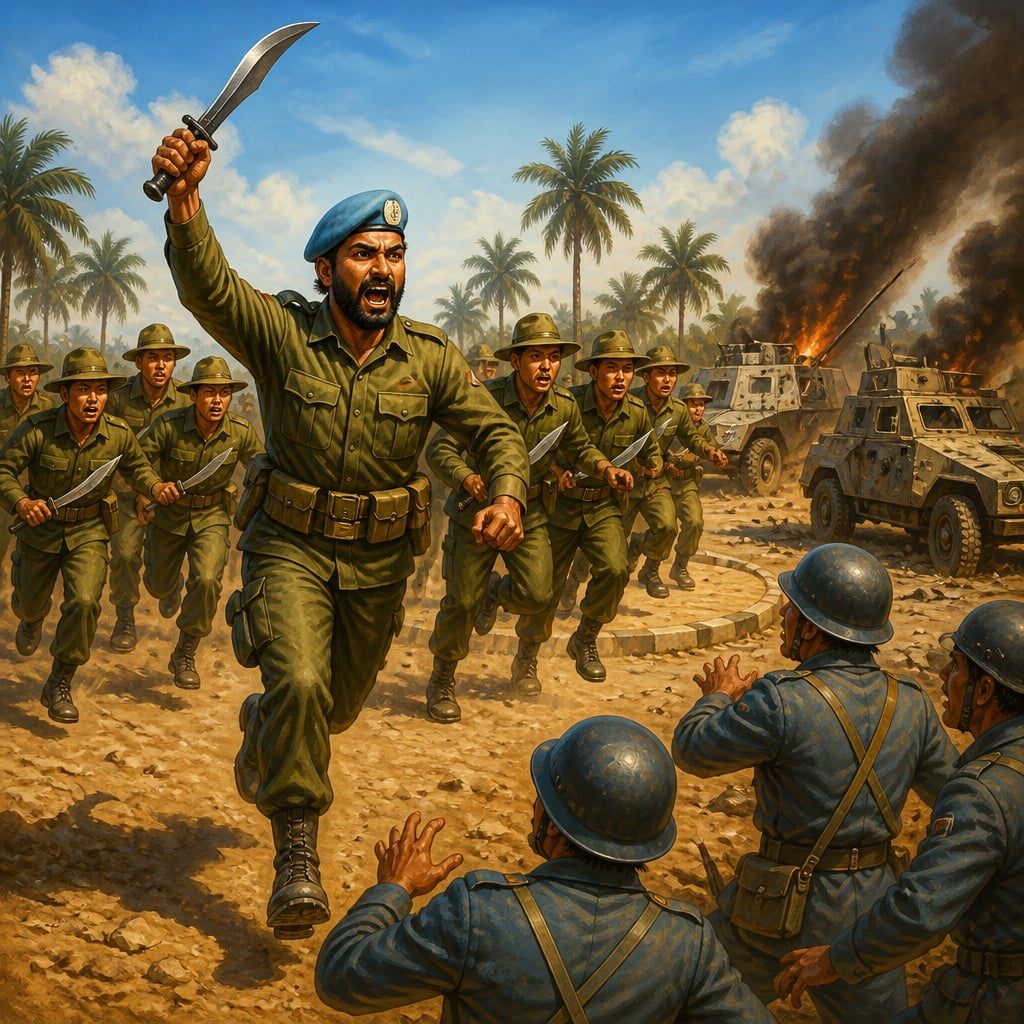
Captain Salaria remains the only soldier in history to receive the Param Vir Chakra for a United Nations peacekeeping mission. In Congo (1961), with just 16 Gorkhas against 90 enemy gendarmes and armoured cars, he led a khukri charge that saved the UN headquarters. His last words: 'I am going in for the attack. I am certain I will win.'
The Gorkha War Cry in Africa
December 5, 1961. Elizabethville, Congo.
A young Indian captain stood with 16 Gorkha soldiers, facing 90 enemy gendarmes armed with automatic weapons and supported by two armoured cars. They were 8,000 kilometers from home, fighting in a land none of them had ever seen before, for people they would never meet.
The odds were impossible. The enemy had them outgunned and outnumbered nearly six to one. Any sensible commander would have held position and called for reinforcements.
Captain Gurbachan Singh Salaria was not sensible. He was a Gorkha officer.
His last radio transmission before the charge: "I am going in for the attack. I am certain I will win."
With the ancient Gorkha battle cry - "Jai Mahakali, Ayo Gorkhali!" (Victory to Goddess Mahakali - The Gorkhas are here!) - he led his men into the guns.
What followed was the most extraordinary action in UN peacekeeping history.
The Congo Crisis
A Nation in Chaos
The Republic of the Congo gained independence from Belgium on June 30, 1960. Within two weeks, the country had collapsed into chaos.
The Congolese army mutinied against its Belgian officers. Belgian paratroopers intervened, ostensibly to protect European civilians but actually to protect mining interests. And on July 11, Katanga - the wealthiest province, home to vast copper and uranium deposits - declared independence under Moise Tshombe.
Katanga's secession was no grassroots movement. It was backed by Belgian mining companies, European mercenaries, and colonial interests that refused to accept the end of empire. Tshombe assembled an army of white mercenaries - some former Belgian soldiers, some ex-SS, some adventurers from across the world - to defend his breakaway state.
The United Nations intervened with ONUC (Opération des Nations Unies au Congo) - at its peak, nearly 20,000 peacekeepers from dozens of countries. India, newly independent and committed to anti-colonialism, contributed a brigade of 3,000 men.
The Indian contingent included 3/1 Gorkha Rifles - Captain Salaria's battalion.
The Elizabethville Situation
By December 1961, the UN was locked in an escalating conflict with Katangese forces. The previous months had seen firefights, ambushes, and the humiliating siege of Jadotville, where 156 Irish peacekeepers had been forced to surrender after running out of ammunition.
Elizabethville, Katanga's capital, was the flashpoint. UN headquarters was located there, but so were Katangese gendarmes, European mercenaries, and a population inflamed by Tshombe's propaganda painting the UN as invaders.
The situation was volatile. And on December 5, it exploded.
Captain Gurbachan Singh Salaria
The Making of a Warrior
Gurbachan Singh Salaria was born on November 29, 1935, in Janwal village near Shakargarh in undivided Punjab. After Partition, his family moved to Gurdaspur in Indian Punjab, and young Gurbachan grew up with the trauma of 1947 fresh in memory.
He was an exceptional student, attending the King George's Royal Indian Military Colleges in Bangalore and Jalandhar - institutions designed to produce India's military elite. In 1953, he joined the 9th batch of the National Defence Academy at Khadakwasla, becoming part of the first generation of officers trained entirely in independent India.
At NDA, Salaria was Cadet No. 1317 in Bravo Squadron. He was known for his physical courage, his infectious enthusiasm, and his deep bond with his fellow cadets. He was commissioned on June 9, 1957, into the prestigious Gorkha Rifles.
The Gorkha Tradition
The Gorkha regiments are among the most storied in the Indian Army. Their soldiers - recruited primarily from Nepal and the hill districts of India - have a warrior tradition stretching back centuries. Their motto is simple: "Better to die than be a coward."
The Gorkha's iconic weapon is the khukri - a curved Nepalese knife that, according to tradition, must draw blood once unsheathed. In close combat, the khukri is devastatingly effective. Gorkha soldiers have used it to terrifying effect from the battlefields of World War I to the jungles of Burma to the mountains of Kashmir.
Salaria joined 3/1 Gorkha Rifles in March 1960. By the time the battalion deployed to Congo, he had earned the respect of his Gorkha soldiers - no small achievement for any officer, let alone one so young.
Deployment to Congo
When 3/1 Gorkha Rifles arrived in Elizabethville in late 1961, they entered a war zone masquerading as a peacekeeping mission. The Katangese gendarmes and mercenaries had no intention of respecting UN authority, and firefights were becoming more frequent.
Captain Salaria was given command of a platoon. His mission: help secure UN operations in a city where every block could become a battlefield.
December 5, 1961, would test everything he had learned.
The Battle of the Roundabout
The Tactical Situation
The Katangese had established a roadblock at a strategic roundabout in Elizabethville. This roadblock controlled a key approach to the UN headquarters. If reinforced, it could be used to encircle and attack the UN command center itself.
3/1 Gorkha Rifles was ordered to clear it.
The plan was a two-pronged attack:
- One company with two Swedish armoured cars would attack frontally
- Captain Salaria with two sections (about 16 men) and two Swedish armoured personnel carriers would advance from the airfield as a cutting-off force
Salaria's role was to prevent enemy reinforcements from reaching the main battle. It seemed straightforward enough - a blocking action, secondary to the main assault.
It would become anything but secondary.
First Contact
At approximately 1:12 PM, Salaria's small force approached to within 1,500 yards of their objective. And then everything went wrong.
The enemy had positioned a force that no one had detected: approximately 90 gendarmes, heavily armed with automatic weapons, supported by two armoured cars. They opened fire the moment Salaria's force came into range.
Salaria had 16 men against 90. Two APCs against two armoured cars. A 3-inch mortar against automatic weapons.
By any rational calculation, he should have taken cover, radioed the situation, and requested support. The odds were impossible. Retreat would have been understandable.
Captain Salaria chose a different path.
The Charge
Salaria made an instant decision: attack.
His reasoning was pure Gorkha tactical doctrine. A defensive posture against a larger force with superior firepower would mean slow annihilation. The enemy would pin them down and destroy them at leisure. The only chance was to close the distance, to get inside the enemy's effective range, to use the weapons the Gorkhas knew best: bayonets and khukris.
He radioed his last message: "I am going in for the attack. I am certain I will win."
Then he raised the ancient battle cry: "JAI MAHAKALI, AYO GORKHALI!"
Victory to the Goddess Mahakali. The Gorkhas are here.
Into the Guns
What followed was medieval warfare in the modern age.
Salaria led from the front, as Gorkha officers always do. His men followed, charging directly into automatic fire. The 3-inch mortar provided covering fire, but most of the damage would be done hand-to-hand.
The Gorkhas hit the enemy position like a wave. Bayonets flashed. Khukris came out of sheaths. Grenades flew into bunkers and vehicles. The gendarmes, who had expected to slaughter a pinned-down enemy from a distance, suddenly found themselves in close combat with some of the most feared infantry soldiers in the world.
The fight was brutal and brief. When it was over:
- 40 enemy gendarmes lay dead
- Both enemy armoured cars were destroyed
- The roadblock was shattered
- The approach to UN headquarters was secured
But Captain Salaria was not among the living.
The Death of a Hero
During the charge, a burst of automatic fire struck Salaria in the neck. It was a mortal wound. But he didn't stop. He continued leading, continued fighting, continued inspiring his men until blood loss finally brought him down.

His Gorkhas carried him from the battlefield, but it was too late. Captain Gurbachan Singh Salaria died of his wounds on December 5, 1961. He was 26 years old - six days short of his 26th birthday.
He had been an officer for four years, five months, and 26 days.
The Significance
Tactical Impact
Salaria's charge wasn't just heroic - it was decisive.
The enemy force he destroyed was positioned to reinforce the main roadblock that the Gorkha battalion was attacking. Had those 90 gendarmes and two armoured cars reached the main battle, the outcome could have been very different.
More critically, the force was positioned to threaten UN headquarters itself. Salaria's action prevented the encirclement of the UN command center - which would have been a catastrophe for the entire Congo operation.
A 26-year-old captain with 16 men changed the course of a battle - and possibly of the entire UN mission.
The Only UN PVC
Captain Gurbachan Singh Salaria was awarded the Param Vir Chakra posthumously. His father, Munshi Ram Salaria, received the medal on January 26, 1962.
To this day, Captain Salaria remains the only soldier in history to receive the Param Vir Chakra for action during a United Nations peacekeeping mission. In over 75 years of UN peacekeeping, involving soldiers from dozens of countries in conflicts across the world, no other nation has awarded its highest gallantry honor for a UN action.
This isn't because other peacekeepers haven't shown courage. It's because what Salaria did was extraordinary even by the standards of extraordinary courage.
First NDA Graduate to Receive PVC
Salaria was also the first graduate of the National Defence Academy to receive the Param Vir Chakra. The NDA at Khadakwasla trains the future leaders of all three Indian armed services. That one of its earliest graduates achieved India's highest military honor set a standard for generations of cadets who would follow.
Today, a square at NDA is named "Salaria Square" in his memory. Every cadet who passes through Khadakwasla learns his story.
The Gorkha Spirit
What Made the Charge Possible
How did 16 men defeat 90?
Part of the answer is tactical surprise. The enemy expected a firefight at range, not a bayonet charge. They were psychologically unprepared for hand-to-hand combat.
Part of the answer is Gorkha training. From childhood, Gorkha soldiers are trained in close combat. The khukri isn't just a weapon - it's an extension of the warrior's arm. In tight quarters, against an enemy who has only trained to shoot, the Gorkha is in his element.
But the deepest answer is cultural. The Gorkha warrior tradition teaches that death is preferable to dishonor. A Gorkha who retreats in the face of the enemy disgraces himself, his family, and his regiment. Better to charge into certain death than to live with that shame.
Salaria didn't charge because he calculated he could win. He charged because retreating was unthinkable. And his men followed because they shared the same values.
The Battle Cry
"Jai Mahakali, Ayo Gorkhali!"

Mahakali is the fierce aspect of the goddess Shakti - the destroyer of evil, the protector of the righteous. Gorkha regiments have invoked her name in battle for centuries.
The cry isn't just a war shout. It's a declaration of identity. It says: We are Gorkhas. We are here. And we do not retreat.
When Salaria raised that cry in Elizabethville, he connected his 16 men to a warrior lineage stretching back through the mountains of Nepal, through countless battlefields, through generations of men who had chosen death over dishonor.
The gendarmes heard the cry and saw the charge. And they broke.
Legacy
Memorials and Honors
Captain Salaria's sacrifice is commemorated across India:
- Param Yodha Sthal at the National War Memorial in New Delhi features a bust of Salaria alongside the other 20 PVC recipients
- Salaria Square at NDA, Khadakwasla
- Multiple schools, roads, and institutions named in his honor across Punjab
- Annual commemorations by 3/1 Gorkha Rifles on December 5
In Popular Culture
Salaria's story was dramatized in the 1988 television serial "Param Vir Chakra" directed by Chetan Anand, introducing his sacrifice to a generation of Indians who might otherwise never have heard of the Congo operation.
India's UN Peacekeeping Tradition
India has been one of the largest contributors to UN peacekeeping missions since the organization's founding. Indian soldiers have served in Congo, Gaza, Korea, Cambodia, Rwanda, Somalia, and dozens of other missions.
Captain Salaria set the standard. His courage demonstrated that Indian peacekeepers would not merely patrol and observe - they would fight and, if necessary, die for the UN's mission. That commitment has earned India's peacekeeping forces respect worldwide.
What He Teaches Us
Captain Salaria's story carries lessons that transcend military context:
On Leadership: He led from the front. When the moment came, he didn't order his men to charge - he charged first, trusting them to follow. True leaders don't ask others to take risks they won't take themselves.
On Decisive Action: Faced with impossible odds, he made an instant decision and committed fully. Hesitation would have been fatal. Sometimes the best plan is immediate, aggressive action.
On Fighting for Principle: Salaria had no personal stake in Congo. He wasn't defending his home or his family. He was fighting for the principle that the international community could maintain peace. He gave his life for an idea.
On the Warrior Spirit: The Gorkha tradition isn't about loving war. It's about accepting that some things are worth dying for, and acting accordingly when the moment comes. Salaria embodied that spirit in its purest form.
Conclusion: The Gorkhas Are Here
In the chaos of the Congo, in a conflict that few Indians even knew about, a young captain from Punjab led hill soldiers from Nepal in a charge that saved a UN headquarters thousands of miles from home.
He was 26 years old. He had been an officer for less than five years. He faced odds of nearly six to one. He didn't hesitate.
"I am going in for the attack. I am certain I will win."
He did win. His body lies in Elizabethville, but his spirit lives on in every Gorkha regiment, every NDA cadet, every Indian peacekeeper who serves under the UN flag.
The battle cry he raised that day still echoes:
"JAI MAHAKALI, AYO GORKHALI!"
Victory to the Goddess. The Gorkhas are here.
And in the person of Captain Gurbachan Singh Salaria, PVC, they always will be.
Captain Gurbachan Singh Salaria Param Vir Chakra (Posthumous) November 29, 1935 - December 5, 1961 3rd Battalion, 1st Gorkha Rifles The Only UN Peacekeeper to Receive the PVC
Jai Hind.
Historical context
Congo Crisis and UN Peacekeeping (1960-1964)
The Congo deployment was India's first major UN peacekeeping contribution. Prime Minister Nehru, committed to anti-colonialism, saw the mission as supporting African independence against neo-colonial interests. Indian troops served with distinction, and Salaria's sacrifice set the standard for India's peacekeeping tradition.
Living traditions
India remains one of the largest contributors to UN peacekeeping worldwide. Captain Salaria's sacrifice set the standard for Indian peacekeepers - not merely observers, but warriors willing to fight and die for peace. His story is taught at NDA and all military training institutions. The 1988 TV serial 'Param Vir Chakra' introduced his story to millions of Indians.
- Param Yodha Sthal, National War Memorial: The section of the National War Memorial dedicated to all 21 PVC recipients. Captain Salaria's bust is featured here alongside the other Param Virs, with his citation and story displayed.
- National Defence Academy: Salaria Square at NDA commemorates the first NDA graduate to receive the PVC. The academy trains cadets from all three services, and Salaria's story is taught to every batch.
Reflection
- Salaria charged into impossible odds because retreat was culturally unthinkable to him. What values are so deeply ingrained in you that you would act on them even at great personal cost?
- Salaria died fighting for strangers in a faraway land - for the principle that international peacekeeping should work. Is fighting for abstract principles as noble as fighting for home and family? Why or why not?
- The Gorkha motto says 'Better to die than be a coward.' Is there wisdom in this, or is it a dangerous glorification of death? When does courage become recklessness?