Vakpradushana: The Danger of Loose Talk
Know when to speak and when to stay silent
The beloved tale of the Talkative Tortoise teaches that even true friends cannot save us from our own inability to stay silent. Kambugriva loved to talk, and that love cost him everything. Sometimes silence is not just golden; it is the price of survival.
The Fourth Evening
The animals of Mahilaropya had come to treasure these evening gatherings beneath the banyan tree. Each night, Chirasena the crane unveiled new wisdom through ancient stories. This fourth night, the audience had grown larger still, even creatures who usually stayed hidden had emerged to listen.
"We have explored many dangers," began Chirasena, settling his long neck into a comfortable curve. "Meddling. Pride. False friends. Tonight, I wish to speak of something simpler, and perhaps more deadly. The danger of words."
A young parrot, known in the forest for her constant chatter, shifted nervously on her branch.
"Words can build kingdoms or destroy them," continued the crane. "The right word at the right time can save a life. But the wrong word, or simply too many words at the wrong moment, can end one. Let me tell you of Kambugriva, the tortoise who could not keep silent."
The Tale of the Talkative Tortoise
Beside a serene lake in the forest of Magadha, there lived a tortoise named Kambugriva, which means "conch-necked," for the spiral patterns on his ancient shell. Kambugriva was old, wise in many ways, and possessed of great knowledge. But he had one weakness that overshadowed all his virtues: he could not stop talking.
From dawn to dusk, Kambugriva talked. He talked to the fish. He talked to the frogs. He talked to the water lilies and the lotus flowers. He talked to himself when no one else would listen. His voice was a constant presence at the lake, commenting on everything, questioning everything, explaining everything.
"The water level is lower today," he would announce to no one in particular. "I believe it is due to the lack of rain. Of course, rain itself is caused by the evaporation of water from surfaces such as this very lake, which rises into clouds, which then, "
And on he would go, while the fish rolled their eyes and the frogs dove deep to escape his lectures.
But Kambugriva had two true friends who loved him despite his endless chatter: a pair of geese named Sankata and Vikata. These noble birds had known the tortoise for many years. They appreciated his wisdom and his kind heart, even if they sometimes wished he would simply be quiet.
"You are a good friend, Kambugriva," Sankata would say. "If only you could learn when to close your mouth."
"Talking is my nature," the tortoise would reply. "Just as flying is yours. Would you ask a bird not to fly?"
For many years, the three friends lived happily by the lake. But then a terrible drought came to the land of Magadha. Month after month passed with no rain. The rivers dried to trickles. The wells ran dry. And the lake where Kambugriva lived began to shrink.
First the shore retreated. Then the shallows vanished. Each day, the tortoise had to drag himself further across the cracking mud to reach the remaining water. And each day, that water grew warmer, muddier, and more foul.
"We must do something," said Sankata, looking at her friend with concern. "If the lake dries completely, Kambugriva will die."
"There is another lake," said Vikata. "Far to the south, in the mountains. The snow-fed waters never dry up, even in the worst drought. If we could bring him there..."
"But how?" asked Sankata. "We can fly, but Kambugriva cannot."
The geese thought and thought. Finally, Vikata had an idea.
"We shall carry him," he declared. "We will find a strong stick. Each of us will hold one end in our beaks. Kambugriva will bite the middle and hold on tight. We will fly him to the southern lake."
"It could work," agreed Sankata slowly. "But there is one danger."
Both geese looked at their friend, who was already approaching, eager to join the conversation.
"What are you discussing?" asked Kambugriva. "I noticed you two conferring. Is it about the drought? I have been thinking about the drought myself. The meteorological conditions suggest, "
"Kambugriva," interrupted Sankata gently. "We have a plan to save your life. But it requires something very difficult from you."
"Anything!" declared the tortoise. "I will do anything. What is required?"
"Silence," said Vikata. "Complete, absolute silence."
The geese explained their plan. They would carry Kambugriva through the air to the southern lake. But if he opened his mouth to speak even once, even for a single word, he would fall to his death.
"Can you do it?" asked Sankata. "Can you hold your silence for the entire journey?"
Kambugriva considered. It would be the hardest thing he had ever done. But the alternative was dying in the mud of a dried-up lake.
"I can do it," he said. "I promise. Not one word."
The next morning, the geese found a sturdy stick of bamboo. They positioned themselves on either side, gripping the ends firmly in their beaks. Kambugriva bit down hard on the middle.
"Remember," said Sankata, her voice muffled around the stick. "No matter what happens, do not open your mouth."
Kambugriva nodded, for nodding required no words.
The great wings of the geese began to beat. Slowly, incredibly, they rose into the air, carrying their friend between them. Higher and higher they climbed, until the dying lake was just a brown smudge far below.
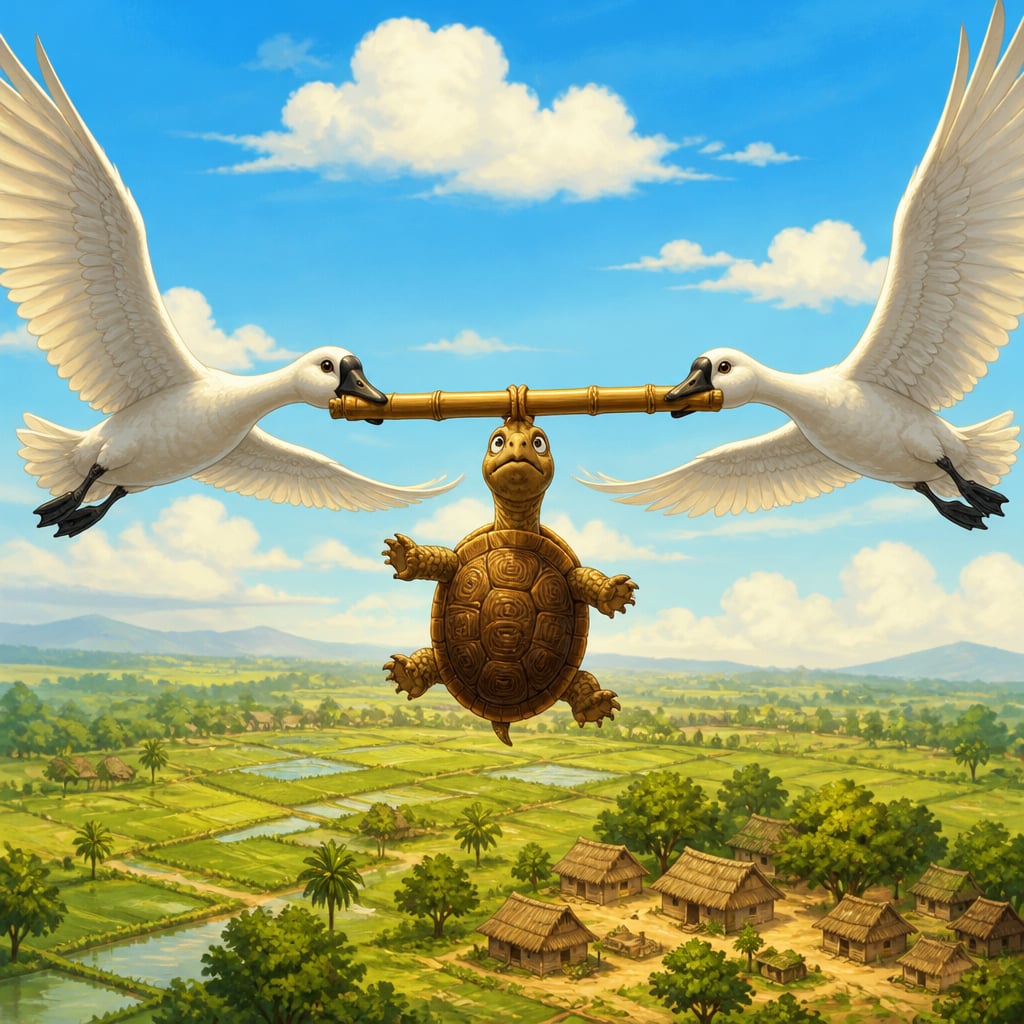
Kambugriva was amazed. He had never seen the world from such a height! The forests spread beneath him like a green carpet. Rivers wound through valleys like silver ribbons. Mountains rose in the distance, their peaks touching the clouds.
He wanted to comment on everything he saw. He wanted to describe the beauty, analyze the geography, compare this view to descriptions he had heard from traveling birds. The words built up inside him like water behind a dam.
But he held his silence. For his friends. For his life.
They flew over forests and fields, over villages and roads. And as they passed above a small town, children playing in the street looked up and pointed.
"Look!" cried one child. "A tortoise in the sky!"
"How strange!" laughed another. "Geese carrying a tortoise! What a funny sight!"
"That tortoise must be very stupid," called out a third child, "to let birds carry him like a piece of luggage!"
The children burst into laughter, pointing and jeering.
Kambugriva heard every word. Stupid? How dare they call him stupid! He was the wisest creature at the lake! He knew more about more subjects than any tortoise in Magadha! He would not be mocked by ignorant children who could not appreciate the brilliance of, "WHO ARE YOU CALLING STUPID?" he shouted.
The moment the words left his mouth, so did the stick.
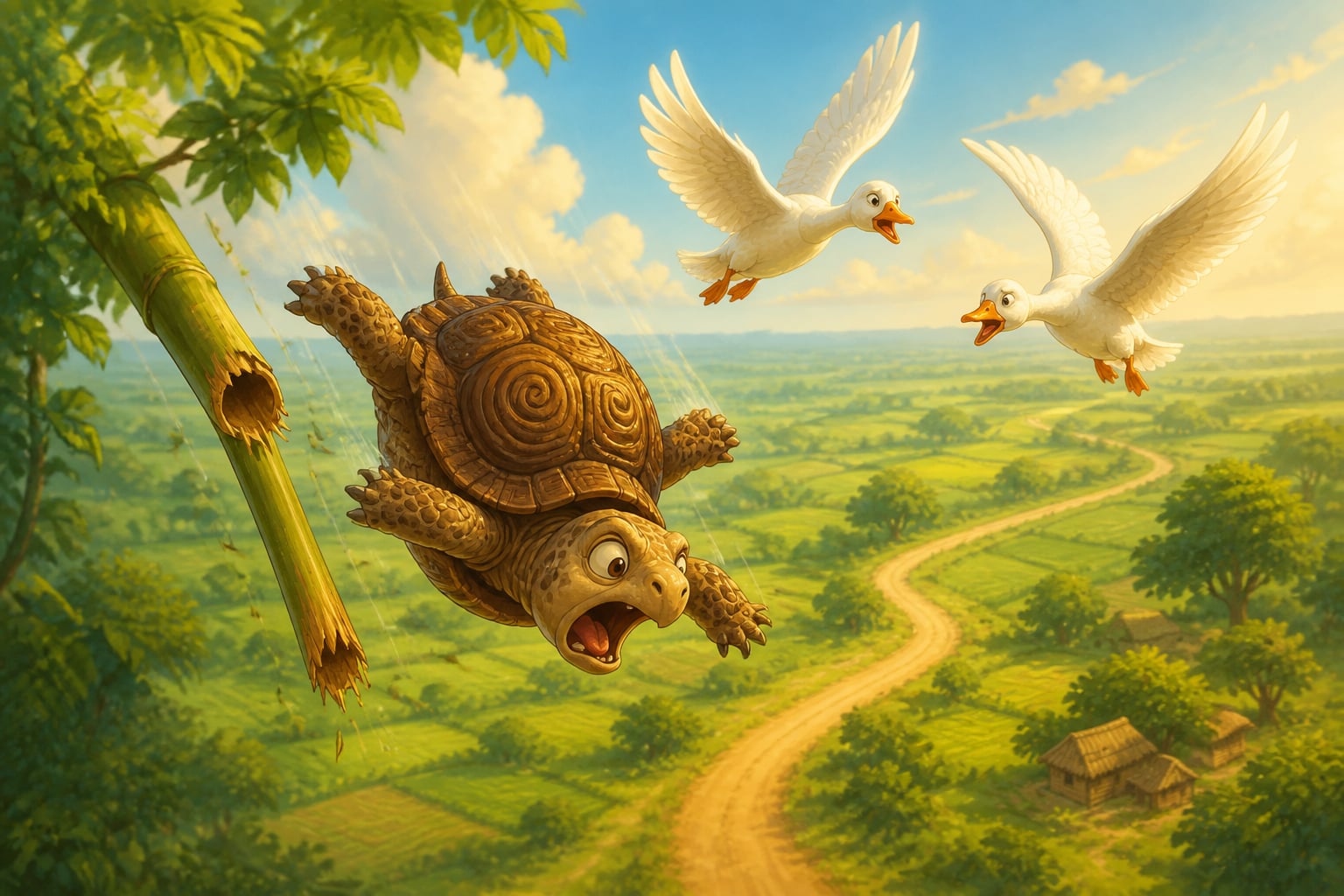
The geese screamed in horror as they felt the weight vanish. But there was nothing they could do. Kambugriva fell like a stone, spinning through the air, the ground rushing up to meet him.
His last thought, in the moment before impact, was that he should have remained silent.
The geese circled the spot where their friend had fallen, crying out in grief. But it was too late. Kambugriva, the conch-necked one, the tortoise who knew so much but could not learn to be quiet, was gone.
The Weight of Words
Chirasena paused. Several of the younger animals were crying softly. Even the adults sat in heavy silence.
"It seems so unfair," whispered a young deer. "He only spoke one sentence."
"Sometimes," said Chirasena, "one sentence is all it takes. Kambugriva knew the stakes. His friends had warned him clearly. He understood that his life depended on silence. And yet, when pride was wounded, he could not help himself."
"But the children were so cruel," protested the parrot. "Why should he have to endure their mockery?"
"The children's mockery would have ended the moment he passed out of sight," replied the crane. "Their words could only hurt his pride, and pride is not life. But Kambugriva valued his pride more than his survival. He could not bear to be thought a fool, even by strangers whose opinions meant nothing."
"Is the lesson that we should never defend ourselves?" asked an old badger.
"The lesson," said Chirasena, "is that there is a time to speak and a time to be silent. Kambugriva could have defended himself at any other moment. On the ground, surrounded by friends, he could have talked for hours about how wise he truly was. But in that one moment, high in the sky, silence was the only appropriate response."
"Wisdom," continued the crane, "is not just knowing what to say. It is knowing when to say it, and when to say nothing at all."
The forest animals absorbed this truth in silence, which seemed, under the circumstances, the most fitting response.
Reflection
- Think of a time when you said something you immediately regretted, when you knew, even as the words left your mouth, that you should have stayed silent. What triggered that response? What did you learn from that experience?
- Kambugriva couldn't bear to be thought foolish by children he would never see again. Why do we care so much about what strangers think of us? Is this concern ever useful, or is it always harmful? How do we decide whose opinions actually matter?
- The Panchatantra seems to value silence highly. But silence can also be harmful, when we don't speak up against injustice, or when we stay quiet about things that matter. How do we distinguish between wisdom that counsels silence and cowardice that fears speech?