Anuchitachara: Meddling in Others' Affairs
The danger of interfering where you don't belong
Two cautionary tales about the consequences of meddling in others' business: The Monkey and the Wedge teaches that curiosity without understanding brings disaster, while The Foolish Sage shows how interference in others' affairs destroys both helper and helped.
A New Chapter Begins
The forest of Mahilaropya lay quiet in the aftermath of tragedy. Where once the laughter of Lion King Pingalaka and his dear friend Sanjivaka the bull had echoed through the glades, now only silence remained. The animals gathered in small groups, speaking in hushed whispers about the terrible thing that had happened, how false words from the jackal Damanaka had destroyed the most beautiful friendship the forest had ever known.
"We must learn from this sorrow," said Chirasena the wise crane, perched upon a low branch where many animals had assembled. "The story of Pingalaka and Sanjivaka teaches us about false friends and misplaced trust. But there are other lessons the Panchatantra holds, wisdom that can save us from our own foolishness."
"Tell us, wise one," called out a young deer. "What other dangers should we guard against?"
Chirasena ruffled his feathers thoughtfully. "Perhaps the most common danger is not from enemies at all, but from ourselves, from the urge to meddle in things that do not concern us. Let me share two tales that illustrate this truth."
The Tale of the Monkey and the Wedge
In the great city of Varanasi, a wealthy merchant had undertaken the construction of a magnificent temple. Teams of carpenters worked day and night, sawing logs and shaping beams for this holy work. The construction site buzzed with activity from dawn until dusk.
One day, as the sun reached its peak, the master carpenter called for the midday rest. "Leave your tools where they are," he announced. "We shall continue after our meal."
The workers set down their saws and hammers. One carpenter had been in the middle of splitting a massive log of sal wood. He had driven a wooden wedge deep into the crack to hold it open, planning to finish the work after lunch. The log lay there, half-split, the wedge holding the crack wide like an open mouth.
As the workers departed for the village, a troop of monkeys descended from the nearby trees. They had been watching the work with great curiosity, and now they saw their chance to explore.
"Look at these strange objects!" cried one monkey, picking up a chisel.
"What is this thing?" asked another, examining a saw with puzzled eyes.
Among them was a particularly restless monkey named Chanchala, whose name meant "the fickle one." He was known throughout the troop for his inability to leave anything alone. While his companions played with smaller tools, Chanchala's eyes fell upon the half-split log.
"What a curious sight," he said, climbing onto the massive timber. He peered at the wedge holding the crack open. "I wonder what this wooden peg does."
"Leave it alone, Chanchala," warned an elder monkey nearby. "These are the tools of humans. We do not understand their purposes."
But Chanchala's curiosity burned like a fire that could not be quenched. He squatted on the log, positioning himself directly over the crack, and began tugging at the wedge.
"It seems stuck," he muttered, pulling harder.
"Come away from there!" called his mother from a nearby branch. "You are always meddling with things that are none of your concern!"
Chanchala ignored her. He wrapped both hands around the wedge and pulled with all his might. Suddenly, the wedge flew free, and the crack slammed shut with tremendous force.
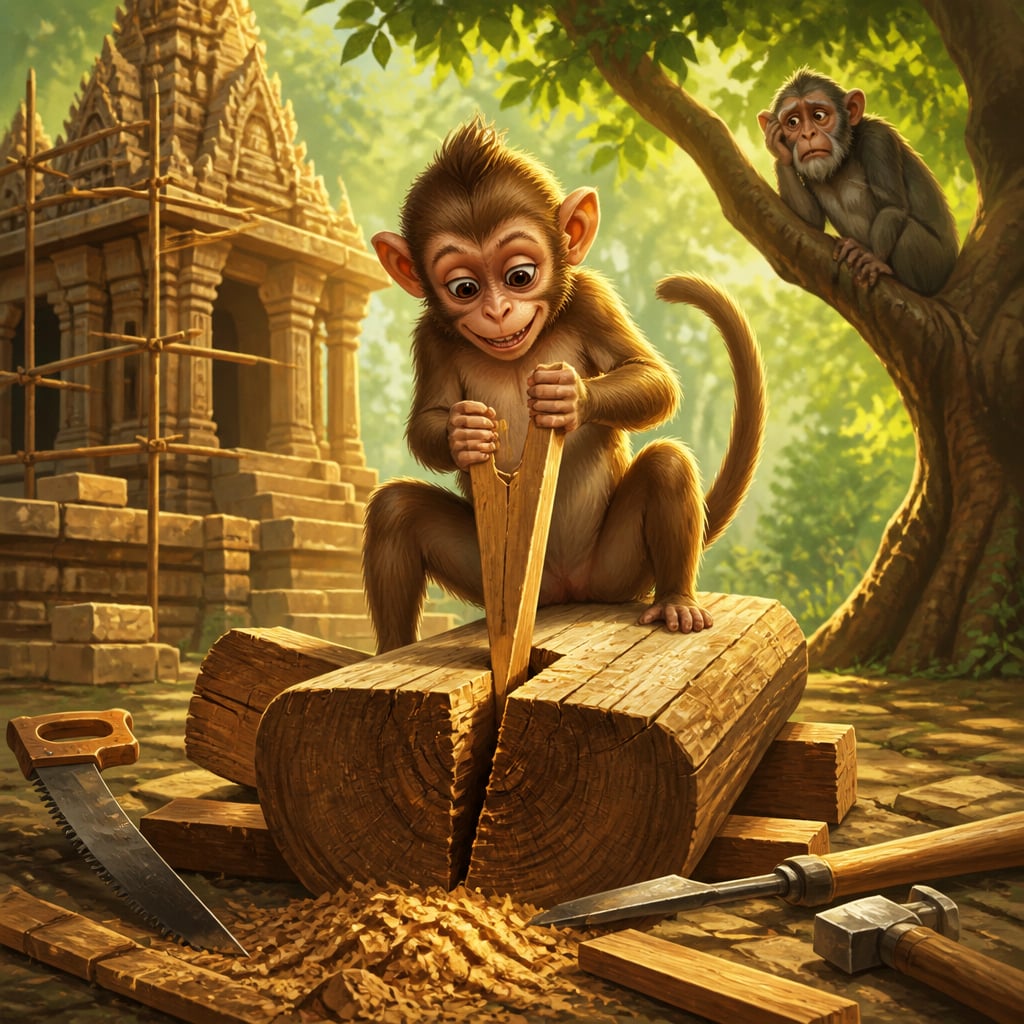
The monkey's terrible scream echoed across the construction site. His body, which had been sitting directly over the crack, was caught in the closing gap. The massive log held him in a grip of iron.
When the carpenters returned from their meal, they found the monkey trapped and lifeless, a victim of his own meddling nature. The master carpenter shook his head sadly.
"This is what happens," he said to his apprentices, "when one interferes in matters one does not understand."
The Tale of the Foolish Sage
Not far from that same city, there lived a sage who had spent many years in meditation and study. He was learned in the scriptures and respected by all who knew him. Yet for all his book knowledge, he lacked the simple wisdom of common sense.
One day, this sage was walking through the forest when he came upon a most unusual sight. A cobra and a mongoose were locked in combat, circling each other with deadly intent. The mongoose, small but fearless, darted in and out, avoiding the snake's strikes. The cobra, its hood spread wide, hissed and lunged.
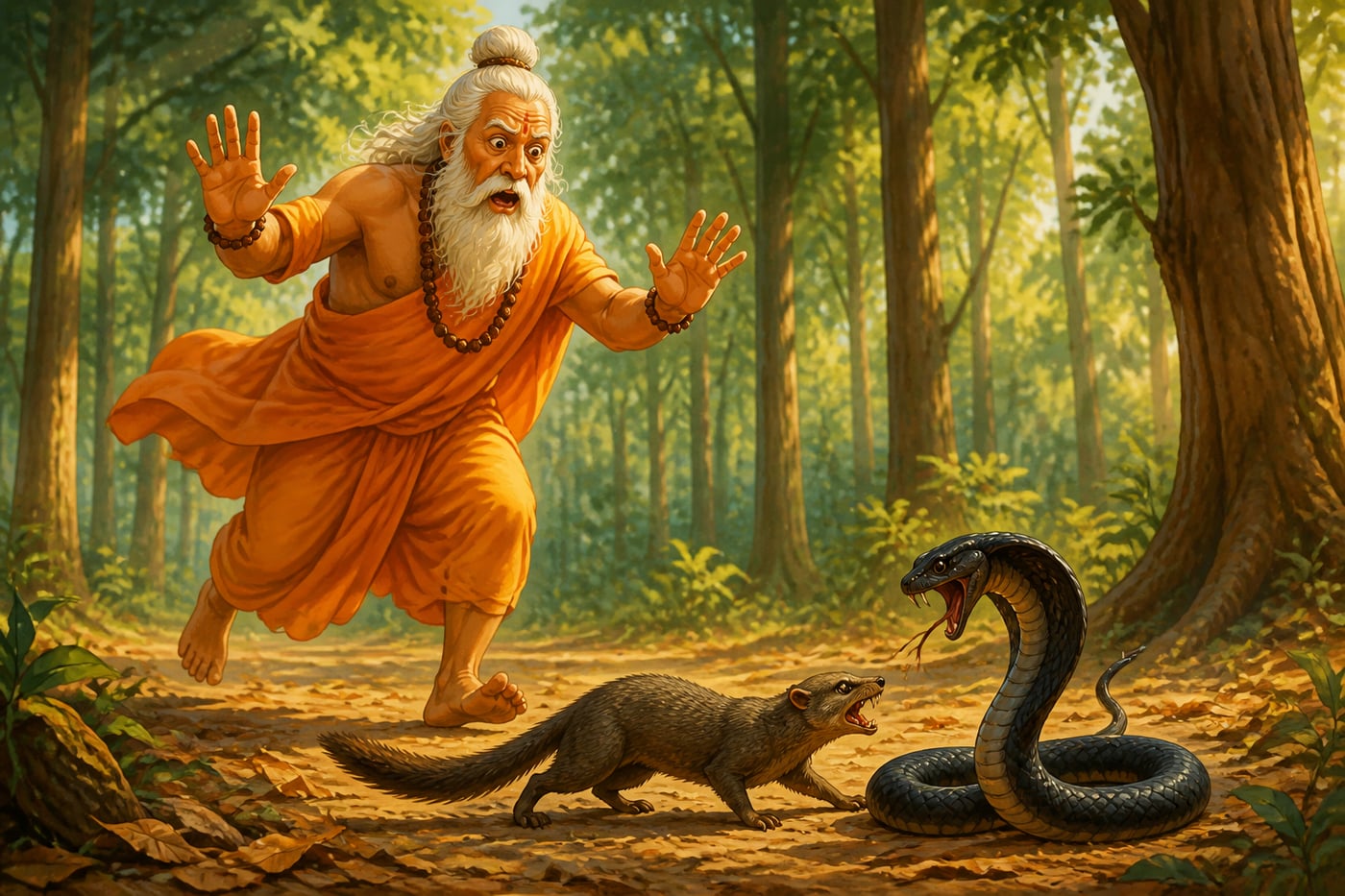
"Stop this violence at once!" cried the sage, rushing forward. "All creatures are brothers! You must not fight!"
The mongoose paused, startled by this interruption. In that moment of distraction, the cobra struck. Its fangs sank deep into the mongoose's neck. Within moments, the brave little creature lay dead.
But the story did not end there. The cobra, wounded from the battle and agitated by the sage's interference, turned its fury upon the holy man himself. Before the sage could flee, the snake struck, and its venom began its deadly work.
As both the mongoose and the sage lay dying, a passing woodcutter witnessed the scene.
"Foolish man," he said, shaking his head. "The mongoose was protecting this forest from a snake that had been killing birds and small animals for months. The mongoose understood its duty; the snake understood its nature. Only you understood nothing, and your interference has killed you both."
The sage, with his final breath, whispered: "I sought to do good, but I did not seek first to understand."
The Wisdom of Non-Interference
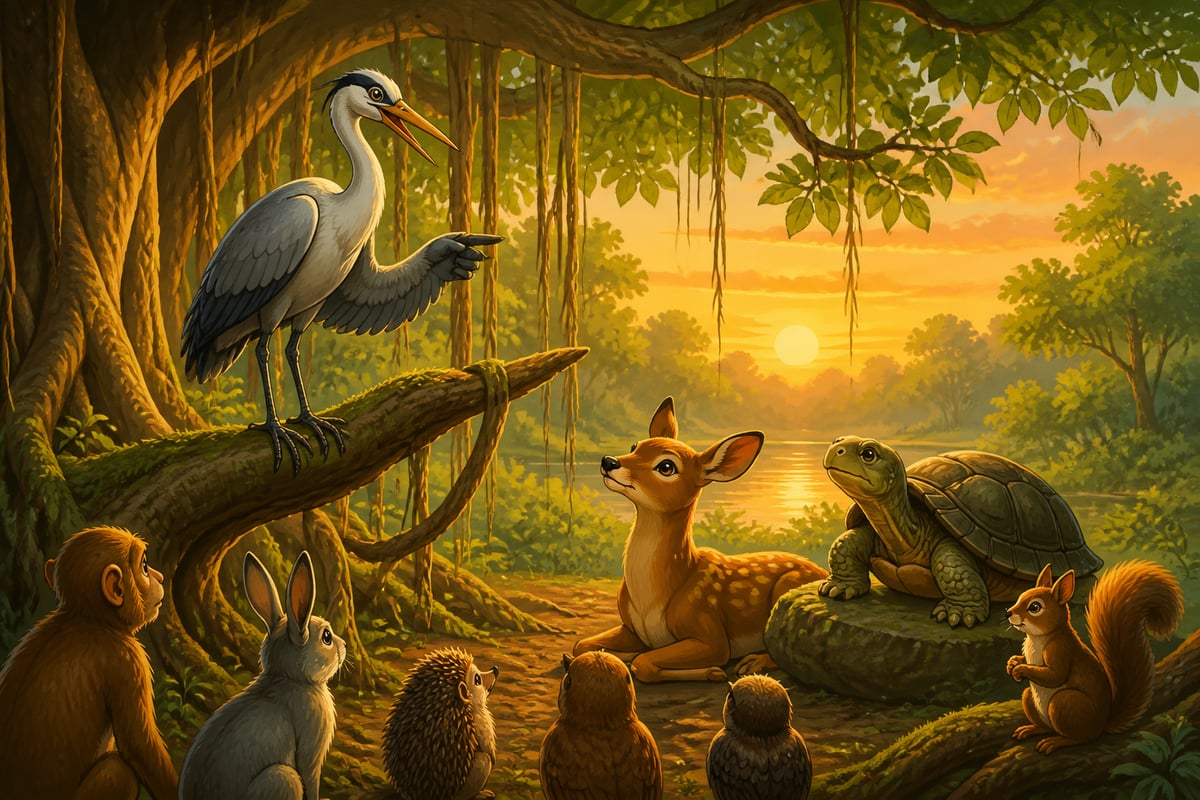
Chirasena the crane fell silent, and the gathered animals sat in thoughtful contemplation.
"Both tales teach the same lesson," said an old tortoise slowly. "The monkey died because he could not leave things alone. The sage died because he interfered without understanding."
"But how do we know when to help and when to stay back?" asked a young squirrel.
Chirasena nodded at this wise question. "The answer lies in three questions you must always ask yourself: First, do I truly understand this situation? Second, has anyone asked for my help? Third, am I qualified to offer assistance?"
"If the answer to any of these is no," continued the crane, "then the wisest course is to observe, to learn, and to refrain from action. Many disasters in this world come not from those who do too little, but from those who do too much without understanding."
The animals murmured in agreement, each one thinking of times when their own curiosity or desire to help had led to trouble.
"Remember," concluded Chirasena, "the wedge in the log served a purpose the monkey did not comprehend. The battle between snake and mongoose was part of nature's balance that the sage did not grasp. When we meddle in affairs beyond our understanding, we become like the monkey, caught in the very trap we sought to explore."
As the sun began to set over the forest of Mahilaropya, the animals dispersed, carrying with them this ancient wisdom: that sometimes the greatest kindness is restraint, and the truest wisdom is knowing the limits of one's own understanding.
Reflection
- Think of a time when your curiosity led you to touch, open, or investigate something you shouldn't have. What happened? What did you learn from that experience?
- The sage believed he was doing good by stopping the fight. When have you tried to help in a situation you didn't fully understand? How can we tell the difference between times when we should help and times when we should step back?
- The Panchatantra seems to value restraint and non-interference highly. But couldn't this advice be taken too far? When is it right to interfere, even if we haven't been asked? How do we balance caution with the duty to act?