Mithyamitra: False Friends
Recognizing and avoiding fake friendships
Two tales of deception and betrayal: The Blue Jackal who disguised himself as a divine being, and the Camel who trusted the wrong companions. Both stories reveal how false friends use us for their benefit and abandon us when we become inconvenient.
Shadows of Deception
The third night of stories arrived with clouds covering the moon. The forest of Mahilaropya seemed darker than usual, the shadows deeper, as the animals gathered once more beneath the great banyan.
"Tonight's tales are the darkest yet," Chirasena the crane warned as the creatures settled into their places. "We have spoken of meddling and of pride. Now we must speak of something more sinister, false friends who pretend to be what they are not."
A murmur ran through the assembly. Many were thinking of Damanaka, the jackal whose false friendship had destroyed King Pingalaka's bond with Sanjivaka.
"There are two kinds of false friends," continued Chirasena. "Those who deceive us about who they are, and those who deceive us about their intentions. Tonight, I shall tell you both tales."
The Tale of the Blue Jackal
In a forest not far from the city of Mathura, there lived a jackal named Chandarava, a name that means "fierce howler." But Chandarava was neither fierce nor much of a howler. He was thin, weak, and constantly hungry, for the other jackals in the pack bullied him away from every meal.
One evening, driven mad by hunger, Chandarava ventured into the city itself to search for food. He crept through dark alleys, his nose twitching at the smells from human homes. Finally, he discovered an open courtyard behind a dyer's workshop, where scraps of food had been left out.
But as he was eating, dogs began barking nearby. Chandarava panicked. He ran blindly through the workshop, looking for escape, and fell directly into a great vat of indigo dye.
The jackal splashed and struggled, certain he would drown. But the vat was not deep, and he managed to scramble out the other side. Dripping with blue dye, he fled into the night, not stopping until he was deep in the forest.
When morning came, Chandarava looked at his reflection in a stream, and gasped. His entire body had turned a brilliant, shimmering blue. He no longer looked like a jackal at all. He looked like some magical creature, unlike anything the forest had ever seen.
An idea began to form in his cunning mind.
When the other forest animals discovered him, they were terrified. A blue creature! Surely this must be some divine being, some messenger of the gods!
"Who are you?" stammered a deer, falling to his knees.
Chandarava drew himself up with great dignity. "I am Kakudruma, sent by Brahma himself to rule this forest. The creator of all things looked upon this land and found it lacking proper leadership. He has sent me to bring order and divine wisdom."
The animals were awestruck. Even the lions and tigers bowed before this strange blue being. Who would dare to question a messenger of Brahma?
And so Chandarava, now calling himself King Kakudruma, rose to power. He sat on a throne of stones covered with leaves. He gave orders that were obeyed without question. He ate the finest foods, for the hunters of the forest brought him the choicest portions of every kill.
But there was one thing Chandarava feared above all else: other jackals. He knew that if jackals came near, they might recognize him, or worse, he might be unable to resist howling with them, as jackals do when they hear the howls of their kind.
"Jackals are evil creatures," he announced to his court. "Servants of dark forces. They are banished from my kingdom on pain of death."
The jackals were driven away, and Chandarava lived in luxury, his secret safe. Weeks passed, then months. He grew fat and arrogant, forgetting that his power rested entirely on a lie.
Then one night, a pack of jackals passed near the edge of the forest. They raised their voices in the ancient call, the howl that jackals have used since the beginning of time to find their scattered kin.
Chandarava heard the howl. Something deep within him stirred. Before he could stop himself, before he could remember who he was supposed to be, he threw back his head and answered with a howl of his own.
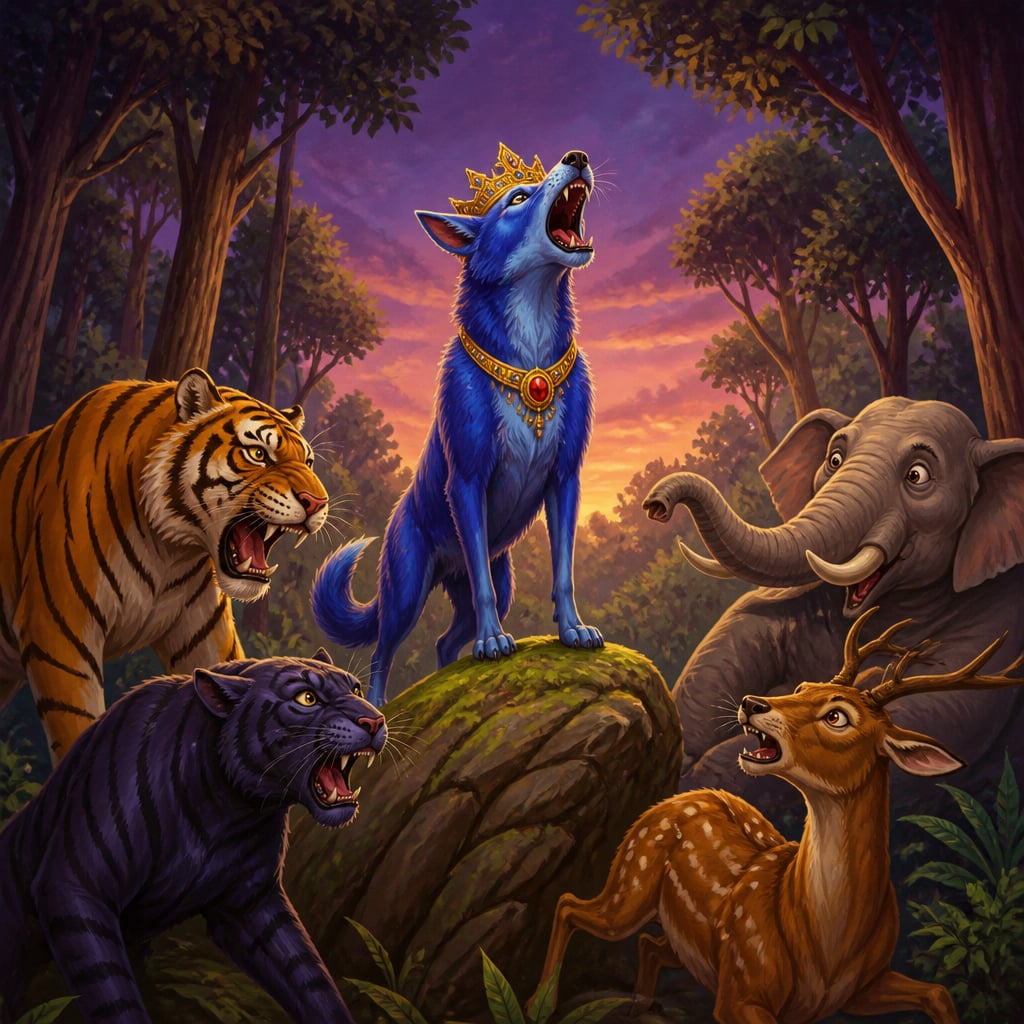
"AWOOOOOO!"
The court fell silent. Then the whispers began.
"That sound..." "A jackal's howl!" "He is no divine being, he is a jackal!"
The spell was broken. The animals looked at their "king" with new eyes, and now they could see what they had missed before. The shape of his snout. The yellow gleam in his eyes. The way he moved, all jackal, painted blue.
Rage replaced reverence. The lion, humiliated at having bowed to a jackal, pounced first. Chandarava tried to run, but he was surrounded. Within moments, the false king was torn to pieces by the very creatures he had deceived.
The Tale of the Camel and His False Friends
In another part of that same great forest lived a lion named Madotkata, whose name meant "intoxicated with power." He was attended by three companions: a leopard named Chaturaka (the clever one), a crow named Sukarna (good-eared), and a jackal named Kravyamukha (flesh-faced).
These three were not the lion's friends, they were his servants who lived off the scraps of his kills. They flattered him constantly, competed for his favor, and would do anything to maintain their positions close to power.
One day, a camel named Kanthaka wandered into the forest. He had become separated from a merchant's caravan and was hopelessly lost. When the lion's three companions found him, they saw an opportunity.
"Great King," said Chaturaka the leopard, "we have found a strange creature, a camel from the human world. He is lost and alone."
"Should we kill him?" asked Kravyamukha the jackal eagerly.
"No," said the lion thoughtfully. "Bring him to me. A king should show mercy to the helpless."
Kanthaka was brought before Madotkata, trembling with fear. But the lion was true to his word. He granted the camel his protection and invited him to stay in the forest.
"You are safe here," declared the lion. "No one shall harm you while you are under my protection."
The three companions smiled and welcomed Kanthaka warmly. But inwardly, they seethed. They had hoped to eat the camel, and now their king had declared him untouchable.
Time passed. Kanthaka, believing the flattery of his new "friends," grew comfortable. He grazed peacefully in the forest clearings, trusting completely in the lion's protection.
Then one day, Madotkata fought with an elephant and was gravely wounded. He could no longer hunt. Day after day, the great lion grew weaker, and his three companions grew hungrier.
"We must find food," said Sukarna the crow. "Or we will all starve."
"There is food right here," whispered Kravyamukha the jackal, glancing at Kanthaka, who was grazing nearby. "A whole camel full of meat."
"But the king promised him protection," said Chaturaka the leopard.
"Then we must convince the king to break his promise," replied the jackal. "Or better still, we must convince the camel to offer himself."
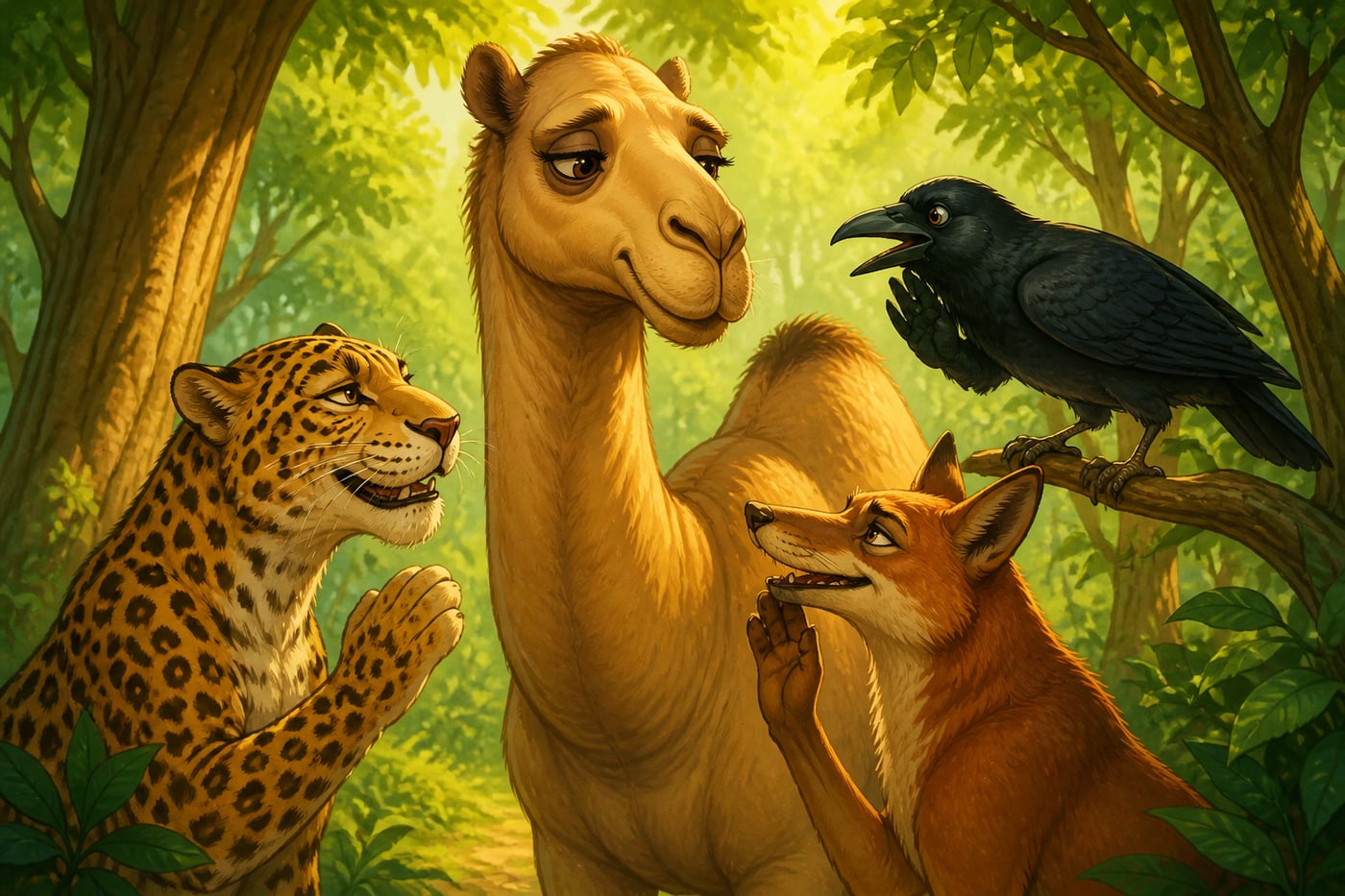
The three conspirators approached Kanthaka with false concern.
"Dear friend," said Chaturaka, "we are so worried about the king. He is dying of hunger, and there is nothing we can do."
"If only someone could help him," sighed Sukarna. "Someone who loved him enough to make a sacrifice."
"I would give my own flesh," declared Kravyamukha, "but I am too small. One jackal would not satisfy a lion."
"I too would offer myself," said the leopard, "but the king needs someone larger."
Kanthaka, innocent and trusting, felt his heart swell with the desire to help. These were his friends, were they not? They would do the same for him.
"I will offer myself," he said. "The king saved my life. It is only right that I give my life to save his."
The three companions could hardly contain their glee. They led Kanthaka to where Madotkata lay weak and starving.
"Great King," announced Chaturaka, "Kanthaka has something to say to you."
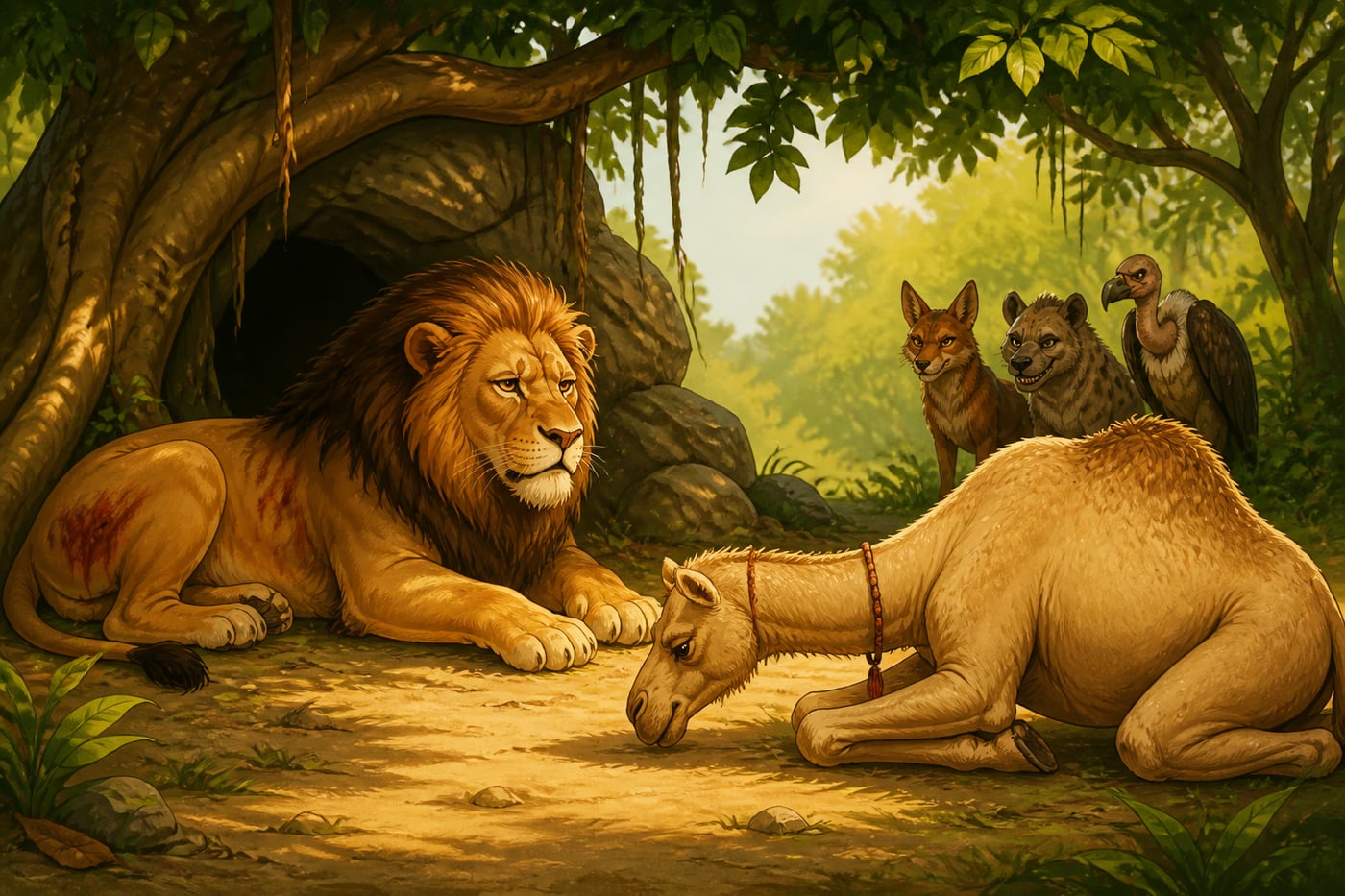
"My lord," said the camel, kneeling before the lion, "you gave me protection when I was helpless. Now you are in need. Please, take my flesh. Let my body nourish you back to health."
The lion hesitated. He had indeed promised protection. But he was so hungry, and the camel was offering himself freely...
"You are noble to offer," said Madotkata. "And since you offer freely, I accept."
In moments, it was over. The camel who had trusted too much, who had called false friends true, lay dead. The three companions feasted alongside their king, congratulating each other on their cleverness.
The Wisdom of Recognition
Chirasena paused, and the forest was very quiet. Even the night insects seemed to have stopped their chirping.
"Two tales," said the crane. "Two kinds of false friends. Chandarava deceived others about who he was. Kanthaka's 'friends' deceived him about their intentions."
"But how can we know?" asked a young rabbit, trembling. "How can we tell true friends from false?"
"The signs are there, if we look for them," replied Chirasena. "Chandarava banished all jackals, why would a divine being fear one species? Those who hide from their own kind have something to hide. And Kanthaka's friends only became interested in his welfare when they needed something. True friends care for us always, not only when it serves them."
"Remember," continued the crane, "false friends often reveal themselves in small moments before the great betrayal. Chandarava feared the howl of jackals. The three companions flattered Kanthaka but never truly included him. Pay attention to these signs."
An old fox spoke up. "It seems the Panchatantra teaches us to trust no one."
"Not so," corrected Chirasena. "It teaches us to trust wisely. The four friends of whom we shall hear in Course Two, the crow, mouse, deer, and tortoise, trusted each other absolutely, and that trust saved their lives many times. Trust is precious. But because it is precious, it must be given carefully, not freely to anyone who flatters us or claims to be something special."
The animals nodded, each one thinking of friendships they had questioned, of companions who perhaps smiled too sweetly or flattered too easily.
"Tomorrow," said Chirasena, "we shall speak of another danger, the danger of talking too much. For tonight, remember the blue jackal and the trusting camel. One pretended to be what he was not; the other believed friends who were not. Both paid with their lives."
Reflection
- Have you ever pretended to be something you're not to fit in or gain acceptance? What happened? How did it feel to maintain that pretense? What did you learn about the difference between being accepted for who you pretend to be versus who you really are?
- Think about your friendships. How do you distinguish between friends who genuinely care about you and those who are friendly because they want something? What signs or tests help you recognize true friends?
- The lion Madotkata accepted Kanthaka's 'willing' sacrifice, even though the offer was manipulated by others. When someone offers something freely, do we have any responsibility to question whether they truly understand what they're giving up? Where is the line between accepting generosity and taking advantage?