Suhridvachana: Ignoring Good Advice
When pride makes you ignore wise counsel
The tale of Uddhataka the Musical Donkey teaches that arrogance and pride make us deaf to the warnings of true friends. When we believe ourselves talented without justification, we invite disaster upon ourselves.
The Animals Gather Once More
The next evening found the animals of Mahilaropya gathered again beneath the great banyan tree where Chirasena the crane held court. Word had spread of the crane's storytelling, and even more creatures had come to listen, young foxes, curious rabbits, and a family of deer with their spotted fawns.
"Yesterday we learned about meddling," began Chirasena, settling his gray feathers. "About the monkey who could not leave things alone, and the sage whose interference brought death. But there is another kind of foolishness, perhaps even more common, that I would speak of today."
"What foolishness is that?" asked a young jackal pup, his ears perked forward.
"The foolishness of pride," answered the crane. "The folly of believing ourselves wiser than we are, more talented than we are, and refusing to listen when friends try to save us from ourselves. Let me tell you the tale of Uddhataka the donkey, who thought himself a great singer."
The Tale of the Musical Donkey
In a village on the banks of the Ganga lived a washerman named Shubhadatta, who owned a donkey called Uddhataka. Now, this donkey had lived a hard life. By day, he carried heavy bundles of clothes to and from the river. His master fed him poorly, and by evening, the poor creature was always exhausted and hungry.
But Uddhataka had discovered a secret. Each night, after Shubhadatta fell asleep, the donkey would slip free from his rope and sneak into the nearby cucumber fields belonging to a farmer. There he would feast on the finest vegetables, cucumbers, melons, gourds, eating until his belly was round as a drum.
One night, as Uddhataka grazed in the moonlit field, he encountered a jackal named Chapalaka, who had also come seeking vegetables.
"Greetings, friend donkey!" called Chapalaka. "You seem to know this field well."
"I come here every night," boasted Uddhataka. "Look at me, am I not sleek and well-fed? While other donkeys waste away under their masters' neglect, I have found the secret to a good life."
The two became companions, meeting each night in the cucumber field. Chapalaka proved to be good company, clever, cautious, and always watching for the farmer who might discover them.
Weeks passed, and the friendship deepened. But as Uddhataka grew more comfortable, a strange pride began to swell within him. Perhaps it was the good food, or perhaps it was the moonlight that seemed to make everything magical. Whatever the cause, the donkey became convinced that he possessed a hidden talent.
"Chapalaka," announced Uddhataka one particularly beautiful night, "I wish to sing."
The jackal stopped mid-chew, a cucumber dangling from his mouth. "I beg your pardon?"
"Sing!" repeated the donkey, gazing up at the full moon with misty eyes. "Look at that magnificent moon! Can you not feel it? The beauty of this night calls forth the music within my soul. I must express my joy through song."
Chapalaka stared at his friend with growing alarm. "Dear Uddhataka, I admire your poetic spirit, but perhaps this is not the best place for a recital. We are, after all, thieves in a farmer's field. Any noise might, "
"Noise?" Uddhataka drew himself up with great dignity. "What I produce is not noise, my friend. It is art. I am a musician of considerable talent."
"You are a donkey," Chapalaka said carefully. "And with the greatest respect, donkeys are not known for their melodious voices. The sound you call singing, others might call... well..."
"Braying?" Uddhataka's eyes narrowed. "You think I merely bray? Listen here, jackal, you may know nothing of music, but I have listened to the village musicians for years. I have absorbed their techniques. My voice may surprise you."
"I do not doubt your enthusiasm," said Chapalaka desperately, "but consider the consequences. If you raise your voice, the farmer's dogs will hear. The farmer will come running. We will be caught!"
"You are a coward," declared Uddhataka. "And worse, you are ignorant of art. I thought you were my friend, but a true friend would support my artistic expression, not stifle it with fear."
Chapalaka realized that reason was having no effect. He tried a different approach.
"Very well," he said. "If you must sing, at least wait until we have left the field. Sing on the road home, where there is no danger."
"The moment is now," insisted Uddhataka, his eyes still fixed on the moon. "Art cannot be scheduled. Inspiration cannot wait. When the muse calls, the artist must answer."
"Then I must leave you," said Chapalaka sadly. "For I value my skin more than any concert. Please, friend, reconsider. I speak from love, not jealousy."
But Uddhataka was no longer listening. As Chapalaka slipped away through a gap in the fence, the donkey threw back his head and began to sing.
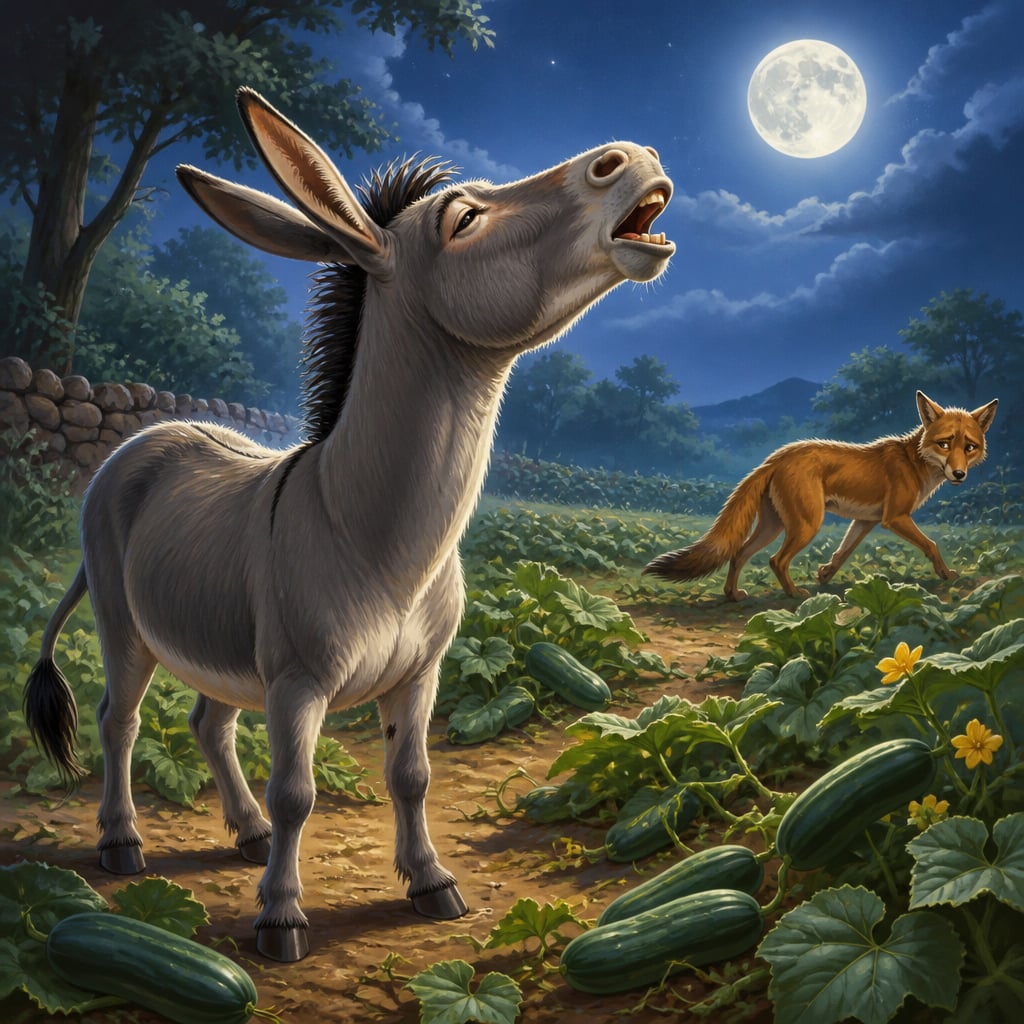
What emerged from his throat was not music. It was the terrible, ear-splitting bray of a donkey, loud enough to wake the dead, harsh enough to curdle milk, and absolutely unmistakable in the quiet night.
"HEE-HAW! HEE-HAW! HEE-HAAAAWWW!"
Within moments, dogs began barking furiously. Lanterns flickered to life in the farmhouse. Angry voices shouted into the night.
"There's something in the field! Get the sticks!"
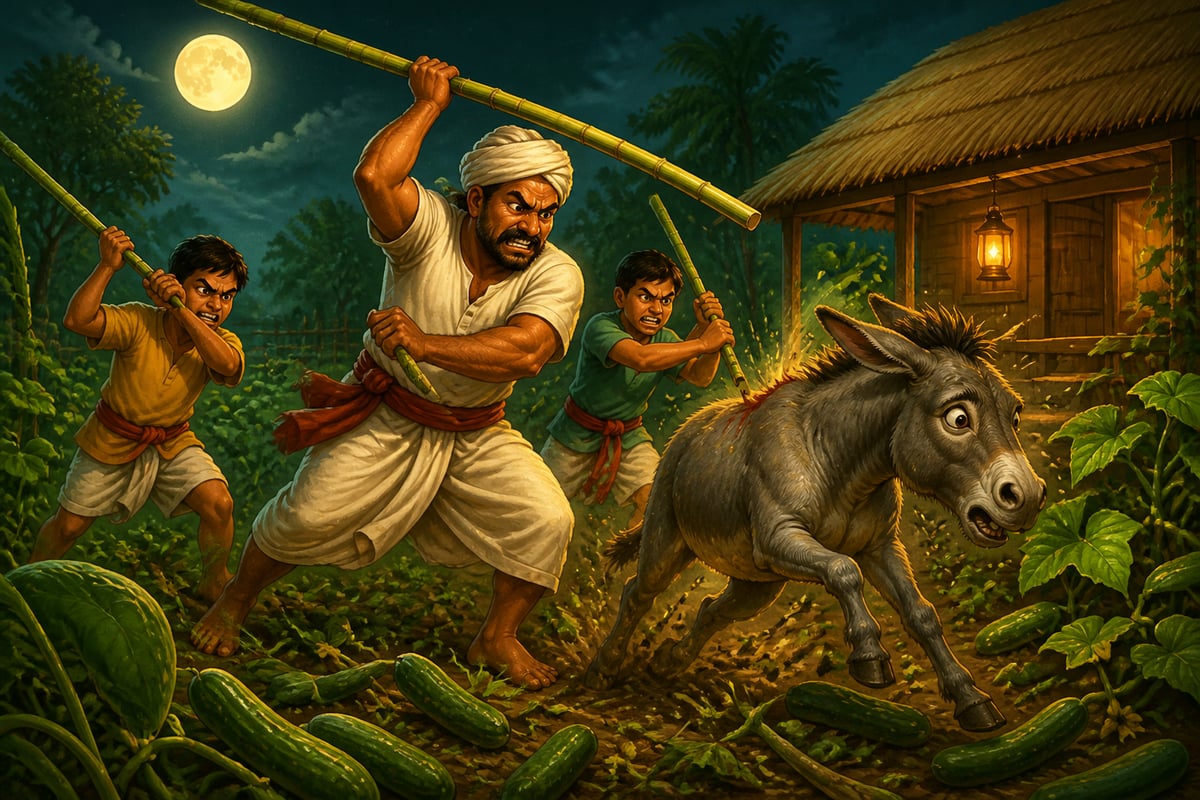
The farmer and his sons burst from the house, armed with heavy bamboo poles. They charged toward the sound of the braying, their dogs racing ahead.
Uddhataka, lost in his "performance," noticed nothing until the first blow landed across his back. Then came another, and another. The farmer beat him savagely, cursing the donkey who had been stealing his vegetables for months.
"So you're the thief!" the farmer roared. "And now you have the audacity to announce yourself? Stupid beast!"
By the time the beating was done, Uddhataka could barely walk. His body was covered in bruises, his ears were torn, and one of his legs was badly injured. He limped home in agony, reaching his master's yard just before dawn.
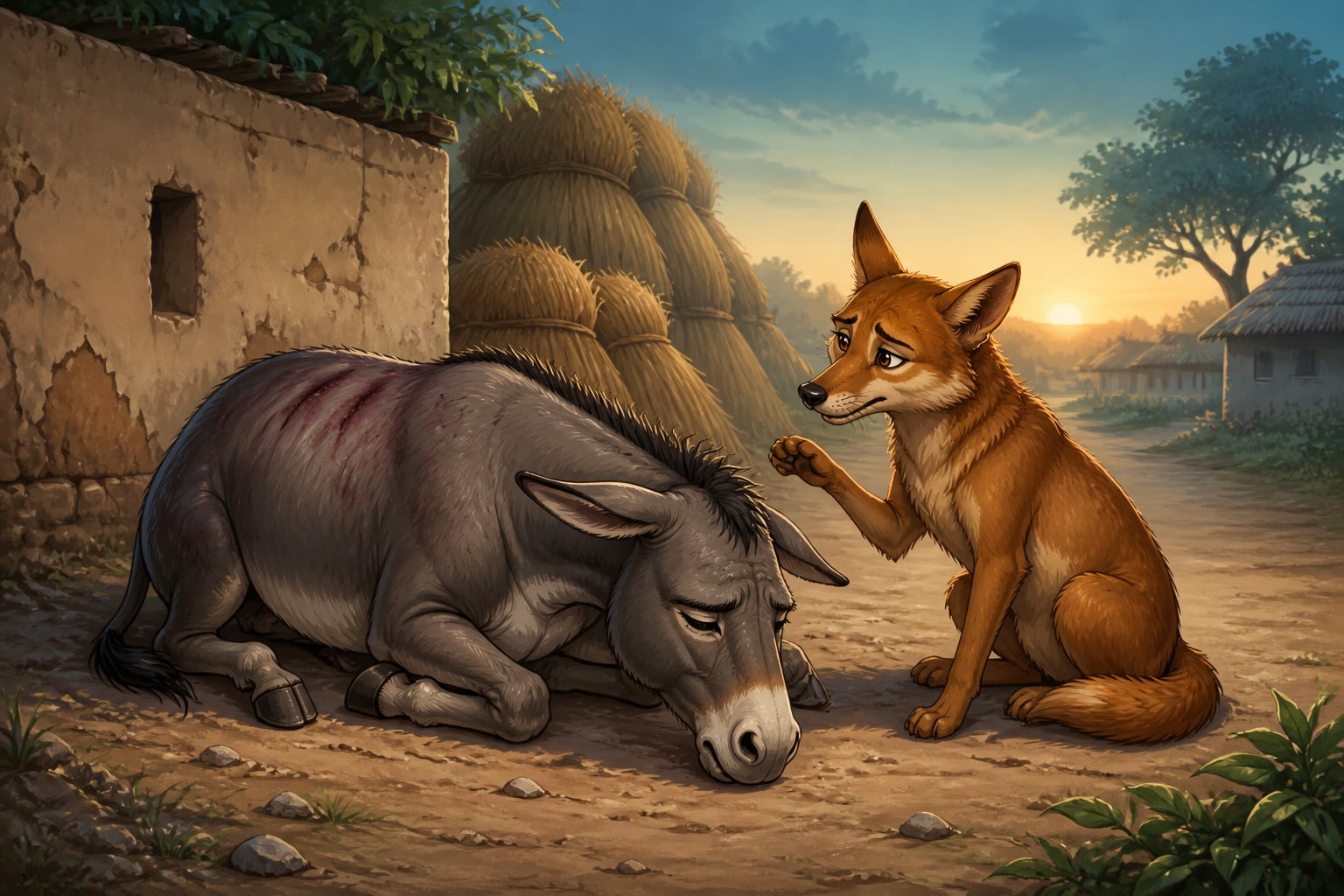
At the edge of the village, Chapalaka was waiting.
"My friend," said the jackal, his voice heavy with sorrow. "I tried to warn you."
"I know," groaned Uddhataka, collapsing on the ground. "I was a fool. I thought I knew better. I thought my talent was real. I thought you were trying to hold me back."
"Pride is a strange thing," said Chapalaka gently. "It makes us believe we are something we are not. It makes us deaf to those who love us and blind to danger."
"If only I had listened," whispered the donkey. "You were not my enemy, you were my truest friend. And I called you ignorant."
From that night forward, Uddhataka never sang again. And whenever pride began to whisper in his ear, telling him he was special, telling him he was exceptional, he would remember the farmer's stick, and he would listen to his friends instead.
The Wisdom of Listening
Chirasena fell silent, and a soft breeze stirred the leaves of the banyan tree.
"Poor donkey," said a young doe. "He only wanted to express himself."
"That is true," agreed Chirasena. "And there is nothing wrong with expressing oneself. But Uddhataka's error was not in wanting to sing, it was in refusing to hear the truth about his singing. When Chapalaka warned him, he did not hear wise counsel. He heard criticism, jealousy, ignorance."
"But how do we know when advice is good?" asked an older fox. "Sometimes people try to discourage us from things we should actually do."
"An excellent question," said the crane. "The answer lies in examining the source. Chapalaka gained nothing by discouraging Uddhataka. He was not jealous of the donkey's 'talent.' He was not competing with him. He simply saw danger that his friend could not see because pride had blinded him."
"True friends tell us what we need to hear," continued Chirasena, "not what we want to hear. And true wisdom is recognizing that our friends might see us more clearly than we see ourselves."
The animals nodded thoughtfully, each one thinking of times they had ignored good advice, or times they had tried to help a friend who would not listen.
"Remember Uddhataka," concluded the crane. "He was not a villain. He was not stupid. He was simply proud, and pride made him deaf to wisdom. Do not let your pride make you a donkey singing in a cucumber field."
Reflection
- Have you ever believed you were good at something, only to discover later that you weren't? How did you find out? How did it feel? What did you learn about yourself?
- Think of a time when you tried to warn a friend about something but they wouldn't listen. What happened? Why do you think it's so hard for people to hear advice, even when it comes from those who care about them?
- The Panchatantra values listening to wise counsel. But how do we distinguish between friends who want to help us grow and people who want to hold us back? Is all criticism worth heeding? When should we ignore advice and trust ourselves?