Buddhiparajaya: When Cleverness Wins
Using intelligence to overcome stronger enemies
The final lesson of Mitrabhedha celebrates the triumph of intelligence over brute strength. A small hare defeats a mighty lion, and a clever crow destroys a deadly serpent, both using wit rather than force. When you cannot match your enemy's power, you must outthink them.
The Final Gathering
On the fifth and final night, the animals of Mahilaropya assembled beneath the great banyan for what they knew would be Chirasena's last tale. The crane had guided them through lessons about meddling, pride, false friends, and dangerous words. Now something different waited.
"We have spent these nights learning what not to do," began Chirasena. "Do not meddle. Do not ignore wise counsel. Do not trust false friends. Do not speak at the wrong moment. But tonight, I wish to end on a different note, a lesson about what we should do when faced with enemies we cannot defeat by strength alone."
The animals leaned forward. Many had lived their entire lives in fear of predators, the strong preying on the weak, the fast hunting the slow. Was there hope for the small and vulnerable?
"Intelligence," said Chirasena, "is the great equalizer. Let me tell you two tales of tiny creatures who defeated mighty foes through cleverness alone."
The Tale of the Cunning Hare
In a forest called Bhadravana lived a lion named Bhasuraka, which means "the one who terrifies." And truly, he was terrible. Unlike lions who hunt only when hungry, Bhasuraka killed for sport. Day after day, he rampaged through the forest, slaughtering deer, rabbits, foxes, and every creature that crossed his path.
The animals lived in constant terror. Families were torn apart. Herds scattered and fled. The forest, once full of life, grew silent and empty.
Finally, the surviving animals gathered in secret council.
"We cannot continue like this," said an elderly elephant. "At this rate, there will be no animals left in Bhadravana."
"But what can we do?" wailed a deer. "He is too strong to fight!"
"Perhaps," suggested a wise old bear, "we can offer him a bargain."
The animals agreed to approach the lion with a proposal. Trembling, a delegation went before Bhasuraka.
"Great King," they said, "your hunting is destroying the forest. Soon there will be nothing left to hunt. But if you agree to stop your rampages, we will send you one animal every day as a meal. You will never go hungry, and we will survive."
Bhasuraka considered. On one paw, he enjoyed the thrill of the hunt. On the other paw, hunting was tiring work, and a meal delivered to his den each day sounded rather pleasant.
"Very well," he growled. "One animal every day, delivered to my den by noon. If you miss even one day, I will kill every creature in this forest."
And so the terrible bargain was struck. Each day, by lottery, one unfortunate animal was chosen to become the lion's meal. Some went weeping. Some went bravely. All went, because the alternative was the death of everyone.
Weeks passed. Then months. The forest lived in grim acceptance of this sacrifice.
Then one day, the lot fell upon a hare named Shashaka, whose name simply meant "the little hare." He was not particularly strong or fast. But he had always been known for his clever mind.
The other animals wept when they learned Shashaka was chosen.
"We will miss your wisdom," they said. "You always had such clever ideas."
"Perhaps," said Shashaka thoughtfully, "I shall have one more."
He set off toward the lion's den, but he did not hurry. He wandered through the forest, thinking and planning. The sun rose higher and higher. Noon passed. The afternoon wore on.
By the time Shashaka finally arrived at Bhasuraka's den, the lion was furious with hunger.
"You are late!" roared Bhasuraka. "And you are nothing but a scrawny rabbit! This is an insult! For this, I will slaughter every animal in the forest!"
"Great King," said Shashaka, trembling but thinking quickly, "please forgive me. I would have arrived much sooner, but I encountered a terrible obstacle."
"What obstacle could delay my rightful meal?" snarled the lion.
"Another lion, my lord. A fearsome beast who lives in a well not far from here. When he saw me, he said: 'Where are you going, little hare?' I told him I was bringing tribute to King Bhasuraka. He laughed and said: 'Bhasuraka? That weak fool? I am the true king of this forest! Bring that meal to me instead!'"
Bhasuraka's eyes narrowed. "Another lion? In my territory?"
"Yes, Great King. He was enormous, much larger than... that is to say, very large indeed. He seized half of the animals that were meant for you and said he would take everything from now on. He called you many terrible names. He said you were a coward who would not dare face him."
The lion's pride was inflamed. "Show me this well. I will tear this pretender apart!"
"Of course, my lord," said Shashaka. "Follow me."
The little hare led the mighty lion through the forest to an ancient well. Its walls were of stone, old and crumbling, and the water at the bottom was deep and dark as a mirror.
"He lives down there," said Shashaka, pointing into the well. "Look, you can see him!"
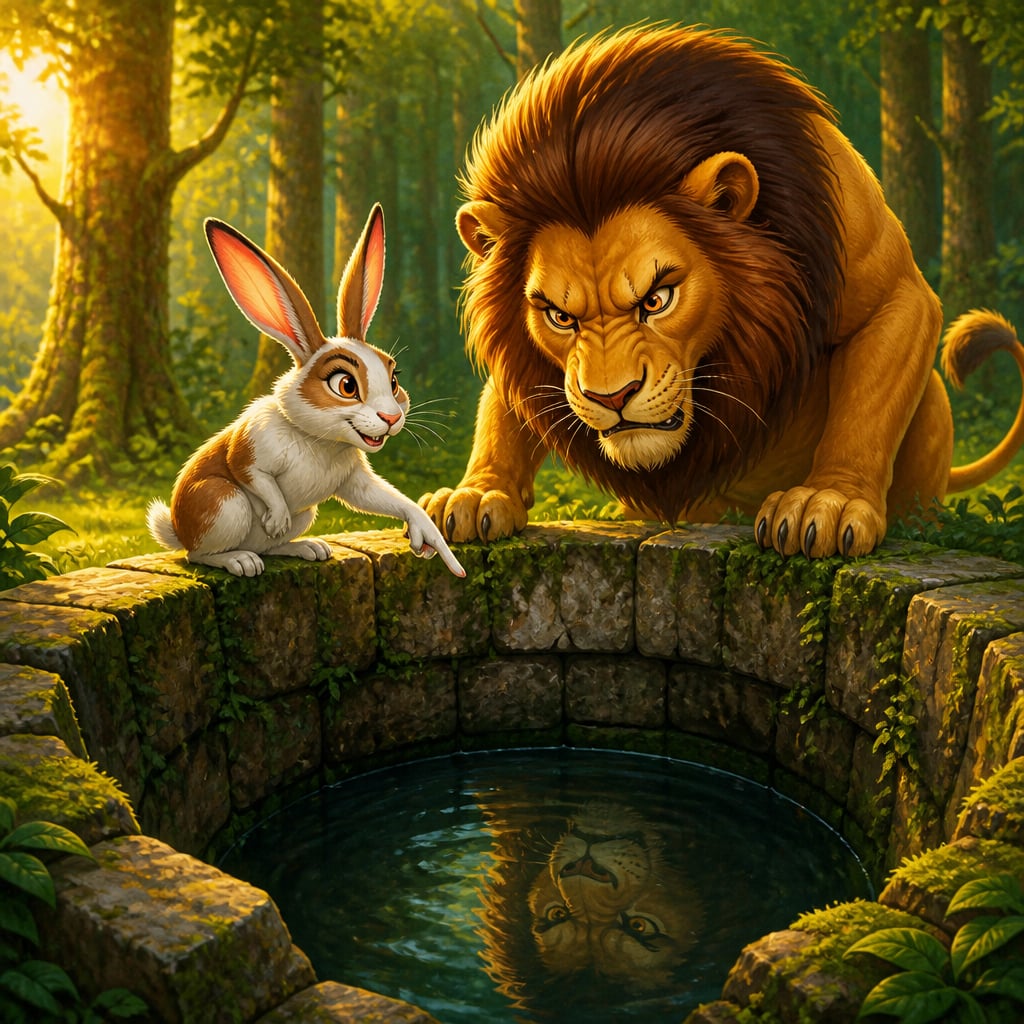
Bhasuraka peered over the edge of the well. There, in the water below, he saw a lion staring back at him. A huge lion, with fierce eyes and bared fangs.
Of course, it was only his own reflection. But Bhasuraka, mad with rage and pride, did not stop to think.
"THERE YOU ARE!" he roared. "COME OUT AND FACE ME!"
The reflection roared back, for his roar echoed off the well's walls, seemingly in answer.
Blind with fury, Bhasuraka leaped into the well to destroy his enemy.
The splash was tremendous. And then there was silence.
The lion, unable to climb the smooth stone walls, unable to swim in the deep water, drowned in the darkness of the well.
Shashaka hopped back to the forest to deliver the news. The animals could not believe it at first. The terrible Bhasuraka, dead? Killed by a little hare?
"Not by my strength," said Shashaka, "but by his own pride. I only provided the mirror; he destroyed himself."
From that day forward, the animals of Bhadravana lived in peace. And the little hare was honored as the wisest creature in the forest.
The Tale of the Crow and the Serpent
In a tall banyan tree at the edge of a village lived a crow and his wife. For many years, they had built their nests in that tree, raised their chicks, and lived in happiness.
But then a great black cobra came to live in a hollow at the base of the tree. And every season, when the crows hatched their eggs, the cobra would slither up and devour the helpless chicks.
Year after year, the crows' children were taken. The mother crow was inconsolable.
"We must leave this tree," she wept. "We cannot fight a cobra."
"We have lived here all our lives," said her husband. "Our parents lived here. Their parents lived here. I will not abandon our home to this serpent."
"Then what can we do? You cannot fight him. Your beak against his fangs? You would die, and our children would still be devoured."
The crow thought for a long time. Then he flew to visit a wise jackal who lived nearby.
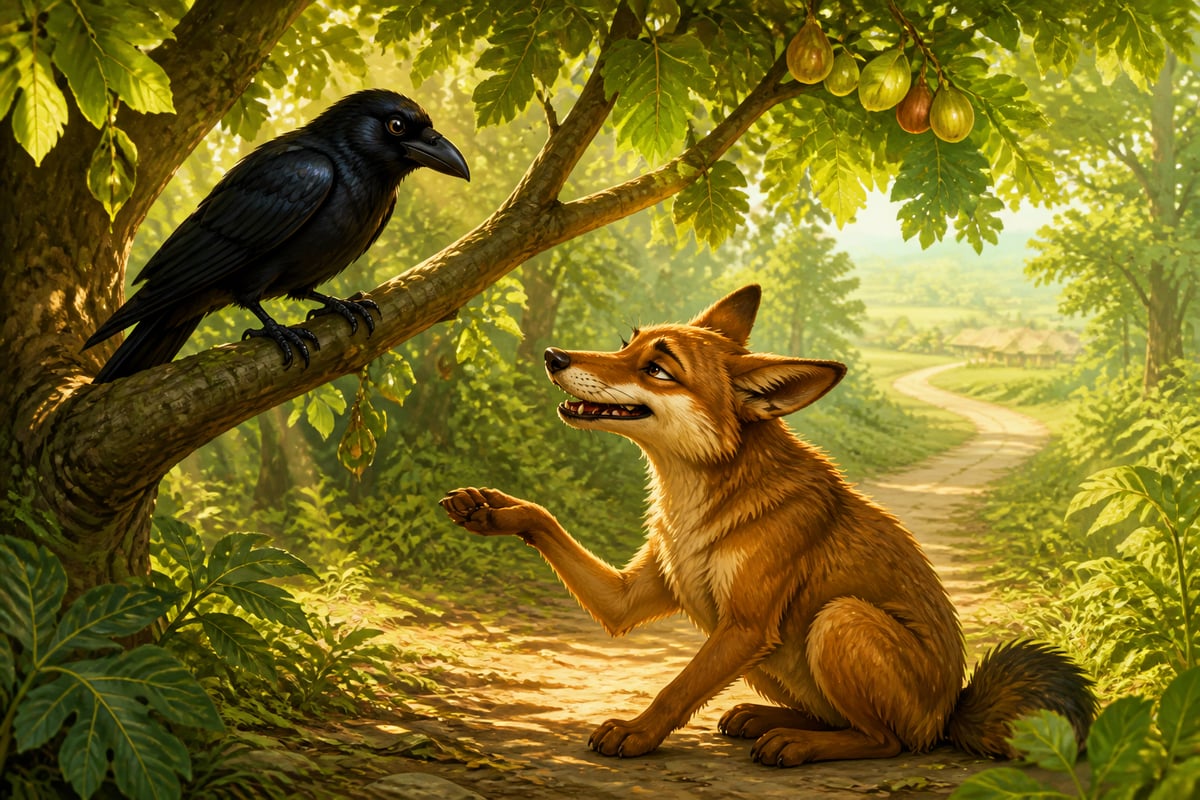
"Uncle Jackal," said the crow, "I need your advice. There is a cobra who eats my children. I am not strong enough to fight him. How can I defeat an enemy I cannot match in combat?"
The jackal smiled his clever smile. "The answer, nephew, is not to fight at all. Let others fight for you."
"But who would fight a cobra on my behalf?"
"Humans," said the jackal. "Humans fear and hate cobras above all creatures. If you can make the humans believe the cobra is their enemy, they will destroy him for you."
The crow listened as the jackal explained his plan.
The next day, the crow flew to the nearby village. The princess was bathing in the royal garden, and she had left her gold necklace on the edge of the pond while she swam.
The crow swooped down, seized the necklace in his beak, and flew away, but slowly, deliberately, making sure the royal guards saw him.
"A crow has stolen the princess's necklace!" shouted the guards. "After him!"
The crow led them on a chase through the village, over fields, toward the great banyan tree. The guards followed, never quite catching up, never losing sight of the glittering gold.
When the crow reached the tree, he dropped the necklace directly into the hollow where the cobra lived.
"The necklace went in there!" shouted the guards, rushing to the tree.
They peered into the hollow, and saw the cobra, coiled around the gold necklace, hissing at them with fangs bared.
"A snake! Kill it!"
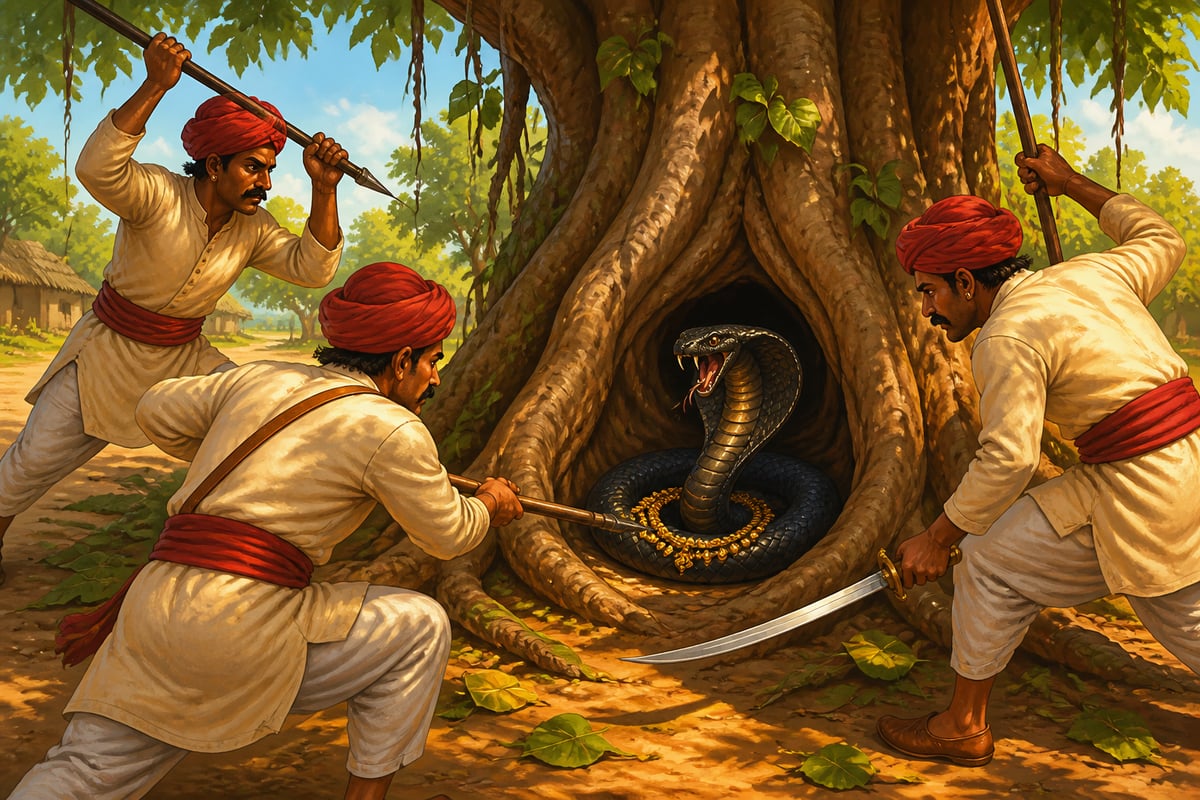
The guards attacked with sticks and swords. The cobra fought back, but it was no match for armed men. Within minutes, the serpent was dead.
The guards retrieved the princess's necklace and returned to the palace, congratulating themselves on their bravery. They never knew they had been manipulated by a crow.
And the crow and his wife raised their chicks in peace for the rest of their days.
The Wisdom of Strategy
Chirasena fell silent, and the forest seemed to breathe easier.
"Both the hare and the crow faced enemies they could not defeat by force," said the crane. "The lion was stronger than any hare. The cobra was more deadly than any crow. Yet both small creatures won, not through strength, but through understanding."
"The hare understood that Bhasuraka's greatest weakness was his pride," continued Chirasena. "He turned the lion's own strength against him. The crow understood that he did not need to fight the cobra himself, he only needed to bring the cobra into conflict with someone who could."
"Is this... trickery?" asked a young deer uncertainly. "Is it honorable to win through deception?"
"Consider the alternative," replied Chirasena. "Should the hare have thrown himself into the lion's jaws out of 'honor'? Should the crow have watched his children die rather than use his wits? When the choice is between clever survival and honorable death, the Panchatantra counsels survival."
The old crane spread his wings, preparing to depart.
"This concludes our lessons from the first tantra, Mitrabhedha, the Breaking of Friendship. We began with the tragedy of Pingalaka and Sanjivaka, whose friendship was destroyed by the scheming Damanaka. We learned that false friends can break the strongest bonds, that meddling brings disaster, that pride makes us deaf to wisdom, that loose talk destroys us, and that intelligence can overcome strength."
"These are hard lessons," Chirasena acknowledged. "The Panchatantra does not pretend the world is kind. But it teaches us how to navigate that world, how to recognize danger, how to protect ourselves, and how to turn our weaknesses into strengths."
"In the next tantra, Mitralabha, the Gaining of Friends, we will hear different tales. Tales of true friendship, mutual aid, and the strength that comes from trust. But that is for another time."
The crane rose into the air, his great wings catching the moonlight.
"Remember what you have learned. The world is full of jackals like Damanaka, donkeys like Uddhataka, and lions like Bhasuraka. But it also has room for clever hares and wise crows. Be the latter, not the former. And may your friendships be true, your words be measured, and your intelligence sharp."
With that, Chirasena flew into the night, leaving the animals of Mahilaropya to ponder the wisdom of the ages.
Reflection
- Think of a time when you solved a problem through cleverness rather than force or direct effort. What did you understand about the situation that allowed you to find a creative solution? How did it feel to win through wit?
- The hare used the lion's pride against him, and the crow used human fear of snakes. Is it ethical to manipulate others' emotions and instincts, even for self-defense? Where is the line between clever strategy and harmful manipulation?
- Throughout Mitrabhedha, we've seen animals deceive, manipulate, and scheme, sometimes for evil (Damanaka) and sometimes for good (Shashaka, the crow). The Panchatantra doesn't condemn these tactics outright. What makes the difference between a Damanaka and a Shashaka? Is deception ever truly justified?