Sahasaniryana: Hasty Decisions
Acting too quickly brings regret
Chapter Two shifts from greed to poor judgment as the cause of losing what we have. Through the tragic tale of a Brahmin woman who killed her loyal mongoose in a moment of panic, and a wife whose hasty actions destroyed her family, we learn that impulsive decisions, acting before understanding, can destroy in seconds what took years to build. The cost of haste is often irreversible.
A New Chapter Begins
The frame story of Raktamukha has shown us how greed, lobha, leads to the loss of what we have. But greed is not the only cause of labdhapranasha. There is another, equally dangerous: aviveka, poor judgment, the failure to think carefully before acting.
In the teachings of the wise, aviveka takes many forms. Sometimes it is haste, acting before understanding. Sometimes it is credulity, trusting without verification. Sometimes it is thoughtlessness, failing to consider consequences. All lead to the same destination: the destruction of what we had and the regret that follows.
This chapter presents tales that illuminate aviveka's many faces, beginning with its most tragic form: the hasty decision made in a moment of panic.
The Tale of the Brahmin and the Mongoose
In a village blessed by the sacred Ganga, there lived a Brahmin named Devasharman and his wife Mandakini. They had been married many years but were childless, a source of quiet sorrow that they rarely spoke of.
One day, a traveling sage passed through their village. Seeing their piety and their hidden grief, he blessed them: "Within the year, you shall have a son."
And so it came to pass. Mandakini gave birth to a beautiful boy, and the couple's joy knew no bounds. They named him Subhadra, "the auspicious one."
Around the same time, a mongoose, a small, sleek creature with bright eyes, appeared at their doorstep. She had just given birth herself, and her babies had been killed by a snake. Mandakini, her heart overflowing with maternal feeling, took pity on the orphaned creature.
"Let us raise this mongoose alongside our son," she said to her husband. "They will grow up as brothers."
Devasharman agreed, and so Subhadra and the mongoose, whom they named Rakshaka, "the protector", were raised together. They slept in the same room, played on the same floor, and grew to love each other as only childhood companions can.
The Fateful Day
One afternoon, when Subhadra was still an infant, Mandakini needed to fetch water from the well. The baby slept peacefully in his cradle; Rakshaka the mongoose dozed nearby.
"I will only be gone a moment," Mandakini told herself. "Rakshaka will watch over him."
She left, pot in hand, walking toward the village well.
While she was gone, a cobra, black as death, hood spread wide, slithered into the house through a crack in the wall. It moved toward the cradle where the baby slept, its forked tongue tasting the air, sensing warm blood.
Rakshaka awoke.
For a mongoose, there is no greater enemy than a cobra. The two species have warred since the beginning of time. But more than instinct drove Rakshaka now, he saw his brother, his beloved companion, in danger.
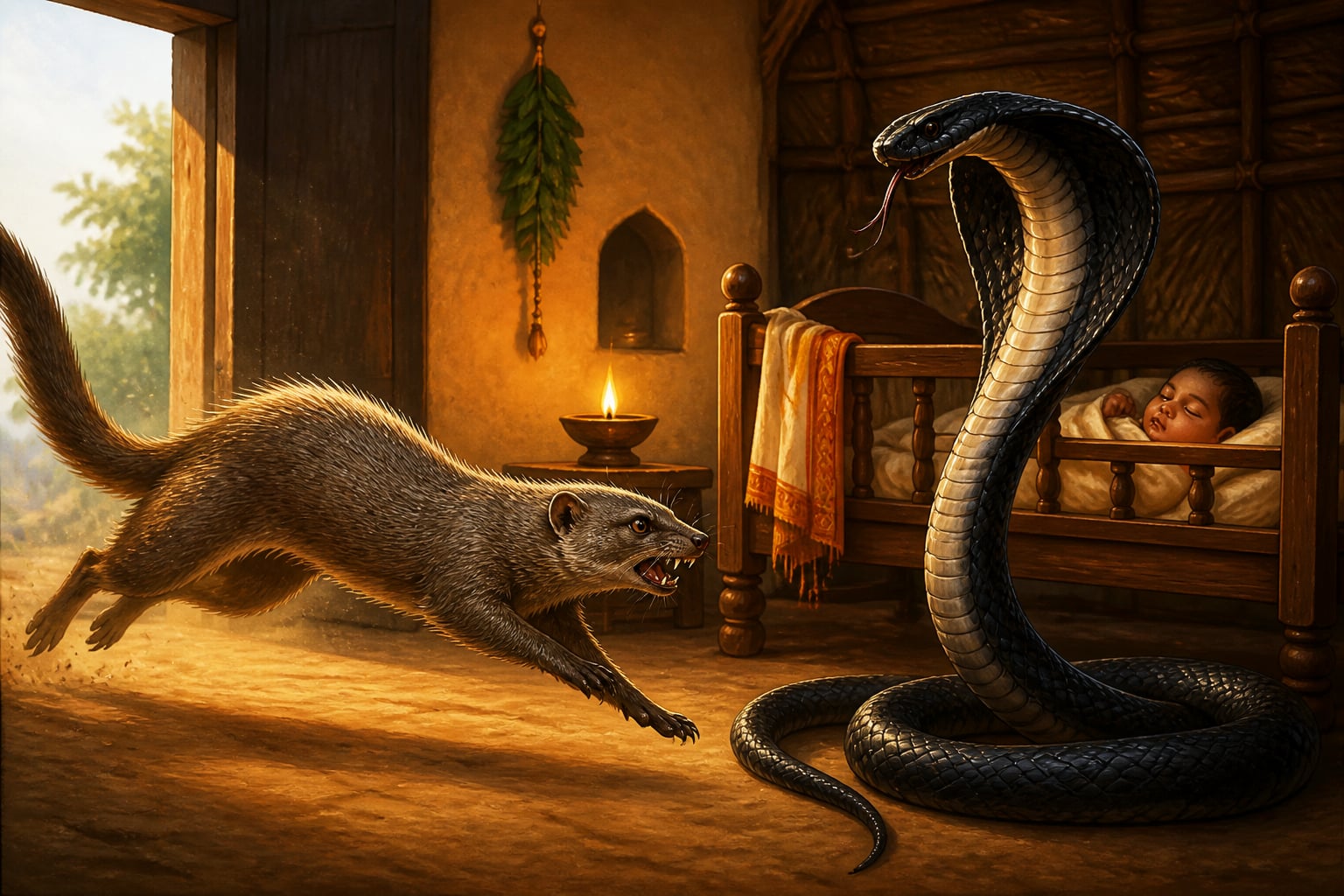
He attacked.
The battle was fierce but brief. Mongooses are born cobra-killers, quick and fearless. Rakshaka dodged the cobra's strikes, waiting for his moment, then clamped his teeth on the snake's neck and shook until the life left it.
The cobra lay dead. The baby slept on, undisturbed, protected.
Rakshaka, proud of his victory, ran to meet his mother at the door. His mouth and paws were covered in the cobra's blood.
The Hasty Decision
Mandakini walked back from the well, her pot balanced on her head. As she approached the house, Rakshaka bounded out to greet her, blood dripping from his fur, his eyes bright with excitement.
Mandakini saw the blood.
She did not see the dead cobra inside.
She did not pause to think.
She did not ask questions.
She did not look for evidence.
In that terrible moment, her mind leaped to a single, horrifying conclusion: "The mongoose has killed my baby!"
Before thought could catch up with emotion, before reason could temper panic, she raised the heavy water pot above her head and brought it crashing down on Rakshaka's skull.
The mongoose who had saved her son died at her feet.
The Discovery
Mandakini rushed inside, terrified of what she would find.
Subhadra lay in his cradle, sleeping peacefully, a smile on his infant face.
Beside the cradle lay the dead cobra, its neck torn by mongoose teeth.
Mandakini stared. Her mind struggled to comprehend what her eyes were telling her.
The blood on Rakshaka's mouth was not her son's. It was the cobra's.
The mongoose had not attacked the baby. He had protected him.
He had given his life to save her child, and she had killed him for it.
Mandakini sank to the floor, clutching the dead mongoose to her chest, wailing with a grief beyond words. She had destroyed in one moment of panic what years of love had built. She had killed her son's protector, her household's guardian, her family's faithful friend.
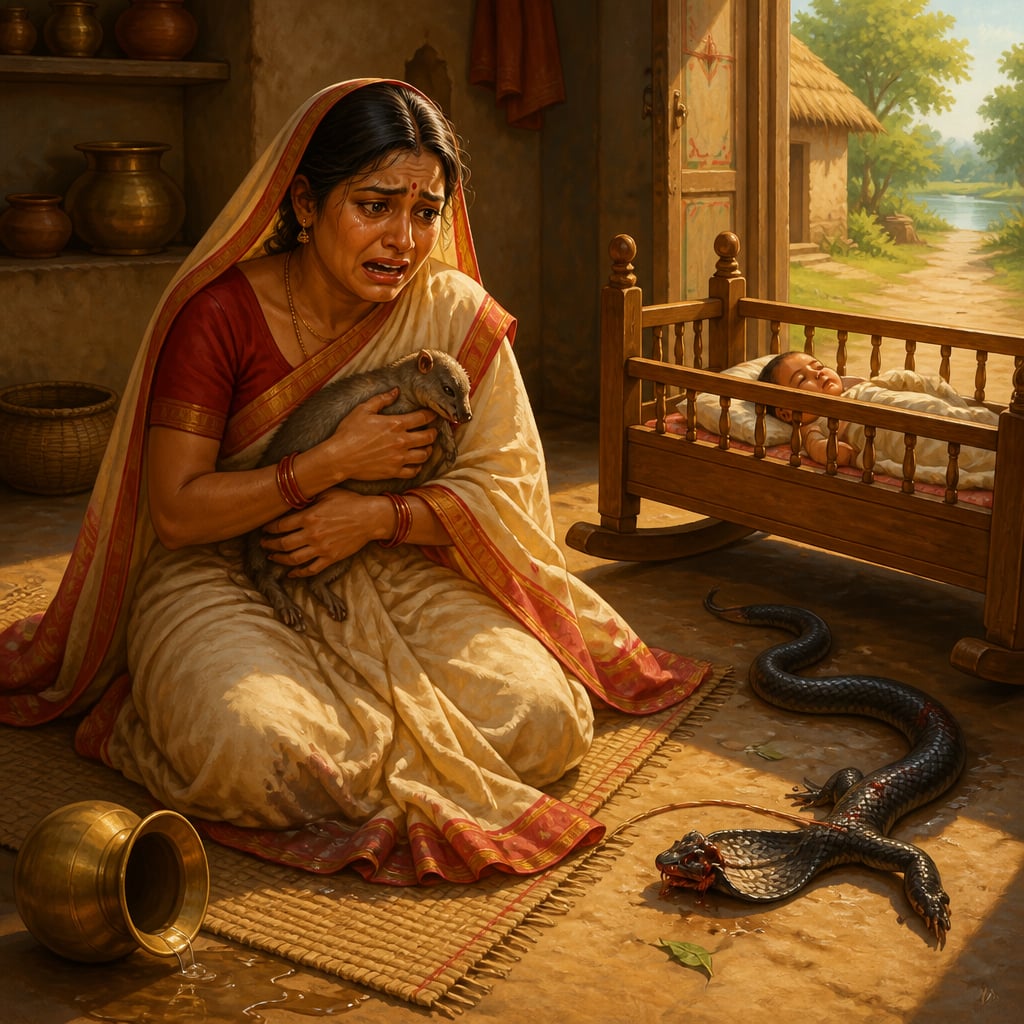
And there was no taking it back.
No apology could revive Rakshaka. No tears could undo the blow. No regret, however deep, could restore what haste had destroyed.
The Lesson Applied

Devasharman returned home to find his wife inconsolable, the dead mongoose in her arms, and the dead cobra by the cradle. He understood immediately what had happened.
He did not rage at her. He did not condemn her. He simply sat beside her and wept with her, for there was nothing else to do.
Later, when grief had softened enough for words, he said:
"This is why the wise say: 'Never act in haste.' Had you paused for one moment, one breath, you would have looked inside, seen the cobra, understood the truth. But panic does not pause. Fear does not investigate. And now we must live forever with what cannot be undone."
Mandakini never forgave herself. For the rest of her life, she honored Rakshaka's memory, lighting lamps at his grave, speaking of him to Subhadra when he was old enough to understand.
"He was your brother," she would say, tears flowing. "He died protecting you. And I killed him because I did not stop to think."
The Moral Deepened
This tale, one of the most famous in the Panchatantra, teaches a lesson that seems simple but is devastatingly difficult to practice: pause before you act, especially in crisis.
Mandakini was not evil. She was not foolish. She was not careless. She was a loving mother who saw blood and panicked. Her mistake was not in her love but in her speed, in acting before understanding, in concluding before investigating.
This is the nature of sahasaniryana, hasty action. It does not announce itself as folly. It feels like urgency, like necessity, like the only possible response. It is only afterward, when the irreversible has been done, that we see how easily we could have waited, how simply we could have checked, how tragically we chose speed over wisdom.
The mongoose cannot be brought back. But every person who hears this tale carries within them a question that might, someday, save them from the same fate: "Do I truly know what I think I know? Should I wait, even for a moment, before I act?"
Reflection
- Think of a time when you acted hastily and later regretted it, perhaps words spoken in anger, an email sent too quickly, or a decision made in panic. What would have been different if you had paused even briefly before acting?
- Why do you think Mandakini's first thought was 'the mongoose killed my baby' rather than 'I should check what happened'? What does this reveal about how fear affects our reasoning?
- The verse says 'good fortune chooses those who act after reflection.' Is this literally true? Do thoughtful people actually have better outcomes, or does it just feel that way? What is the relationship between careful action and good results?