Pratyayavamchana: Betrayed Trust
When confidence is misplaced
Believing lies, losing truth. Betrayal by trusted ones. Verify claims; blind faith leads to ruin.
Pratyayavamchana: Betrayed Trust
Chirakarin's voice grew heavy with the weight of his final tale. "We have spoken of foolish friends who harm through incompetence. But there is a deeper wound, those who deliberately use our trust as the very weapon of our destruction. This is pratyayavamchana: the deception of confidence."
The Brahmin and the Three Rogues
A Brahmin named Mitra Sharma was returning from a distant village, where a grateful patron had gifted him a plump goat for sacrifice. He carried the goat across his shoulders, pleased with his good fortune.
Three rogues saw him on the forest path, Dhurtaka, Khalanaka, and Vanchanaka. Hungry and lazy, they devised a plan to steal the goat without effort.
The first rogue, Dhurtaka, approached the Brahmin from ahead. "Noble sir," he exclaimed with exaggerated horror, "why do you carry a dog on your sacred shoulders? Have you lost your senses? A Brahmin defiled by a dog's touch must perform elaborate purification!"
"This is no dog," said Mitra Sharma, confused. "It is a goat, given to me for sacrifice."
"A goat!" laughed Dhurtaka, shaking his head. "Your eyes deceive you, or perhaps someone has cursed you. That is clearly a dog." He walked away, still shaking his head in apparent concern.
Mitra Sharma continued, now troubled. He examined the goat. It looked like a goat. It smelled like a goat. It bleated like a goat.
A few minutes later, the second rogue, Khalanaka, appeared. "Brahmin!" he cried. "What madness is this? Are you performing some strange penance? Why carry a dead calf on your shoulders?"
"This is neither dog nor dead calf," said Mitra Sharma, growing agitated. "It is a living goat!"
"Friend," said Khalanaka gently, "I fear you are ill. That is plainly a dead calf. Perhaps fever clouds your vision. You should rest."
He too walked away. Now Mitra Sharma was deeply unsettled. Two strangers, neither knowing the other, had seen different animals, but both agreed it was not a goat. Perhaps he was indeed cursed or sick?
When the third rogue, Vanchanaka, approached with fresh alarm, "Sir! Why do you carry a donkey? Has some demon possessed you?", Mitra Sharma's last certainty crumbled.
"Something is terribly wrong," he thought. "Three different people, three different animals, but all agree: what I see is not what is. I must be under some enchantment."
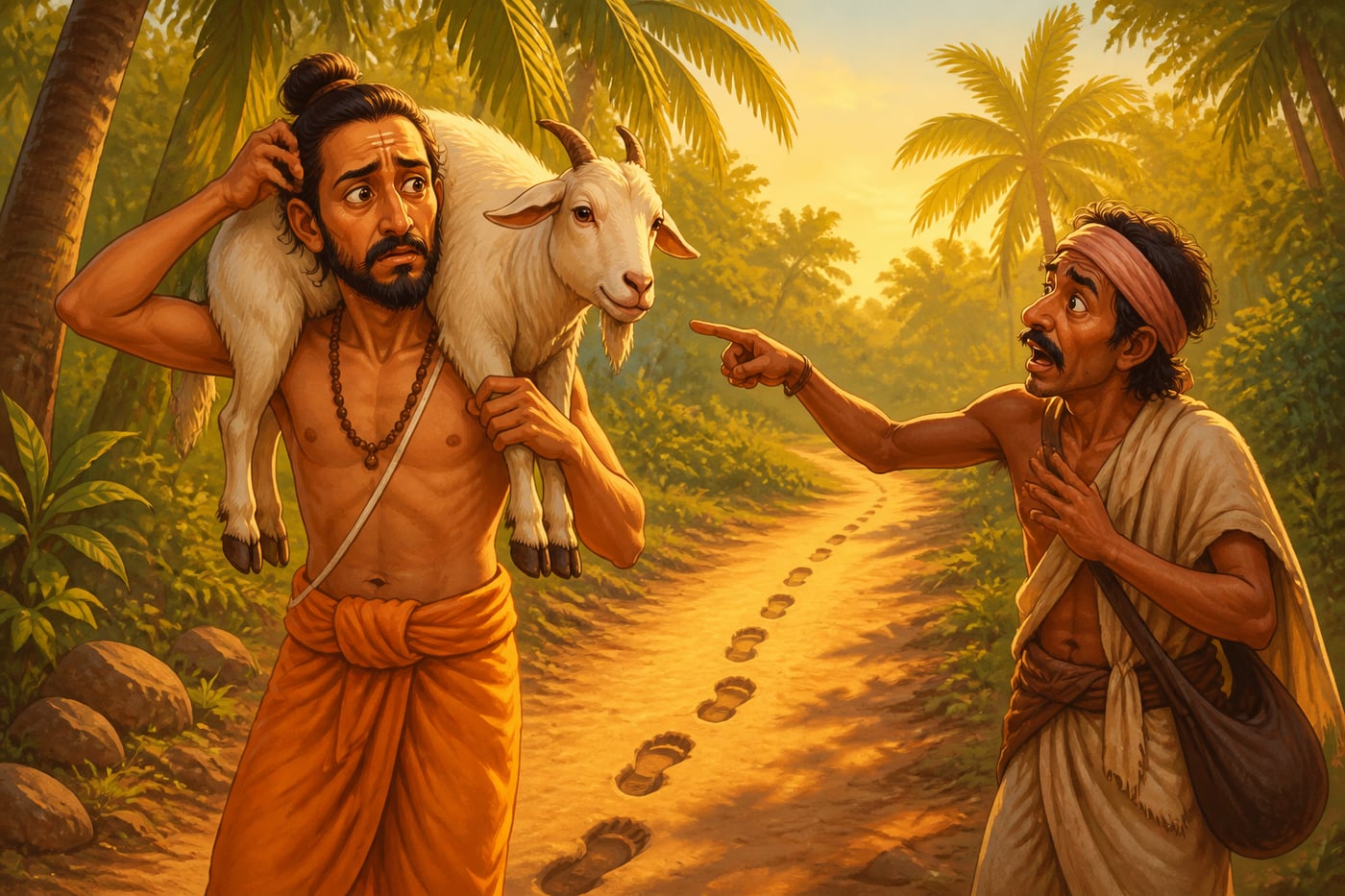
In fear and confusion, he threw the goat from his shoulders and fled. The three rogues collected their prize, laughing at how easily consensus creates reality in a doubting mind.
The Crocodile's Heart
In a great river lived a crocodile named Karalakesara with his wife. Nearby, a magnificent jamun tree overhung the water, and in its branches lived a monkey named Raktamukha. (Chirakarin smiled sadly. "Yes, the same Raktamukha. After his exile, he found peace in this tree, until even that was taken from him.")
Raktamukha would drop jamun fruits into the water for Karalakesara, and over time, a genuine friendship formed. The crocodile would share river gossip; the monkey would share the sweetest fruits. They talked for hours.
One day, Karalakesara brought some jamuns home to his wife. She tasted them and grew thoughtful. "These are wonderfully sweet. Where did you get them?"
"My friend the monkey gives them to me," said the crocodile proudly.
"A monkey who eats such sweet fruits daily," mused his wife, "must have the sweetest heart of all. I want to eat his heart."
"What? He is my friend! I could never, "
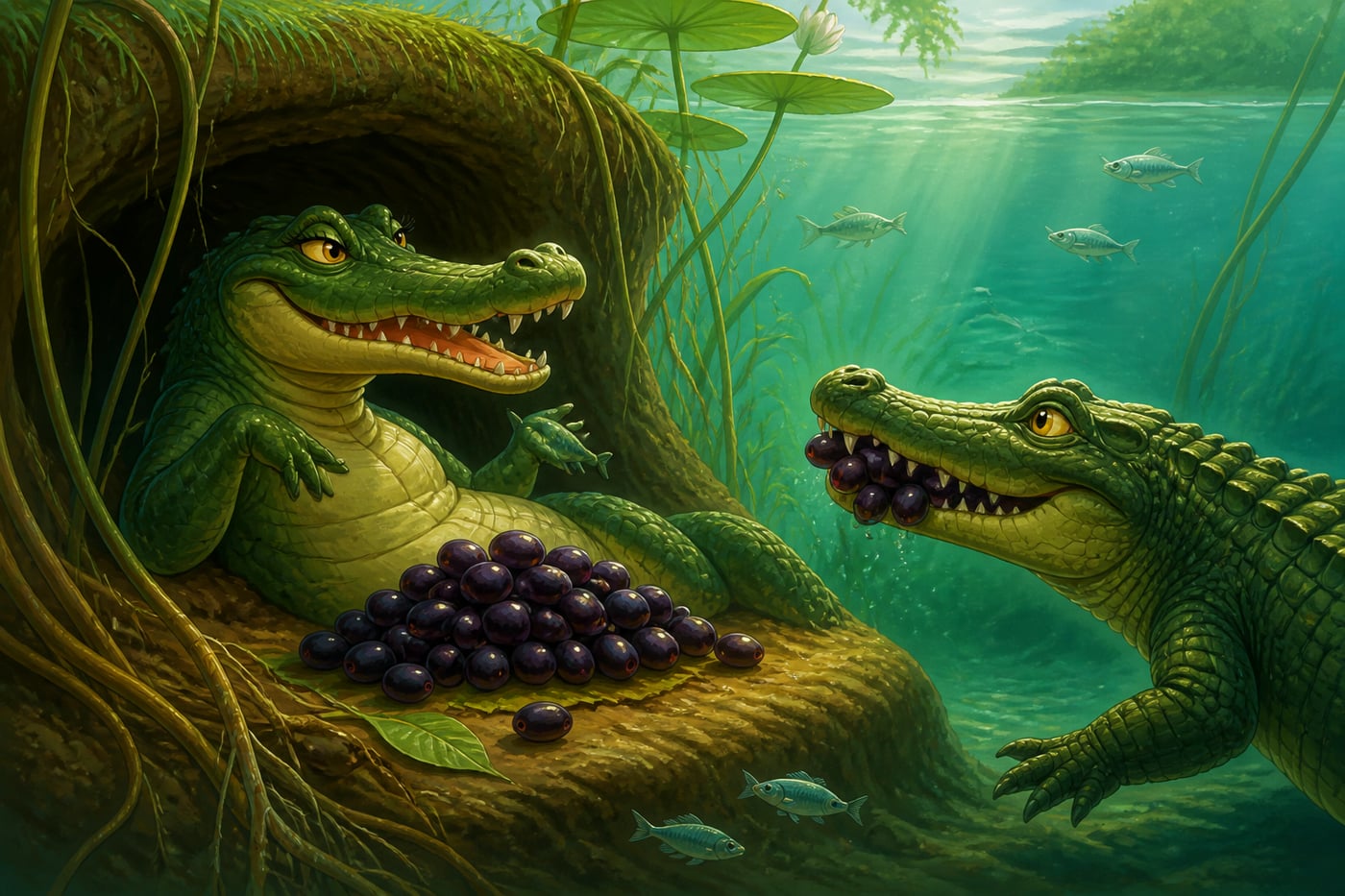
"If you truly loved me, you would bring me what I crave," she said coldly. "Perhaps you love this monkey more than your own wife. Very well. I shall starve myself until I waste away."
Torn between friendship and domestic peace, Karalakesara made his terrible choice. He swam to the jamun tree.
"Friend monkey! My wife wishes to meet you. She has prepared a feast in your honor. Come, ride on my back, I will carry you to our home."
Raktamukha, trusting his friend completely, climbed onto the crocodile's back. They swam toward the river's center.
Midway, Karalakesara began to sink beneath the water.
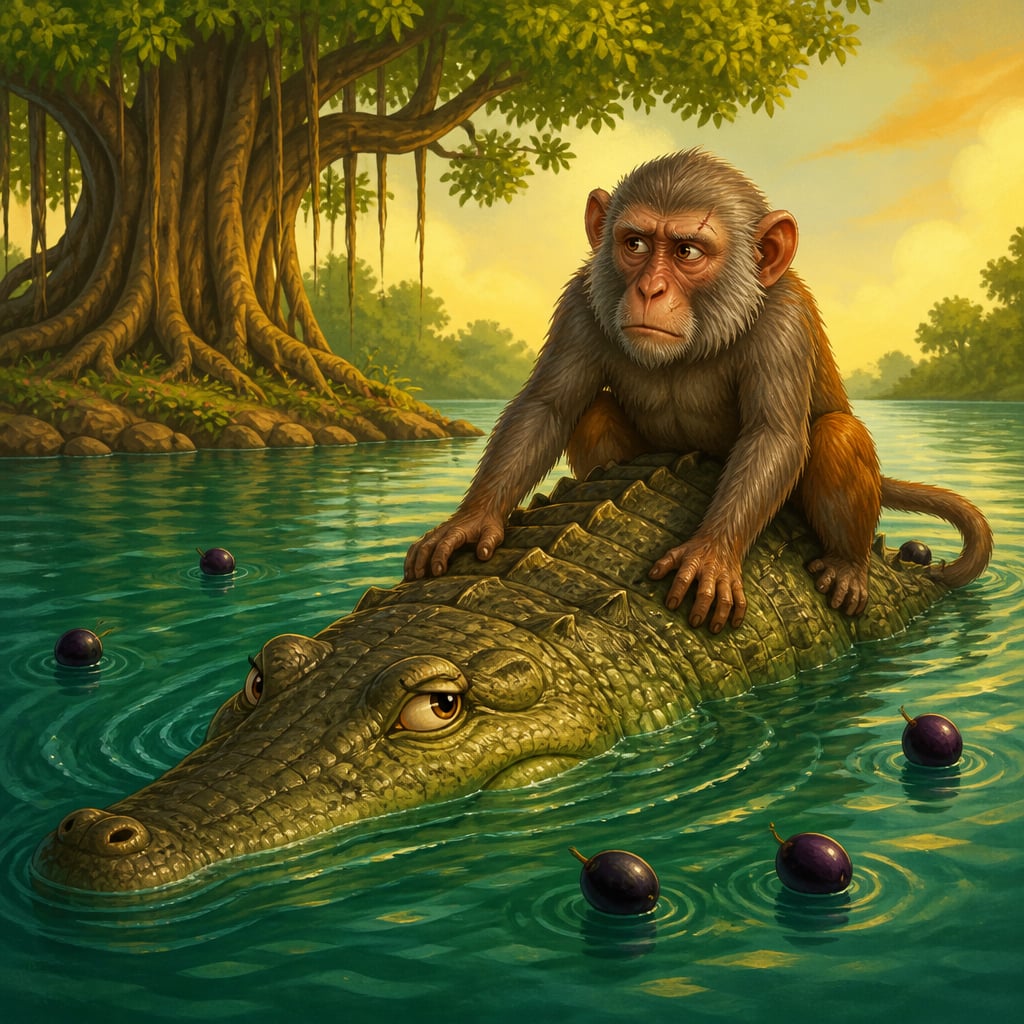
"Friend! What are you doing? I cannot swim!" cried Raktamukha.
"I am sorry," said the crocodile, unable to maintain the pretense. "My wife craves your heart. I must bring you to her."
In that moment, Raktamukha's wit, sharpened by past failures, awakened. "Ah, why didn't you tell me sooner? I would have brought it willingly! But we monkeys don't carry our hearts inside us. We store them in the jamun tree for safekeeping. Take me back and I will fetch it for you!"
The crocodile, not very clever, believed this and turned back. The moment they reached the tree, Raktamukha leaped to safety.
"Fool!" he shouted from the branches. "I trusted you completely, and you used that trust to lead me to death. We can never meet again. Beware, Karalakesara, you have lost a friend who gave freely. Your wife, who demanded my destruction, will demand more from you still. You chose her cruelty over my kindness, and that choice reveals who you truly are."
The crocodile swam home in shame, having lost his only friend for a wife who would never be satisfied.
The Weight of Betrayal
Chirakarin was silent for a long moment. The assembly waited.
"The Brahmin lost his goat because repeated lies shattered his trust in his own perception. The monkey nearly lost his life because complete trust created complete vulnerability. Both are forms of pratyayavamchana, but they teach different lessons.
"The Brahmin's error was allowing others to override his direct knowledge. He saw a goat. He held a goat. He should have trusted his senses over strangers' claims. When many voices unite against our own experience, that is precisely when we should be most suspicious, not least.
"Raktamukha's error was different. He had genuine knowledge of Karalakesara, they were true friends for a season. But he forgot that circumstances change people. The crocodile who fed on free jamuns was the same crocodile who answered to a demanding wife. The situation shifted; the character revealed itself."
Vegavati asked, "Then should we trust no one?"
"No," said Chirakarin. "We should trust wisely. Trust what you know directly over what others claim. Trust people within the scope of their proven character. And always leave yourself a way to survive if trust is betrayed. Raktamukha survived because his wits saved him at the last moment, but better still to have never been so vulnerable."
The Thread Complete
Sthiramati spoke: "We have learned much, Chirakarin. The tales of lobha showed how greed destroys from within. The tales of aviveka showed how poor judgment destroys from without. Is there a connection between them?"
"There is," said Chirakarin. "Greed clouds judgment. The greedy merchant entered the river because gold beckoned. The greedy wife demanded her husband betray his friend. Raktamukha himself fell first to greed for Subhadanta's fruit, and only then to the crocodile's betrayal. The two failures feed each other.
"But viveka, discrimination, wisdom, pause, is the cure for both. It asks: Is this desire healthy? Is this person trustworthy? Is this action wise? It creates space between impulse and action, between feeling and choice.
"This is the teaching of Labdhapranasha: what we gain through good fortune, we lose through greed and folly. What remains is what we build through wisdom. Guard your gains not just with walls, but with discernment. For the greatest treasure is the clear mind that sees truth, resists illusion, and chooses well."
The assembly sat in contemplative silence. Outside, the sun was setting over the kingdom, the same kingdom that, under wiser counsel, would endure and prosper.
The teachings of Chirakarin had been heard. Whether they would be heeded remained to be seen.
Reflection
- Think of a time when many people told you something that contradicted your own observation or intuition. Did you trust them or yourself? What was the result?
- The crocodile was a genuine friend until external pressure corrupted him. Have you seen friendships change when circumstances change? What does this teach about the nature of trust?
- Raktamukha's journey through this course took him from curious monkey-king to exiled wanderer to nearly-eaten victim to clever survivor. What does his arc teach about the relationship between suffering and wisdom?