Bahyavibhrama: Trusting Appearances
Things aren't always what they seem
The Old Tiger and the Traveler, and The Cunning Snake. Don't judge by appearance; test before trusting.
Bahyavibhrama: Trusting Appearances
Chirakarin continued his discourse to the gathered ministers. "The Brahmin's tragedy arose from hasty action. But there is another form of aviveka, the failure to look beyond appearances. Let me share two tales that illuminate this danger."
The Old Tiger and the Gold Bracelet
In a forest near the banks of a great river lived an old tiger named Krutadarsha. Age had stolen his strength, his claws were worn, his teeth blunted, and his legs could no longer carry him in pursuit of prey. For days he went hungry, growing ever weaker.
"I must use cunning now," he thought, "since strength has abandoned me."
One day, he found a golden bracelet lost by some traveler. An idea bloomed in his crafty mind. He waded into the river at a shallow ford and waited, holding the bracelet prominently in his paw.
When a merchant came to the crossing, Krutadarsha called out in a weak, trembling voice: "Noble traveler! Please stop! I am an old tiger who has renounced violence. In my youth, I killed many creatures and lost my own family as punishment. A sage taught me the error of my ways. Now I practice dharma and give charity to pilgrims. Take this gold bracelet as my gift!"
The merchant hesitated. "How can I trust a tiger?"
"Look at me!" cried Krutadarsha pathetically. "I am old and feeble. My claws are worn to nothing. I stand in the water far from you. What harm could I possibly do? Besides, does not the shastra say that gifts given freely must be accepted? Would you deny an old creature his final act of merit?"
The merchant's greed awakened. Gold was gold, and the tiger truly did look harmless, thin, aged, standing vulnerably in the water.
"Very well," said the merchant, stepping into the river.

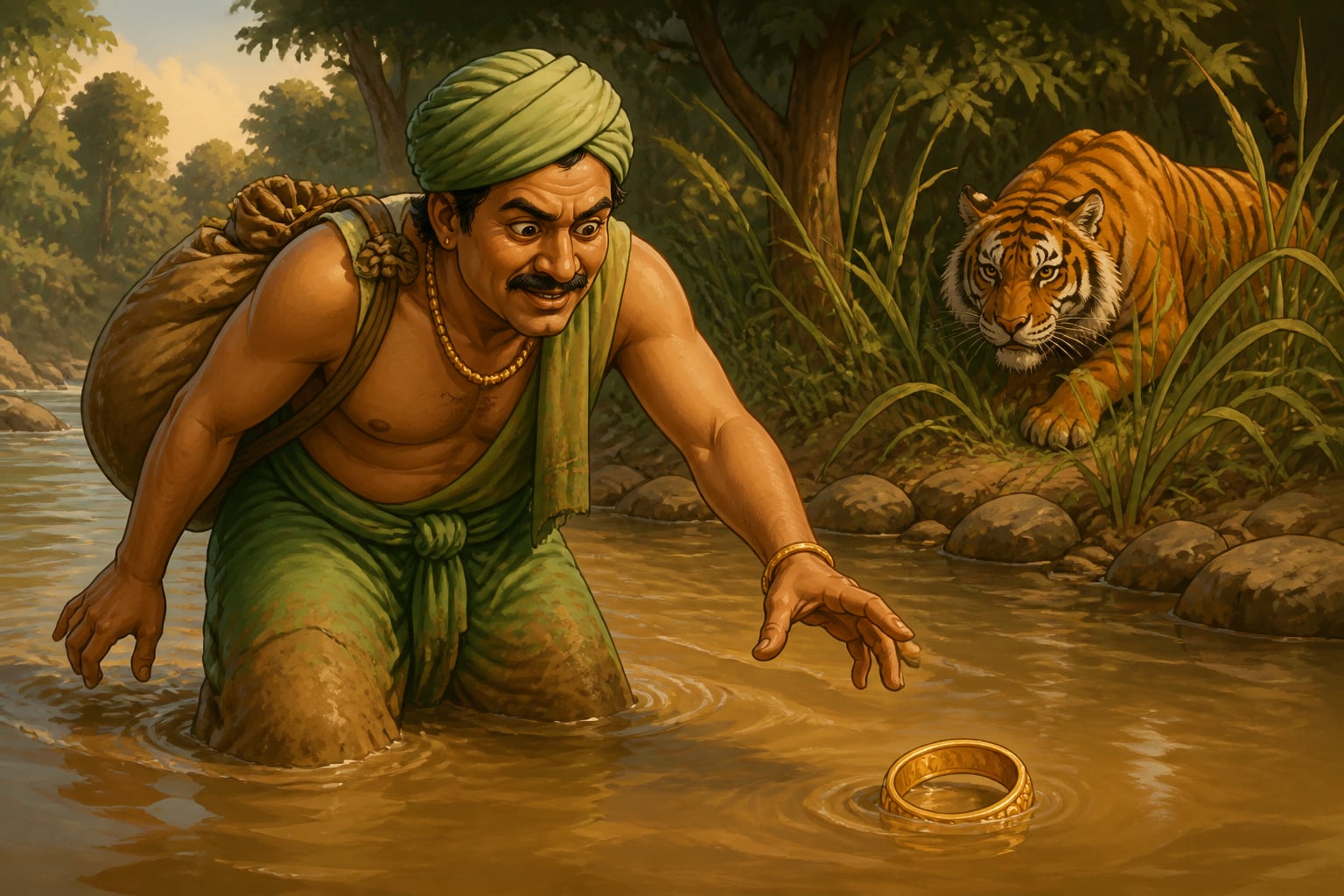
The moment he entered deep enough for his feet to sink into the muddy bottom, the tiger's demeanor changed. Moving with sudden speed that belied his apparent weakness, Krutadarsha pounced. The merchant, stuck in the mud, could not flee.
As the tiger devoured his prey, he reflected: "Greed made him believe what he wanted to believe. He saw the gold, not the tiger."
The Reformed Snake
In a village lived a snake named Mandavisha who had terrorized the community for years, biting farmers in the fields and children who strayed too close to his burrow. The villagers tried everything, smoke, prayers, snake-charmers, but Mandavisha was too clever.
One day, a traveling ascetic passed through. Moved by the villagers' fear, he approached Mandavisha's burrow and spoke of ahimsa, of the karma that awaited creatures who caused suffering, of the peace found in renunciation.
To everyone's amazement, Mandavisha emerged and declared himself reformed. "You speak truth, holy one. I renounce violence forever."
The ascetic left. For weeks, Mandavisha kept his word. He harmed no one. Children began to mock him, throwing stones. Young men kicked him when they passed. The snake, keeping his vow, endured it all, growing weak and bruised.
When the ascetic returned months later, he found Mandavisha half-dead in his burrow. "What happened to you?"
"I followed your teaching," the snake said bitterly. "I harmed no one. And look what they did to me."
The ascetic shook his head. "I told you not to bite. I never told you not to hiss. You could have defended yourself through deterrence without causing harm. True wisdom lies in appearing strong while practicing restraint, not in becoming vulnerable to every aggressor."
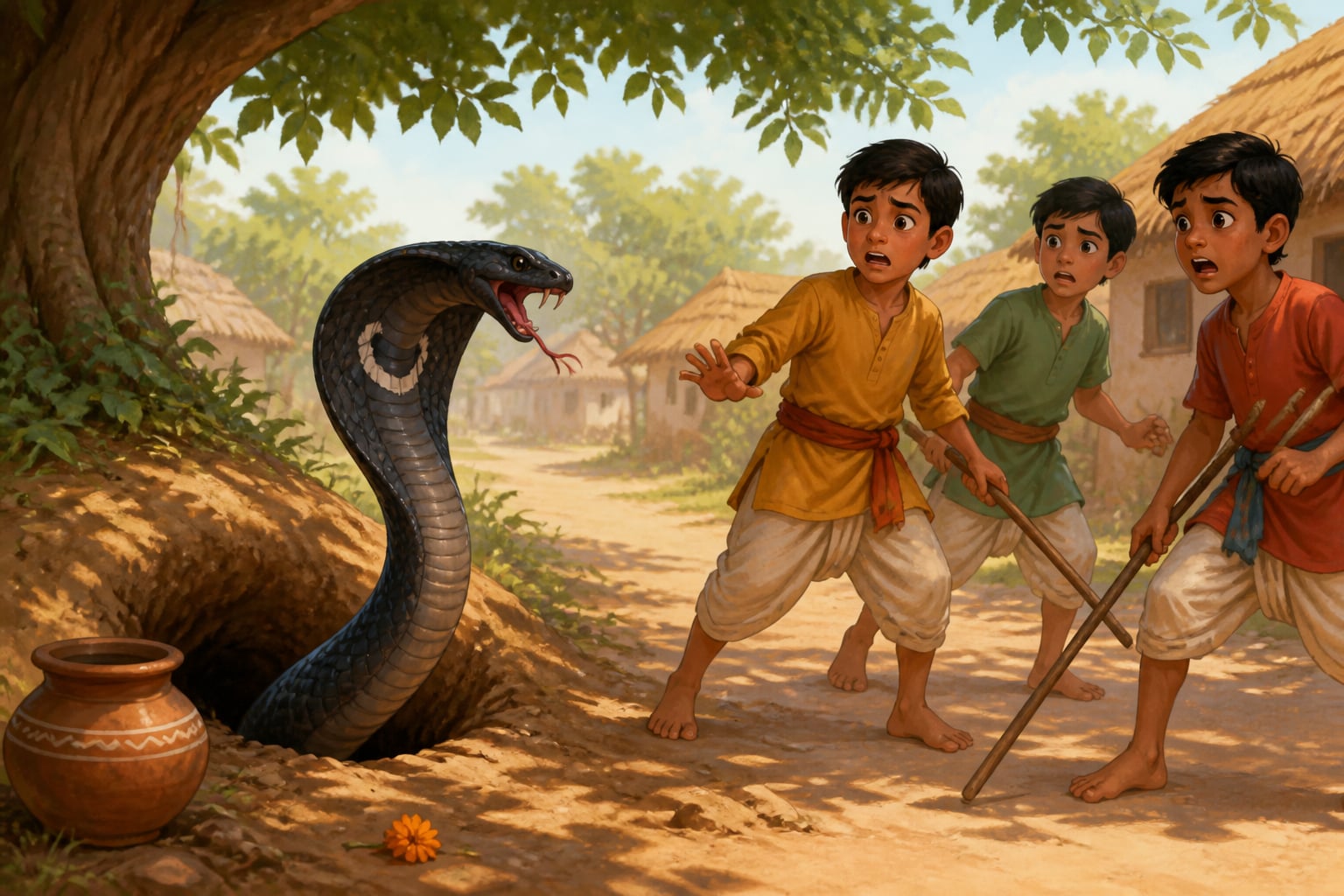
Mandavisha recovered, and learned to hiss fiercely while keeping his vow. The villagers, seeing his apparent ferocity, gave him wide berth, never knowing he had truly changed inside.
The Sage's Synthesis
Chirakarin paused. "These tales seem to contradict, yet they illuminate the same truth from different angles."
Tarunika asked, "How so, wise one?"
"The merchant was destroyed by trusting the tiger's false appearance of piety. The snake was nearly destroyed by making his genuine transformation too apparent. The lesson is this: appearances can deceive in both directions. The wicked may seem virtuous; the virtuous need not advertise their vulnerability.
"True viveka, discrimination, requires us to test claims before believing them, and to protect our genuine virtues with appropriate presentation. The world rewards neither naive trust nor naked goodness."
Vegavati objected, "But surely we cannot go through life suspecting everyone?"
"Not suspecting," Chirakarin clarified, "but verifying. The merchant could have tested the tiger's sincerity without entering the water. He could have asked the tiger to throw the bracelet to shore. His failure was not in engaging with the tiger, but in abandoning caution when greed beckoned.
"Similarly, the snake's initial approach was flawed. He confused non-violence with non-resistance. Ahimsa does not require becoming prey. One can be gentle of heart while being firm of boundary."
Sthiramati nodded slowly. "The Brahmin and mongoose tale taught us to investigate before acting. These tales teach us to investigate before trusting, and to be wise in how we present ourselves."
"Precisely," said Chirakarin. "Now let me tell you of those who act without any thought at all, a more dangerous form of aviveka still."
Reflection
- Think of a time when you believed something because you wanted it to be true. What warning signs did you rationalize away? How might you recognize such moments in the future?
- The snake was genuinely reformed but nearly died because he made his transformation too visible. When is transparency a virtue, and when does it become dangerous vulnerability?
- Is all deception wrong, or are there gradations? The tiger deceived to kill; the snake learned to 'hiss' to survive. Where do we draw the line between harmful manipulation and protective wisdom?