Shatruvishrambha: Trusting Enemies is Dangerous
Never trust your enemy
Two tales reveal the deadly danger of trusting those who wish you harm. A cat pretends to be a holy sage to eat trusting birds, while another cat forms an alliance with a rat, only for both to discover that survival requires constant vigilance, not blind faith.
The Frame: A Minister's Warning
As Sthirajivin settled into his role as spy among the owls, his mind often turned to the dangers of his position. He was surrounded by enemies who would kill him instantly if they discovered his true loyalty. Yet some of those enemies seemed almost friendly, was it possible they could be trusted?
"No," he reminded himself sternly. "Never forget the tale of Lomasa the Cat."
And in his mind, he recited the old stories that his grandmother had told him, stories about the terrible fate of those who trusted their enemies.
The First Tale: Lomasa the Holy Cat
In the branches of an ancient fig tree lived a colony of small birds, finches, sparrows, and wrens, who had built their nests there for generations. The tree stood at the edge of a village, and the birds lived peacefully, feeding on seeds and insects, raising their young in safety.
One day, a cat named Lomasa arrived at the base of the tree. He was old and thin, his fur matted, his movements slow. But his eyes, ah, his eyes were sharp as ever.
"Greetings, little birds!" he called up to them. "I have come seeking wisdom, not prey. I am Lomasa, a reformed soul. I have renounced the killing of living creatures and now follow the path of dharma."
The birds looked down suspiciously. A cat who didn't hunt? It seemed impossible.
"Why should we believe you?" demanded a wise old sparrow named Chitrangada.
"Because I stand here in daylight, where any dog or human could attack me, just to speak words of peace," replied Lomasa. "If I meant you harm, would I risk my own life? I seek only to meditate beneath this sacred tree and share what wisdom I have gained."
Days passed. Lomasa sat motionless at the tree's base, apparently lost in meditation. He ate only fallen fruits and never once looked hungrily at the birds above. Gradually, the younger birds began to believe him.
"Perhaps he truly has changed," said a young finch named Chitraka. "Not all creatures are slaves to their nature."
"Nature does not change," warned Chitrangada. "A cat is a cat. The scorpion stings because that is what scorpions do."
But Chitraka and several other young birds began visiting Lomasa, sitting near him as he "preached" about virtue, compassion, and the spiritual path. The cat spoke beautifully about non-violence, about the unity of all creatures, about the karma that comes from harming others.
Each night, one or two birds would stay late, listening to the cat's teachings until the light faded.
And each night, one or two birds would disappear.
At first, the colony didn't notice. Then they thought a hawk must be hunting nearby. But Chitrangada noticed something else: the disappeared birds were always those who stayed latest with Lomasa.
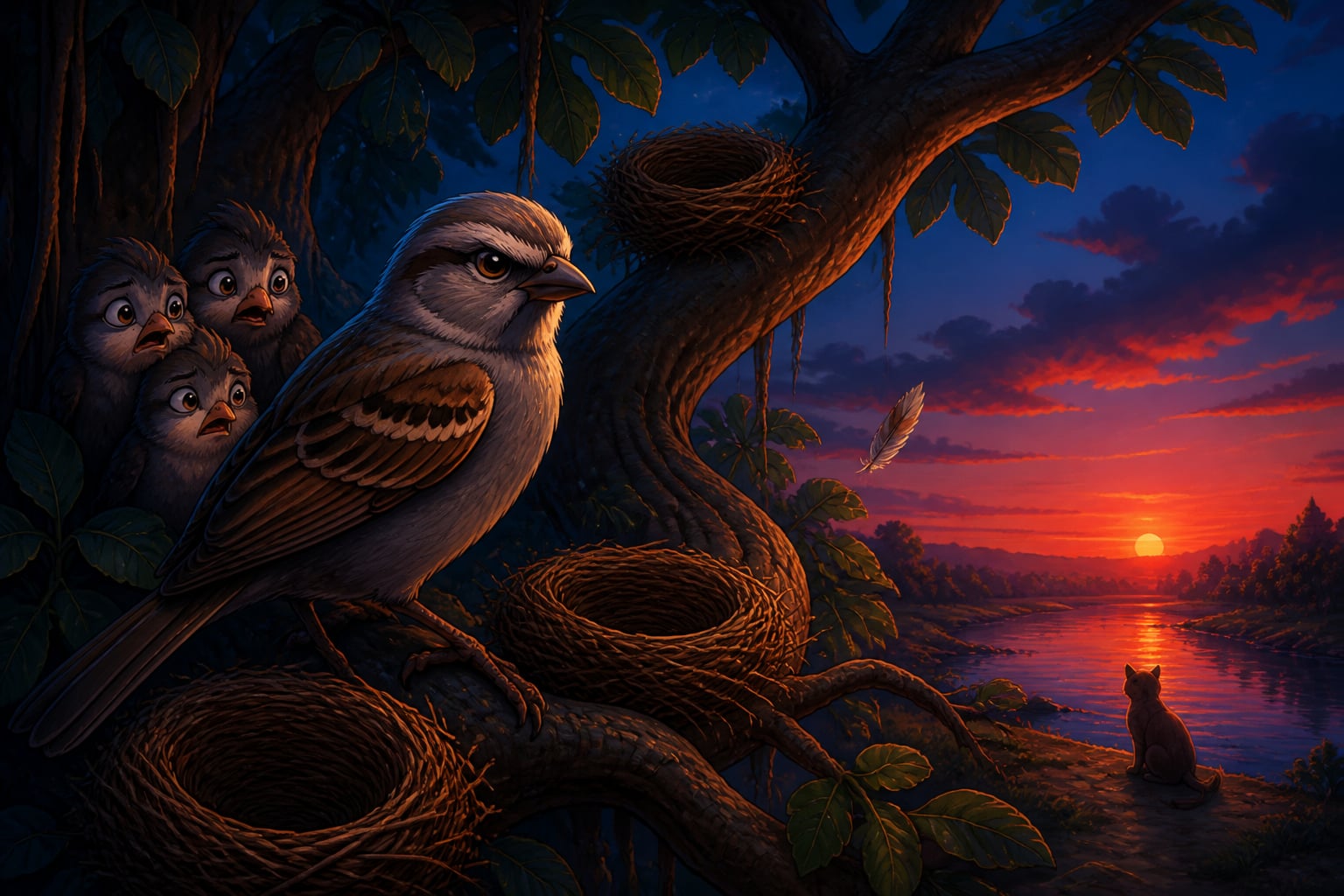
"Count the birds who visit him," she told her mate. "Count how many return."
They counted. And the truth became clear: every bird who trusted Lomasa completely, who stayed alone with him until darkness fell, was eaten.
Chitrangada rallied the survivors and they fled to another tree, far from the holy cat. Lomasa sat at the base of the empty fig tree for days, waiting for prey that never came.
"They have learned," he muttered to himself. "Pity. The trusting ones were so much easier to catch."
The Second Tale: The Cat and the Rat's Alliance
In the hollow of an old tree lived a rat named Palita, clever, cautious, and always planning for the future. His burrow had seven exits, and he never used the same one twice in succession. Survival required vigilance.
Near the same tree lived a mongoose, a cat named Dadhikarna, and in the branches above, an owl. Palita had enemies everywhere. The mongoose hunted by day, the owl by night, and the cat, the cat seemed to hunt constantly.
One evening, Palita emerged from his burrow to find disaster. A hunter had left a net near the tree, and Dadhikarna the cat had become tangled in it. The cat struggled helplessly, unable to free himself.
Palita's first instinct was to run. His second instinct was to run faster. But then he noticed: the mongoose was approaching from one side, and the owl was descending from above. Both predators had spotted the helpless cat and were moving in for the kill.
"Wait," thought Palita. "If they kill the cat, then they will notice me. I am small, but a meal is a meal."
An idea formed in his cunning mind.
"Dadhikarna!" he called out. "I can gnaw through that net and free you. But I have a condition."
"Name it!" gasped the terrified cat.
"You must protect me from the mongoose and owl while I work. And after you are free, you must give me safe passage for one full month, no hunting me, no ambushes, no 'accidents.'"
The cat agreed immediately. Palita scurried to the net and positioned himself near the cat's belly, the only place where neither mongoose nor owl could reach him without going through the cat first.
"Why aren't you gnawing?" demanded Dadhikarna.
"I am," said Palita, nibbling slowly at a single thread. "These things take time."
In truth, Palita gnawed just enough to look busy while watching the mongoose and owl. The predators circled warily but dared not approach the cat's claws. For hours, this standoff continued.
Only when Palita heard the hunter's footsteps approaching at dawn did he gnaw through the remaining threads in a burst of speed. The cat leaped free. The mongoose and owl fled from the approaching human. And Palita vanished into his burrow.
The next evening, Dadhikarna sat outside Palita's burrow.
"Friend rat!" he called sweetly. "Come out! I wish to thank you properly. Let us sit together as allies. Surely we can trust each other now, did we not save each other's lives?"
Palita's voice came from deep within the burrow: "Thank you, friend cat, but I will stay where I am."
"You don't trust me? After everything?"
"I trust that you were sincere when you needed me," replied Palita. "I trust that you are sincere now in wanting to thank me. But I also trust your nature. You are a cat. When hunger comes, gratitude goes. Our alliance was born of necessity; let it end with necessity."
"Then you insult my honor!"
"I protect my life. You may call that whatever you wish."
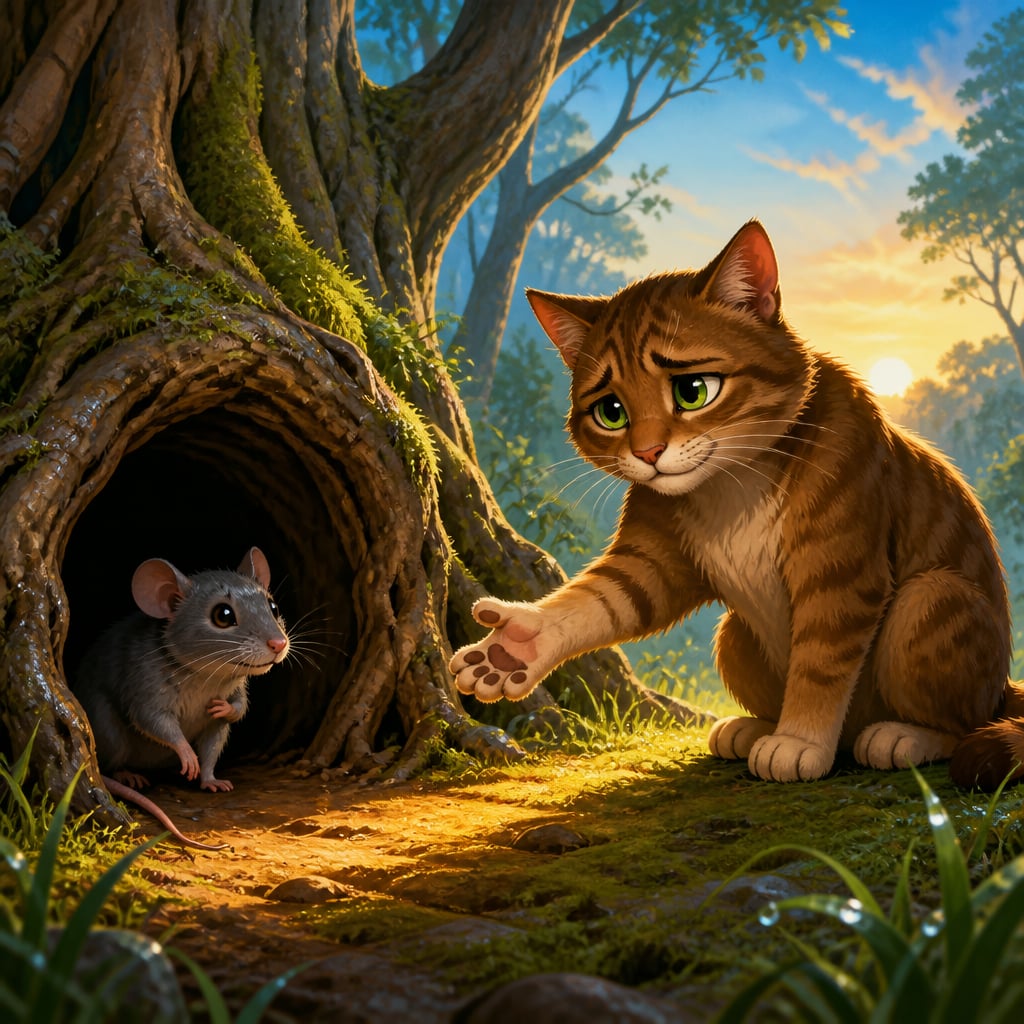
Dadhikarna sat outside the burrow for three days, calling, pleading, even threatening. But Palita never emerged when the cat was near. And on the fourth day, the cat, driven by hunger, attacked a passing bird instead.
"You see?" Palita told his children afterward. "He waited three days to eat me. That is not friendship. That is patience."
The Lesson Applied
Sthirajivin thought of these stories constantly as he lived among the owls. Some of them seemed genuinely kind to him. King Arimardana had even called him "useful" and "valuable." Kruravaktra laughed at his jokes. Lesser owls brought him extra food.
"They seem to like me," he thought sometimes. "Perhaps, "
But then he remembered: he was a crow. They were owls. Their kindness existed because they believed he served their interests. The moment that belief changed, the moment they suspected his true purpose, every smile would become a talon, every friendly word would become a death sentence.
"Trust no enemy," he reminded himself. "Not because they are evil, but because they are what they are. The cat cannot stop being a cat. The owl cannot stop being an owl. And I cannot stop being a crow."
He continued his mission, never letting the owls' apparent friendship cloud his judgment. He was Palita, gnawing at the net, useful for now, but always ready to flee.
And like Palita, he intended to survive.
Reflection
- Think of someone who once harmed you and later claimed to have changed. Did you trust them again? What happened? In hindsight, were there signs that their nature hadn't actually changed?
- Palita refused to trust the cat even after the cat had genuinely helped him. Is this wisdom or ingratitude? When does healthy caution become harmful cynicism? Where do you draw the line between protecting yourself and being unable to trust anyone?
- The story suggests that predators cannot stop being predators. But humans can change, we have moral agency. Or do we? To what extent is human nature fixed versus malleable? Can people truly overcome their fundamental drives, or only learn to hide them better?