Abhaya: Fear from Ignorance
Investigate before fearing
Two tales reveal how fear born of ignorance leads to foolish decisions. A hungry jackal overcomes his terror to discover that a mighty war drum is just leather and air, while a brahmin allows three rogues to convince him that his healthy goat is actually a dog. The wise investigate before they fear.
The Frame: Shadows in the Cave
In the early days of his infiltration, Sthirajivin found the owl caves terrifying. Every shadow seemed to hide an enemy. Every hooting call sounded like a death sentence. The darkness pressed against him like a living thing, and he jumped at sounds he couldn't identify.
One night, unable to sleep, he heard a strange rhythmic booming from deep in the caves, a sound like some massive creature's heartbeat. His first instinct was to flee. His second was to investigate.
"What is that sound?" he asked an owl guard.
The owl laughed. "That? Just water dripping on hollow rock. Makes quite a noise, doesn't it? New arrivals always think it's some monster."
Sthirajivin felt foolish. He had nearly panicked over dripping water. And he remembered an old tale his teacher had told him, about a jackal who discovered the same lesson the hard way.
The First Tale: Gomaya and the War Drum
In a forest near an ancient battlefield, there lived a jackal named Gomaya. He was perpetually hungry, jackals usually are, and spent his days searching for scraps, carcasses, anything edible.
One day, wandering further than usual, Gomaya entered the remnants of an old military camp. Long-dead fires marked where soldiers had once cooked. Rusted weapons lay half-buried in leaves. And in the center of the clearing stood something that made Gomaya's blood run cold.
A massive war drum.
The drum was huge, taller than a man, stretched with thick leather, painted with fearsome designs. And as Gomaya watched, frozen with terror, a branch blown by the wind struck the drum's surface.
BOOM.
The sound was enormous. It echoed through the forest, scattering birds, silencing insects. Gomaya's legs trembled. What creature could make such a sound? What monster lurked within that terrible object?
BOOM.
Another branch struck. Gomaya whimpered and prepared to flee. But hunger held him. He had eaten nothing for three days. If he fled now, he might starve. And besides... the thing hadn't moved. It just sat there, booming when branches hit it.
"Think," Gomaya told himself, fighting his terror. "What kind of monster sits still and only roars when something touches it? No monster. No animal. This thing is not alive."
Slowly, trembling, Gomaya crept closer. The wind died down. The booming stopped. The drum sat silent, enormous but motionless.
"It's just a thing," Gomaya realized. "A human-made thing. The sound comes from the leather, not from any creature inside."
But that leather... Gomaya's nose twitched. His hungry mind raced. Leather meant skin. Skin meant an animal. If this thing were truly dead, truly just leather stretched over wood...
Gomaya bit into the drum's surface. His teeth tore through the painted hide. And inside he found, nothing. Just hollow space and wooden frames. No meat. No prey. Just empty air.
"All that terror," Gomaya laughed bitterly, "for nothing. The great monster was leather and air. I wasted hours fearing something that couldn't have harmed me at all."
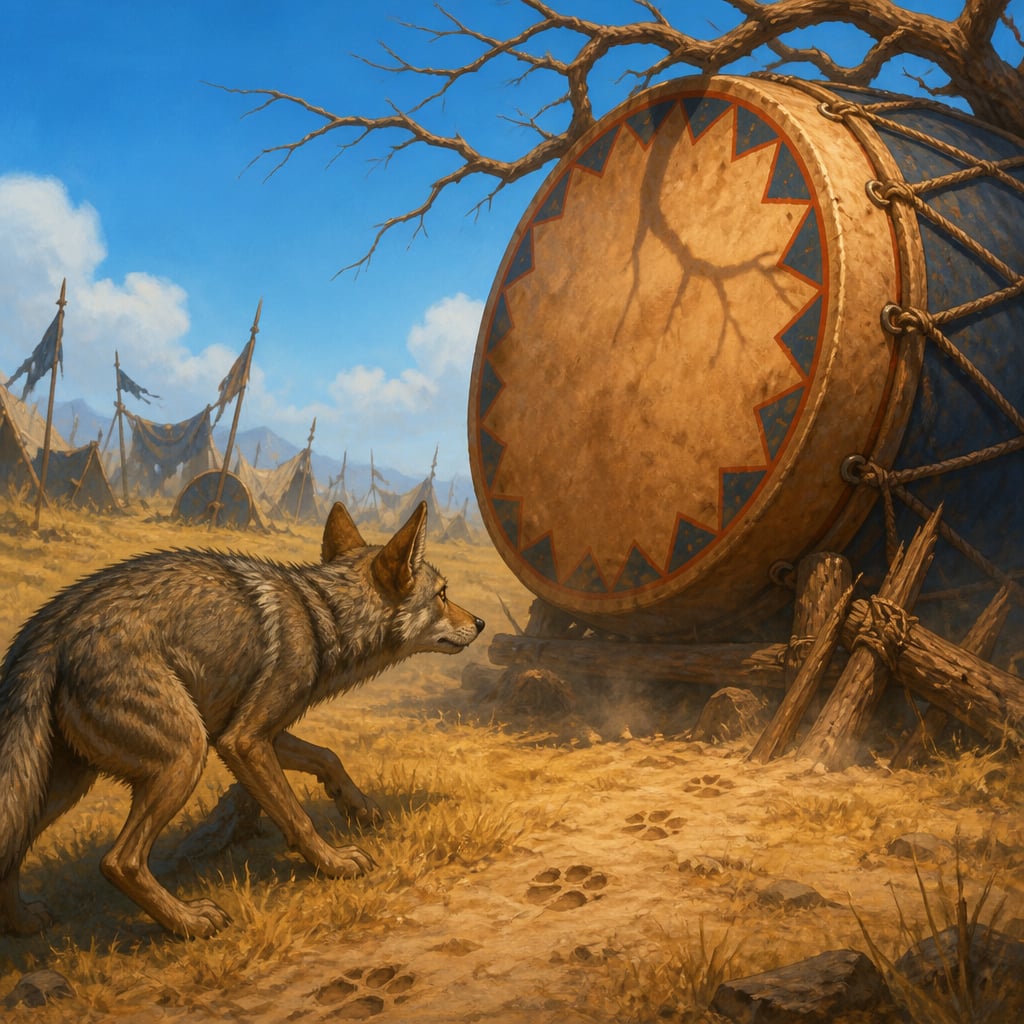
But he had learned something valuable. The loudest sounds don't always come from the greatest threats. Fear based on noise alone is fear based on ignorance. The wise investigate before they flee.
The Second Tale: The Brahmin and the Goat
In a village not far from Mahilaropya, there lived a brahmin priest named Mitra Sharma. He was learned in the scriptures, respected by the villagers, and utterly trusting, perhaps too trusting for his own good.
One day, Mitra Sharma performed a ceremony for a wealthy patron, who gave him a healthy goat as payment. The brahmin was pleased; the goat would provide milk for his family and eventually meat for a feast. He hoisted the animal across his shoulders and began the long walk home.
Three rogues spotted him on the road. They were hungry, lazy, and clever, a dangerous combination.
"Look at that fat goat," said the first rogue, whose name was Thaga. "If we could get it from him, we'd eat well tonight."
"But we can't just take it," said the second, called Dhurta. "He's a brahmin. People would hunt us down."
"We don't need to take it," smiled the third, named Prachanda. "We just need to make him give it away."
They separated and positioned themselves along the road, out of sight of each other.
Mitra Sharma walked on, the goat bleating contentedly on his shoulders. Soon he met the first rogue, who looked at him with apparent shock.
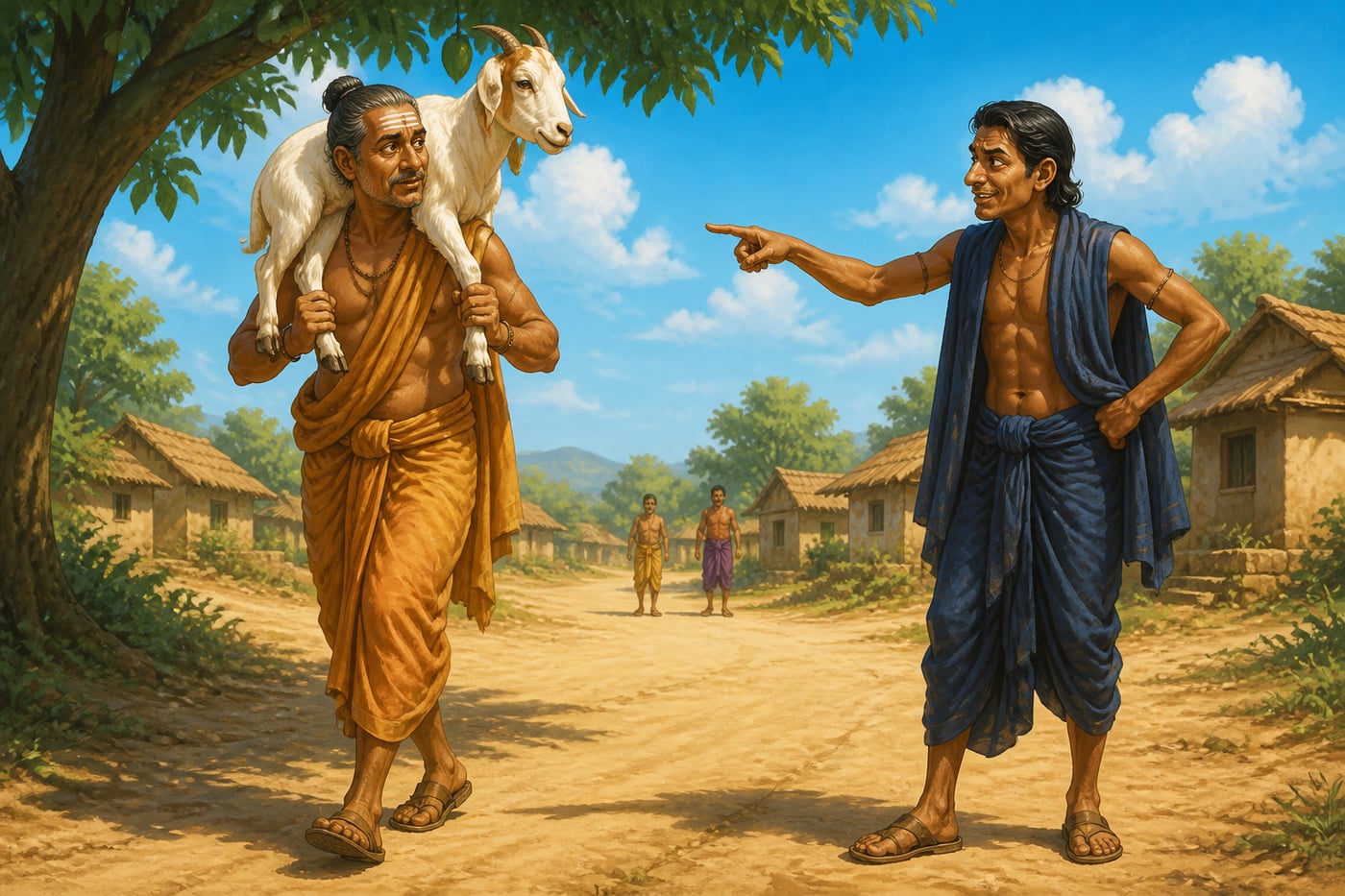
"Respected brahmin!" cried Thaga. "What are you doing? Why are you carrying a dog on your shoulders?"
"This is not a dog," replied Mitra Sharma, confused. "This is clearly a goat."
"It has four legs like a dog. It has a tail like a dog. Sir, I assure you, that is a dog. Perhaps someone tricked you?"
"Nonsense!" snapped the brahmin, and walked on. But a seed of doubt had been planted.
Further down the road, he met the second rogue.
"Oh my!" exclaimed Dhurta. "Brahmin, why do you carry that dog? Surely you know that brahmins should not touch dogs, they are ritually impure!"
"This is a goat," said Mitra Sharma, but his voice wavered. "A goat I received for performing a ceremony."
"Someone has deceived you terribly. Look at its ears, those are dog ears. Look at its snout, that is a dog snout. I fear you have been made a fool."
The brahmin walked on, deeply troubled. Could two strangers be wrong? Could his own eyes deceive him? He looked at the animal on his shoulders. It certainly looked like a goat... but what if everyone else saw a dog?
Then he met the third rogue.
"Brahmin!" shouted Prachanda in apparent horror. "Put that dog down immediately! Are you mad? What will people say when they see a learned priest carrying an unclean animal through the village?"
"Is it... is it truly a dog?" Mitra Sharma whispered, all his certainty shattered.
"Anyone can see it's a dog! You must be possessed by some demon to think otherwise. Drop it at once before you're seen!"
Three strangers. Three independent witnesses. All saying the same thing. Mitra Sharma's mind reeled. Could he truly be so deceived? Was his vision failing? Was he going mad?
In a panic, he threw the goat to the ground and fled toward home, convinced he had somehow been carrying a dog all along.
The three rogues emerged from hiding, laughing. They collected the confused goat and took it to their camp, where they feasted well that night.
Mitra Sharma arrived home empty-handed, told his wife about the "dog," and was thoroughly scolded when she learned the truth. He had traded a valuable goat for three lies, simply because he feared his own perception more than he trusted his own eyes.
The Lesson Applied
Sthirajivin pondered these stories as he navigated the owl court. The owls tried constantly to destabilize him, some deliberately, some unconsciously. They questioned his memories of crow customs. They "corrected" his understanding of events. They told him things about his own people that he knew were false.
"Perhaps you remember it wrong," Kruravaktra would say. "Crows are not known for their memories."
"Everyone says your king is a coward," another owl would mention casually. "Surely you've heard the same?"
It was subtle. It was constant. And if Sthirajivin had not been prepared, it might have worked. He might have begun to doubt his own knowledge, his own memory, his own identity.
But he remembered the brahmin and the goat.
"Three strangers told him what to see," Sthirajivin thought. "And he believed them over his own eyes. I will not make that mistake. I know who I am. I know what I know. No amount of owl voices will change what is true."
He also remembered the jackal and the drum.
"The owls want me to fear them," he realized. "They boom and roar and fill the darkness with terrible sounds. But sounds are just sounds. Fear is useful when it responds to real danger, but fear of noise alone is ignorance. I will investigate before I fear. I will think before I flee."
And so Sthirajivin maintained his clarity of mind, even surrounded by those who wished to confuse him. He trusted his own perceptions because he had verified them. He feared real threats and dismissed imaginary ones.
In a world of shadows and sounds, he kept his eyes open and his mind clear.
Reflection
- Think of something you feared before you understood it, a subject in school, a type of person, a new experience. Did investigation reduce your fear? What 'drums' in your life are still booming because you haven't looked closely at them?
- Have you ever been talked out of something you knew to be true? What made you doubt your own perception? In hindsight, what could you have done to maintain your certainty?
- How do we distinguish between healthy openness to new information and dangerous susceptibility to manipulation? When should we update our beliefs based on others' input, and when should we trust our own perception over outside claims?