Laghuripuksha: Small Enemies, Big Danger
Never underestimate any enemy
Two tales demonstrate that size means nothing when wit and determination align. A tiny sparrow destroys a mighty elephant by gathering allies and exploiting weaknesses, while a persistent mosquito drives a proud lion to madness. The enemies you dismiss may be the ones who destroy you.
The Frame: A Crow Among Eagles
The owls laughed at Sthirajivin.
Not cruelly, they had accepted him as useful, but condescendingly. He was small. He was old. He was a crow, a species they considered barely above vermin. What threat could such a creature pose?
"Look at our little advisor," Kruravaktra would joke. "The mighty crow who ran from his own people. What wisdom can such a tiny, weak creature offer us eagles of the night?"
Sthirajivin bore the mockery patiently. Let them underestimate him. Let them see weakness where determination hid. Let them dismiss the small enemy who was slowly, carefully, gathering the information that would destroy them all.
For Sthirajivin knew what the owls had forgotten: size measures nothing that matters in warfare. And he remembered the tale that proved it.
The First Tale: The Sparrow's Revenge
In a great forest, a sparrow named Kapinjala had built her nest in the branches of a shady tree. It was a good nest, carefully constructed, well-hidden, filled with eggs that would soon become her children.
Then the elephant came.
King Chaturdanta was the lord of elephants in that forest, massive, proud, and utterly careless of smaller creatures. He wandered through the trees, pushing aside whatever was in his path. When he reached Kapinjala's tree, he rubbed his great body against the trunk to scratch an itch.
The tree shook. The branch broke. The nest fell.
Kapinjala watched in horror as her eggs shattered on the ground. Her children, her future, destroyed in an instant by a creature who hadn't even noticed what he'd done.
"Murderer!" she screamed, flying at the elephant's face. "You killed my children!"
Chaturdanta blinked at the tiny bird attacking him. He felt her pecks like the landing of dust motes. With one lazy swing of his trunk, he swatted her away.
"Go build another nest, insect," he rumbled. "I have more important things to think about than your eggs."
He wandered on, already forgetting the incident. But Kapinjala did not forget.
"I am small," she told herself, trembling with grief and rage. "I cannot harm him directly. But I am not alone. And he has weaknesses he doesn't know about."
She flew to find her friend Vinarava the woodpecker.
"I need your help," Kapinjala said, and told her story.
"Against an elephant?" Vinarava was skeptical. "What can birds do against such a monster?"
"We can be clever. We can find allies. We can attack where he is weak rather than where he is strong. Will you help me?"
Vinarava agreed. Together, they sought out Meghanada the gnat and Mandavisarpi the frog.
"Each of you has a power the elephant lacks," Kapinjala explained. "Meghanada, you can fly into his ear and buzz until he goes mad. Mandavisarpi, you know the marshes, you can croak from places that seem safe but hide deadly pits. Vinarava, you can peck out his eyes when he's distracted. And I... I will coordinate us all."
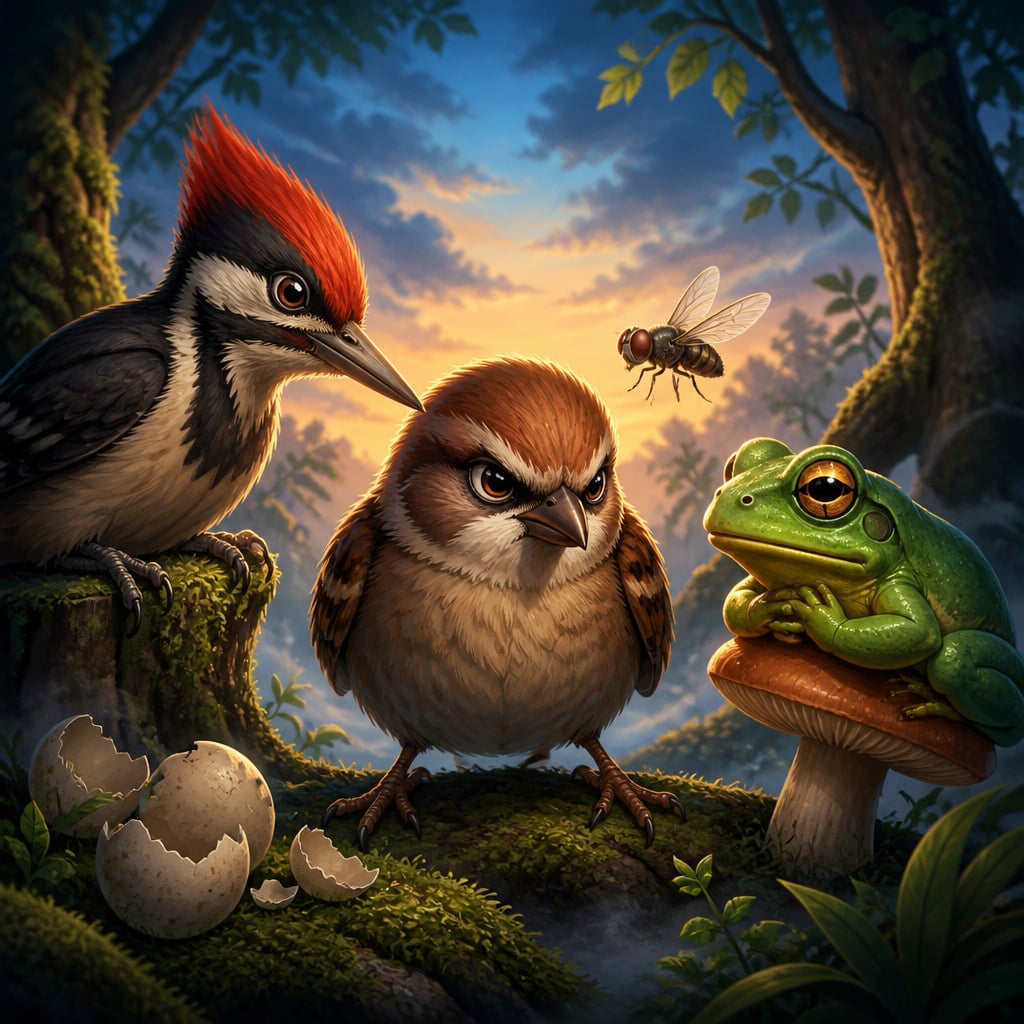
The four creatures planned their attack.
The next day, Chaturdanta was feeding in a meadow when Meghanada flew into his ear. The buzzing was maddening, he couldn't reach it, couldn't stop it, couldn't think. He trumpeted in fury and shook his head.
While he was distracted, Vinarava swooped down and pecked at his eyes. The great elephant, half-mad from the buzzing, half-blind from the attacks, stumbled and raged.
"Water!" he bellowed. "I need water to wash my eyes!"
From the edge of the forest came the sound of frogs croaking, the unmistakable sign of a pond. Chaturdanta charged toward the sound, desperate for relief.
But there was no pond. Only a deep pit, camouflaged with leaves, where Mandavisarpi sat croaking. Chaturdanta plunged in. The pit was filled with mud that sucked at his legs. The more he struggled, the deeper he sank.
"Help!" he screamed. "Someone help me!"
But no help came. The other elephants were far away, and no creature in the forest wished to save the careless king who had destroyed so many homes without noticing.
Kapinjala landed on a branch overlooking the pit.
"Do you remember me now?" she asked. "Do you remember my eggs?"
"You!" Chaturdanta gasped, sinking further. "A sparrow did this?"
"A sparrow who found allies. A sparrow who planned. A sparrow who attacked your weaknesses instead of your strengths." Kapinjala's voice was cold. "You thought I was too small to matter. You were wrong."
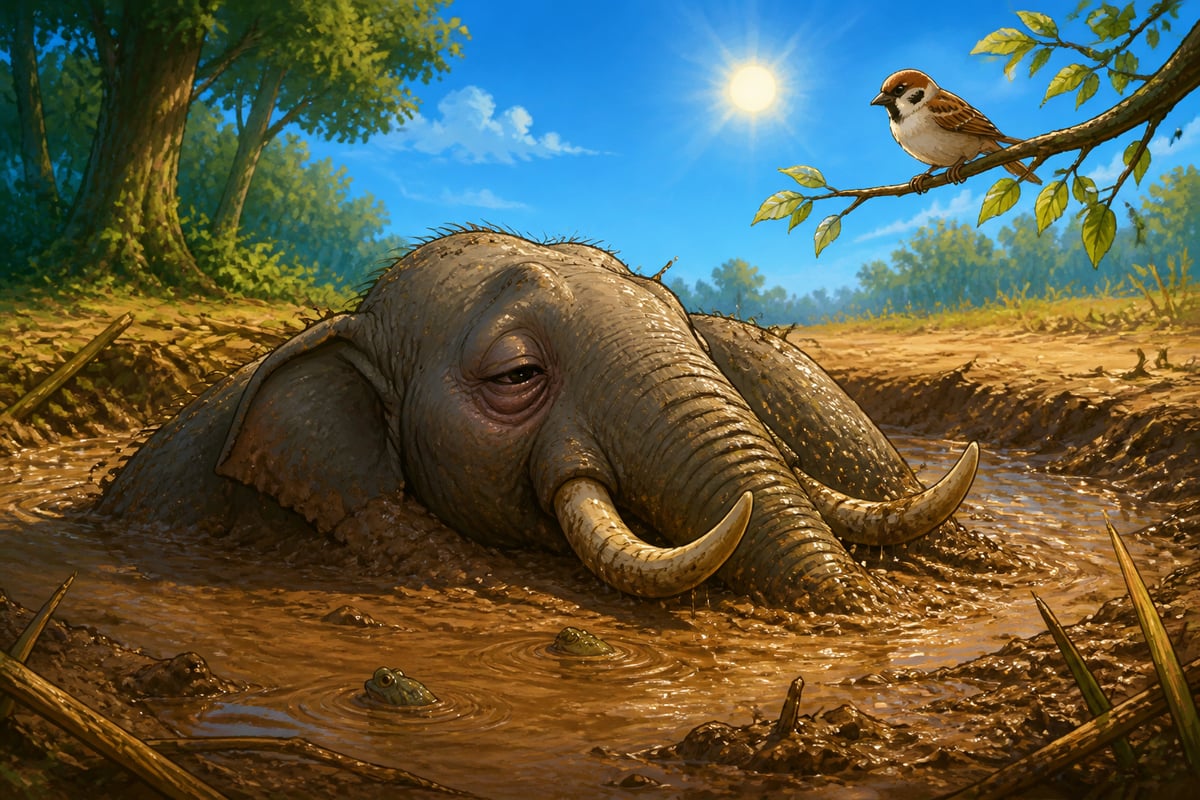
Chaturdanta sank into the mud and died. The mighty king of elephants, destroyed by a sparrow, a woodpecker, a gnat, and a frog.
The Second Tale: The Mosquito and the Lion
In another part of the world, a lion named Bhasuraka ruled his territory with absolute confidence. He was the strongest creature in the land. Nothing could threaten him.
One day, a mosquito landed on his nose.
"Move, pest," growled Bhasuraka. "Before I crush you."
"Crush me?" the mosquito laughed. "I am Anila, the wind-rider. I go where I please. And I please to sit here."
"You dare mock me? I am the king of beasts!"
"You are a pile of meat with teeth. I am small, yes, but my smallness is my strength. You cannot catch me. You cannot crush me. I am faster than your paw, smaller than your claw, more agile than your bite. Watch."
Anila flew at the lion's face, bit him on the nose, and darted away before Bhasuraka could react. The lion roared and swiped, and missed. Anila returned, bit his ear, and vanished again.
"Stand still!" Bhasuraka commanded.
"No." Anila bit him again. And again. And again.
The lion went mad with frustration. He clawed at his own face trying to catch the mosquito. He bit the air. He rolled on the ground. He roared until his throat was raw. Nothing worked.
For hours, Anila tormented him. Bite, flee, return. Bite, flee, return. Never enough to cause real injury, but constant enough to drive the lion to exhaustion and humiliation.
Finally, Bhasuraka collapsed, too tired to fight anymore. Anila landed on his heaving side.
"Surrender," said the mosquito. "Admit that the smallest creature has defeated the king of beasts."
"I... surrender," gasped Bhasuraka. "You win. Just... stop."
Anila buzzed triumphantly and flew away to boast of his victory. But in his pride, he flew too close to a spider's web and was caught.
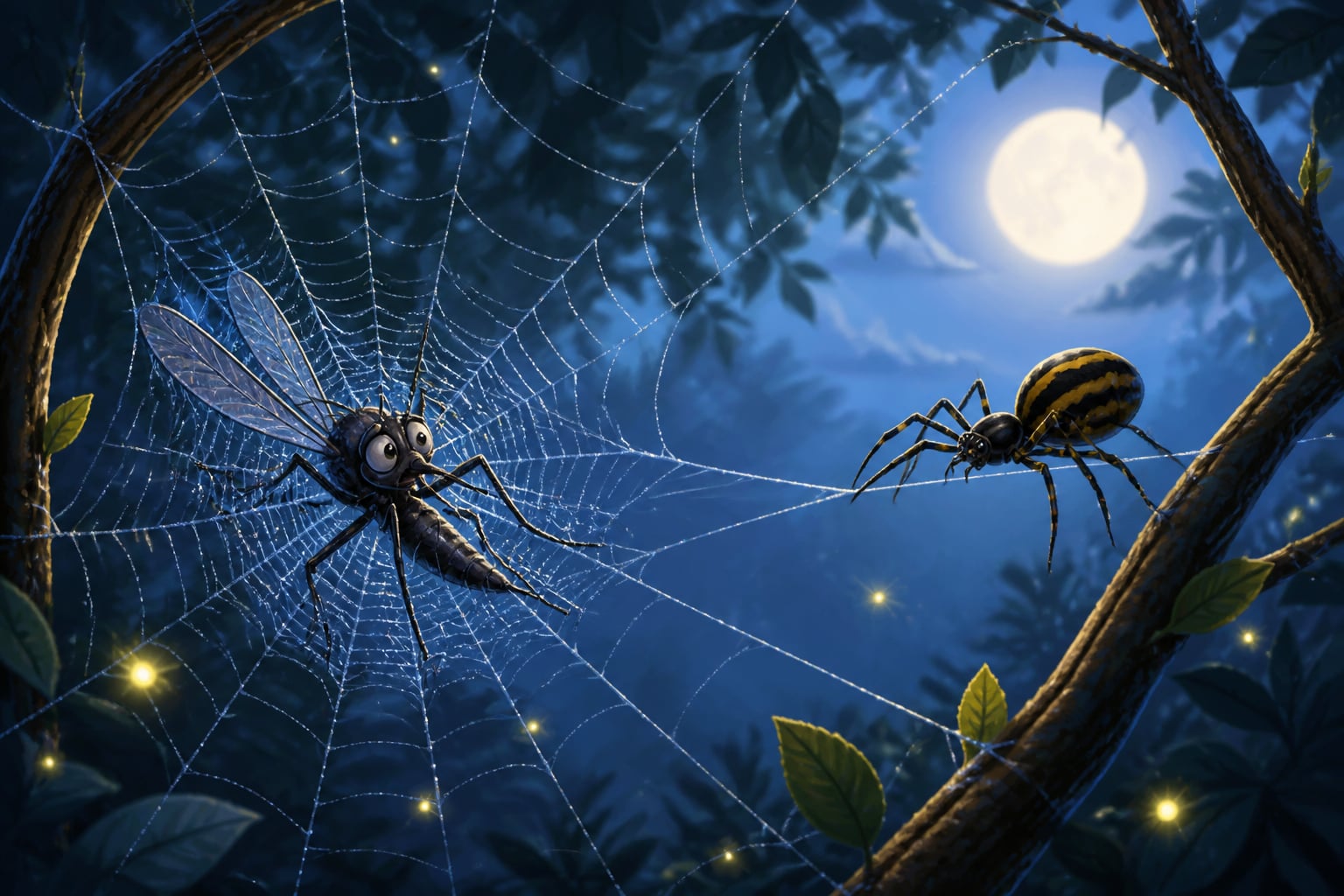
"What is this?" Anila struggled against the sticky strands. "I defeated a lion! I cannot be caught by a spider!"
"You defeated a lion," agreed the spider, approaching. "But you forgot the lesson you taught him. Size is not strength. And there is always someone smaller, more patient, more persistent than you."
The spider ate the mosquito. And somewhere in the forest, Bhasuraka heard the news and laughed bitterly.
"The mosquito defeated me," he said, "and the spider defeated the mosquito. It seems no one is too small to be a threat, or too great to be threatened."
The Lesson Applied
Sthirajivin thought of these stories every time the owls dismissed him. Every condescending joke, every casual assumption of his helplessness, all of it strengthened his resolve.
"They see a small, old crow," he thought. "They don't see the planning. They don't see the allies gathering outside these caves. They don't see the fire being prepared. They see only what they expect to see, weakness."
He remembered Kapinjala's strategy: find allies with complementary strengths. Meghanada could reach where the elephant couldn't see. Vinarava could strike where the elephant couldn't defend. Mandavisarpi could lure where the elephant couldn't escape.
Sthirajivin had his own complementary allies. King Megavarna commanded the crow army. Chittaka the bat carried messages. The dry chamber waited, filled with generations of flammable material. And Sthirajivin himself, small, dismissed, underestimated, had access to places no owl suspected.
"The elephant thought the sparrow was too small to matter," Sthirajivin reminded himself. "The lion thought the mosquito was too insignificant to threaten. Both were wrong. Both died."
He also remembered the mosquito's fate, killed by an even smaller creature while boasting of victory.
"Even when I succeed," Sthirajivin vowed, "I will not become careless. There is always something smaller, something I might overlook. Victory is not the end of vigilance, it is the moment vigilance matters most."
And so he continued his work, small and patient and deadly, waiting for the moment to strike.
Reflection
- Think of a time when someone underestimated you. How did you respond? Did their dismissal make you more determined? Have you ever been the one underestimating someone else?
- Kapinjala built a coalition of creatures who each brought different abilities. When you face challenges larger than yourself, who are your potential allies? What complementary strengths might you combine to achieve what you cannot alone?
- The mosquito's pride after defeating the lion led directly to his death. Why do victories make us vulnerable? Is there something inherent in success that creates blindness? How can we remain vigilant even in triumph?