Krutaghnakriya: Acts of Ingratitude
Beware of ungrateful people
Two tales warn against expecting gratitude from the wicked. A crane saves a wolf from choking, only to be threatened when asking for thanks. A brahmin rescues creatures from a well, and while the tiger and snake repay his kindness, the human he saved betrays him. Nature determines gratitude more than circumstance.
The Frame: Kindness in Enemy Territory
During his months among the owls, Sthirajivin occasionally performed small kindnesses. He helped a young owl find his way through unfamiliar passages. He shared information that helped an advisor avoid embarrassment. He even warned an owl guard about a snake that had entered the caves.
"You are surprisingly helpful," King Arimardana remarked one day. "More helpful than you need to be."
"I serve where I can, Your Majesty," Sthirajivin replied carefully. "Even outcasts can be useful."
But privately, Sthirajivin wondered: would any of these kindnesses be repaid? If his identity were discovered, would the owls he had helped speak in his defense?
He thought not. And he remembered why, an old story about a wolf and a crane.
The First Tale: The Wolf and the Crane
In the forests near Mahilaropya, there lived a wolf named Dushta, a fitting name, for he was wicked to his core. He killed not just for hunger but for pleasure. He betrayed allies when convenient. He felt neither gratitude nor guilt.
One day, Dushta was gorging himself on a freshly killed deer when a bone lodged deep in his throat. He coughed, gagged, clawed at his neck, but the bone would not move. He couldn't eat. He couldn't drink. Each breath was agony.
"I'm going to die," he realized with terror. "Unless someone helps me."
But who would help a wolf? Everyone in the forest knew Dushta's nature. Prey animals fled at his approach. Even other predators avoided him.
Desperate, Dushta made an announcement: "Whoever removes this bone from my throat shall have any reward they desire! Gold, territory, my eternal friendship, name your price!"
Most animals laughed. The wolf's eternal friendship? As valuable as a viper's promise of gentleness.
But one creature stepped forward: a crane named Sarasa, known throughout the forest for her kindness and her foolishness, qualities that often went together.
"I can help," she said. "My long beak can reach the bone. But promise me you won't harm me while I work."
"I promise!" gasped Dushta. "By all the gods, I swear it!"
Sarasa carefully inserted her long beak down the wolf's throat. It was terrifying work, her entire head was inside the jaws of a predator. One snap and she would die. But she trusted his promise.
She found the bone, gripped it carefully, and pulled it free. Dushta gasped with relief as air flowed freely again.
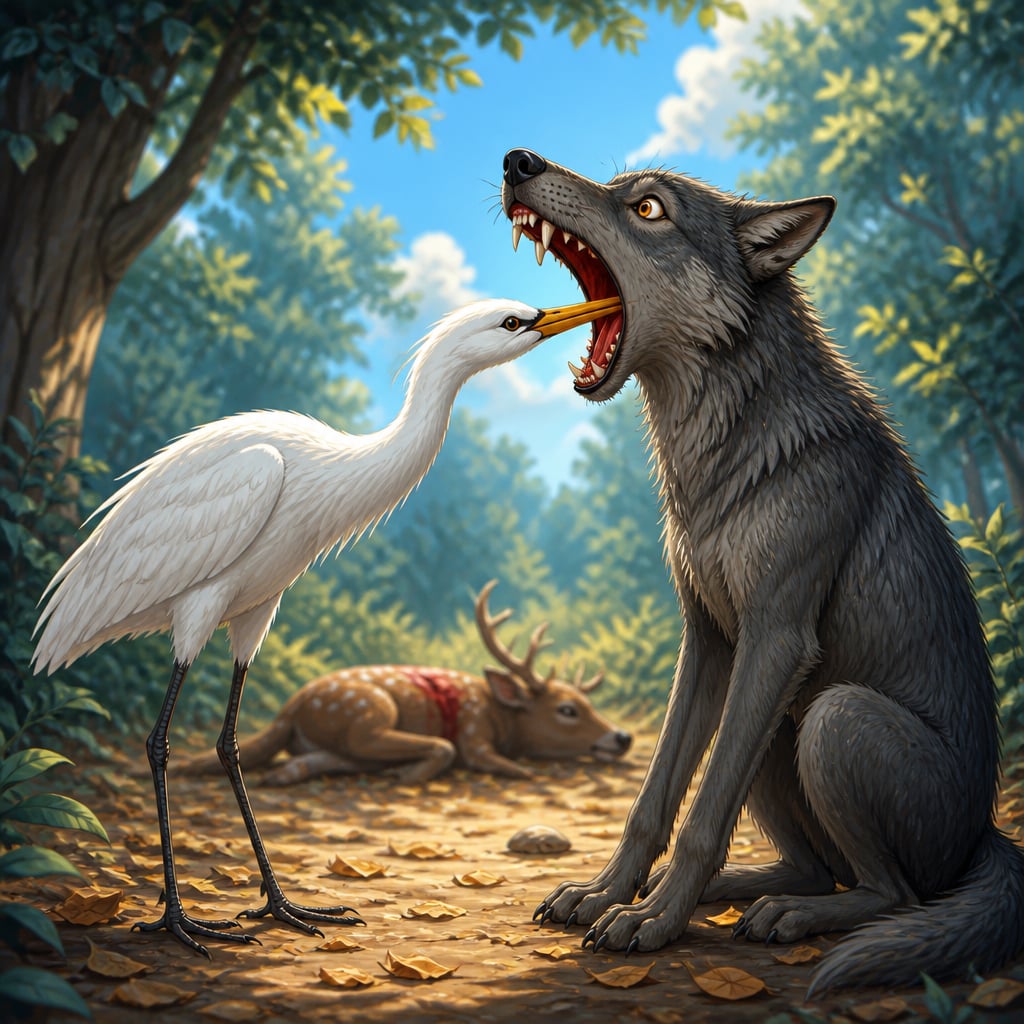
"There," said Sarasa, stepping back. "The bone is removed. You will live. Now, about that reward you promised..."
Dushta stretched his jaws experimentally. Everything worked. The pain was gone. He looked at the crane, really looked at her, and smiled a wolf's smile.
"Reward?" he growled. "Your reward is that I let you live. You stuck your head in a wolf's mouth and withdrew it intact. What greater gift could you receive? Be grateful for your life and leave before I change my mind."
"But you promised, "
"I promised nothing. I was choking. Words spoken in desperation are not binding. Now go, before my appetite returns."
Sarasa fled, shocked and hurt. She had saved his life. She had risked her own. And this was her thanks.
"Remember this," a wise owl told her later. "Gratitude is a quality of the soul, not a response to circumstance. Those who lack gratitude in their nature will never feel it, no matter what you do for them. You cannot create gratitude where none exists."
The Second Tale: The Four in the Well
In a distant kingdom, a brahmin named Gautama was walking through the forest when he heard cries from a dried-up well. Looking down, he saw four creatures trapped at the bottom: a tiger, a snake, a monkey, and a man, a goldsmith named Ratnadatta.
"Help us!" they all cried. "We fell in and cannot climb out!"
Gautama hesitated. A tiger and a snake? Surely they would harm him. But the goldsmith spoke persuasively.
"Noble brahmin, please! I am a craftsman, a family man. Save me and I will repay you with gold and jewels. But if you save the animals, who knows what they might do?"
The tiger spoke next: "Brahmin, I know what men think of tigers. But I swear by my honor, if you save me, I will never forget your kindness. Tigers do not break their word."
The snake added: "The same is true of serpents. We remember those who help us. Rescue us all, and you shall have friends in places you never expected."
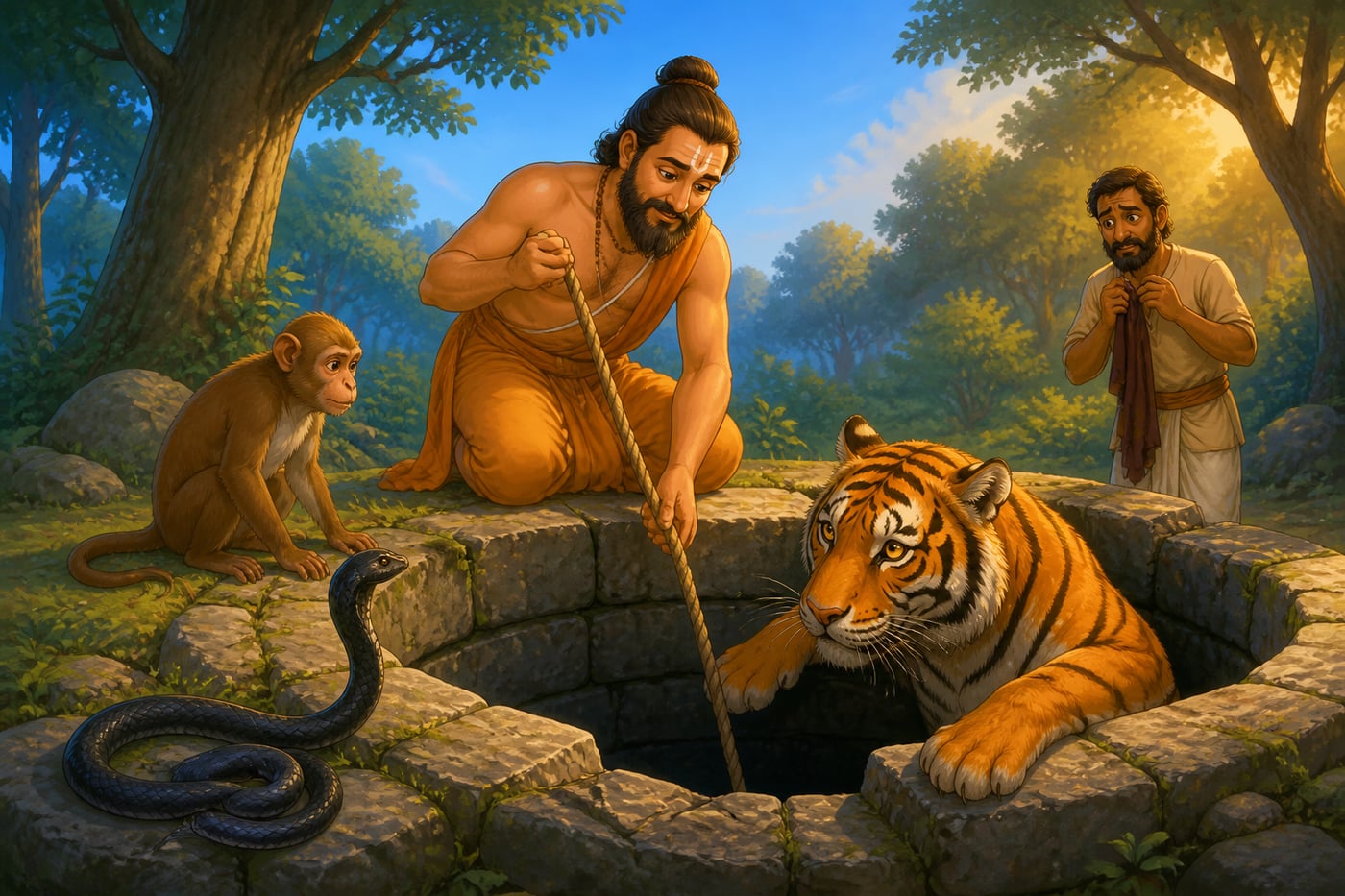
Gautama, being both kind and trusting, lowered a rope and pulled them out one by one. The tiger emerged first, bowed low, and said: "I live near a banyan tree by the river. If you ever need help, come there. I will not forget." Then he bounded away.
The monkey swung up next. "I live in those same trees. Visit anytime, friend brahmin. What is mine is yours." And he scampered off.
The snake slithered out third. "I dwell in an anthill near the city gate. If you face danger, come to me. My venom serves those I love as readily as those I hate." He disappeared into the grass.
Finally, Gautama helped the goldsmith out.
"Ah, my savior!" cried Ratnadatta, embracing him. "You must visit my shop in the city. I will reward you richly. Remember, Ratnadatta the goldsmith, in the jewelers' quarter. I will never forget what you've done!"
Years passed. Gautama fell on hard times. Remembering the promises made at the well, he set out to visit those he had saved.
First, he found the banyan tree. The tiger recognized him immediately. "My friend! You have come at last!" The tiger brought him a golden necklace, treasure from a prince the tiger had killed. "Take this. Sell it. It should help you."
Gautama was amazed but grateful. He visited the monkey, who gave him fruits and showed him where a hidden spring provided fresh water. The snake, when visited, added: "Be careful with that necklace. It belonged to a prince who was murdered. If you sell it, questions will be asked."
"Then what should I do?" asked Gautama.
"Take it to the goldsmith," suggested the snake. "He can melt it down and remake it. That way, no one will recognize the original design."
Gautama agreed. He went to the jewelers' quarter and found Ratnadatta's shop.
"Friend goldsmith!" he called. "Do you remember me? I am Gautama, the brahmin who pulled you from the well."
Ratnadatta's face went pale. He remembered, and he remembered the necklace. It had been widely sought when the prince was killed. Anyone caught with it would be suspected of murder.
"Wait here," said Ratnadatta. "Let me examine the piece."
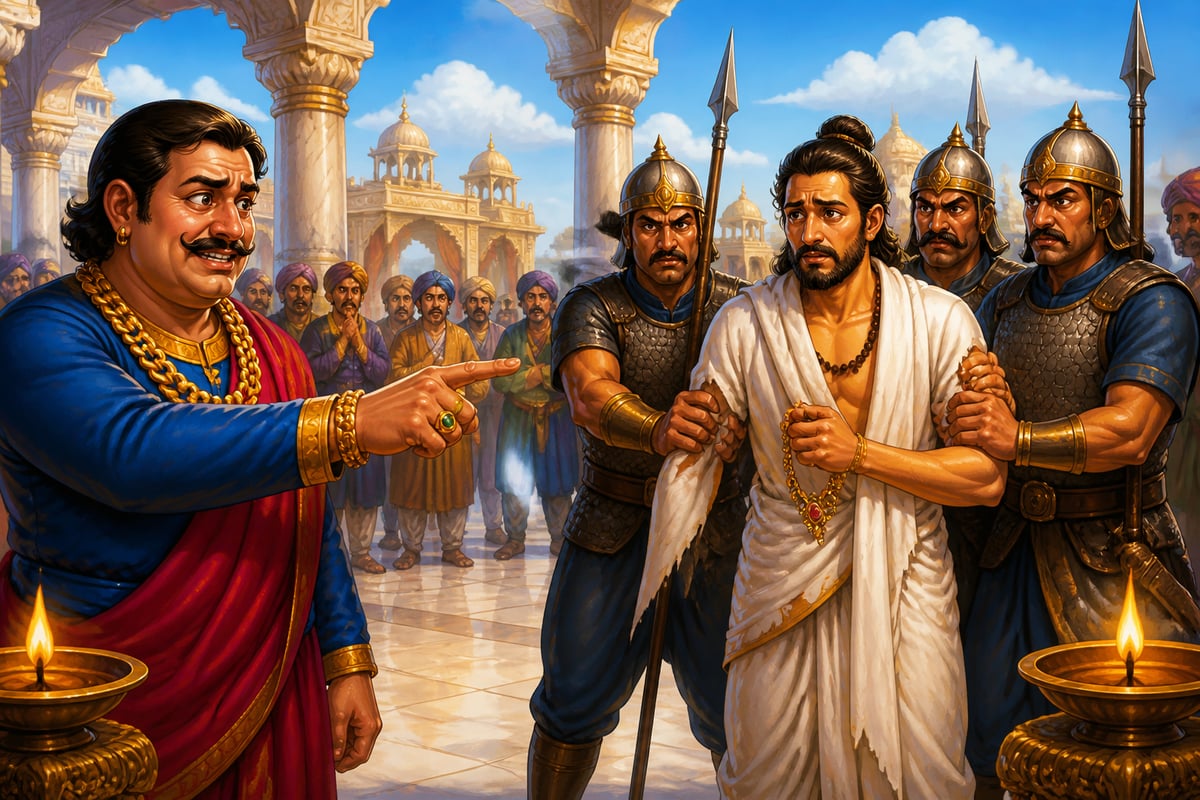
But instead of helping, he went to the palace and reported Gautama to the king's guards.
"There is a murderer in my shop!" he cried. "He has the dead prince's necklace! Arrest him and reward me!"
The guards seized Gautama. He tried to explain, but no one believed a poor brahmin over a respectable goldsmith. He was thrown into prison, sentenced to death.
In desperation, Gautama remembered the snake's offer. He called out through his cell window, describing his location. The snake heard through the network of serpent tunnels that connected the city.
That night, the snake entered the palace and bit the queen, not fatally, but enough to make her very ill. The king's physicians tried everything, but nothing worked.
Then the snake sent word through the city: "Only the brahmin Gautama knows the cure. If you wish the queen to live, free him."
The king, desperate, brought Gautama from the dungeon. The snake had already told Gautama the cure, a simple herbal remedy, and the brahmin applied it. The queen recovered.
"How did you know this cure?" demanded the king.
Gautama told the whole story: the well, the animals, the goldsmith's betrayal, the snake's intervention.
The king investigated and found it true. Ratnadatta was arrested for false accusation. The tiger's testimony, delivered through Gautama, was confirmed by the prince's actual killer, who had been found dead, mauled by a great cat.
Gautama was rewarded richly. But he never forgot the lesson: the wild beasts he had feared proved grateful, while the human he had trusted betrayed him.
The Lesson Applied
Sthirajivin kept these stories close to his heart as he moved through the owl court. He helped owls when it served his cover, but he expected nothing in return. He knew that when the fire came, when his true purpose was revealed, no amount of previous kindness would matter.
"The wolf did not become grateful because the crane saved him," Sthirajivin reminded himself. "The goldsmith did not become loyal because Gautama freed him. Gratitude is a quality some possess and some lack. I cannot create it through kindness."
He also remembered the positive side of the lesson. The tiger, the monkey, and the snake, creatures that a human might naturally distrust, proved more reliable than the human himself.
"Nature is the best predictor," Sthirajivin concluded. "Watch what creatures are, not what they say. The tiger said he would repay kindness, and he did. The goldsmith said the same, but he lied. The difference was not in their words but in their natures."
And so Sthirajivin helped the owls when necessary, smiled at their jokes, and earned their trust. But he never forgot what they were. And he made plans accordingly.
Reflection
- Think of times you helped someone and received no thanks. Now think of times you received help from unexpected sources. What do these experiences teach you about gratitude and character?
- The crane risked her life to save the wolf, trusting his promise. Was she brave or foolish? When does trusting someone's word become reckless? How do we balance generosity with self-protection?
- Ratnadatta, the human, proved worse than the tiger and snake. Does civilization make us more ethical, or does it just teach us to hide our nature better? Is there something about 'civilized' society that enables certain kinds of betrayal?