Vishvasapratyaya: Blind Faith
Believing without evidence
A hunter captures a magical bird that supposedly produces gold in its droppings. A king believes this extraordinary claim without testing it, gives the hunter a fortune for the bird, and releases it to live in the royal gardens. When the bird speaks to reveal the king has been fooled, we learn why extraordinary claims require extraordinary evidence.
The Extraordinary Claim
In the kingdom of Mithila, there lived a hunter named Bharunda who made his living trapping birds in the forest. One day, he caught a magnificent bird with feathers like burnished gold and eyes like black pearls.
As he placed the bird in his cage, it spoke.
"Hunter, do you know what you have caught?"
Bharunda nearly dropped the cage. "A talking bird!"
"I am Sindhuka," the bird said, "and I am worth more than any bird you have ever trapped. My droppings turn to gold the moment they touch the ground. Release me, and you will regret it forever. Sell me to a wealthy man, and you will be rich beyond dreams."
The Hunter's Dilemma
Bharunda stared at the bird. A bird whose droppings became gold? It was impossible. Ridiculous. The stuff of children's tales.
But what if it were true?
"Prove it," he demanded.
"I cannot prove it in a cage," Sindhuka replied smoothly. "The magic only works when I am free, flying in open air, eating the sacred berries of the vana-tulasi tree. In this cage, I am merely a beautiful bird. In freedom, I am a source of infinite wealth."
"Then how do I know you speak truth?"
"You do not," the bird admitted. "But consider: if I am lying, you have lost nothing but a pretty bird. If I am telling truth, you have lost a fortune. Take me to the king. Let him decide if the risk is worth the reward."
Bharunda thought about this. The bird was clever, perhaps too clever. But the hunter was poor, and the possibility of wealth was intoxicating.
He took the bird to the king.
The King's Desire
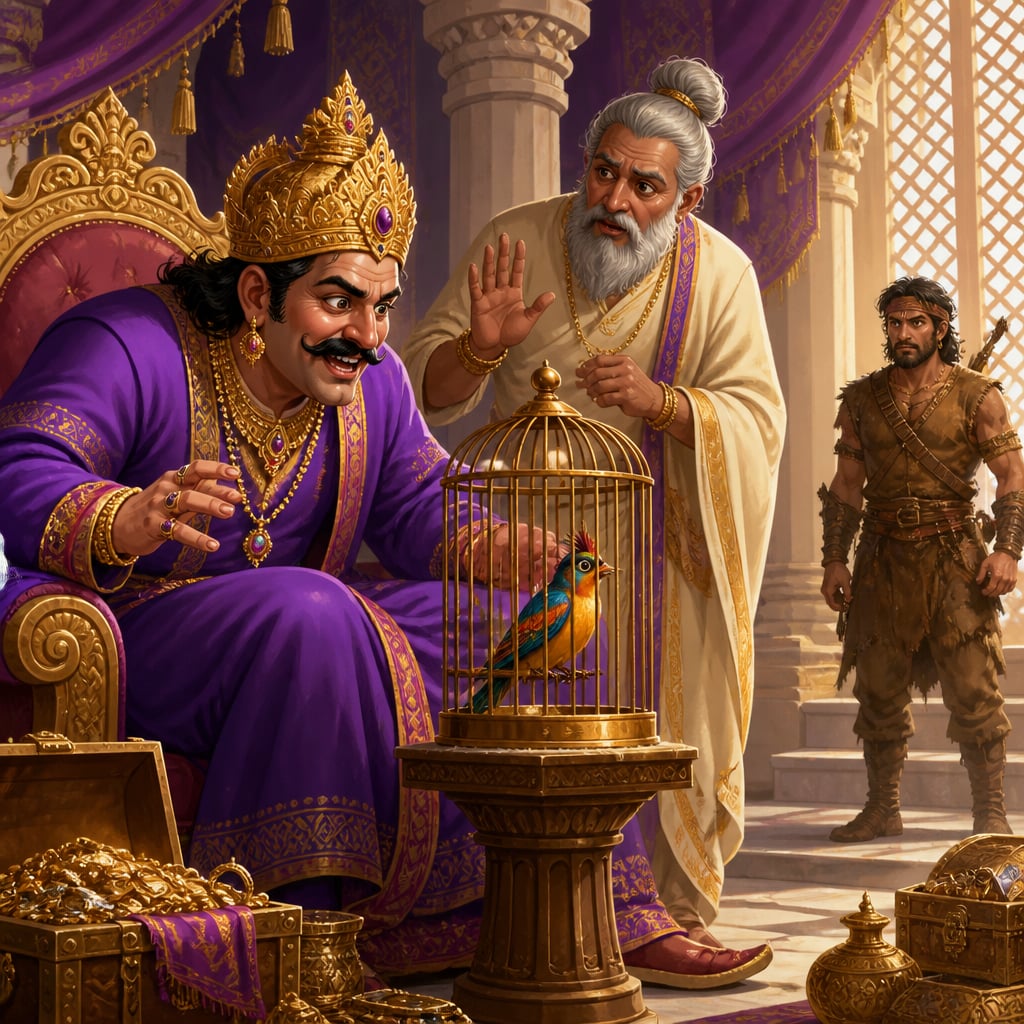
King Nanda of Mithila was known for his ambition. He had expanded his kingdom through war, filled his treasury through taxation, and still he wanted more. When Bharunda presented the golden bird, the king's eyes widened with greed.
"A bird that produces gold?" he breathed. "How do I know this is true?"
"Majesty," Sindhuka said, "I cannot demonstrate while caged. But think: have you ever seen a bird with feathers of such pure gold? Have you ever heard a bird speak? I am clearly no ordinary creature. Why would such an extraordinary bird not have extraordinary powers?"
The king nodded slowly. The logic seemed sound. The bird was clearly magical, it could speak! Why should its other claims be doubted?
His wise minister, Subuddhi, stepped forward.
"Majesty, may I suggest we test the claim before paying the hunter?"
"How would you test it?"
"Keep the bird for a month. Observe its droppings. If they become gold, pay the hunter a fortune. If not, release both bird and hunter with nothing."
But Bharunda protested. "A month? I am a poor man! I cannot wait a month. And the bird says it only works in freedom, caging it for a month may destroy the magic forever!"
King Nanda hesitated. He wanted to believe. The thought of unlimited gold was too attractive to risk.
"Pay the hunter ten thousand gold coins," he ordered. "Release the bird into the royal gardens. We shall see its powers soon enough."
Suuddhi bowed, but his eyes were troubled. The king had paid before testing. That was precisely backward.
Freedom and Truth
The cage was opened. Sindhuka spread his golden wings and flew up to the highest branch of the great banyan tree in the royal gardens.
For a long moment, he simply sat there, preening his feathers.
Then he laughed.
"King Nanda! Foolish, greedy King Nanda! Thank you for your gold, I mean, the gold you gave the hunter for me. As for my golden droppings... watch carefully."
The bird relieved himself. The droppings fell to the ground.
They were ordinary bird droppings. Brown, white, and completely worthless.
The king's face went purple with rage. "You lied! Seize that bird!"
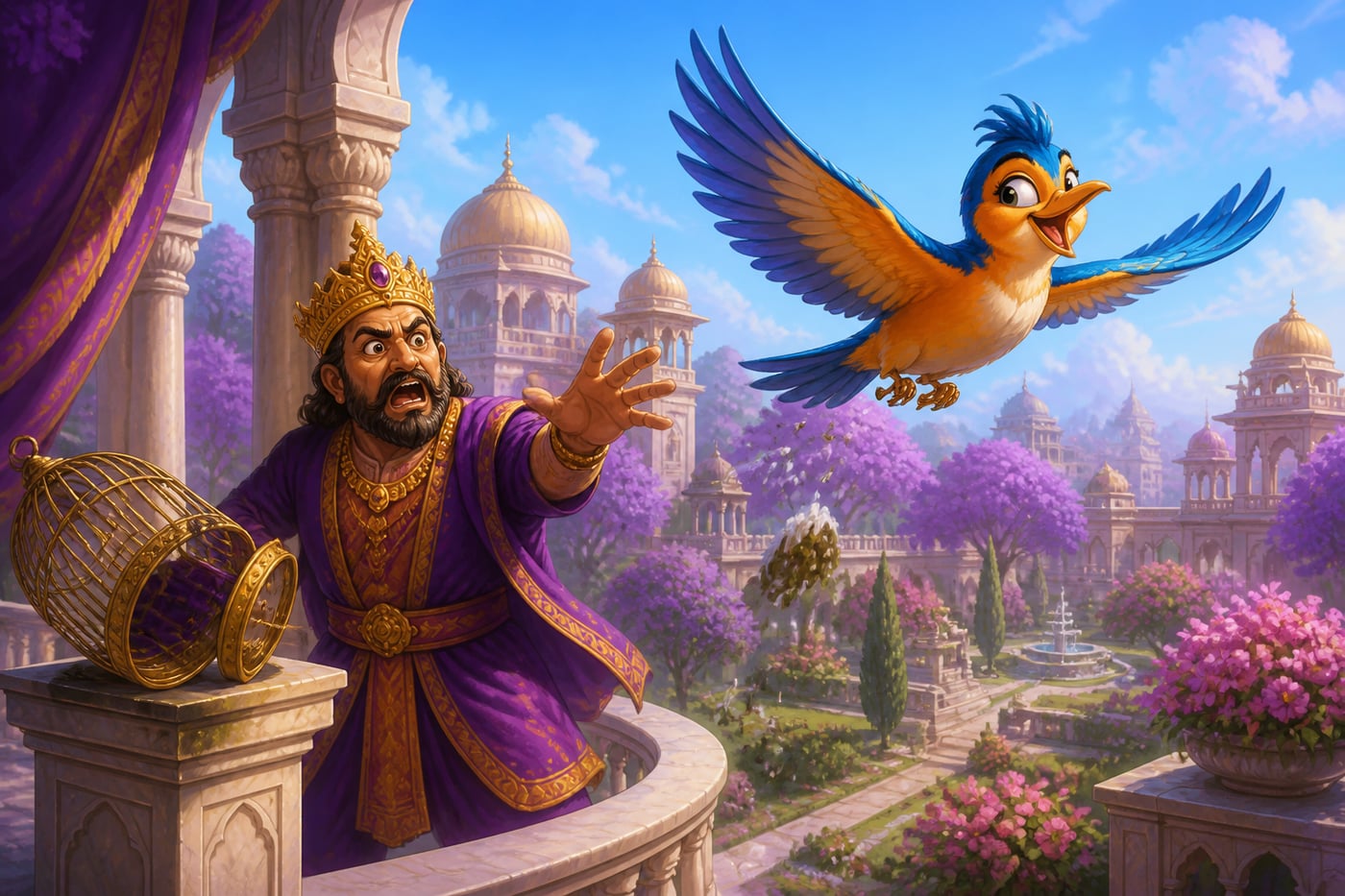
"How will you seize me?" Sindhuka called down. "I am free now, in the open air, where I have always belonged. But before I go, let me teach you something worth more than gold."
The king stood speechless as the bird continued.
The Three Lessons
"First," Sindhuka said, "never believe extraordinary claims without extraordinary proof. I claimed to produce gold from my body, an impossible thing. You should have demanded proof before paying. Any fool can make a claim; only a wise man demands evidence."
"Second, never let greed override judgment. You wanted my gold so badly that you ignored your minister's wise counsel. Desire made you blind. A king who lets desire rule is ruled by those who can manipulate his desires."
"Third, once you have made a mistake, do not compound it with rage. You lost ten thousand coins through foolishness. Do not now lose your dignity through anger. Accept the lesson, learn from it, and be wiser tomorrow."
The bird spread his wings.
"I am not magical, King Nanda. I am simply a bird who learned to speak by living near a sage's hermitage. My golden feathers are natural, some birds have them. My wit is my only real treasure. And now I take my wit and fly away, leaving you with a lesson that costs far less than the ten thousand you paid for it."
Sindhuka flew away and was never seen again.
The King's Reflection
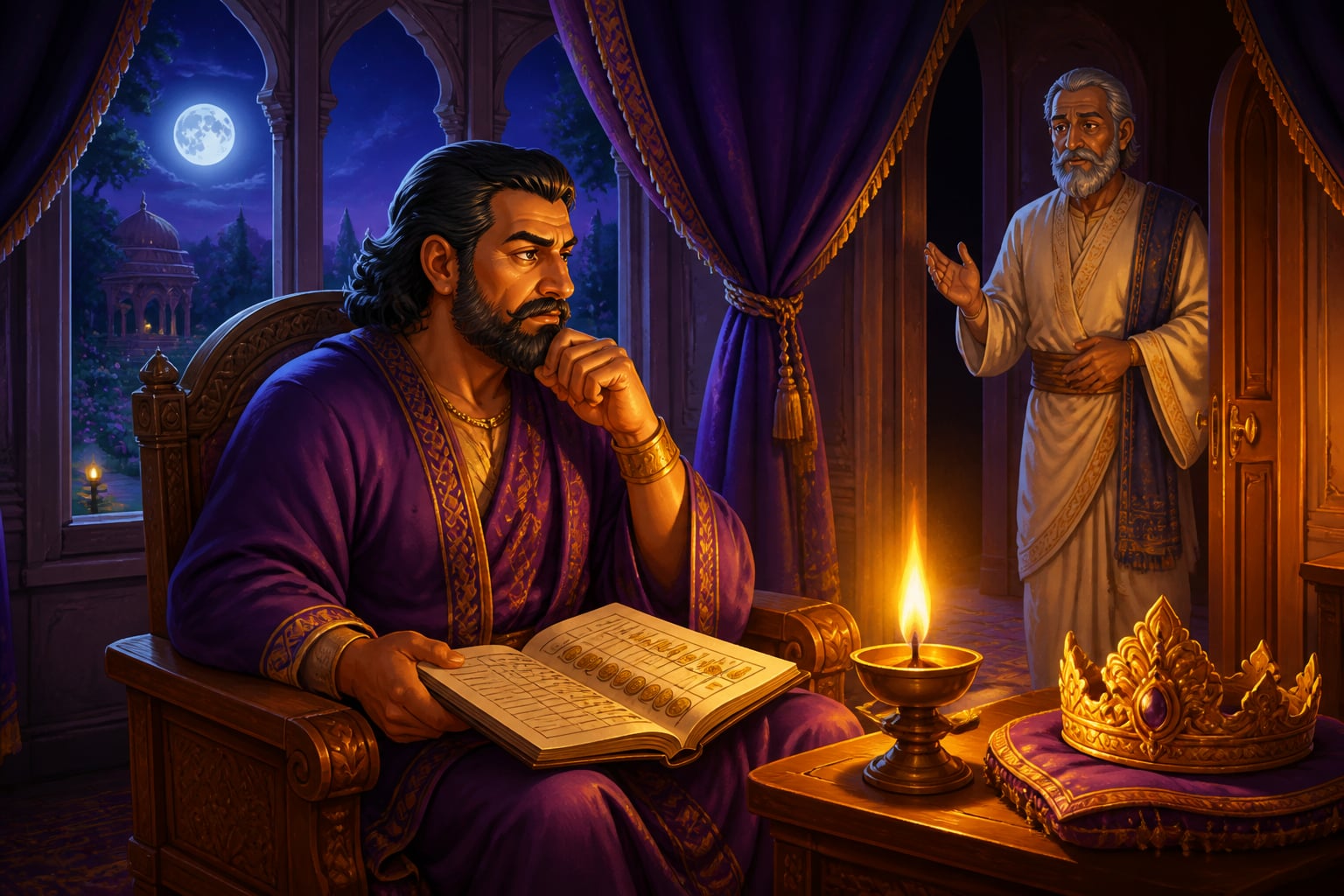
That night, King Nanda sat alone in his chambers. Minister Subuddhi entered quietly.
"Majesty, shall I pursue the hunter? He knowingly sold you a worthless bird."
"No," the king said slowly. "The hunter believed the bird's claims as much as I did. We were both fools. At least he was a poor fool who became rich through foolishness. I was a rich fool who became poorer, and wiser."
"What have you learned, Majesty?"
Nanda was silent for a long moment.
"I have learned that wanting something to be true does not make it true. I wanted a bird that produced gold, so I believed a bird that claimed to produce gold. My desire interpreted the evidence, the golden feathers, the speaking voice, as proof of powers that were never demonstrated.
"Subuddhi, from this day forward, no claim shall be accepted in my court without evidence. No merchant's promise, no diplomat's assurance, no petitioner's plea. We shall test before we trust. We shall verify before we believe.
"That bird cost me ten thousand gold coins. But if this lesson saves me from believing the next liar who promises miracles, it was cheap at the price."
The Moral Deepens
The story of King Nanda and the golden bird spread throughout Mithila. It became a saying: "Test before you trust, or you will pay the price of Nanda."
Merchants verified goods before payment. Courts demanded evidence before judgment. Parents taught children to question wonderful claims.
And Sindhuka, wherever he flew, carried with him the satisfaction of having taught a king what sages had failed to teach: that blind faith, even in the face of seemingly supporting evidence, is still blind.
Extraordinary claims require extraordinary proof.
Desire makes fools of the wise.
And a speaking bird is not necessarily a truthful one.
Reflection
- Have you ever believed something because you wanted it to be true, only to discover you were deceived? What made you susceptible to that deception?
- Was Sindhuka wrong to deceive the king? He lied to save himself, then taught the king a valuable lesson. Does the teaching redeem the deception?
- In an age of misinformation, where extraordinary claims spread instantly online, how do we apply the lesson of the golden bird? What systems help verify claims before they spread?