Mithyapratyaksha: False Evidence
When seeing is not believing
A clever thief plants false evidence to make a carpenter believe his workshop is infested with iron-eating rats. Using this manufactured proof, the thief 'explains' how the carpenter's valuable iron tools were eaten, when in fact they were stolen. This tale teaches that evidence can be fabricated, and we must investigate not just what we see, but whether what we see could have been created to deceive us.
The Carpenter's Trust
In the prosperous city of Mathura, there lived a carpenter named Ujjwala, 'The Brilliant One', famous throughout the region for his fine woodwork. His workshop was filled with tools he had collected over twenty years: chisels of hardened iron, saws with teeth like a tiger's, planes that could shave wood thin as paper.
These tools were Ujjwala's true wealth. A craftsman is only as good as his tools, and Ujjwala's tools were the finest in Mathura.
One day, Ujjwala needed to visit his aged mother in a distant village. The journey would take a full month. He worried about leaving his precious tools unguarded.
"Who can I trust?" he wondered. "Who will watch my workshop while I am gone?"
He thought of his neighbor, Kaitava, a man who always smiled, always offered help, always seemed friendly. Kaitava had no trade of his own and seemed to survive on odd jobs and the kindness of others.
"Kaitava, my friend," Ujjwala said, "I must journey to see my mother. Will you guard my workshop? I will pay you well when I return."
Kaitava's smile widened. "Of course, dear neighbor! Your tools will be safe with me. I will guard them as if they were my own children."
Ujjwala departed, feeling secure.
The Thief's Plan
Kaitava was not what he seemed. Behind his friendly smile lived a calculating mind. He had long envied Ujjwala's tools, worth a small fortune if sold to the right buyer.
"Now they are in my hands," Kaitava thought. "But I cannot simply steal them. Ujjwala will accuse me the moment he returns. I need a story, a story he will believe."
For days, Kaitava pondered. Then, watching a rat scurry across the floor, inspiration struck.
"Iron-eating rats!" he exclaimed. "Everyone has heard the legend. In the old days, rats grew so large and so hungry they ate iron itself. If I can make Ujjwala believe such rats infested his workshop... he will blame nature, not me!"

Kaitava set his plan in motion.
First, he sold Ujjwala's tools, quietly, to merchants in distant markets who would not ask questions. Then he scattered iron filings around the workshop, as if something had been gnawing on metal. He released several large rats he had caught, letting them nest in the corners. He even found the bones of a dead rat and placed iron shavings in its mouth, creating a gruesome display of an 'iron-eater.'
Then he waited.
The Carpenter Returns
A month later, Ujjwala returned from his journey, eager to resume his work. He found Kaitava waiting at the workshop door, his face arranged in an expression of profound sorrow.
"My friend," Kaitava said, shaking his head, "I have terrible news. A tragedy has occurred."
"What? What has happened?"
"Your tools... they have been eaten."
Ujjwala stared. "Eaten? By whom?"
"Not by whom, by what. Iron-eating rats! A plague of them invaded your workshop. I tried to stop them, but they were too many, too fierce. Look, see for yourself!"
Kaitava led Ujjwala into the workshop. The carpenter saw the iron filings, the rat droppings, the nests in the corners. And there, in the center of the floor, lay the arranged bones with iron shavings in their jaws.
"You see?" Kaitava pointed. "This one died choking on your best chisel. The others escaped, but the damage was done. Your tools are gone, Ujjwala. Eaten by vermin. I am so sorry."
The First Doubt
Ujjwala stood motionless, staring at the evidence. His mind struggled to accept what his eyes were showing him.
"Iron-eating rats," he repeated slowly. "I have heard the legend. But I never believed..."
"The old tales are true," Kaitava assured him. "See the proof with your own eyes! The filings, the bones, the droppings. What else could have done this?"
For a moment, Ujjwala almost believed. The evidence was there. He could see it. Touch it. Smell the rats.
But something nagged at him.
"Kaitava," he said slowly, "how did the rats eat the iron but leave the wooden handles untouched?"
Kaitava blinked. He had not thought of this.
"They... they preferred iron to wood," he improvised. "Iron-eating rats eat only iron. It is their nature."
"And the workshop walls are also wood," Ujjwala continued, looking around. "No gnaw marks. No damage. Only the iron is gone."
"As I said, they eat only iron."
"Then why did this one die choking on iron, if iron is their food?"
Kaitava's smile faltered. "It... ate too fast. Choked on a large piece."
Ujjwala knelt beside the arranged bones. He examined them carefully. Then he picked up the iron shavings from the dead rat's mouth.
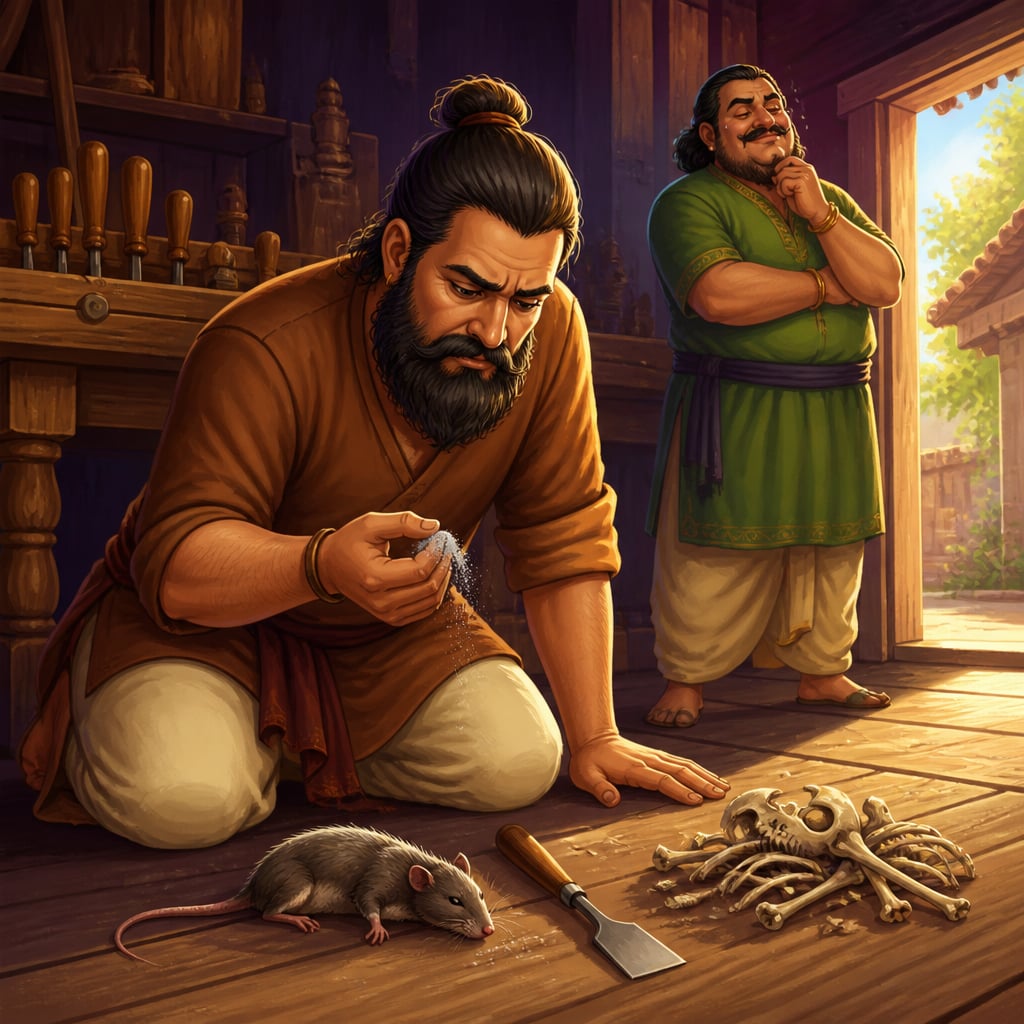
"These shavings are from a file," he said quietly. "I recognize the marks. They were filed, Kaitava. Not chewed. Filed."
The Evidence Unravels
Kaitava began to sweat. "You are mistaken. The rats, "
"There are no iron-eating rats," Ujjwala said, standing. "It is a legend. A story. Rats cannot digest iron. Even a child knows this."
"But the evidence, "
"The evidence was created. By someone who thought I would be too upset to look closely. By someone who counted on me believing what I saw without questioning how I saw it."
Ujjwala's voice hardened.
"Where are my tools, Kaitava?"
"I told you, the rats, "
"WHERE ARE MY TOOLS?"
The false friend's mask finally cracked. Seeing that his deception had failed, Kaitava turned and ran, but not before Ujjwala grabbed him by the collar.
"You will tell me where you sold them," Ujjwala said, "or you will explain your iron-eating rats to the magistrate. I suspect he will be very interested in your natural history."
Justice and Wisdom
Kaitava confessed everything. The tools were recovered from the merchants who had bought them, merchants who were happy to return stolen goods rather than face charges. Kaitava was brought before the village council and punished for theft and betrayal of trust.
But the story did not end there.
As Ujjwala reclaimed his tools, the village elder spoke.
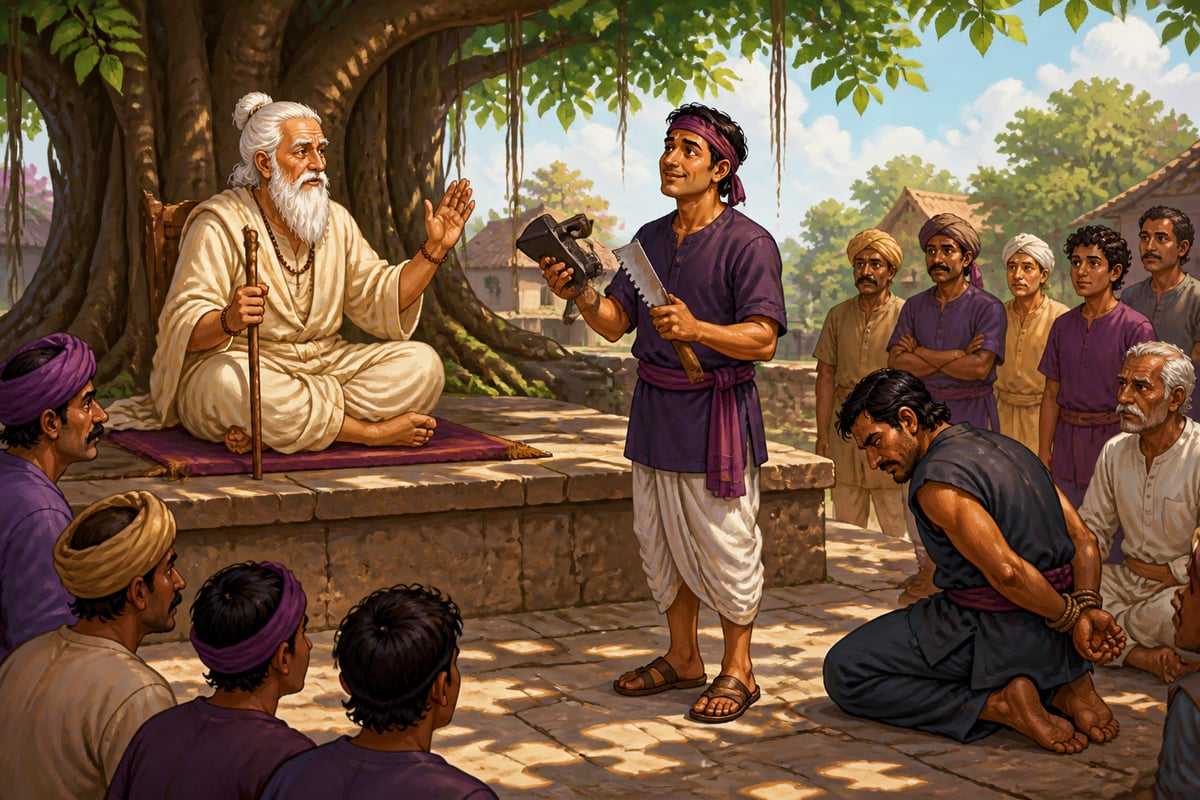
"Carpenter, you were wise to question the evidence. But tell me, what made you doubt?"
Ujjwala considered.
"Three things, Elder. First, the evidence was too convenient. Iron-eating rats that left no mark on wood? That died choking on their own food? It was too neat, too perfect an explanation for my loss.
"Second, the evidence could have been created. Filings can be filed. Bones can be placed. Rats can be released. I asked myself: could someone have made this scene? The answer was yes.
"Third, I knew my accuser. Kaitava had no trade, no income, yet he lived comfortably. How? When a man without means suddenly has access to valuable goods that then disappear... the conclusion is not hard to reach."
The elder nodded.
"You have stated the three tests of evidence. First: Is it too convenient? True evidence is usually messy and incomplete. Fabricated evidence is often too perfect, explaining too much too neatly. Second: Could it have been created? If evidence can be manufactured, consider whether it was. Third: Who benefits? If the evidence supports someone's interests, question whether they made it so.
"Remember, Ujjwala: seeing is not believing. Seeing is only the beginning of investigation. What we see may be real, or it may be theater. Wisdom lies in knowing which."
The Lesson Endures
Ujjwala never forgot the iron-eating rats that never existed. For the rest of his life, whenever he heard a claim supported by 'clear evidence,' he asked three questions:
Is it too convenient?
Could it have been created?
Who benefits?
He taught these questions to his apprentices, who taught them to their apprentices, until the tale of the false rats became famous throughout the land.
And whenever a liar was caught with fabricated evidence, people would say: "He tried to sell iron-eating rats."
The phrase became a proverb for deception exposed, a reminder that what we see with our eyes must still be tested by our minds.
Evidence is not truth.
Evidence can be manufactured.
And the cleverest lie is the one that comes with proof.
Reflection
- Have you ever been convinced by 'evidence' that turned out to be fabricated or misleading? What made you believe it, and what eventually revealed the truth?
- In a world of deepfakes, photoshop, and AI-generated content, how do we know what is real? Has the age of manufactured evidence made truth impossible to find?
- Ujjwala's three tests, Is it too convenient? Could it be created? Who benefits?, are investigative tools. Are there situations where applying such skepticism would be harmful? When should we trust without investigating?