Kalpanamurkhanam: Building Castles in the Air
The danger of living in fantasies
A poor Brahmin receives a pot of flour as alms. Instead of using it wisely, he sits beside it daydreaming about how he will sell it, buy goats, then cattle, then marry, have children, and become wealthy. Lost in his fantasy of scolding his future children, he kicks out, and shatters the pot, losing everything. This beloved tale teaches why we must deal with what we have, not dream about what we might get.
The Dreamer's Pot
In a village near the city of Pataliputra, there lived a Brahmin named Svabhavakripana, 'Naturally Miserly', a name he had earned through years of hoarding every grain he received as alms. He lived alone in a small hut, performing rituals for villagers who paid in rice and flour rather than coins.
One day, a wealthy merchant whose daughter was getting married gave Svabhavakripana a full pot of sattū, roasted barley flour, as payment for performing the wedding prayers.
The Brahmin had never received so much at once. He carried the pot home as if it were filled with gold and placed it carefully in the corner of his hut, hanging it from a nail so rats could not reach it.
That night, he could not sleep. He lay on his mat, staring at the pot in the moonlight, thinking.
The Chain of Dreams
"This sattū is worth at least ten panas," he calculated. "If I sell it in the market during the next festival, when prices rise, I might get twelve or even fifteen panas."
His eyes gleamed in the darkness.
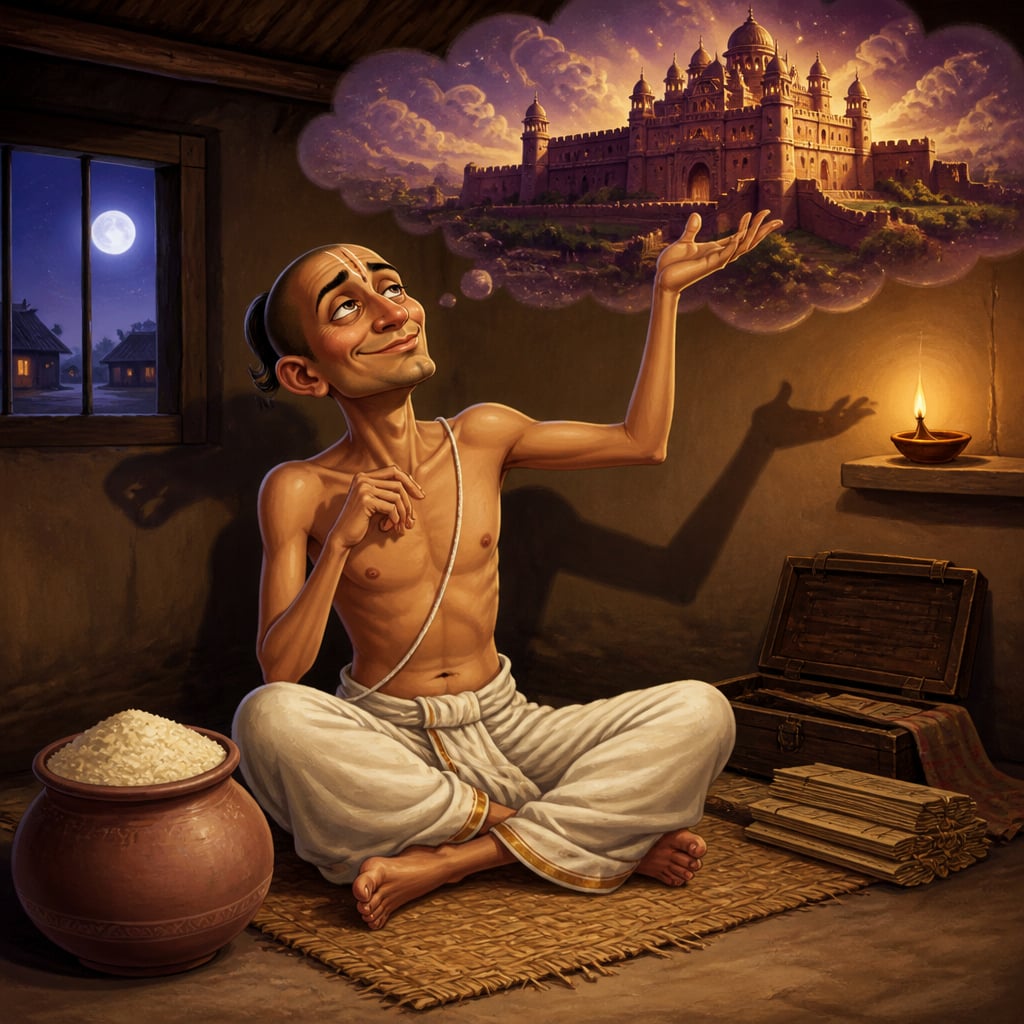
"With fifteen panas, I could buy a she-goat. Goats breed every six months. In three years, I would have a herd of thirty goats!"
He sat up on his mat, no longer tired.
"Thirty goats could be traded for ten cows. Cows give milk every day. I could sell milk, butter, and ghee. In five years, the ten cows would become fifty!"
Now he was pacing, his shadow moving across the walls.
"Fifty cows would make me the richest man in the village. With such wealth, I could buy a proper house, no, a mansion! With carved doorways and a courtyard with a tulasi garden!"
He laughed aloud at the vision.
"And once I have a mansion, every family will want me to marry their daughter. I shall choose the most beautiful girl, the daughter of a royal minister, perhaps! She will bring a magnificent dowry, and we shall live like nobles!"
The Fantasy Deepens
Svabhavakripana sat back down, but his mind raced faster.
"My wife will give me a son. A brilliant boy! I shall name him... Somasharma, 'Protected by the Moon.' He will be handsome and clever, and I will teach him the Vedas myself. He will bring honor to our family!"
The Brahmin's chest swelled with paternal pride for his imaginary son.
"When Somasharma is five years old, he will start running around the house, playing and making mischief. One evening, while I am meditating, he will run into my prayer room and disturb my concentration."
His face darkened at this imagined interruption.
"My wife will be too soft. She will let him do whatever he wants. I will call to her: 'Control that boy! Keep him away from my meditation!' But she will ignore me, spoiling him as mothers do."
Anger rose in the Brahmin's heart, real anger at an imaginary scene.
"When she does not listen, I will have no choice. I will get up and kick the boy away to teach him discipline!"
The Kick That Ended Everything
Lost entirely in his fantasy, Svabhavakripana kicked out with all his strength.
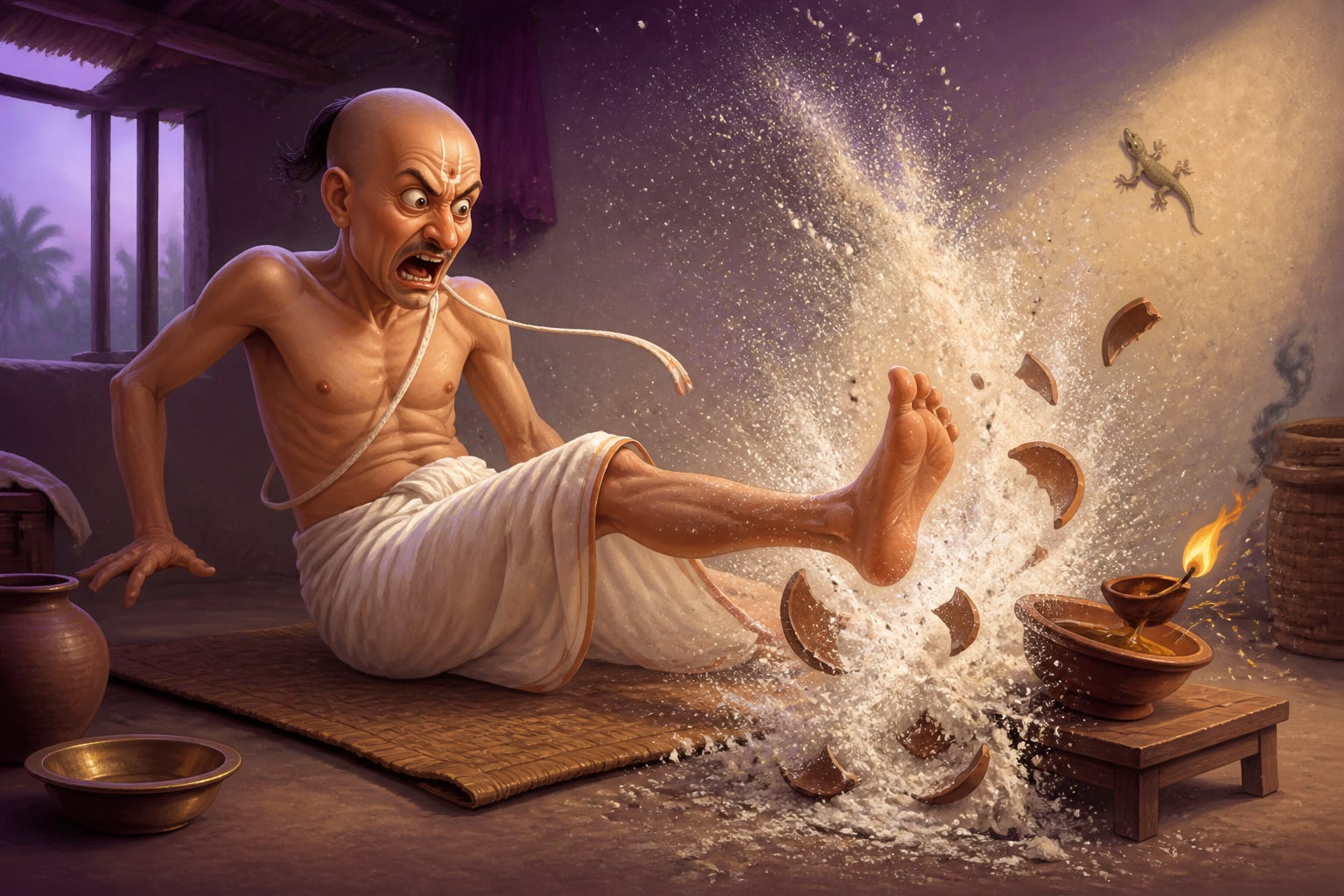
His foot struck the pot of sattū.
The clay shattered. The flour exploded across the hut, covering his face, his mat, the floor, the walls, everything white with the dust of his wasted fortune.
For a long moment, the Brahmin sat motionless, flour settling like snow around him.
Then understanding came.
The goats were gone. The cows were gone. The mansion, the minister's daughter, the brilliant son Somasharma, all gone. They had never existed. They were kalpana, imagination, fantasy, castles built in air.
What had existed, a full pot of sattū, a real fortune for a poor Brahmin, now lay scattered on the ground, ruined beyond saving.
The Neighbors Gather
The crash brought his neighbors running. They found Svabhavakripana sitting in the middle of his flour-covered hut, weeping.
"What happened?" they asked. "Did thieves attack you?"
Through his tears, the Brahmin told them everything: the pot, the calculations, the goats, the cows, the mansion, the wife, the son, the kick.
At first, his neighbors were sympathetic. Then, as the full absurdity of the story became clear, they began to laugh.
"You kicked your imaginary son," one man gasped, "and destroyed your real flour?"
"You were angry at a child who doesn't exist," another added, "and now you have nothing to eat!"
The laughter spread through the village. Within days, everyone knew the story of the Brahmin who lost his fortune to a daydream.
The Wisdom of the Elder
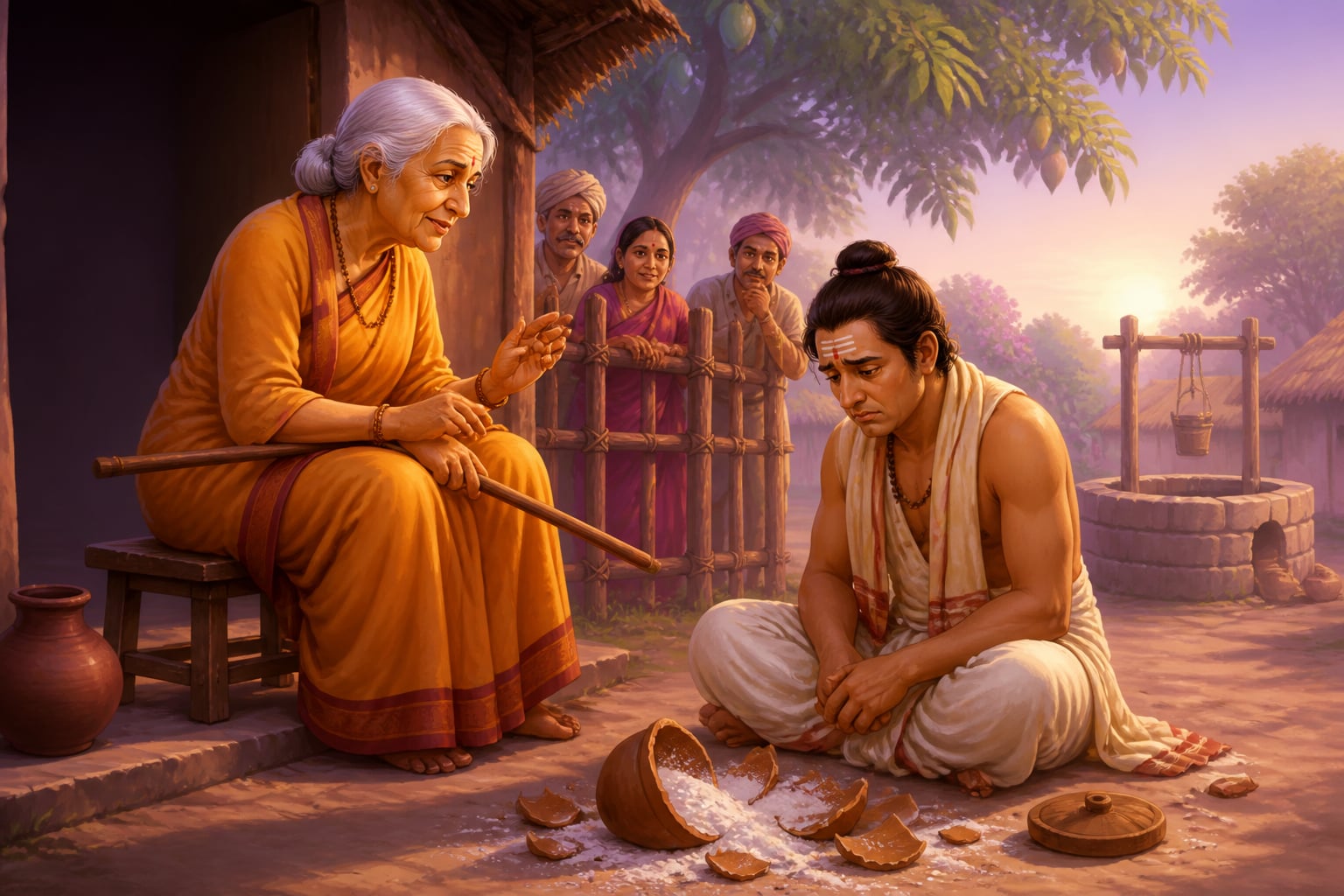
An old woman who had seen many such fools took pity on Svabhavakripana. She brought him some rice and sat beside him as he ate.
"Young man," she said, "let me tell you what you should have learned."
The Brahmin listened, too humiliated to argue.
"A bird in hand is worth two in the bush. You had sattū, real, present, valuable. Instead of using it, you dreamed about what it might become. You spent the reality and received only imagination in return."
"But planning is not wrong," the Brahmin protested weakly. "Should we not think about the future?"
"Planning is wise," the old woman agreed. "But you were not planning. Planning means: 'I will sell this flour tomorrow at the market.' What you did was: 'I will sell this flour and buy goats and trade them for cows and build a mansion and marry a minister's daughter and have a son and kick him.' That is not planning. That is dreaming with your eyes open."
"What is the difference?"
"A plan has steps you can take. A dream has steps that depend on other dreams coming true. You cannot buy goats until you sell the flour. You cannot trade for cows until you have goats. You cannot marry until you are rich. Each step depends on the one before. But you were already kicking your son before you had even sold the flour!"
She shook her head.
"The future is not yours to spend. Only the present is real. Deal with what you have, not what you dream of having. Otherwise, you will kick your dreams and find nothing but scattered flour."
The Lesson Lives On
Svabhavakripana learned. He became a different man, one who valued present reality over future fantasy. He still planned, but he planned step by step, completing each before dreaming of the next.
Years later, through patient work and careful saving, he did acquire goats, and then a few cows, and eventually a small but comfortable house. He married, not a minister's daughter, but a kind woman who made him happy.
When their son was born, he named him Somasharma, to remember the imaginary boy whose non-existent kick had taught him the most important lesson of his life.
"Never build castles in the air," he told his son. "Build on the ground, one stone at a time. The present is the only foundation that will hold."
And when little Somasharma ran through the house and disturbed his father's meditation, Svabhavakripana did not kick him away.
He laughed, remembering a pot of flour, and pulled his real son into his arms.
Reflection
- Have you ever spent so much time dreaming about a goal that you neglected the actual steps needed to achieve it? What 'pot of flour' have you kicked while lost in fantasy?
- Is all imagination harmful, or only imagination mistaken for reality? How do we distinguish between productive visualization and destructive daydreaming?
- In an age of social media where we curate idealized versions of our lives and consume others' highlight reels, how does the lesson of the flour pot apply? Are we all building castles in the air?