Atichaturya: When Over-Cleverness Backfires
Too clever for your own good
A weaver creates an elaborate disguise with multiple arms and heads to appear as a divine warrior, hoping to win glory in battle. His complex deception initially succeeds, but when he tries to maintain the illusion in actual combat, his cleverness leads to catastrophe. This tale teaches that simple honesty often succeeds where complex schemes fail, and that over-cleverness creates fragile structures that collapse under pressure.
The Weaver's Ambition
In the city of Avanti, there lived a weaver named Mantharaka, 'The Slow One', a name given because he worked at his loom with patient, methodical care. His cloth was fine, his patterns beautiful, but his heart was restless.
"What is a weaver's life?" he complained to his wife. "Day after day at the loom, thread by thread, cloth by cloth. No glory. No honor. No one tells tales of weavers."
"Tales are told of warriors," his wife replied. "Perhaps you should have been born a Kshatriya."
"Perhaps," Mantharaka mused, "I can become one."
His wife laughed. "A weaver becoming a warrior? You cannot even lift a proper sword!"
But Mantharaka's mind had begun to spin, not thread, but schemes.
The Divine Disguise
Mantharaka was not strong, but he was clever, too clever, as it would turn out. He began to craft a plan.
"Warriors are admired for their strength," he reasoned. "But what is more admired than strength? The divine. If I cannot be a great warrior, I shall appear to be a god playing at war!"
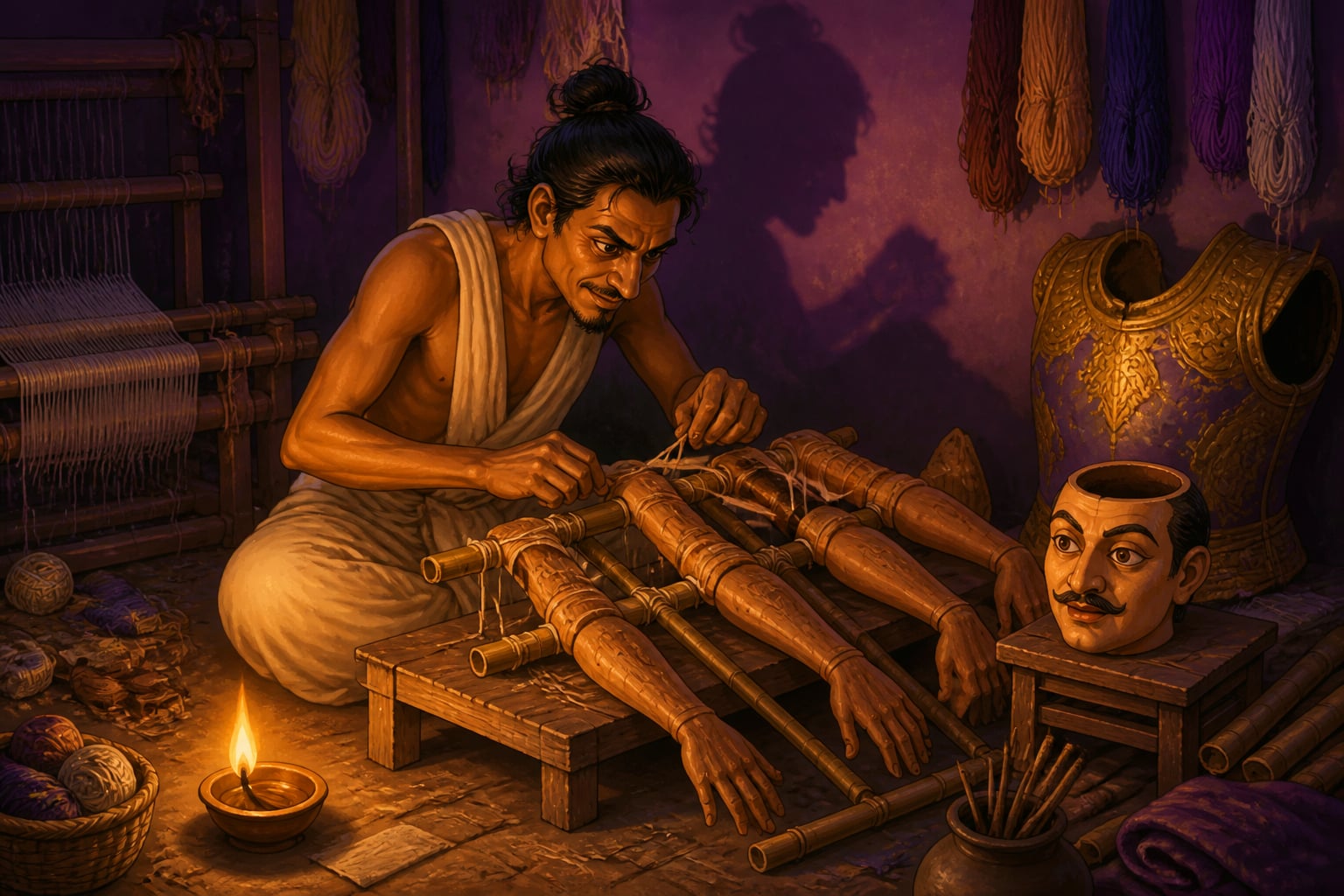
Over many months, working in secret, Mantharaka created an elaborate costume. Using his weaving skills, he constructed a framework of bamboo and cloth that fitted over his body. The framework held:
- Four additional arms, each holding a weapon (painted wood, but fearsome-looking)
- An extra head (a carved mask with painted features)
- Golden cloth draped to suggest divine radiance
- Hidden strings to make the extra arms move
When he wore the contraption, Mantharaka appeared to be a being with six arms and two heads, like Lord Kartikeya or a divine Yaksha warrior.
He practiced in secret, learning to move the false arms with subtle pulls of string, to turn the false head with shifts of his shoulders. The effect was remarkable.
"Now," he declared to himself, "I shall have my glory."
The War Begins
Fortune, or misfortune, provided an opportunity. A neighboring king, Vikramakesari, declared war on Avanti. The king of Avanti, Simhavikrama, called all able-bodied men to defend the city.
Mantharaka saw his chance.
On the eve of battle, he donned his divine disguise and rode to the king's camp on a borrowed horse decorated to match his costume. The guards stared in wonder. The soldiers fell back in awe.
"A divine being has come to aid us!" someone cried.
Word spread through the camp like fire. King Simhavikrama himself came to see.
Mantharaka, now appearing as a six-armed, two-headed celestial warrior, raised all his arms in blessing.
"I am Mahabahu," he announced in a booming voice he had practiced for months, "Sent from the heavens to ensure Avanti's victory. Under my protection, no enemy shall triumph!"
The soldiers cheered. King Simhavikrama bowed with respect.
"Divine one, your presence honors us. What do you require?"
"Only that I lead the charge tomorrow. The enemy shall flee before my aspect, and you shall have victory without great loss of life."
The king agreed. Mantharaka was given a place of honor in the royal tent, fed the finest food, and treated as a living god.
That night, he could barely sleep from excitement. His scheme was working perfectly.
The Battle Begins
At dawn, the armies assembled. Mantharaka, as Mahabahu, rode at the front of the Avanti forces. His costume gleamed in the morning sun. His false arms held their painted weapons high. His extra head scanned the horizon with carved, unblinking eyes.
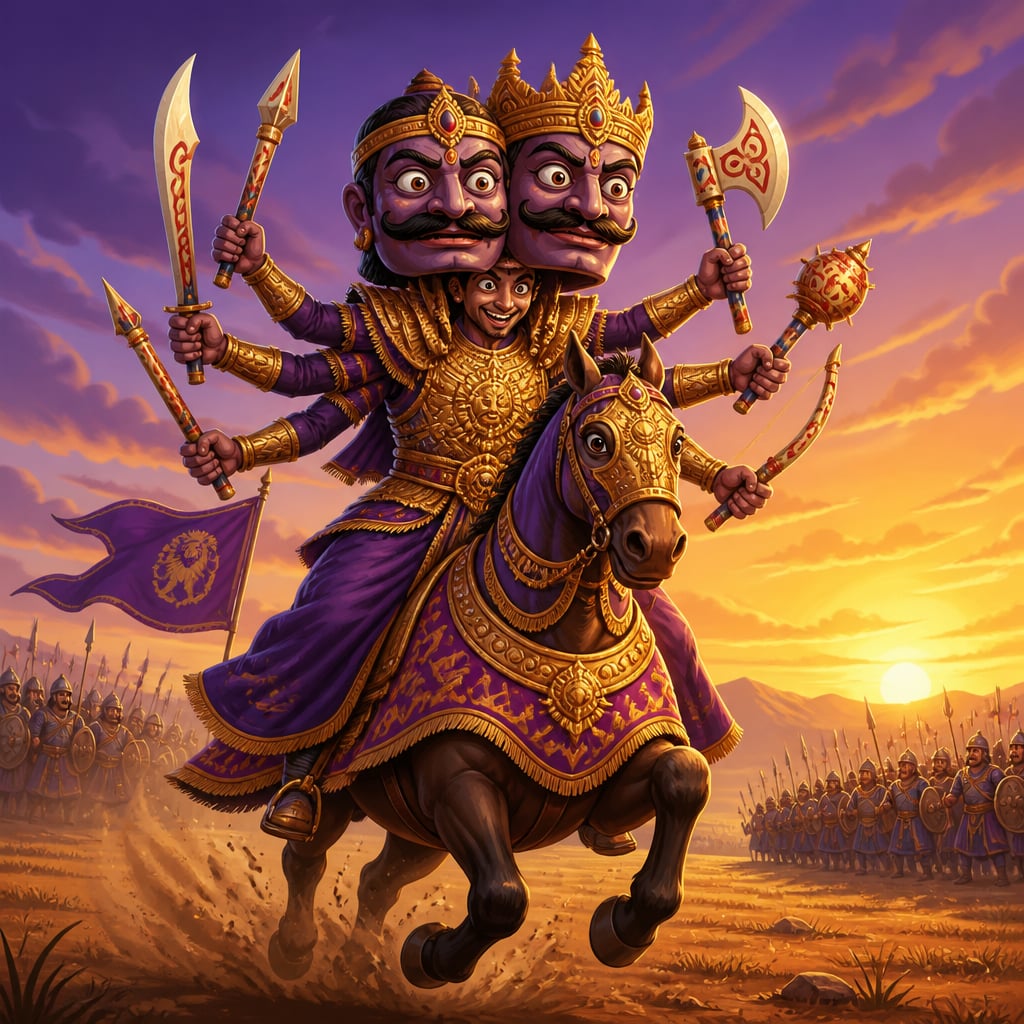
The enemy forces across the field saw him and hesitated. Rumors had reached them of a divine being fighting for Avanti. The sight of the six-armed figure confirmed their fears.
King Vikramakesari's soldiers began to murmur.
"How can we fight a god?"
"He has six arms! He will kill six of us with every stroke!"
"We should retreat!"
Mantharaka's heart swelled with triumph. The plan was working even better than he had imagined. The enemy was terrified!
"CHARGE!" he commanded, raising all six arms in a theatrical gesture.
But in his excitement, he pulled too hard on one of the control strings.
The Scheme Unravels
The string snapped.
One of the false arms, the one holding a gilded trident, swung wildly and then hung limp at an impossible angle.
For a moment, no one noticed. Then a sharp-eyed enemy archer pointed.
"Look! His arm is broken, but there is no blood!"
Other soldiers looked. They saw the arm dangling like a puppet's limb.
"It is not real! He is not a god, he is a fake!"
The fear in the enemy ranks transformed into rage. They had almost fled from a costume. Their humiliation demanded revenge.
"KILL THE IMPOSTOR!"
A hundred arrows flew toward Mantharaka.
The weaver, who had never held a real weapon in his life, tried to flee. But his elaborate costume, with its bamboo frame, its extra arms, its heavy golden cloth, was not designed for speed. The framework caught on his horse's saddle. The extra head twisted backward. The false arms flailed.
He fell from his horse in a tangle of cloth, bamboo, and broken dreams.
The enemy soldiers surrounded him. In his terror, Mantharaka screamed:
"I am just a weaver! Please! I am just a weaver!"
But his words came too late. The soldiers, furious at having been tricked, did not spare him.
The King's Lament
When King Simhavikrama learned what had happened, the battle had turned against him. His soldiers, demoralized by the exposure of their 'divine protector,' fought poorly. Though Avanti eventually negotiated an acceptable peace, the cost in lives was far higher than it might have been.
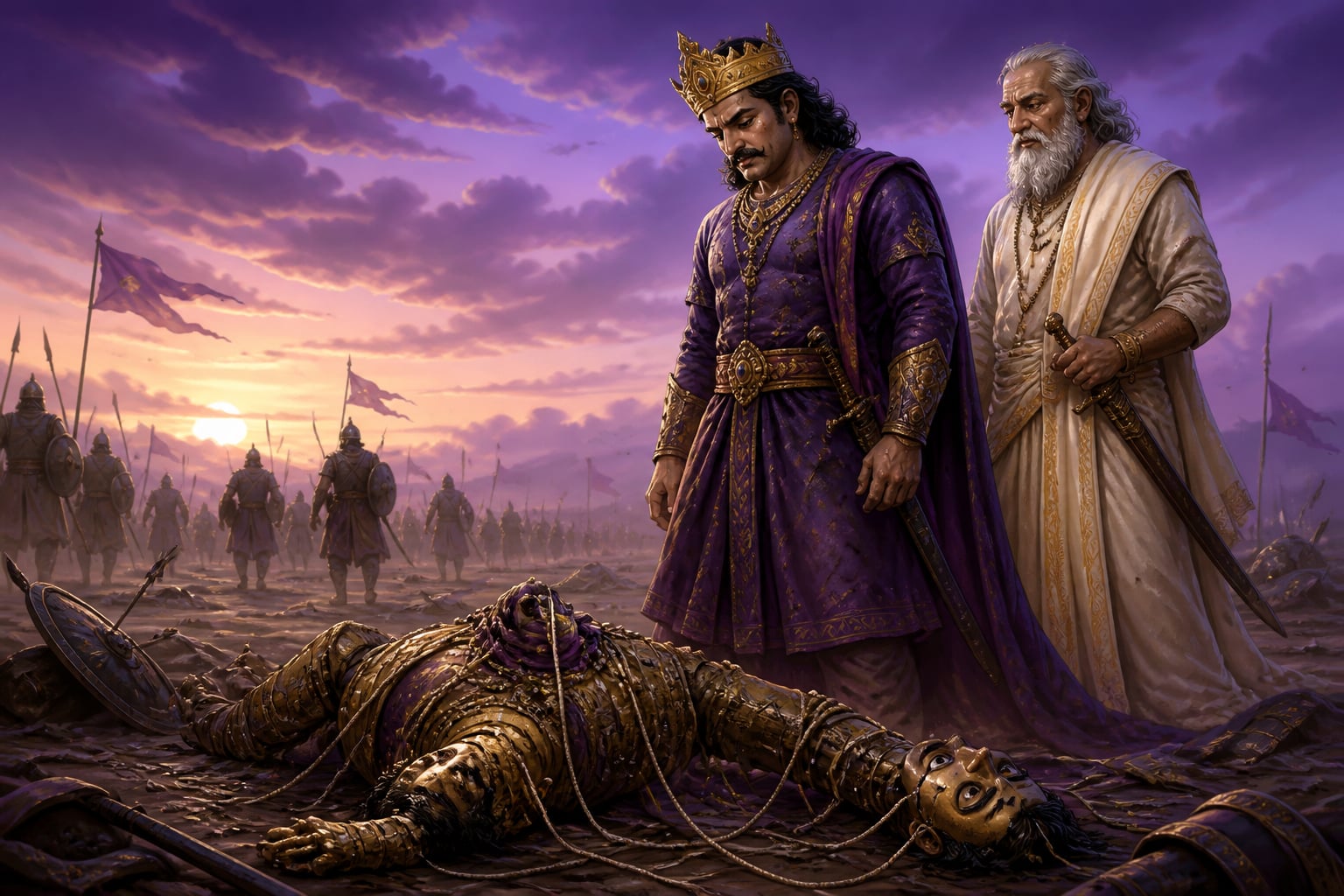
The king stood over Mantharaka's body, still tangled in its elaborate disguise.
"Why?" he asked no one in particular. "Why did he do this?"
An old minister who had served three kings answered.
"Atichaturya, Majesty. Over-cleverness. He was too clever for his own good."
"But his plan nearly worked! If not for the broken string..."
"That is precisely the problem with over-clever schemes, Majesty. They are fragile. They depend on everything going right. A simple plan can survive mistakes; a complex plan cannot. The weaver created a structure of deception that required perfection to maintain. One broken string, and the whole edifice collapsed."
The king nodded slowly.
"He would have been more use to us as a weaver than as a false god."
"Indeed, Majesty. If he had come to battle as himself, a weaver with courage enough to fight, he might have survived with honor. Instead, he came as something he was not, and died as nothing at all."
The Lesson Speaks
Mantharaka's story spread as a warning. Parents told it to children who spun elaborate lies. Teachers told it to students who overcomplicated their answers. Merchants told it to partners who proposed needlessly complex schemes.
The lessons were clear:
First: Simple truth is stronger than complex lies. Mantharaka's costume required dozens of mechanisms to work. A single failure exposed him. If he had simply fought as a brave weaver, he would have needed no mechanisms at all.
Second: Over-cleverness creates fragility. The more elaborate a scheme, the more ways it can fail. Every additional element, every extra arm, every hidden string, was another point of potential collapse. Complexity is not the same as strength.
Third: Pretending to be more than you are invites greater scrutiny. Had Mantharaka been an ordinary soldier, no one would have examined him closely. By claiming to be divine, he drew every eye. The higher the claim, the harder the fall when exposed.
Fourth: Begin with what you can sustain. Mantharaka could maintain his illusion in a tent, speaking to amazed soldiers. He could not maintain it in battle, under arrows, in chaos. A scheme that works only under perfect conditions is not a scheme, it is a wish.
And so the story ends with a proverb that echoes through the centuries:
"Better a simple truth you can defend than a clever lie you cannot sustain."
The weaver sought glory through deception and found death.
He was too clever for his own good.
And his cleverness killed him.
Reflection
- Have you ever created an overly complex solution to a problem when a simpler approach would have worked? What drove you toward complexity, and what was the result?
- Mantharaka wanted glory he had not earned. Is it always wrong to 'fake it till you make it'? When does pretending to be more than you are help growth, and when does it lead to destruction?
- The minister said Mantharaka would have been 'more use as a weaver than a false god.' In a society that rewards impression over substance, how do we value genuine but unglamorous contributions over impressive but hollow ones?