Parikshavihina: Acting Without Investigation
Verify before acting
A Brahmin woman leaves her infant son in the care of their loyal pet mongoose. When she returns to find the mongoose's mouth covered in blood, she strikes without investigating. Only then does she discover the snake, and the terrible price of acting on assumption.
The Tale That Names the Tantra
This is the story that gives Aparikshitakarakam its name. 'Aparikshita' means 'unexamined' or 'without investigation.' 'Karakam' means 'action' or 'doing.' Together: 'Doing without examining', the fifth and final tantra of the Panchatantra, teaching the most dangerous form of foolishness: acting on assumption.
The Brahmin's Family
In a village near the sacred river Godavari, there lived a Brahmin named Devasharma and his wife Mandakini. They had waited many years for a child, and when a son was finally born to them, their joy knew no bounds.
They named the boy Saubhagya, 'Good Fortune', for he was their greatest blessing.
At the same time, a mongoose gave birth in a hollow near their home. When the mother mongoose died, Mandakini took pity on the orphaned pup and brought it into their household.
"It will grow up with our son," she said. "They will be like brothers."
Devasharma was uncertain. "A mongoose is a wild creature. Can we trust it with an infant?"
"Watch them," Mandakini replied.
And indeed, as the weeks passed, the mongoose, whom they named Ratna, showed extraordinary devotion to the baby. He slept at the cradle's foot. He watched over Saubhagya during every nap. When the baby cried, Ratna would nuzzle him gently until he calmed.
Devasharma's doubts faded. "The mongoose loves our son as his own brother," he acknowledged. "I was wrong to worry."
The Fatal Day
One afternoon, when Saubhagya was four months old, Mandakini needed to fetch water from the well at the edge of the village.
"The baby is sleeping," she told her husband. "I will return quickly."
Devasharma looked up from his prayers. "Go. Ratna is here. He will watch the child."
Mandakini hesitated. Leaving her infant with only a mongoose as guardian felt wrong. But Ratna had proven his loyalty a hundred times. She placed her water pot on her hip and left.
The moment she was gone, something stirred in the shadows.
The Black Snake
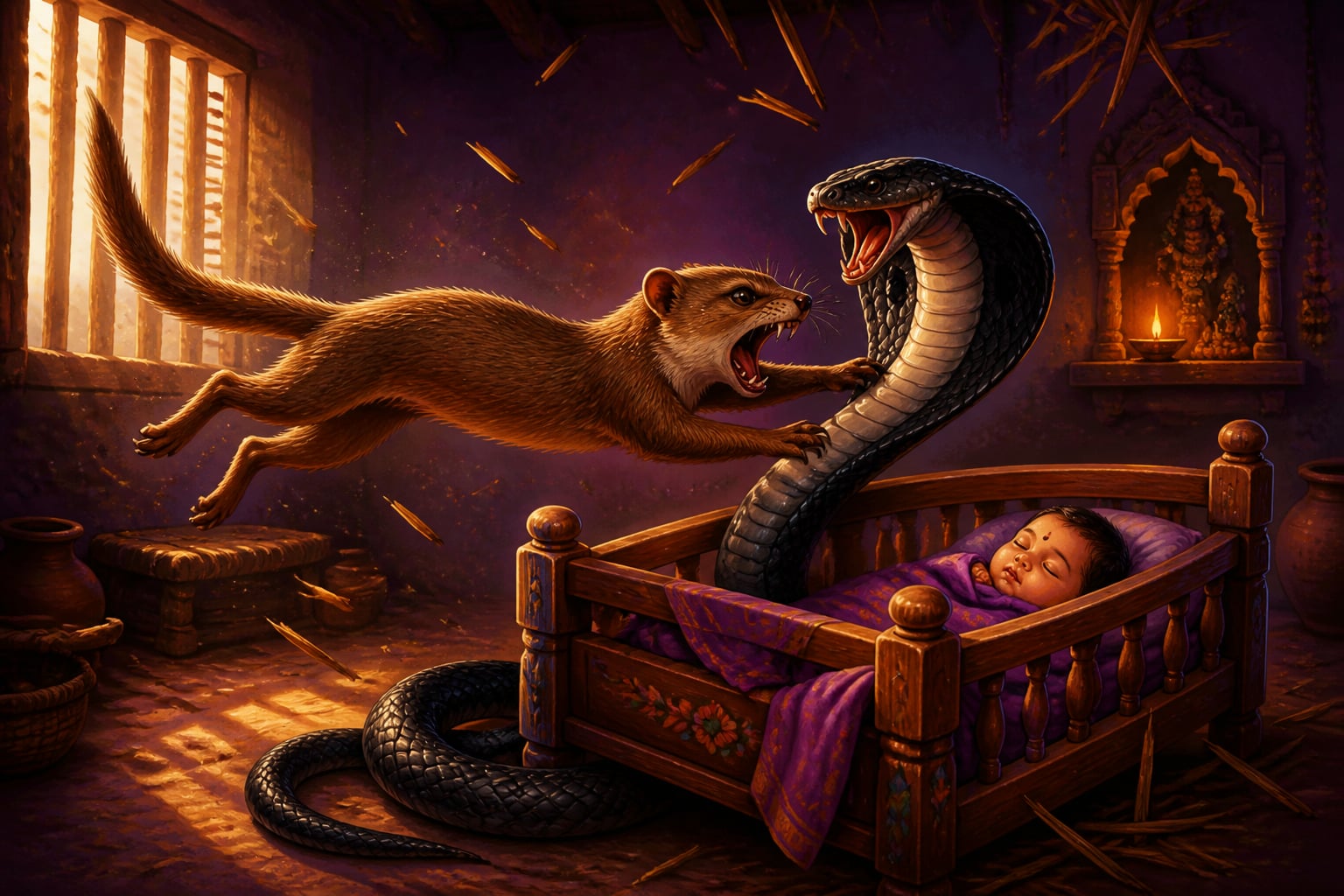
A cobra, thick as a man's wrist, black as moonless night, had been hunting mice in the thatch above. The scent of the sleeping infant drew it down. Slowly, silently, it descended toward the cradle.
Ratna saw it.
Mongooses are natural enemies of snakes. It is in their blood, their bones, their deepest instincts. But Ratna did not attack from instinct alone. He attacked because the snake was approaching his brother.
The battle was brief and brutal. The cobra struck; Ratna dodged. The cobra coiled; Ratna leaped. Teeth met scales, claws met flesh. In minutes, the snake lay dead, its head nearly severed by Ratna's fierce jaws.
The baby slept through it all.
Ratna, bleeding from a bite on his leg but victorious, heard footsteps approaching. Mandakini was returning! He ran to the door to greet her, to show her what he had done, to receive her praise for protecting his brother.
His muzzle was still wet with the cobra's blood.
The Mother Returns
Mandakini reached the door and saw Ratna rushing toward her. She saw the blood on his face, his paws, his chest.
She did not see the dead snake behind him.
She did not hear the baby breathing peacefully in his cradle.
She saw only blood.
In that instant, a terrible certainty seized her heart. The mongoose had killed her baby. The wild creature she had trusted, the animal her husband had warned her about, it had shown its true nature.
"MONSTER!" she screamed.
She swung the heavy clay water pot with all her strength.
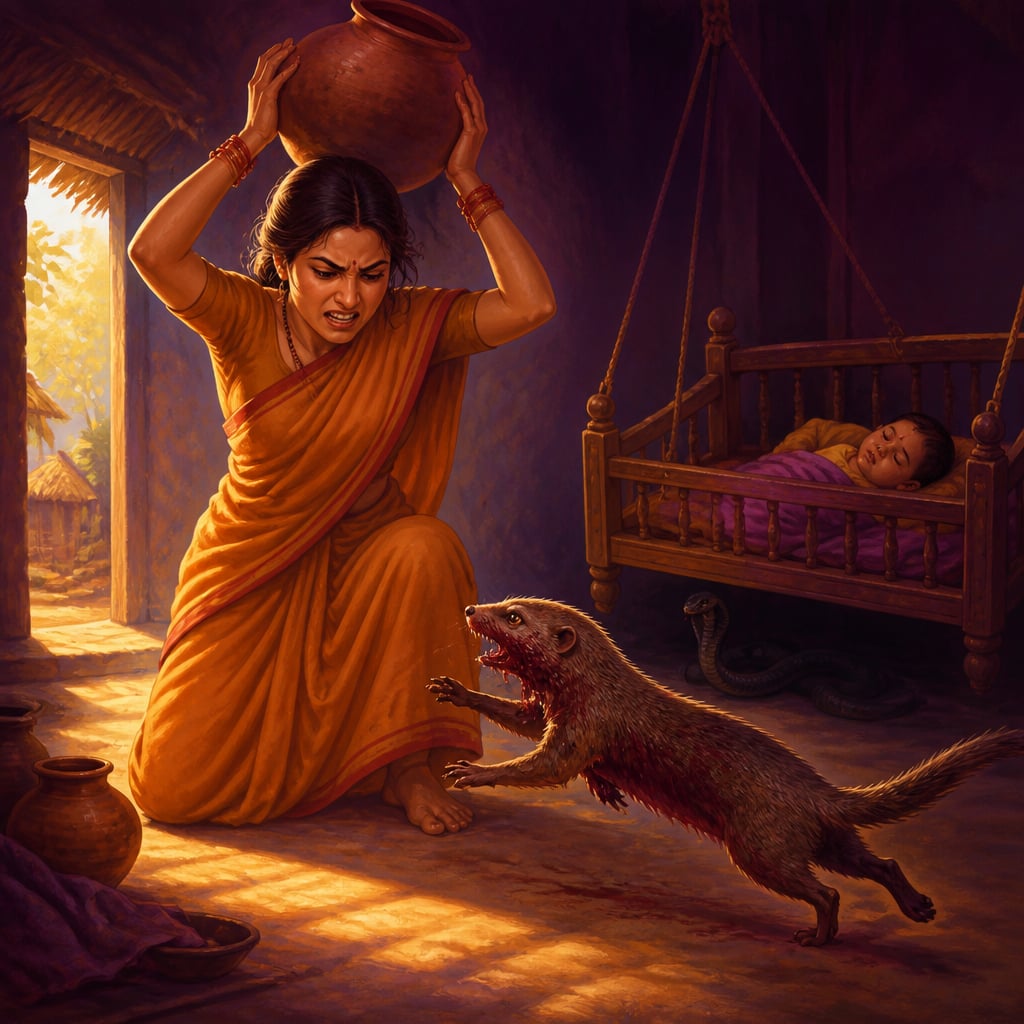
Ratna, running toward her with joy, had no chance to dodge. The pot struck his skull. He fell. He did not rise.
The Discovery
Mandakini dropped the broken pot and rushed past the mongoose's body to the cradle, tears already streaming, prayers already on her lips.
Saubhagya was sleeping. Perfectly. Peacefully. Not a scratch on him.
For a moment, she could not understand. Then she saw the blood drops leading away from the cradle. She followed them with her eyes.
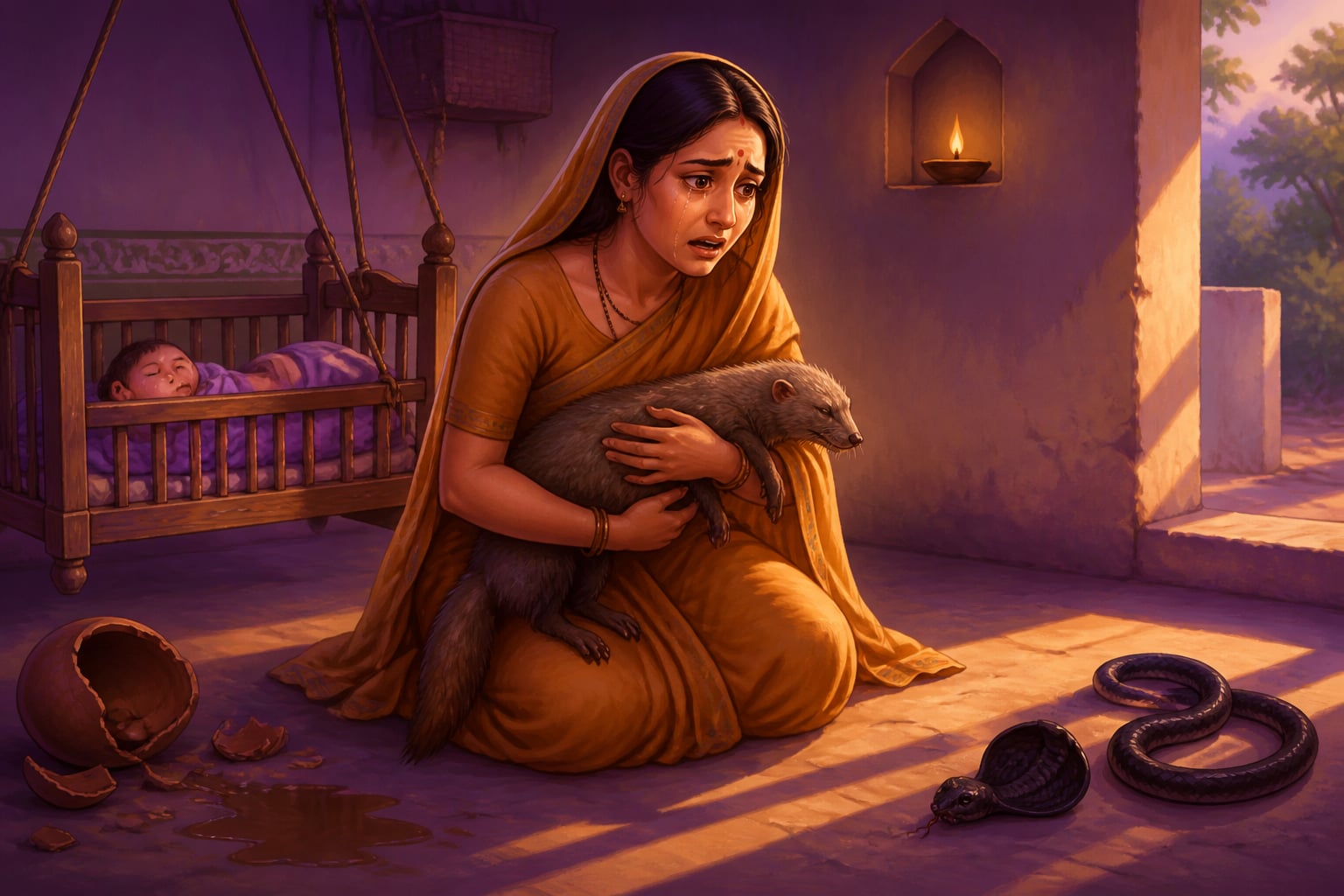
The cobra's body lay beside the wall. Dead. Killed by something with sharp teeth and fierce determination.
Killed by Ratna.
Mandakini turned slowly. The mongoose lay where she had struck him, his loyal eyes still half-open, his blood mingling with the cobra's blood on the floor.
He had died believing she was coming to thank him.
The Price of Assumption
When Devasharma returned from his prayers, he found his wife holding the mongoose's body, weeping as if her heart would break.
"What happened?"
Through her tears, Mandakini told him everything: the cobra, the blood, the assumption, the blow.
"I did not look," she sobbed. "I did not check on our son. I did not see the snake. I saw blood and assumed. I acted without examining. And I killed the one who saved our child."
Devasharma was silent for a long time. When he spoke, his voice was gentle but heavy with grief.
"This is why the wise say: aparikshita na kartavyam, never act without investigation. You saw one thing and assumed another. Your assumption killed a hero."
"He was more than a hero," Mandakini whispered. "He was my son's brother. And I killed him for doing what brothers do."
The Lesson Endures
They buried Ratna beneath the neem tree where he had loved to play. For years afterward, whenever Saubhagya asked about the small grave in the garden, his parents told him the story.
"A mongoose saved your life," they said. "And your mother killed him because she acted without thinking. Never make the same mistake. Before you act, especially in anger, always investigate. Always check. Always give the innocent a chance to be proven innocent."
Saubhagya grew up remembering. When he had children of his own, he told them the story. They told their children. And so the tale passed down through generations, until it found its way into the Panchatantra, a warning that has echoed for two thousand years.
Do not act without investigation.
Assumptions kill.
The blood on the mongoose's mouth was not guilt, it was proof of loyalty.
But Mandakini did not stop to ask whose blood it was.
Reflection
- Have you ever acted on assumption and later discovered you were wrong? What was the cost of not verifying before acting? How might you have investigated differently?
- Mandakini acted from love for her child. Her motivation was pure, but her action was destructive. How do we reconcile good intentions with harmful outcomes? Does intention excuse consequences?
- In our age of instant communication, we often react immediately to news, images, or claims. How does the mongoose story apply to our tendency to share, comment, or judge before verifying?