Pratishodha: Bhima's Terrible Vows
When rage becomes prophecy, the vows that shaped a war
The miracle of the endless cloth has preserved Draupadi's dignity, but Bhima's restraint has reached its limit. The second Pandava, whose strength equals ten thousand elephants, erupts with vows so terrible that the very earth trembles. He swears to drink the blood of Dushasana who touched Draupadi's hair, to break the thigh that Duryodhana offered obscenely, and to slaughter all hundred Kaurava brothers. Arjuna adds his own oath, that Karna, who called for Draupadi's stripping, will die by his arrows. These are not mere threats. In the Mahabharata, words spoken in sacred presence become destiny. The war has now been declared, not by armies, but by vows.
Pratishodha: Bhima's Terrible Vows
The Breaking Point
Throughout the humiliation of Draupadi, Bhima had remained still. His elder brother Yudhishthira had not given permission to act. The laws of the assembly bound his hands. The rules of the game made them all slaves.
But Bhima was not made for stillness.
When Duryodhana exposed his thigh and invited Draupadi to sit upon it, something in Bhima snapped. The chains of restraint that had held him, obedience to his brother, respect for the assembly, acceptance of the game's rules, shattered like dry twigs.
Bhima rose.
The hall fell silent. Even the Kauravas, drunk on their victory, felt a chill. They knew what Bhima was. They had seen him tear apart rakshasas with his bare hands. They knew his strength had no equal among mortals.
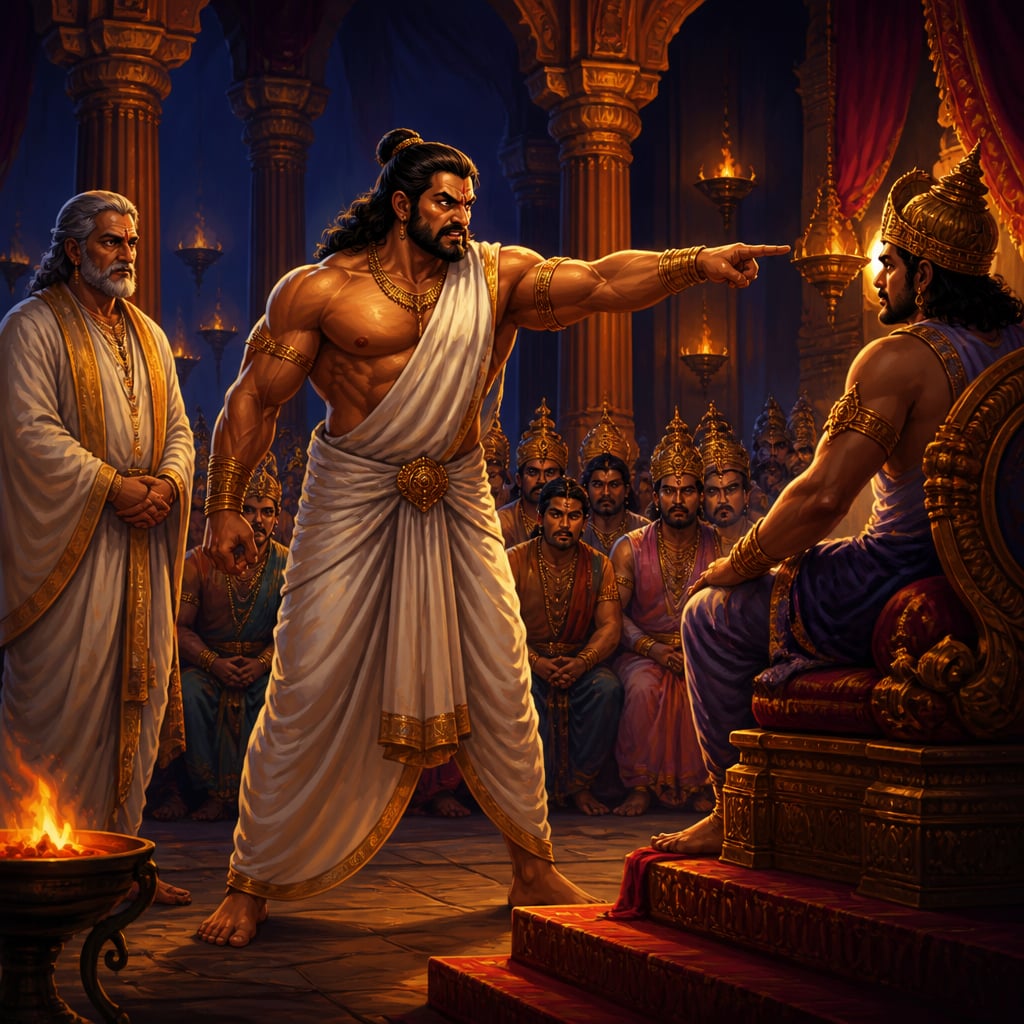
The First Vow: Dushasana's Blood
Bhima's voice filled the hall like thunder rolling across mountains:
*"Dushasana! You who dared touch the sacred hair of Panchali, hear my words and tremble!
In the great battle that will come, and it WILL come, I will find you on that field. I will tear open your chest with my bare hands. And I will drink the blood that flows from your heart!
Let the gods above witness! Let the ancestors below witness! Let every being in this hall witness!
If I fail to drink Dushasana's blood, may I never reach the worlds of my fathers!"*
The vow was spoken. In the dharmic tradition, a vow made in sacred assembly, calling gods and ancestors as witness, becomes unbreakable destiny.
The Second Vow: Duryodhana's Thigh
Bhima turned to Duryodhana, who had shrunk back despite himself:
*"And you, Suyodhana, you who showed your thigh to our wife, mark it well!
That very thigh, with which you insulted Draupadi, I will shatter with my mace. You will die not standing like a warrior but crawling like the worm you are!
If I fail to break Duryodhana's thigh, may I be reborn as a chandala for seven lives!"*
The specification was deliberate. Breaking the thigh in combat was forbidden by the rules of mace-fighting, a foul blow, an act of adharma. Bhima was declaring that he would violate dharmic rules to fulfill this vow. The insult demanded an equally rule-breaking response.
The Third Vow: The Hundred Brothers
Bhima's rage was not yet spent:
*"And all of you, all hundred sons of Dhritarashtra, who sat and watched, who laughed, who permitted this crime, not one of you will survive the coming war!
I will kill you all with my own hands! Your mother will weep over a hundred corpses! The line of Dhritarashtra will end in blood and ash!
If even one of you survives my mace, may I never see heaven!"*
One hundred brothers. One vow. In the war that followed, Bhima would fulfill this vow exactly, killing all hundred Kauravas, though not all by his own hand.
Arjuna's Vow: Karna's Death

Arjuna, who had been silent, now rose beside his brother:
*"And I add my own vow. Karna, you who called for Draupadi to be stripped, you who called her a public woman, hear me!
In battle, when you stand before me, I will send arrows through your throat until your voice is silenced forever. The tongue that spoke those words will speak no more.
If I fail to kill Karna in battle, may my Gandiva bow become ash in my hands!"*
Arjuna's vow bound his divine bow itself to the promise. In the dharmic worldview, weapons too had consciousness, and binding them to a vow created powerful spiritual force.
The Nature of Vows
In the Mahabharata's world, vows (pratijna) are not mere promises. They are reality-shaping declarations that bind cosmic forces:
| Element | Function |
|---|---|
| Words | Create the pattern of future reality |
| Witnesses | Gods, ancestors, assembly members who hold the vow-maker accountable |
| Self-curse | The penalty for failure, which motivates fulfillment |
| Sacred context | The assembly setting amplifies the vow's power |
| Emotional force | Rage, grief, or determination charges the vow |
When Bhima spoke his vows, he was not predicting the future, he was creating it. The words went out into the cosmos and began organizing reality around their fulfillment.
The Psychology of Righteous Rage
Bhima's vows reveal something important about anger in the dharmic framework:
Not All Anger Is Wrong: Bhima's rage was not petty irritation or ego-driven fury. It was righteous anger (dharmakrodha), the appropriate response to gross injustice. The Mahabharata does not condemn this anger; it shows it as necessary.
Anger as Fuel: Bhima's rage would sustain him through thirteen years of exile. Every time despair threatened, the memory of Draupadi's humiliation and the vows he had made would rekindle his purpose.
Anger Channeled: Notice that Bhima did not act in the moment. His vows channeled immediate rage into future action. This transformation of explosive emotion into sustained purpose is presented as mature handling of anger.
Sahadeva's Prophecy
The youngest Pandava, Sahadeva, known for his gift of prophecy, spoke in a strange, distant voice:
*"I see what will be. Crows will feast in the plains of Kurukshetra. The rivers will run red. Women will wander searching for husbands who will never return.
What has begun in this hall cannot be stopped. The wheel turns. Thirteen years from now, these vows will be written in blood across the battlefield.
All that I see has already happened, we simply have not lived through it yet."*
The prophecy confirmed what the vows had created: an inevitable future of war and destruction.
The Kauravas' Response
The Kauravas responded to the vows with varying degrees of awareness:
Duryodhana: Laughed nervously, trying to maintain bravado. But something in him knew that Bhima's words carried the weight of destiny.
Dushasana: Paled visibly. The specificity of Bhima's vow, the tearing of the chest, the drinking of blood, haunted him. He would never forget it.
Karna: Met Arjuna's eyes defiantly. "Let your arrows come. I await them." But his voice held less certainty than his words.
Shakuni: Smiled. War would serve his purposes. Let them make vows, war would destroy the Kuru house completely, which was all he wanted.
Dhritarashtra: The blind king heard the vows and trembled. For the first time, he understood what his indulgence had unleashed.
Draupadi's Silent Vow

Amid the spoken vows of her husbands, Draupadi made her own vow, silently, within her heart:
*"Until Bhima washes my hair with Dushasana's blood, these locks will remain unbound. Through forest and palace, through disguise and revelation, I will wear my shame as a banner until it is avenged.
And I will not forgive. Not one of them. Not Duryodhana. Not Dushasana. Not Karna. Not the silent elders. Not my own husbands who failed to protect me.
Let them earn my forgiveness through blood. Nothing less will wash away this day."*
Draupadi's vow was not spoken aloud, but her unbound hair proclaimed it for thirteen years. It was the visual reminder that kept the Pandavas' purpose sharp.
The Elders' Horror
Bhishma sat with his head in his hands. The vows he had heard were death sentences for the house he had spent his life protecting. His silence in Draupadi's hour had led to this moment.
Drona saw his students, both Pandavas and Kauravas, now sworn to kill each other. Everything he had taught them about the art of war would be turned to mutual destruction.
Vidura wept openly:
"I told you, brother. I told you what gambling among princes brings. Now hear the price. Your hundred sons will die. The line you hoped to establish will be erased from the earth. All because you could not say 'no' to your firstborn."
Dhritarashtra finally spoke:
"What have we done? What have I done? Is there no way to undo this?"
But there was no undoing. The vows had been spoken. The cosmic machinery of cause and effect was now in motion.
The Moral Complexity
The epic does not present Bhima's vows as simply heroic or simply troubling. They are both:
Heroic Because:
- They respond to genuine injustice
- They promise protection for the abused
- They hold perpetrators accountable
- They demonstrate courage before overwhelming odds
Troubling Because:
- They commit to rule-breaking (the thigh blow)
- They promise extreme violence (drinking blood)
- They doom an entire generation to death
- They foreclose all possibility of reconciliation
The Mahabharata's genius lies in holding both truths simultaneously. The vows are both right and terrible. The war they promise is both just and catastrophic.
Fulfillment
Every vow made in that hall was fulfilled:
| Vow | Fulfillment |
|---|---|
| Bhima drinks Dushasana's blood | Day 16 of war, Bhima tears open Dushasana's chest |
| Bhima breaks Duryodhana's thigh | Day 18, the final mace duel |
| All hundred Kauravas die | Throughout the 18-day war |
| Arjuna kills Karna | Day 17, Karna's chariot wheel stuck |
| Draupadi washes hair in blood | After Dushasana's death |
The specificity of fulfillment, after thirteen years of exile and eighteen days of war, demonstrates the power the epic attributes to sacred vows.
The Point of No Return
This moment marks the point of no return in the Mahabharata. Before this, reconciliation was theoretically possible. After the vows, it was not.
*"The words had been spoken. The futures had been sealed. The only question remaining was not WHETHER the war would come, but when.
And every person who heard those vows knew that when it came, it would be the end of the world they knew."*
The Sabha Parva, which began with dreams of glory and the construction of a wonder-palace, now ended with vows of blood and destruction. The trajectory from Maya Sabha to Kurukshetra was set.
Thirteen years would pass. But the vows would not fade. And when the time came, they would be fulfilled to the letter, at a cost beyond anyone's imagining.
Living traditions
Bhima's vows have become cultural touchstones for discussing commitment, revenge, and the costs of conflict. In Indian political discourse, 'Bhima's vow' is shorthand for an unbreakable commitment, sometimes admiringly, sometimes as warning of inflexibility. The scene has been adapted into countless films, plays, and television productions, always carrying the dramatic weight of irreversible commitment.
- Sankalpa (Sacred Resolution): The practice of making 'sankalpa' (sacred resolution) before beginning any important work traces to the power of vows in epic tradition. When Hindus begin puja or other rituals, they formally state their intention as a binding declaration.
- Martial Arts Vow Traditions: In some martial arts traditions of India, practitioners make vows before significant training phases or combat, invoking the spirit of Bhima's pratijna.
- Hastinapur Sabha Site: The traditional site of the ancient Hastinapura sabha hall where the dice game and Bhima's vows took place. While the archaeological record doesn't confirm the specific location, pilgrims visit the general area.
- Kurukshetra War Memorial Sites: Kurukshetra, where the vows were fulfilled, is now a major pilgrimage center. The Kurukshetra Development Board maintains sites associated with various war incidents, including locations traditionally associated with Dushasana's death and Duryodhana's fall.
- Bhimashankar Temple: While primarily a Jyotirlinga Shiva temple, this site incorporates Bhima legends. Local traditions connect the name to Bhima, and his vows are remembered as examples of devotion to dharma through fierce protection.
Reflection
- Bhima's restraint broke only when Duryodhana made the obscene gesture to Draupadi. What finally breaks your restraint? What are the triggers that push you from patience to action?
- The vows foreclosed all possibility of reconciliation. Was this loss worth the satisfaction of revenge? When does the commitment to justice become the obstacle to peace?
- Bhima's vows committed him to extreme violence, including rule-breaking (the forbidden thigh blow). Was this justified by the circumstances? Are there injustices that justify abandoning normal ethical constraints?