Kshama: The Forgiving King

When fear masquerades as mercy, Dhritarashtra's boons to Draupadi

The terrible vows have been spoken. Omens of destruction shake the hall. Dhritarashtra, blind to justice but not deaf to doom, suddenly seeks to undo what he has allowed. He offers Draupadi boons, as many as she wishes. With devastating wisdom, Draupadi asks only for her husbands' freedom. The king offers more; she refuses. The Pandavas are released, their kingdom restored, and they depart for Indraprastha. But this mercy is too late and too shallow, motivated by fear rather than justice. And Duryodhana, watching his victory dissolve, is already planning the second game.

Kshama: The Forgiving King

The Turn of Fear

The assembly hall had become a theater of horror. Bhima's vows still echoed. Sahadeva's prophecy hung in the air. And then the omens began:
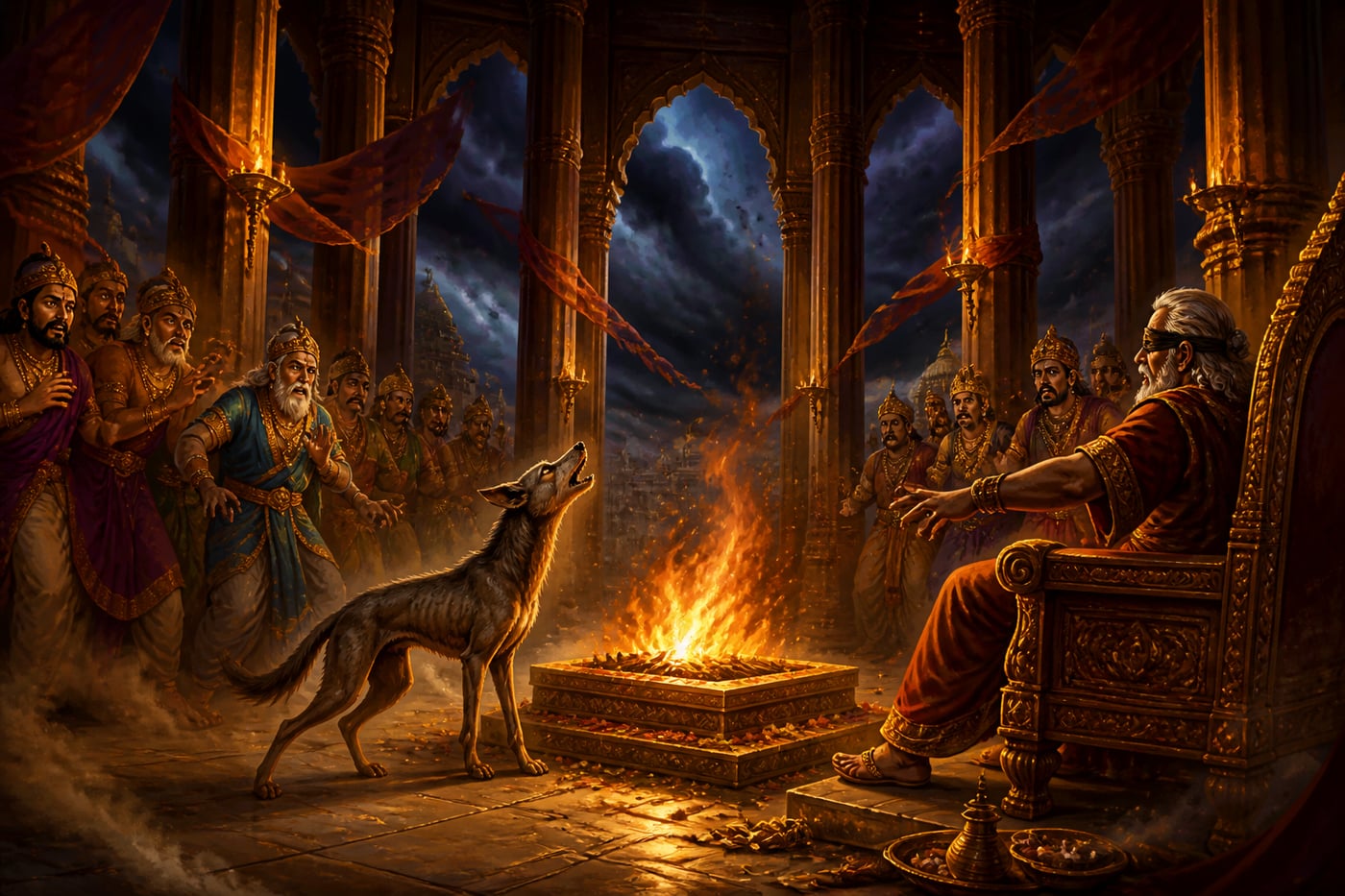
Omens shaking the Hastinapura hall

Dhritarashtra, who could not see the events that had unfolded but could hear everything, now heard the cosmic response. The blind king trembled.

"What have we done? What sounds are these? Vidura, what do these omens mean?"

Vidura's answer was merciless:

"They mean destruction, brother. They mean that what your sons have done today will bring ruin upon the entire Kuru race. The woman they have humiliated will be the fire that consumes us all."


The Belated Awakening

For the first time since the dice game began, Dhritarashtra intervened:

"Daughter Draupadi! Approach me. I have been, I have allowed, "

He could not finish the sentence. What could he say? That he had allowed his daughter-in-law to be dragged, insulted, nearly stripped? That he had sat silent while his sons turned his court into a scene of depravity?

He tried again:

"You are blameless in all this. You have been wronged beyond measure. I wish to make amends. Ask of me any boon, and it shall be granted."


The First Boon

Draupadi, standing amid the mountains of divine cloth, her hair still disheveled, her eyes still burning, considered the offer.

She could have asked for anything:

Instead, she asked:

"O King, I ask this: Let my husband Yudhishthira be freed from slavery. A son of a slave is also a slave. Let my son Prativindhya not grow up knowing his father was enslaved. Free Yudhishthira."

Draupadi stands tall before the blind king Dhritarashtra and asks only for the freedom of her husband as her first boon.

The request was precise, minimal, strategic. Freeing Yudhishthira, the eldest, the king, established a legal precedent without appearing greedy.

Dhritarashtra granted the boon immediately.

"It is done. Yudhishthira is free. Ask another boon."


The Second Boon

Draupadi's second request:

"Let Bhima, Arjuna, Nakula, and Sahadeva also be freed. Let them have their weapons and chariots returned. Let my husbands not walk from here as beggars."

Again, precise. Again, practical. She was undoing the results of the game step by step.

Dhritarashtra granted this boon also.

"It is done. All five Pandavas are free, with their weapons and chariots. Ask another boon, daughter. Ask as many as you wish, I will grant them all."


The Refusal of More

Draupadi paused. The assembly waited. She could ask for the kingdom back. She could ask for Duryodhana's exile. She could ask for justice against those who had humiliated her.

Instead, she said:

*"A kshatriya woman may ask two boons. I have asked two. I will ask no more. My husbands are free. They are warriors. Whatever else is needed, they will win by their own strength. I will not be called greedy or grasping.

Two boons are enough."*

The refusal was as powerful as any demand. It demonstrated:


Karna's Grudging Praise

Karna, who had been Draupadi's cruelest attacker, now spoke with unexpected respect:

*"Among all the women in the world, we have not heard of such an act. When the Pandavas were sinking in the ocean of distress, Draupadi became their boat.

The Pandavas were like drowning men; Draupadi swam to shore and pulled them with her.

I acknowledge: she has saved them all."*

This praise from an enemy recognized Draupadi's extraordinary achievement. Through two carefully chosen boons, she had undone everything the dice game had accomplished.


The Kingdom Restored

Dhritarashtra, still trembling with fear of the omens, went further than Draupadi had asked:

"Yudhishthira, my nephew, take back your kingdom. Take back Indraprastha. Take everything you lost. Let there be peace between our families. Go in prosperity."

The king was trying to buy peace with generosity. But was it generosity, or fear?

The distinction matters:

True Generosity Fear-Based Giving
Arises from love or justice Arises from terror of consequences
Does not expect gratitude Hopes to ward off retribution
Given freely Given to escape punishment
Creates genuine good will Creates resentment on all sides

Dhritarashtra's 'generosity' was clearly the second kind. He gave not because it was right but because he was afraid of what might happen if he didn't.


Duryodhana's Fury

While his father dissolved the results of the dice game, Duryodhana watched in disbelief. Everything he had won, the kingdom, the humiliation of his enemies, the satisfaction of revenge, was being given away.

Shakuni whispering the second dice game to Duryodhana

He pulled Shakuni aside:

"Uncle, my father undoes everything! What good was the game if he gives it all back?"

Shakuni's response was calm:

"Patience, nephew. Let them leave with their kingdom. Let them feel safe. And then, challenge them again. Yudhishthira cannot refuse a challenge. This time, we will stake something he cannot win back so easily."

The second game was already being planned before the first one's results were even settled.


The Departure

The Pandavas prepared to leave. They were free, armed, and had their kingdom restored. By any measure, they had escaped disaster.

But look at what remained:

Vidura walked with Yudhishthira to the chariot:

"Nephew, my heart tells me this is not the end. Be vigilant. Duryodhana will not rest until he has destroyed you, and now he has more reason than ever to try."

Yudhishthira's response revealed his nature:

"I know, uncle. But what can I do? A kshatriya cannot refuse a challenge. If they call us back, we must return. Perhaps fate has a purpose in all this."


The Meaning of Kshama

The title of this lesson is "Kshama: The Forgiving King," but we must ask: Was there genuine kshama (forgiveness) here?

What Kshama Truly Means:

What Actually Happened:

Dhritarashtra's 'forgiveness' was really avoidance. He wanted to escape consequences without addressing causes. This is not kshama, it is cowardice dressed as mercy.


Draupadi's Choice

Draupadi's decision to ask only two boons has been debated for millennia:

Those Who Praise It Say:

Those Who Question It Say:

The epic itself does not resolve this debate. It presents her choice without judgment, leaving readers to draw their own conclusions about the limits of nobility.


The Incomplete Resolution

As the Pandavas departed for Indraprastha, nothing had actually been resolved:

The 'forgiveness' was a pause, not an ending. The wheel of karma had been set spinning too fast to stop with mere boons.

"What has been sown in this hall cannot be unplanted. The boons may delay the harvest, but they cannot prevent it. We have all, every one of us, created the war that will come."


The Final Irony

Dhritarashtra's fear-driven generosity achieved exactly what Vidura had warned about from the beginning: it satisfied no one.

The Kauravas felt: Their legitimate victory had been stolen by their weak father.

The Pandavas felt: They had been gravely wronged and barely compensated.

Draupadi felt: She had been humiliated beyond repair; no boons could undo that.

The Elders felt: They had failed in their duty and been exposed.

Kshama, true forgiveness, might have healed these wounds. What Dhritarashtra offered was not kshama but kshama's counterfeit: mercy without justice, reconciliation without repentance, peace without transformation.

The Pandavas rode toward Indraprastha with their kingdom restored. But a messenger was already being prepared to call them back. The second game awaited.

Living traditions

The concept of incomplete reconciliation, addressing symptoms without treating causes, has become a framework for analyzing modern peace processes and conflict resolution. Political scientists have cited the dice game's aftermath as an ancient example of how forced reconciliation without justice leads to renewed conflict. The lesson remains relevant: sustainable peace requires more than ceasefires and boons; it requires addressing underlying grievances and power imbalances.

Reflection

More in Sabha Parva

All lessons in Sabha Parva · The Mahabharata course