Dyuta: The Game Begins

The dice game that would cost a kingdom, and ignite a war

The trap is set. Yielding to Duryodhana's obsession, Dhritarashtra constructs a magnificent gambling hall and summons the Pandavas for a 'friendly' game of dice. Yudhishthira, bound by kshatriya dharma never to refuse a challenge, walks knowingly into catastrophe. With Shakuni's magical dice and Yudhishthira's compulsive honor, the game spirals from wealth to kingdom to brothers to self, and finally to the unthinkable: the wagering of Draupadi herself.

Dyuta: The Game Begins

The Persuasion of a Blind King

In the palace of Hastinapura, Duryodhana found his father Dhritarashtra alone. The blind king could not see his son's fevered eyes, but he could hear the trembling in his voice.

"Father, I am dying. Not from wound or disease, but from a fire that burns within. The Pandavas' prosperity consumes me. I cannot eat, I cannot sleep, I cannot think of anything but their glory and my humiliation."

Dhritarashtra, torn between duty and love, asked: "What would you have me do?"

"Invite them here. For a game of dice. Let uncle Shakuni play on my behalf. I ask nothing more."

The blind king knew the request concealed something dark. He summoned Vidura, his wise half-brother, for counsel.


Vidura's Warning

Vidura spoke with the clarity of one who sees consequences others miss:

"O King, do not do this. Gambling among princes leads only to conflict. The dice will not remain dice, they will become weapons, and the game will become war. Send Duryodhana away with firm refusal. A father's duty is to guide, not to indulge."

But Dhritarashtra's response revealed the flaw that would destroy his family:

"I know you speak truth, Vidura. But what can I do? Whatever is destined to happen will happen. Let the hall be built. Let the invitation be sent."

With these words, "What can I do?", Dhritarashtra chose fate over responsibility, passivity over courage, his son's wishes over dharma.
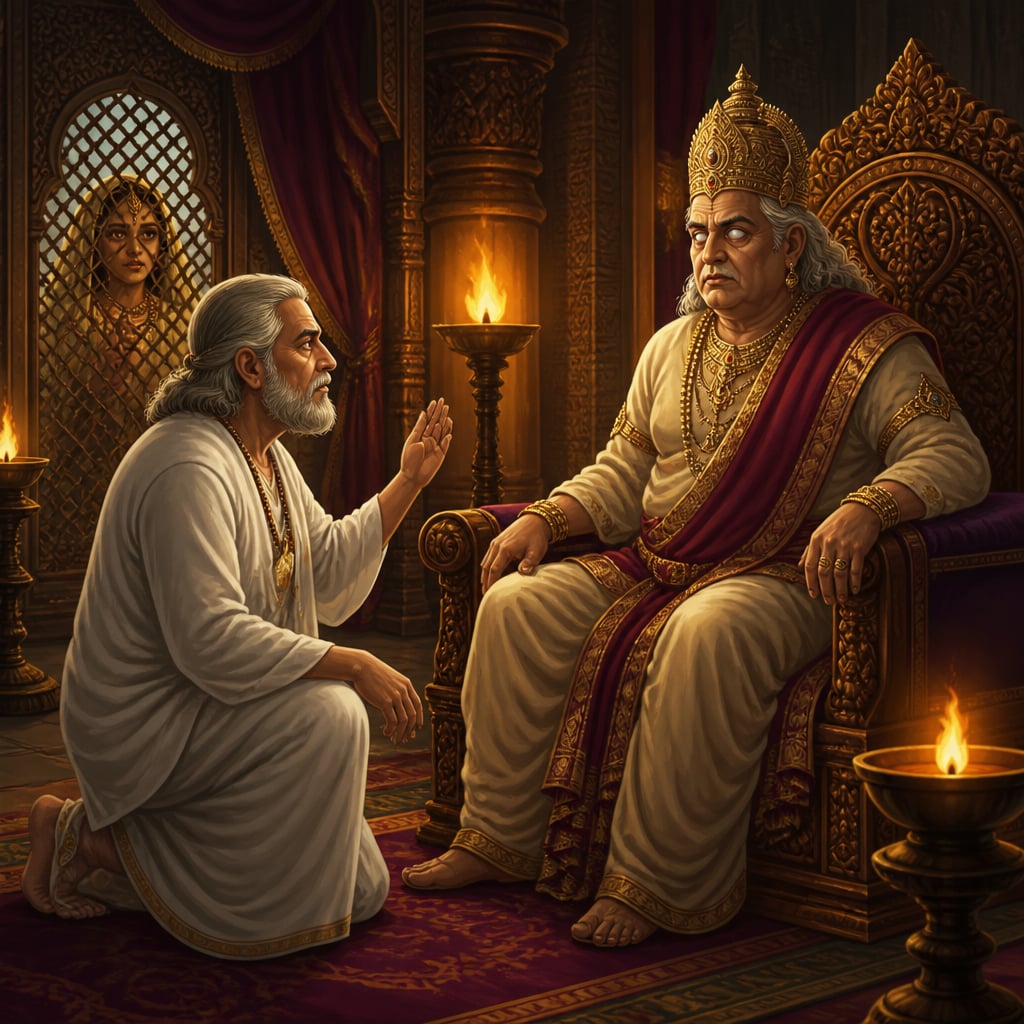
Vidura kneels before the blind king Dhritarashtra in a torchlit Hastinapura chamber, hand raised in earnest warning against the planned dice game.

The Sabha was commissioned. The dice were prepared. The trap was baited.


The Invitation

Vidura himself was sent to Indraprastha, bearing the invitation. His heart was heavy, for he was the messenger of destruction disguised as hospitality.

The invitation read:

Element Details
From Dhritarashtra, King of Hastinapura
To Yudhishthira, Samrat of Bharatavarsha
Occasion Inauguration of new Sabha hall
Activities Fellowship, celebration, friendly games
Request Honor us with your presence and participation

Yudhishthira received Vidura warmly. But Vidura's eyes betrayed his words.

"Uncle, you carry an invitation, but your face carries a warning. What troubles you?"

Vidura spoke carefully: "Yudhishthira, I am bound to deliver this message. But I am not bound to hide my fears. Gambling brings ruin. Refuse if you can."

Yudhishthira's response sealed his fate:

"I know the dangers, uncle. But a kshatriya cannot refuse a challenge. It is not in my power to decline, my dharma forbids it."


The Dharma That Binds

Yudhishthira's adherence to kshatriya code deserves examination:

The Rule: A kshatriya must accept any challenge from a peer, whether to battle, debate, or game. To refuse is cowardice, worse than defeat.

The Trap: Shakuni and Duryodhana knew this rule. By framing gambling as a challenge from fellow kshatriyas, they made refusal impossible for a dharmic king.

The Question: Was Yudhishthira right to place rigid adherence to one dharma above wisdom that could foresee disaster? Or was his 'dharma' actually disguised pride, unable to be seen as a coward?

"The wise say that dharma is subtle. Sometimes what appears as righteousness is merely pride wearing virtue's mask."


Arrival at Hastinapura

The Pandavas arrived in state, Yudhishthira, Bhima, Arjuna, Nakula, and Sahadeva, accompanied by Draupadi. They were received with honors befitting the Samrat of Bharatavarsha.

The new Sabha hall was magnificent, designed to rival the Maya Sabha, though it could not match that structure's supernatural beauty. But its purpose was not wonder. Its purpose was destruction.

Duryodhana greeted his cousins with elaborate courtesy, his hatred perfectly masked:

"Welcome, dear cousins! How wonderful that you honor us with your presence. Let us put aside old differences and enjoy each other's company as family should."

Bhima's eyes narrowed with suspicion. Arjuna's hand unconsciously moved toward his bow. But Yudhishthira, ever trusting, accepted the words at face value.


The Hall of Dice

The gambling hall was arranged with careful symbolism:

In the center: a gaming board. Beside it, Shakuni, rolling dice between his fingers with the ease of long practice.

Duryodhana spoke: "Let the game begin. My uncle Shakuni will play on my behalf, he is more skilled in these matters than I."

Yudhishthira asked: "Should I not play against my challenger directly?"

Shakuni smiled: "In dyuta, one may appoint a representative. This is perfectly within the rules. Unless you fear an old man's skill?"

The challenge was clear. Yudhishthira could not refuse without appearing cowardly.


The Dice of Bone

What the Pandavas did not know was the nature of Shakuni's dice.

According to tradition, these dice were carved from the bones of Shakuni's own father, who had died cursing the Kuru clan. Some versions say Shakuni could control them through sorcery; others say he had practiced so long that he could throw any number at will.

The dice were not fair.

The game was not a game.

It was an execution disguised as entertainment.


The Spiral Begins

The first stakes were modest, jewels, gold coins, ornaments. Yudhishthira lost. He staked more. He lost again.

"The strange madness of the gambler," the text observes, "is that each loss convinces him the next throw will restore all."

The progression of stakes:

Round Stake Result
1-5 Gold, jewels, ornaments Lost
6-10 Horses, elephants, chariots Lost
11-15 Treasury, palaces, lands Lost
16-20 Kingdom, armies, cities Lost

With each loss, Shakuni's smile widened. Duryodhana's eyes gleamed. The elders watched in horrified silence.


The Voice of Reason Ignored

Vidura rose:

"Enough! This is not a game, it is slaughter! Dhritarashtra, as king, stop this before irreparable harm is done!"

Duryodhana snapped:

"Uncle Vidura always favors the Pandavas. Let the game continue. No one is forcing Yudhishthira to play."

Bhishma spoke:

"The prince speaks law, though not justice. Yudhishthira entered willingly. We cannot stop him by force."

The distinction was crucial, and devastating. Legally, Yudhishthira was a willing participant. Morally, he was a victim of manipulation. The elders hid behind legality while morality burned.


The Final Stakes

Yudhishthira had lost everything external. The Maya Sabha, the treasury, the kingdom, all gone. Yet the game continued.

Shakuni taunted: "What remains, O King? You have wagered all you own. Unless... you have things you do not truly own?"

The implication was clear. And Yudhishthira, deep in the gambler's trance, crossed a line no king should cross.

Yudhishthira staking his brothers at the dice board

"I stake Nakula."

Gasps filled the hall. A man cannot stake another man, yet Yudhishthira claimed authority over his brothers as head of family.

Lost.

"I stake Sahadeva."

Lost.

"I stake Arjuna."

The great archer, conqueror of the northern kingdoms, reduced to a gaming piece.

Lost.

"I stake Bhima."

The mighty Bhima, slayer of Jarasandha, trembled with rage but said nothing.

Lost.


The Final Stake

Shakuni: "You have nothing left, Yudhishthira. The game is over... unless?"

Yudhishthira's voice came from somewhere far away, as if possessed:

"I stake myself."

Lost.

The Samrat of Bharatavarsha, victor of the Rajasuya, was now a slave.

Shakuni: "A slave who owns nothing cannot wager. But wait, did you not have something you never truly owned? Something, or someone, held in common with your brothers?"

The words hung in the air like poison.

Duryodhana spoke: "He means Draupadi. The Panchali princess. Stake her, cousin. One last throw. Win, and all is restored. Lose, and... well."


The Unthinkable Wager

Yudhishthira's voice, hollow as an empty vessel:

Yudhishthira speaking the wager of Draupadi

"I stake Draupadi, daughter of Drupada, princess of Panchala... my wife."

The hall erupted. Bhima roared. Arjuna's face went white. The elders cried out in protest.

But the dice were already rolling.

Lost.

Draupadi, queen, empress, daughter of a king, wife of five heroes, was now, by the rules of a rigged game, the property of Duryodhana.


The Silence of the Elders

In this moment, the moral failure was not Yudhishthira's alone. Look at who was present:

Any one of them could have stopped the game. None did.

Bhishma would later say: "I was bound by my oath to the throne."

Drona would say: "I was bound by my position as employee of the king."

Vidura would say: "I warned them. What more could I do?"

But silence in the face of injustice is complicity. The elders' failure to act was as great a crime as Shakuni's cheating or Duryodhana's cruelty.


The Dharma Question

The dice game raises questions that echo through millennia:

On Rules vs. Justice: The game was 'legal', Yudhishthira consented, the rules were followed. But legality without morality is tyranny in procedural dress.

On Dharma's Limits: Yudhishthira's 'dharma' of never refusing a challenge led to catastrophe. When does rigid principle become destructive dogma?

On Collective Responsibility: Every witness who stayed silent shared responsibility. 'I could not stop it' is rarely true, more often it means 'I chose not to risk stopping it.'

On Addiction's Power: Yudhishthira's behavior shows the psychology of gambling addiction, the escalating stakes, the belief that the next throw will redeem all losses, the inability to walk away.


The Stage Is Set

Draupadi, watching from the gallery, did not yet know she had been wagered and lost. The messenger was being dispatched to summon her to the hall.

The game of dice was over.

But the real game, of justice, dharma, and divine intervention, was about to begin.

What would Draupadi say when she learned she had been staked like property? What question would she ask that would echo through eternity? The answer would shake the very foundations of the Kuru court.

Living traditions

The dice game has become a powerful metaphor in Indian public discourse for any rigged system or manipulated competition. Political commentators frequently reference 'Shakuni's dice' when discussing corruption or unfair practices. The scene has been adapted into countless films, television series, and plays, always resonating because its themes of manipulation, addiction, and the failure of bystanders remain perpetually relevant.

Reflection

More in Sabha Parva

All lessons in Sabha Parva · The Mahabharata course