Digvijaya: Conquest of the Quarters

Four brothers conquer the world

With Jarasandha dead, the four younger Pandavas ride forth to conquer the four quarters of the earth. Arjuna to the north, Bhima to the east, Nakula to the west, and Sahadeva to the south, each brother subduing kingdoms and gathering tribute for Yudhishthira's Rajasuya, establishing Pandava sovereignty over all of Bharatavarsha.

The Four Directions

With Jarasandha's death, the greatest obstacle to the Rajasuya had fallen. But a Chakravarti's sovereignty must be acknowledged by all, not merely claimed. Before Yudhishthira could perform the grand sacrifice, every king in Bharatavarsha must either submit tribute or be conquered.

The task was divided among the four younger Pandavas, each assigned a cardinal direction:

Direction Commander Symbol Key Challenges
North Arjuna Mountains & snow Himalayan kingdoms, warlike tribes
East Bhima Rising sun Magadha's vassals, jungle kingdoms
West Nakula Setting sun Desert kingdoms, wealthy traders
South Sahadeva Ocean Dravidian kingdoms, island realms

Yudhishthira remained at Indraprastha, governing the empire's heart while his brothers expanded its reach. The eldest Pandava understood that a king who leaves his capital vulnerable invites usurpation, and there were enemies watching from Hastinapura.

Arjuna's Northern Campaign

Arjuna, the peerless archer, rode north toward the Himalayas with a vast army. His route took him through kingdoms that had never acknowledged any southern overlord.
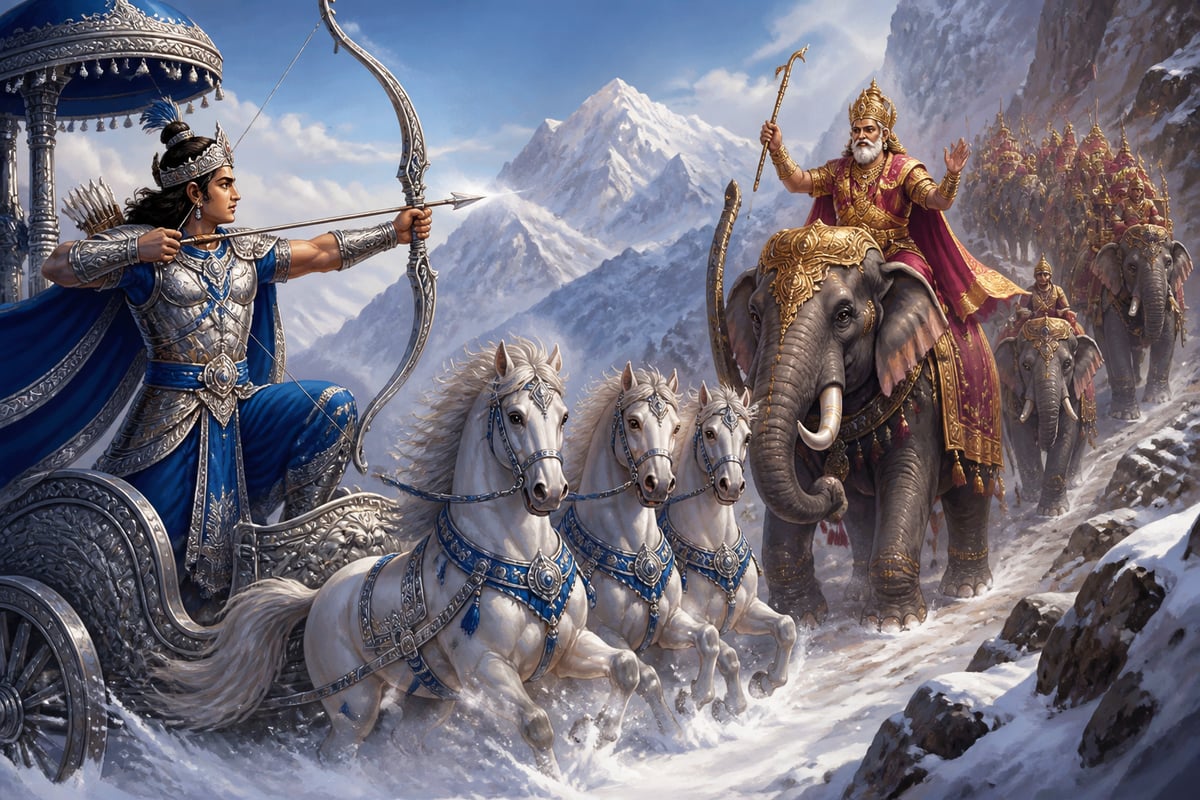
Arjuna receiving Bhagadatta's surrender in the Himalayas

First fell Bhagadatta of Pragjyotisha, the elephant-king whose war-beasts were legendary. The battle lasted days, but Arjuna's archery proved superior to Bhagadatta's elephant corps. Rather than face total destruction, the wise king submitted, offering tribute of gold, elephants, and precious mountain gems.

"I have never been defeated," Bhagadatta told Arjuna after the battle. "But against the wielder of Gandiva, even pride must bow. Take my allegiance to your brother."

Arjuna pressed on through:

Some submitted peacefully, recognizing that resistance against the hero of Khandava was futile. Others fought, and lost. By the campaign's end, every northern kingdom from the Gangetic plains to the Himalayan glaciers acknowledged Yudhishthira's sovereignty.

Arjuna returned with tribute beyond counting: horses from the steppes, yaks from the highlands, gold from mountain streams, and gems that held imprisoned starlight.

Bhima's Eastern Campaign

Bhima, fresh from killing Jarasandha, marched east into territories that had once been the tyrant's vassals. Many submitted immediately, they had seen what the son of Vayu could do.

"The man who tore Jarasandha apart wishes our allegiance," reasoned the kings of the east. "What fool would refuse?"

But not all were so wise. The Angas, the Vangas, and the Pundras of the Gangetic delta tested Bhima's strength. They learned what Jarasandha had learned: there was no testing Bhima's strength and surviving.

Bhima's campaign was notable for its speed rather than its subtlety. Where other commanders might negotiate, Bhima simply appeared at the gates with his mace and waited. Most kings opened those gates quickly.

The eastern tribute included:

The Kingdom of Magadha itself, now ruled by Jarasandha's son Sahadeva, sent the richest tribute of all, a gesture of gratitude for the mercy Krishna had shown.

Nakula's Western Campaign

The twins, though youngest, proved themselves worthy commanders. Nakula, known for his beauty and his skill with horses, rode west toward the setting sun.

His route passed through:

In Madra, Nakula faced a delicate situation. King Shalya, his maternal uncle, initially refused submission. Blood ties complicated the demand for tribute.

Nakula appealing to Shalya in Madra

"You ask me to bow to your brother?" Shalya laughed. "I who held you as an infant?"

"Uncle," Nakula replied carefully, "I ask not for myself but for dharma. The Rajasuya requires acknowledgment from all kings. Will Madra alone stand apart? What would my mother say?"

The mention of Madri softened Shalya's heart. He submitted, though his pride would later lead him to fight for the Kauravas at Kurukshetra. Family obligations, the Mahabharata reminds us, rarely flow in simple directions.

Nakula's western tribute featured:

Sahadeva's Southern Campaign

Sahadeva, wisest of the twins, marched south into the Dravidian kingdoms, lands of ancient culture, powerful kings, and traditions older than the Vedas themselves.

His campaign was the longest and most diplomatically complex. Southern kings did not share the northern codes of Kshatriya honor; they had their own traditions, their own pride.

Sahadeva conquered or received submission from:

The southern kings respected Sahadeva's approach. He came not merely as a conqueror but as a diplomat, honoring local customs and acknowledging southern achievements. Where possible, he accepted symbolic submission rather than demanding humiliating tribute.

"The south has its own dharma," Sahadeva wrote to Yudhishthira. "Force alone will not hold these kingdoms. I have won their acknowledgment through respect."

Southern tribute included:

The Price of Empire

The Digvijaya was successful beyond expectation. Within months, all of Bharatavarsha acknowledged Yudhishthira's sovereignty. Tribute flowed into Indraprastha from every direction.

But the campaigns were not without cost:

Lives Lost

Thousands died in the various battles. Kings who resisted too long saw their armies destroyed, their sons killed, their kingdoms diminished. The wheel of conquest ground many beneath it.

Resentments Planted

Forced submission breeds resentment. Kings who bowed to the Pandavas today might seek revenge tomorrow. The Mahabharata's audience knew that many of these conquered rulers would fight against the Pandavas at Kurukshetra.

Pride Inflated

Success can be as dangerous as failure. The ease of conquest fed Pandava confidence, perhaps too much confidence. They were building an empire, but also building the conditions for its collapse.

The Return of the Victors

One by one, the brothers returned to Indraprastha. Each brought tales of adventure, wagons of tribute, and the formal submission of dozens of kings.

Yudhishthira received them in the Maya Sabha, surrounded by the impossible beauty Maya had created. The crystal floors reflected their victories; the jeweled walls witnessed their glory.

"Brothers," Yudhishthira said, "you have done what no one has done before. All of Bharatavarsha acknowledges our sovereignty. The Rajasuya can proceed."

The four brothers knelt before their eldest, presenting the symbolic tributes of all four directions. Draupadi watched from her throne, pride and concern mingling in her eyes. Krishna stood nearby, his expression unreadable.

The four younger Pandava brothers kneel before Yudhishthira in the Maya Sabha, each presenting symbolic tribute from the four directions of their conquest.

The world has been conquered, Yudhishthira thought. Now comes the harder task, holding it together.

The Geography of Power

The Digvijaya reveals the Mahabharata's understanding of political geography. Power flows from the center outward; challenges come from the periphery. A king who cannot project force to his borders will soon have no borders to project force to.

But the epic also warns against overreach. Jarasandha had conquered much of Bharatavarsha too, and his empire died with him. Conquest without legitimacy creates only temporary submission.

The Pandavas understood this partially. They sought not just submission but acknowledgment, the voluntary recognition that Yudhishthira's sovereignty was righteous. This is why the Rajasuya mattered: it wasn't just a display of power but a ritual confirmation of cosmic order.

Whether they achieved this deeper legitimacy, the coming chapters would reveal.

Living traditions

The Digvijaya concept influenced India's understanding of national unity. The idea that diverse regions can acknowledge a common sovereignty while maintaining distinct identities shaped both ancient empires and modern Indian federalism. The 'unity in diversity' principle has roots in how the Pandavas managed their conquered territories.

Reflection

More in Sabha Parva

All lessons in Sabha Parva · The Mahabharata course