Chakravarti: The Dream of Empire

Narada inspires the Rajasuya

The celestial sage Narada visits Yudhishthira's magnificent court and, through descriptions of his father Pandu's place in heaven, plants the seed of a fateful ambition, the Rajasuya yajna that will establish Yudhishthira as Chakravarti, sovereign of the world, but at a terrible cost.

The Celestial Wanderer

In the splendor of the Maya Sabha, where light danced through crystal pillars and jeweled floors reflected infinite skies, a visitor arrived who traveled between worlds as easily as men walk between rooms. Narada, the divine sage, appeared in the court of Yudhishthira, his veena in hand, his hair wild with cosmic winds, his eyes holding the knowledge of all three realms.

Narada was no ordinary sage. He was the messenger between gods and mortals, the wanderer who witnessed everything and reported to all. Where he went, change followed. The gods themselves watched his movements with interest, for Narada's arrival often heralded turning points in the cosmic order.

"Welcome, O divine one," Yudhishthira said, rising from his throne to receive the sage. "What brings you to our humble court?"

Narada smiled, a smile that held secrets within secrets. "Humble?" he said, gazing at the impossible architecture surrounding them. "O king, I have seen the sabhas of Indra in Amaravati, of Yama in his realm of the dead, of Varuna beneath the waters, of Kubera in the mountains. Your court rivals them all."
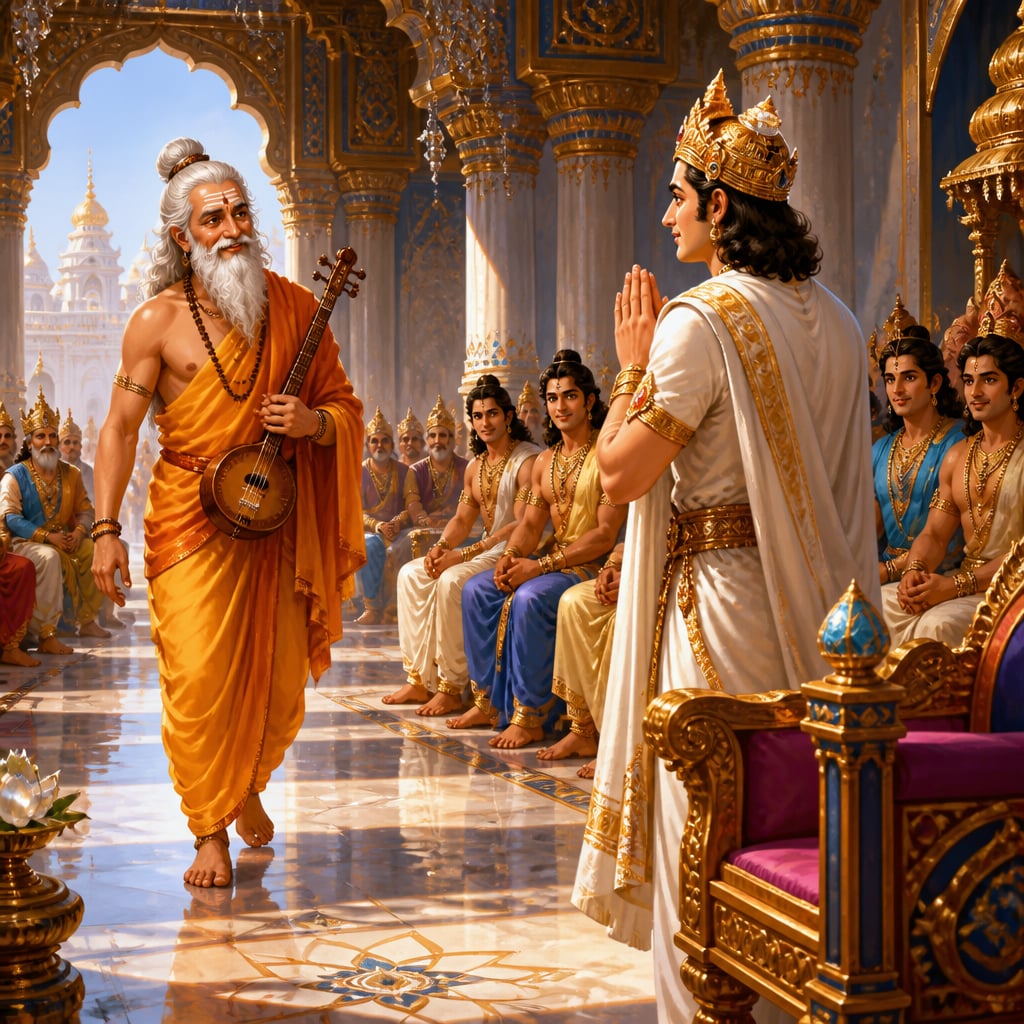
The sage Narada with veena walks into Yudhishthira's jewel-pillared court at the Maya Sabha as the king rises from his throne to greet him.

Questions of a King

Yudhishthira, ever thoughtful, saw an opportunity in the sage's presence. Here was one who had witnessed all of existence, who better to advise a king on governance?

"Tell me, O sage," Yudhishthira asked, "what makes a righteous king? How should I rule my people?"

Narada's response came as a series of penetrating questions, thirty-two questions that probed every aspect of kingship:

Domain Sample Questions
Justice Do you punish the guilty regardless of their status? Do you protect the innocent even at cost to yourself?
Economy Is your treasury growing through dharmic means? Do you tax without crushing the people?
Defense Are your forts well-maintained? Is your army loyal and well-paid?
Administration Are your ministers capable and honest? Do you verify what they tell you?
Personal Conduct Do you rise early? Do you balance work with rest? Do you honor the gods and sages?

These questions, known as the Rajan Dharma Prashna, became one of the Mahabharata's most important treatises on governance. They reveal that dharmic kingship is not about power but about responsibility, not about what a king can take, but what he must give.

The Five Sabhas

Narada then described the assembly halls of the five great lords of the cosmos, each representing a different aspect of divine power:

Indra's Sabha in Amaravati

The hall of the king of gods, where celestial musicians play eternally and victory is celebrated in endless festivals. Here, warriors who died bravely find their reward.

Yama's Sabha in Yamapuri

The austere court of Death himself, where every soul's deeds are weighed on scales that cannot be cheated. Chitragupta keeps the records; none escape judgment.

Varuna's Sabha beneath the Waves

The underwater palace of the lord of waters, surrounded by sea creatures and rivers in feminine form, where the cosmic order of the waters is maintained.

Kubera's Sabha in Alaka

The treasury of the universe, where the lord of wealth sits surrounded by Yakshas and Gandharvas, guardian of all precious things buried in the earth.

Brahma's Sabha in Brahmaloka

The highest assembly, where the Creator himself sits with sages and gods, where time moves differently and a moment contains ages.

"Your Sabha, O Yudhishthira," Narada concluded, "approaches these divine courts in splendor. But there is one honor you have not yet achieved, one that would place you among the greatest kings who ever lived."

The Father's Blessing

Yudhishthira's attention sharpened. "What honor, O sage?"

"I have seen your father Pandu in the realm of the ancestors," Narada said, his voice softening. "He dwells in a blessed place, but he spoke to me of you. He said: 'My son Yudhishthira is virtuous, but until he performs the Rajasuya yajna, until he becomes Samrat, emperor of all Bharatavarsha, my joy will not be complete.'"

The words struck Yudhishthira like thunderbolts. His father, whom he barely remembered, who had died when Yudhishthira was young, was watching from the realm of the Pitrs, waiting for his son to achieve supreme glory.

"The Rajasuya," Narada continued, "is the sacrifice of world sovereignty. Only a king acknowledged by all other kings can perform it. To do so, you must first conquer, or receive submission from, every ruler on earth. You must become Chakravarti, the wheel-turner, whose chariot wheels roll unchallenged across all directions."

The Weight of Ambition

Yudhishthira alone at night weighing the Rajasuya

That night, Yudhishthira could not sleep. The sage's words circled in his mind like vultures around a dying warrior.

The Rajasuya.

It was the ultimate expression of royal power, a sacrifice so grand that it had been performed by only a handful of kings in all of history. To even attempt it required defeating or gaining the allegiance of every kingdom in Bharatavarsha.

And there was Jarasandha.

The mighty king of Magadha, who had already defeated the Kauravas, who had imprisoned eighty-six kings in his dungeons waiting to sacrifice them to Rudra, who had driven Krishna himself from Mathura, Jarasandha stood like a mountain blocking the path to world sovereignty.

Without defeating Jarasandha, Yudhishthira realized, no Rajasuya is possible. And defeating Jarasandha... that might be impossible itself.

But his father's words echoed: My joy will not be complete.

Council of Brothers

Krishna counseling the Pandavas on the Rajasuya

The next morning, Yudhishthira summoned his brothers and Krishna to counsel.

"Narada has planted a seed in my heart," he confessed. "The Rajasuya yajna. Our father waits for us to achieve this glory. But I fear the cost. To become Chakravarti, we must conquer the world. That means war, death, suffering. Is my desire for glory, even for our father's blessing, worth the lives of thousands?"

Bhima spoke first, his voice like a war drum: "Brother, we are Kshatriyas. Battle is our dharma. Let us conquer! I alone will defeat Jarasandha if you give the command."

Arjuna, more measured, nodded: "The Rajasuya is not merely glory, it establishes dharmic order across the land. Under your rule, justice will flourish. The wars we fight will end greater injustices."

Nakula and Sahadeva pledged their support: "Command us, eldest brother. We will ride to the four corners of the earth."

All eyes turned to Krishna, who had remained silent, his enigmatic smile revealing nothing.

The Dark Lord's Counsel

"O Yudhishthira," Krishna finally spoke, "your hesitation does you credit. A king who rushes to war without counting the cost is no king at all. But consider this: Jarasandha holds eighty-six kings in chains, awaiting slaughter. Is that not injustice? The lesser kings of Bharatavarsha groan under petty tyrants. Would your rule not bring them relief?"

He paused, letting the words settle.

"The Rajasuya is not vanity, it is responsibility. A Chakravarti does not merely rule; he maintains cosmic order on earth. The question is not whether you desire power, but whether you are willing to bear its weight."

Krishna's dark eyes met Yudhishthira's. "I will help you. But first, Jarasandha must fall. And for that, I have a plan."

The Seed Takes Root

Thus did Narada's visit transform the destiny of nations. A wandering sage, a few questions, a message from a dead father, and suddenly the greatest war in human history became inevitable.

Yudhishthira did not know, could not know, that the path to the Rajasuya would lead through Jarasandha's corpse, through Shishupala's severed head, through the dice game that would strip him of everything, through thirteen years of exile, and finally through the blood-soaked fields of Kurukshetra.

All he knew was that his father was watching, that duty called, and that Krishna, mysterious Krishna, would guide his steps.

The wheel of the Chakravarti had begun to turn.

The Nature of Destiny

Looking back, we might ask: Was Narada's visit a blessing or a curse? Did the sage serve dharma by inspiring the Rajasuya, or did he set in motion a tragedy that would consume millions?

The Mahabharata offers no easy answers. Perhaps the war was inevitable, the adharma of the Kauravas would eventually demand correction. Perhaps Narada was merely the instrument of a destiny already written.

Or perhaps the epic is teaching us something about ambition itself: how even righteous desires can lead to unintended consequences, how the path to glory often passes through valleys of shadow.

Yudhishthira wanted to honor his father. He wanted to establish dharmic rule. These are noble goals. Yet their pursuit would create more orphans, more widows, more grieving fathers than any event in human history.

The Maya Sabha still stood, magnificent and illusory. But now it held something new within its crystal walls: the dream of empire, beautiful and terrible, waiting to unfold.

Living traditions

The Chakravarti ideal continues to influence Indian political discourse. The Lion Capital of Ashoka, who adopted the Chakravarti title, is India's national emblem. The concept of 'benevolent universal sovereignty' underpins modern India's aspirations for regional leadership and soft power projection.

Reflection

More in Sabha Parva

All lessons in Sabha Parva · The Mahabharata course