Vamsha: The Heir Protected
Krishna saves unborn Parikshit
With Bhishma's departure, the Pandavas turn to the future, but the future itself is under threat. Ashwatthama's Brahmastra has targeted the last heir of the Kuru line, the unborn child in Uttara's womb. Only Krishna's divine intervention can preserve the dynasty, setting the stage for the great Ashvamedha sacrifice that will legitimize Yudhishthira's hard-won rule.
A Kingdom Without Heirs
The ashes of Bhishma's pyre had barely cooled when a new crisis gripped Hastinapura. Yudhishthira sat on the throne of his ancestors, but the victory felt hollow. Of the hundred Kauravas, none remained. Of the Pandavas, all five had survived, but their sons had not.
Draupadi's five sons, one from each husband, had been slaughtered in their sleep by Ashwatthama's midnight massacre. The Upapandavas were gone. Abhimanyu, the brilliant warrior who had pierced the Chakravyuha, lay dead on Kurukshetra. The entire next generation had been erased.
Except for one fragile hope.
Uttara, the princess of Virata who had married Abhimanyu just before the war, carried his child in her womb. This unborn infant was now the sole surviving heir of both the Pandava and Kaurava lines, the last branch on a tree that had lost all its other limbs.
"All our victories mean nothing," Yudhishthira said quietly, "if the line ends with us. What is a kingdom without heirs but a house without a roof?"
The Shadow of Ashwatthama
But even this final hope was under threat. In his rage after the war's end, Ashwatthama had committed the unthinkable. Unable to accept his father Drona's death, unable to bear the Pandavas' victory, he had invoked the most terrible weapon in existence, the Brahmastra, and directed it not at warriors but at the womb.
"Let the Pandava line be extinguished utterly," Ashwatthama had screamed into the night. "Let no heir of theirs ever draw breath."
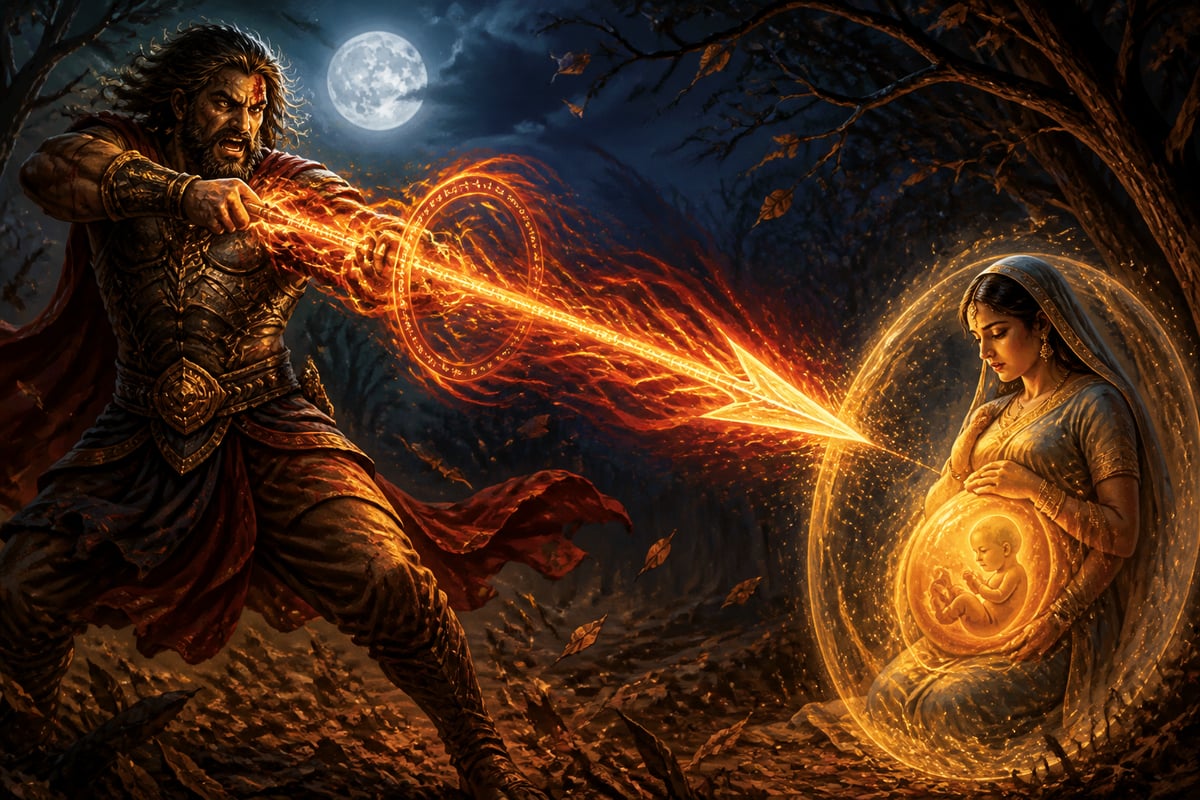
The weapon had been launched. Arjuna had countered with his own Brahmastra, and the collision of these apocalyptic forces had nearly destroyed the world. But Ashwatthama, unable to withdraw his weapon as Arjuna could, had redirected it toward its original target, the unborn children of the Pandavas.
The sages had stripped Ashwatthama of the jewel from his forehead and cursed him to wander the earth for three thousand years, his wound never healing, finding no rest or companionship. But curses could not undo what had already been done. The Brahmastra's fire had entered Uttara's womb.
The Divine Shield
In the palace of Hastinapura, Uttara lay in her chambers, her hands pressed to her swelling belly. She could feel something wrong, a heat that should not be there, a presence that meant death.
"The child moves strangely," she whispered to Subhadra, her mother-in-law and Krishna's sister. "There is fire inside me."
Subhadra's face went pale. She knew what this meant. The Brahmastra was not a weapon that could be blocked or deflected by ordinary means. It would find its target eventually, burning through any protection, consuming what it had been sent to destroy.
But Subhadra also knew something else. Her brother was no ordinary man.
Krishna arrived in the chamber as if summoned by thought rather than message. He stood at the foot of Uttara's bed, his dark eyes seeing not just the terrified young widow but the cosmic forces at play within her.
"Do not fear," he said, and his voice carried a resonance that seemed to still the very air. "What Ashwatthama has sent, I will turn away. The child will live."
"But the Brahmastra, " Subhadra began.
"Was created by Brahma," Krishna completed her thought. "And I am that from which Brahma himself emerged. The weapon knows its master."
The Battle in the Womb
What happened next was witnessed by none but Krishna himself. Yet the sages who later recorded these events described it thus:
Krishna extended his consciousness into the womb of Uttara. There, in that small dark space where a new life struggled to form, he found the Brahmastra, a coil of divine fire that had wrapped itself around the developing child, preparing to consume it utterly.
The weapon recognized him. How could it not? The Brahmastra was the essence of creative and destructive power, and here was the source of all power, the origin point of creation itself.
| The Confrontation | The Brahmastra | Krishna's Response |
|---|---|---|
| First assault | Fire to burn | Became the child's shield |
| Second assault | Heat to dissolve | Surrounded the child with coolness |
| Third assault | Energy to unmake | Absorbed the energy into himself |
The weapon could not proceed. To destroy the child, it would have to destroy Krishna first, and that was beyond even its terrible capability. The Brahmastra withdrew, its purpose thwarted, its fire quenched by the presence of the one who existed before fire itself.

The Child Who Was Tested
Months later, when Uttara's time came, the birth was difficult. The child emerged silent, unmoving, apparently stillborn. The midwives wailed. Draupadi, who had lost all her sons, could not bear to look. Kunti turned away, her aged heart breaking.

But Krishna lifted the infant in his hands.
"He is not dead," the lord said. "He is parīkṣita, tested. He has faced the Brahmastra and survived. He has known death before knowing life. This child will be remarkable."
Krishna breathed upon the infant's face. His breath, which had once spoken the universe into existence, now spoke life into this small form. The child's eyes opened. He drew his first breath. And then, impossibly, he smiled.
Parikshit, "the tested one", had entered the world.
"This child," Krishna declared to the assembled family, "has been examined by the fire of Brahma's weapon and found worthy. He will rule after you, Yudhishthira. He will continue what you have begun. The Kuru line will not end, it will flourish through him."
The Weight of Survival
For Yudhishthira, the birth of Parikshit changed everything. Until this moment, the war had felt like an ending, the bloody conclusion to a conflict that had consumed three generations. Now it revealed itself as a beginning.
There will be a future, Yudhishthira realized. Not just for us, but for those who come after.
This realization brought both hope and responsibility. If there was to be a future, it needed to be built on solid foundations. The kingdom that Parikshit would inherit could not be one stained by the illegitimacy of war. It needed to be purified, sanctified, established beyond all doubt as rightfully ruled.
This is where Bhishma's teachings became practical. The grandfather had spoken extensively about rajadharma, the duties of kings. Among the highest duties was the performance of the Ashvamedha yajna, the horse sacrifice that proclaimed a king's sovereignty over all the lands the sacred horse traversed.
"The Ashvamedha will accomplish several things," Krishna explained to the brothers:
- Legitimacy: It will establish your rule as divinely sanctioned
- Purification: It will cleanse the kingdom of the war's accumulated sins
- Prosperity: The rituals will invoke blessings for the land and people
- Succession: It will prepare the way for Parikshit's eventual rule
The Decision to Sacrifice
But an Ashvamedha was no simple ceremony. It required vast resources, gold, grains, ghee, cattle by the thousands. It required a year of preparation and a year of execution. It required a horse of perfect qualities, and a warrior capable of following it wherever it wandered and defeating any king who dared to challenge the sacrifice.
"We have the warrior," Yudhishthira said, glancing at Arjuna. Despite his grief over Abhimanyu's death, despite his exhaustion from the war, Arjuna remained the greatest archer in the world.
"We have the intent," Bhima added. "Let the horse go where it will. I will ensure no one stops the sacrifice."
"But do we have the resources?" Nakula asked practically. "The war has drained our treasuries. Eighteen akshauhinis of soldiers need to be fed, or rather, their widows and orphans do. The fields of Kurukshetra grow nothing but bones."
It was Sahadeva who remembered the solution, something Bhishma had mentioned during his teachings on charity.
"King Marutta," he said. "The ancient king who performed a sacrifice so magnificent that even the gods attended. His treasure is said to be hidden in the Himalayas, waiting for one worthy enough to claim it."
The Hope of Marutta's Gold
The story of Marutta's treasure gave the Pandavas direction. According to legend, Marutta had been the wealthiest king in history, so wealthy that when he performed his yajna, the utensils were made of gold, and so much gold remained afterward that he buried it in the mountains rather than burden his successors with protecting it.
"If we can find this treasure," Yudhishthira said, "we can perform the Ashvamedha as it should be performed. We can feed every widow, endow every orphan, and still have enough to make our sacrifice worthy of the gods."
Vyasa, who had been listening silently, finally spoke.
"The treasure exists. I know where it lies. But claiming it is not merely a matter of finding it. You must be worthy, not by birth or conquest, but by intention. Go to the Himalayas with pure purpose, and the gold will reveal itself. Go with greed, and you will find only stone."
Preparing for the Future
As the Pandavas made their preparations to seek Marutta's gold, Uttara sat in her chambers with infant Parikshit in her arms. She had lost her husband before she truly knew him, Abhimanyu had been killed mere weeks after their wedding. Now she was a mother and a widow, responsible for the future of an entire dynasty.
Krishna visited her one last time before departing for Dwaraka.
"Your son will be a great king," he told her gently. "Greater than his father, greater than his uncles. He will rule for sixty years, and when he dies, it will not be in defeat but through the curse of a Brahmin's son, and that death will set in motion events that culminate in the end of the present age."
Uttara's eyes widened. "You speak as if you see the future."
"I see all times," Krishna replied. "Past, present, and future are before me like an open book. Your son's great-grandson will hear this very story from the sage Vaishampayana during a sacrifice, the tale of how his ancestor was saved from Ashwatthama's weapon."
He touched the infant's forehead. "Remember, little one, that you have already been tested by the greatest weapon ever created, and you survived through divine grace. Let this knowledge make you humble, not proud. You lived not through your own merit but through protection. So should all kings remember, their power is borrowed, their authority a trust."
With those words, Krishna departed. The Ashvamedhika Parva, the Book of the Horse Sacrifice, had truly begun.
Living traditions
The story of Parikshit's prenatal protection has become a template for prayers during pregnancy in Hindu tradition. Many expecting mothers recite verses from this narrative seeking similar divine protection. The concept that a child can be 'tested' and 'saved' before birth resonates with modern parents who have experienced complicated pregnancies. The name Parikshit remains popular in India, carrying connotations of resilience, divine grace, and destined greatness. The narrative also prefigures modern discussions about consciousness before birth and the spiritual status of the unborn.
- Garbha Raksha (Protection of the Womb): Rituals and prayers for the protection of unborn children, invoking divine protection against harm. The story of Krishna protecting Parikshit is often recited during pregnancy for auspicious blessings.
- Hastinapur: The ancient capital of the Kuru dynasty where Parikshit was born and later ruled. Archaeological excavations have revealed Painted Grey Ware pottery dating to the Mahabharata period (1200-800 BCE), suggesting continuous habitation during the epic's timeframe.
- Sukratal: The traditional site where King Parikshit listened to the Bhagavata Purana from Sage Shukadeva during the seven days before his death. A major pilgrimage site for devotees of Krishna and the Bhagavata tradition.
Reflection
- Parikshit was 'tested before he was born', facing destruction while still in the womb. In what ways have your early experiences, even before you were fully aware, shaped who you've become? How might challenges you don't remember still influence you today?
- The Pandavas realized their war-won kingdom would be meaningless without an heir. What are you building that will outlast you? Who are you preparing to inherit your knowledge, resources, or responsibilities?
- Krishna tells Parikshit that his survival was 'through divine grace, not through his own merit.' How do you balance gratitude for the gifts you've received with pride in your own achievements? Can both exist together?