Nakula: The Golden Mongoose
Mongoose tests the sacrifice
At the height of Yudhishthira's triumph, a strange creature appears, a mongoose whose body is half golden, half ordinary brown. It rolls in the sacrificial dust and declares that this magnificent Ashvamedha does not equal a simple meal once given by a starving Brahmin family. The mongoose's story teaches that true charity is measured not by quantity but by the completeness of self-surrender.
The Visitor
The celebrations were winding down. Kings had departed for their realms. The priests had received their dakshina. The fires, though still burning, had settled into the steady glow of completion rather than the fierce blaze of ritual. The greatest sacrifice of the age was done.
And then a creature walked into the sacrificial arena.
It was a mongoose, but no ordinary mongoose. Half of its body gleamed with the unmistakable luster of pure gold: one side of its face, one ear, the right half of its torso, one foreleg. The other half was the ordinary reddish-brown fur that any mongoose might possess.
The guards moved to chase it away, what was a common animal doing in the sacred precinct?, but something in its manner stopped them. The mongoose walked with purpose, not with the darting nervousness of a frightened creature. It moved directly to the center of the arena, to the spot where the richest offerings had been poured.
And there, it rolled.
The Rolling and the Judgment
Yudhishthira watched in puzzlement as the half-golden creature rolled back and forth in the dust and ashes of the sacrifice. It rolled thoroughly, coating every part of its body in the residue of the Ashvamedha.
Then it stopped. It examined itself carefully, the golden half still golden, the brown half still brown. Nothing had changed.
The mongoose made a sound that seemed almost like a sigh.
"It is as I expected," the creature said, and yes, it spoke, in a voice that carried clearly across the arena. "This sacrifice, magnificent as it appears, does not equal the gift of the poor Brahmin of Kurukshetra. Still I am only half golden."
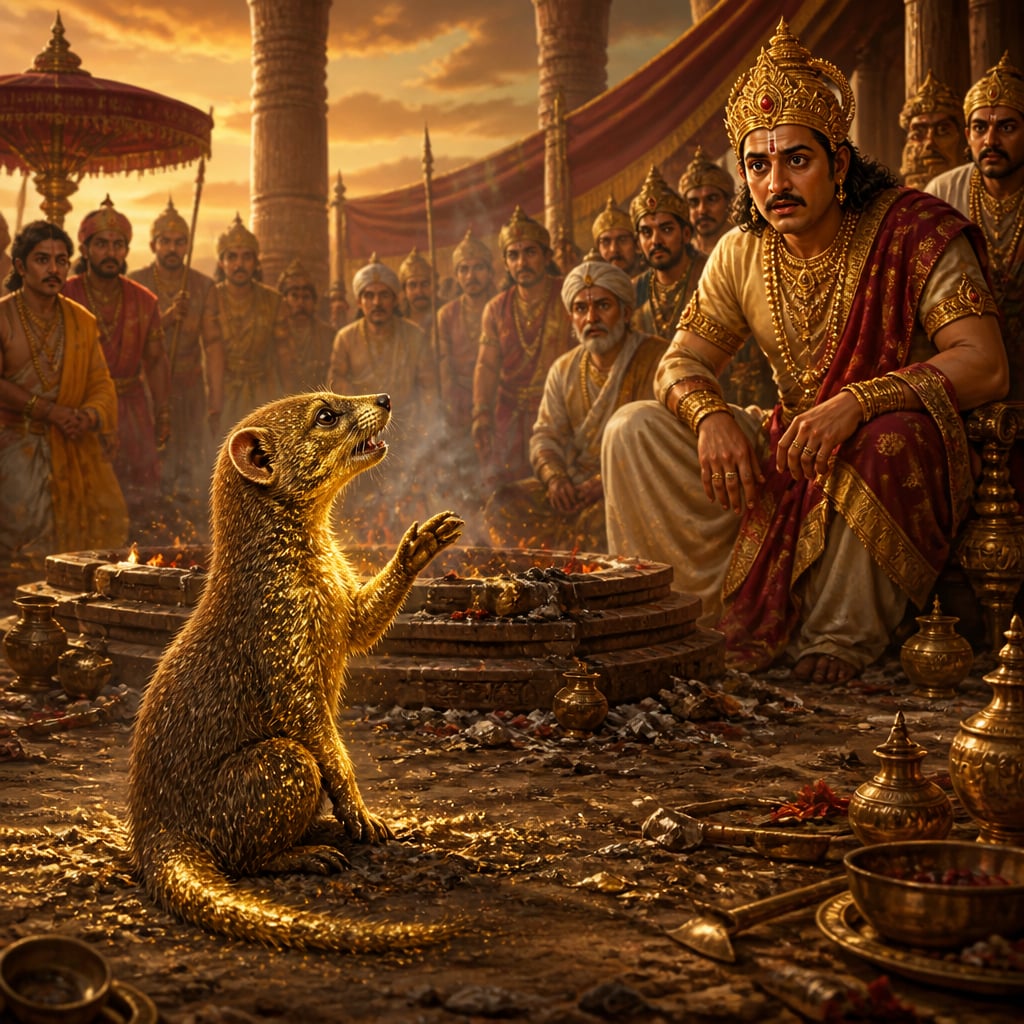
The assembled onlookers, those who had not yet departed, stood frozen. A talking mongoose was strange enough. But its words were stranger still: a claim that the grandest sacrifice in living memory did not match some unknown Brahmin's gift.
Yudhishthira stepped forward. His characteristic doubt had found a new focus.
"Who are you?" he asked. "And what is this gift you speak of that surpasses the Ashvamedha?"
"I am a witness," the mongoose replied. "A witness to what true giving looks like. Sit, O king, and I will tell you."
The Story of Unchhavritti
Many years ago, the mongoose began, in a small village not far from where we now stand, there lived a Brahmin named Unchhavritti. His name meant "one who lives by gleaning", that is, one who survives by gathering the grains that fall from harvested fields, too poor to grow his own crops or buy from others.
Unchhavritti lived with his wife, his son, and his daughter-in-law. Four people, one mud hut, and never enough to eat. But Unchhavritti was content, for he had something more valuable than wealth: he had dharma. He performed his daily rituals, maintained his Brahminical duties, and trusted that his poverty was a test rather than a punishment.
Then came the famine.
| Before the Famine | During the Famine |
|---|---|
| Gleaned grain from fields | Fields lay barren |
| Simple but sufficient meals | Days without food |
| Hope for better times | Death approaching |
The rains had failed. The fields produced nothing to glean. For days, then weeks, Unchhavritti's family ate nothing but water and wild leaves. They grew thin. They grew weak. Death circled their hut like a patient vulture.
The Miraculous Flour
One day, after so many foodless days that counting seemed pointless, Unchhavritti found something. In a corner of an abandoned granary, hidden beneath debris, he discovered a handful of barley flour. Just enough, when divided carefully, for each family member to have one small portion.
With trembling hands, he brought the flour home. His wife, Dharmavrata ("devoted to dharma"), made four small cakes from it, one for each of them. The family sat together, ready to eat their first real food in weeks.
Unchhavritti lifted his portion to his mouth.
There was a knock at the door.
The Guest
"I am a hungry traveler," the voice said. "I have heard that a Brahmin lives here who honors the dharma of hospitality. Is this true?"
Unchhavritti looked at the cake in his hand. He looked at his family, wife gaunt, son hollow-eyed, daughter-in-law barely able to stand. He looked at the stranger in his doorway, a man with the unmistakable marks of Brahminical learning.
Hospitality was dharma. Turning away a hungry guest was sin. But surely there was an exception when one's own family was starving?
"There is no exception," Unchhavritti said aloud, answering his own thought. "Dharma does not bend to convenience. Come, friend. Eat."

He gave his cake to the stranger.
The traveler ate. When he finished, his hunger was not satisfied.
"I am still hungry," he said. "Do you have more?"
The Wife's Portion
Dharmavrata looked at her husband. She understood. Without a word, she offered her own cake to the guest.
"Wife, you need not, " Unchhavritti began.
"What is my dharma if not to support yours?" she replied. "If you give to the guest, then so do I. We walk this path together."
The stranger ate the second cake. His hunger remained.
"I am still hungry," he said again.
Now the son spoke: Dharmasena, named for his father's devotion. "Take mine. If my parents have given their portions, how can I keep my own? The dharma of sons is to follow their fathers."
The third cake was eaten. The stranger's hunger persisted.
"I am still hungry."
The Daughter-in-Law's Choice
All eyes turned to the daughter-in-law, Subhadra, the newest member of the family, married to Dharmasena only the year before. She held the last cake, the final food in the household.
She was not bound by the same dharma as the others. She could keep her portion. No one would blame her, she had married into this family, not chosen its poverty.
But Subhadra looked at her husband, at her parents-in-law, at the stranger whose hunger seemed bottomless. She understood something: that dharma is not a calculation of obligation, but a recognition of what must be done.
"I came to this family to share its life," she said quietly. "How can I share its life if I do not share its dharma?"
She gave away the last cake.
The stranger ate. And then, everything changed.
The Revelation
The stranger's form began to shift and glow. The shabby traveler became radiant, luminous, unmistakably divine.
"I am Dharma himself," the figure announced. "I came to test you, and you have passed beyond all expectation. You have given not from abundance but from desperate need. You have given not just what you could spare but what you could not spare. This is the truest giving, the giving that costs everything."
The family stood in stunned silence. They had given away their only food. They would die of starvation. But they had kept their dharma, and Dharma himself had witnessed.
"Your reward awaits you in heaven," the god continued. "No palaces await you on earth, that was never your path. But your souls will ascend to the highest realms, where those who gave everything receive everything in return."
The vision faded. The family sat in their empty hut, foodless, but somehow at peace.
They died that night, all four of them, quietly, in their sleep. Death came not as a thief but as a messenger, carrying them upward.
The Mongoose's Transformation
"And I?" the mongoose continued, back in the sacrificial arena, speaking to Yudhishthira and the assembled listeners. "I was living nearby. After the family departed their mortal forms, I crept into their hut, curious.
"I rolled in the dust where those four cakes had been prepared, in the flour that had scattered, in the earth that had absorbed the presence of Dharma himself. And when I emerged..."
The mongoose displayed its body, the gleaming golden half.
"Half of me was transformed. Half of me became golden from contact with the remains of that sacrifice."
"And since then," the mongoose said, "I have traveled to every great yajna in the land. The Rajasuya of kings. The great fire sacrifices of emperors. And now, this Ashvamedha, the grandest sacrifice of the age, funded by Marutta's legendary treasure.
"At each one, I have rolled in the sacred dust, hoping to complete my transformation. But none of them has changed even a single hair on my remaining brown half."
The Meaning
Yudhishthira sat in silence, absorbing the story. The mongoose's judgment was clear: the Ashvamedha, for all its grandeur, did not equal the simple meal of a starving Brahmin family.
But why?
"You gave from abundance," the mongoose explained, as if reading his thought. "Marutta's treasure was vast. You gave much, but you still had more. The family of Unchhavritti gave from nothingness. They gave everything they had, literally everything. There was no 'more' left. That is the difference."
"But I did what was prescribed," Yudhishthira protested gently. "The Ashvamedha is the greatest of sacrifices. The shastras say so."
"The shastras measure ritual correctness," the mongoose replied. "I measure something else: the completeness of surrender. Unchhavritti and his family surrendered completely, their food, their survival, their very lives. What did you surrender, O king? What did you actually lose?"
Yudhishthira had no answer.
The Departure
The mongoose turned to leave, its purpose fulfilled. But before it disappeared into the twilight, it offered one final teaching:
"Do not despair, O king. Your sacrifice was good, it fed the hungry, clothed the poor, established peace. It was dharmic. But understand that dharma has heights beyond what ritual can reach. The truest sacrifice is not performed in grand arenas with priests and fires. It is performed in humble huts by people who give away their last grain without any witness but their own conscience."
"If you wish to equal what that family gave," the mongoose concluded, "do not perform another yajna. Instead, find a moment when you can give everything, not everything you have, but everything you are. That is the sacrifice the gods value most."
The half-golden creature padded out of the arena and vanished into the gathering darkness.
The Lesson Absorbed
Long after the mongoose had gone, Yudhishthira remained in the arena. His brothers came to check on him. Draupadi sent messengers. But he sat alone, thinking.

The mongoose had not condemned his sacrifice. It had simply... contextualized it.
All the gold, all the ritual, all the acknowledgments of kings, these were good things. They had established his sovereignty and healed his kingdom. But they were not the highest things. The highest thing was something simpler, something available to anyone: the willingness to give without remainder.
What would I give, Yudhishthira wondered, if I had nothing but one meal, and a stranger appeared at my door?
He did not know. He hoped he would pass the test. But he could not be certain.
And perhaps that was the mongoose's real gift: not judgment, but humility. The reminder that even an emperor's greatest achievement could be exceeded by a beggar's complete surrender.
The Ashvamedhika Parva draws toward its close with this teaching. The sacrifice is complete. The sovereignty is established. But the deepest lesson, that true giving costs everything, remains for each person to learn in their own way.
Living traditions
The mongoose story continues to influence modern Indian discussions about philanthropy and social responsibility. It is often cited when questioning whether giving from abundance truly constitutes sacrifice, and whether modern charitable giving, with its tax benefits and social recognition, matches the dharmic standard of total giving. The story challenges the comfortable assumption that writing large checks is equivalent to the complete surrender that transforms both giver and receiver.
- Atithi Devo Bhava: The principle that 'the guest is God', a foundational teaching of Hindu hospitality that requires treating unexpected visitors as divine. The mongoose story is often cited as the ultimate expression of this principle.
- Kurukshetra Pilgrimage Sites: The region associated with both the great war and, in some traditions, the location of Unchhavritti's village. Pilgrims visit to connect with the profound spiritual events described in the Mahabharata.
- Dana Mandapas (Charity Halls): Many temples maintain specific halls for food distribution, inspired by teachings like the mongoose story. The principle of feeding the hungry regardless of their status connects to Unchhavritti's dharma.
Reflection
- The mongoose asked what Yudhishthira actually lost through his giving. Ask yourself the same question: when you give, what do you actually sacrifice? What would it mean to give until you felt real loss?
- Unchhavritti's family gave away their survival, trusting that hospitality was worth more than life. Is there any principle you would sacrifice your survival for? Is there anything more important to you than your own continuation?
- The mongoose's half-golden body served as a visible measure of sacrificial merit. If you had such a visible measure of your own giving over time, what would it show? Would you want others to see it?