Relevance in 2026 and Beyond

Succession, Sacrifice, and What We Leave Behind

How the Ashvamedhika Parva's teachings on succession planning, true sacrifice, and rebuilding after catastrophe apply to modern leadership, family businesses, and philanthropy.

The Question Nobody Wants to Ask

Your organization has just survived its worst crisis. Reputations are salvaged, the bleeding has stopped, and everyone wants to move forward. But one question hangs in the air, asked in whispers if at all: Who comes next?

Succession. The word itself feels like an admission of mortality. Yet how this question is answered, or avoided, shapes everything that follows. Do you name an heir and risk being sidelined? Do you wait and risk chaos? Do you choose competence over connection, or trust bloodlines over merit?

The Modern Challenge

We're living through a generational transition unprecedented in scale. In India alone, an estimated $1 trillion in wealth will transfer between generations over the next decade. Globally, 70% of family businesses fail in the transition to the second generation; 90% don't survive to the third.

The numbers tell one story. The headlines tell another. The Ambani family's careful choreography of Mukesh Ambani's children into Reliance leadership. The painful public battle over Subrata Roy's Sahara empire after his death in 2023. The quiet crisis at Tata Sons when Cyrus Mistry was abruptly removed, a drama that played out in courts for years before his tragic death in 2022.

These aren't abstract governance problems. They're questions about identity, legacy, and love. When a founder steps back, are they diminished? When children take over, do they honor or erase their parents? When an organization outlives its creator, what carries forward?

The modern world has created elaborate mechanisms to handle succession, boards, trusts, voting structures, executive search firms. Yet the deeper questions remain stubbornly personal. What makes someone worthy of inheriting not just assets, but meaning?
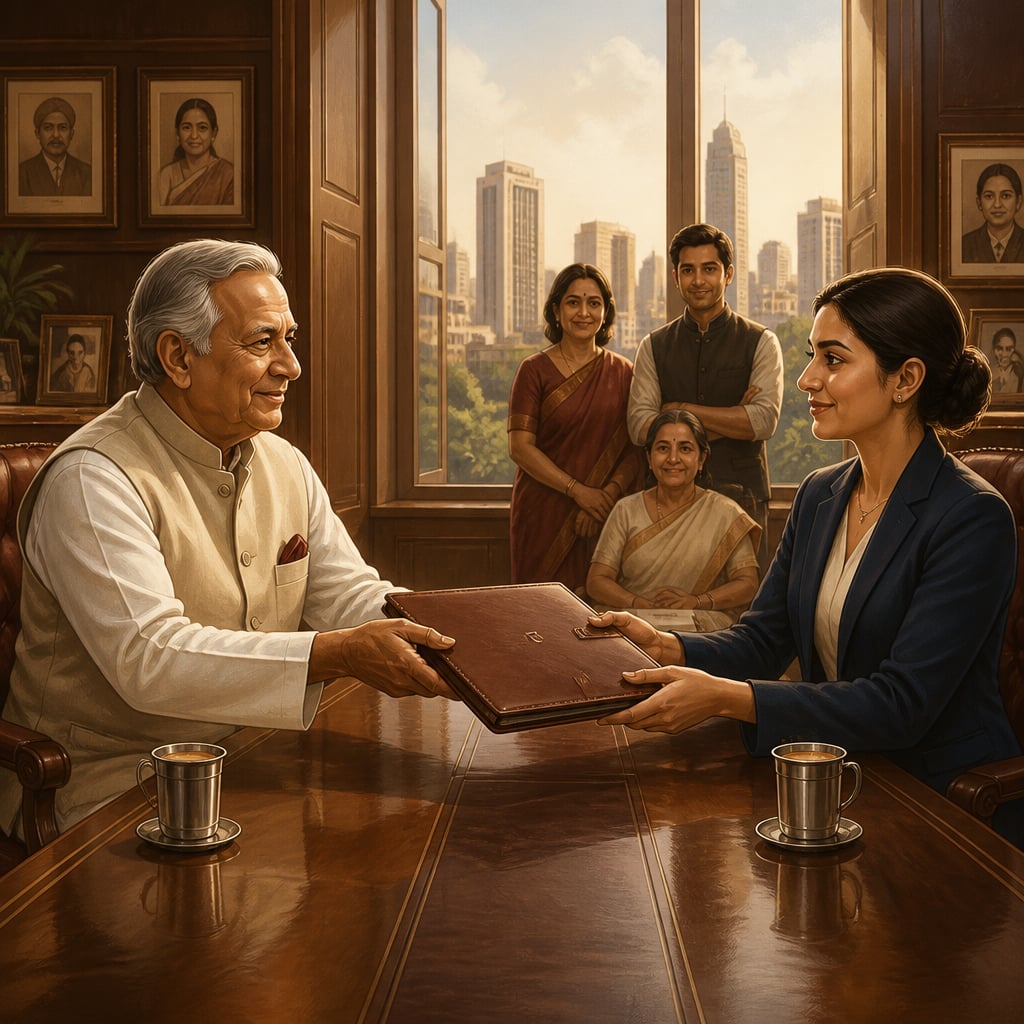
An elderly Indian business leader hands a leather-bound corporate folder across a conference table to his adult daughter.

What the Ashvamedhika Parva Actually Teaches

The Pandavas faced succession under the worst possible circumstances. They had just fought a war that killed nearly everyone, their teachers, their cousins, their friends, an entire generation. Their heir was an unborn child, nearly killed in the womb by their enemy's final weapon.

Yudhishthira's response was the Ashvamedha yajna, a year-long ritual that served multiple purposes simultaneously. It purified the kingdom of war's sins. It established his authority to rule without constant challenge. It generated wealth through tribute rather than conquest. And most importantly, it created time and structure for the kingdom to heal while the next generation grew.

But the parva's deepest teaching comes in its final episode: the golden mongoose. A creature appears at Yudhishthira's grand sacrifice and declares it inferior to a poor man's gift of a handful of flour, because that flour was given at the cost of the giver's life, while Yudhishthira gave from abundance.

The mongoose's judgment is uncomfortable: scale doesn't equal sacrifice. A billionaire's charity foundation, staffed with hundreds and dispensing millions, may mean less than a working family's decision to sponsor one child's education at genuine cost to themselves.

The Bridge: Ancient Wisdom, Modern Application

Succession Isn't a Transaction, It's a Ritual

When Yudhishthira performed the Ashvamedha, he wasn't simply filing paperwork to transfer power. He was creating a shared experience that aligned the kingdom around his authority. The ritual took a full year. It involved every part of society. It created stories people could tell.

Modern succession often fails because it's treated as a legal event rather than a cultural transformation. When Ratan Tata stepped back from Tata Sons, the initial transition to Cyrus Mistry collapsed partly because there was no equivalent ritual, no shared process that made the new leader's authority feel legitimate to all stakeholders. The organization had changed its paperwork but not its story.

Contrast this with how Narayana Murthy handled Infosys succession, a deliberate, visible, multi-year process of stepping back that gave the organization time to transfer not just authority but loyalty.

True Sacrifice Has Real Costs

Corporate Social Responsibility budgets now run into billions globally. Companies compete to announce larger pledges, grander foundations, more ambitious commitments. Yet the mongoose's question persists: what did it actually cost you?

A modern philanthropist giving quietly without publicity

MacKenzie Scott's approach to philanthropy, giving away $17 billion since 2019 with minimal publicity and no strings attached, represents something closer to the flour giver's spirit than the typical foundation model. She's not optimizing for recognition or control. She's simply giving.

This doesn't mean large-scale philanthropy is worthless. It means we should be honest about what it is and isn't. A foundation that employs hundreds and generates positive press is a business, not a sacrifice. That's fine, but calling it sacrifice confuses the categories.

Sometimes the Heir Must Fight the Parent

The Babhruvahana episode, where a son unknowingly battles and kills his father, captures something uncomfortable about succession: sometimes the new generation must symbolically defeat the old. Not out of hatred, but necessity.

Every family business faces this moment. Does the founder's child implement their own vision, even if it contradicts the founder's? The Murugappa Group's careful navigation of this tension across generations offers a template: honor the founder's values while allowing methods to evolve. The Adani Group's rapid expansion under the second generation shows another path, dramatic growth that transforms the founder's vision entirely.

Neither approach is right or wrong. But both require something difficult: the parent must allow themselves to be surpassed, and the child must be willing to surpass.

Addressing the Skeptics

Skeptical readers might reasonably ask: What can a 2,000-year-old horse sacrifice possibly teach us about modern corporate governance?

They have a point. We shouldn't pretend the Mahabharata anticipated SEBI regulations or private equity structures. The technical machinery of modern succession has no Vedic equivalent.

But the human dynamics haven't changed. Parents still want to be remembered. Children still want to be respected. Organizations still need their transitions to feel legitimate, not just legal. The Ashvamedhika Parva addresses these permanent problems.

The other objection is more personal: "I don't have an empire to pass on. Why should I care about succession?" But succession isn't just about wealth. It's about meaning. What do you hope to pass on to your children, and are you building systems that make that transfer possible? The question applies to family recipes as much as family fortunes.

Your Practice Begins Now

Three takeaways to carry forward:

On succession: Start the conversation earlier than feels comfortable. Yudhishthira began preparing for the next generation while that generation was still in the womb. What are you doing now to prepare whoever comes after you, in your work, your family, your communities?

On sacrifice: Audit your giving for real cost. Not tax-efficient donations from surplus, but gifts that change how you live. The mongoose's standard is demanding, and clarifying.

On healing: If you're leading an organization through recovery, remember that rituals matter. Create shared experiences that help people process what happened and believe in what comes next. Don't just announce the new strategy, give people time to grieve the old one.

More in Ashvamedhika Parva

All lessons in Ashvamedhika Parva ยท The Mahabharata course