Ashvamedha: The Horse is Released
The horse sacrifice begins
With Marutta's ancient gold retrieved from the Himalayas, Yudhishthira possesses the wealth to perform the grandest sacrifice of his reign. The Ashvamedha yajna, the horse sacrifice, will proclaim his sovereignty, purify the kingdom, and establish his dynasty's legitimacy. As a magnificent stallion is selected and released, Arjuna prepares to follow it wherever it may roam.
The Gold of Marutta
The Pandavas returned from the Himalayas transformed. Where they had departed with empty hands and heavy hearts, they came back with wagons groaning under the weight of ancient gold. Marutta's treasure had revealed itself, just as Vyasa had promised, not to the greedy, but to those who sought it for righteous purpose.
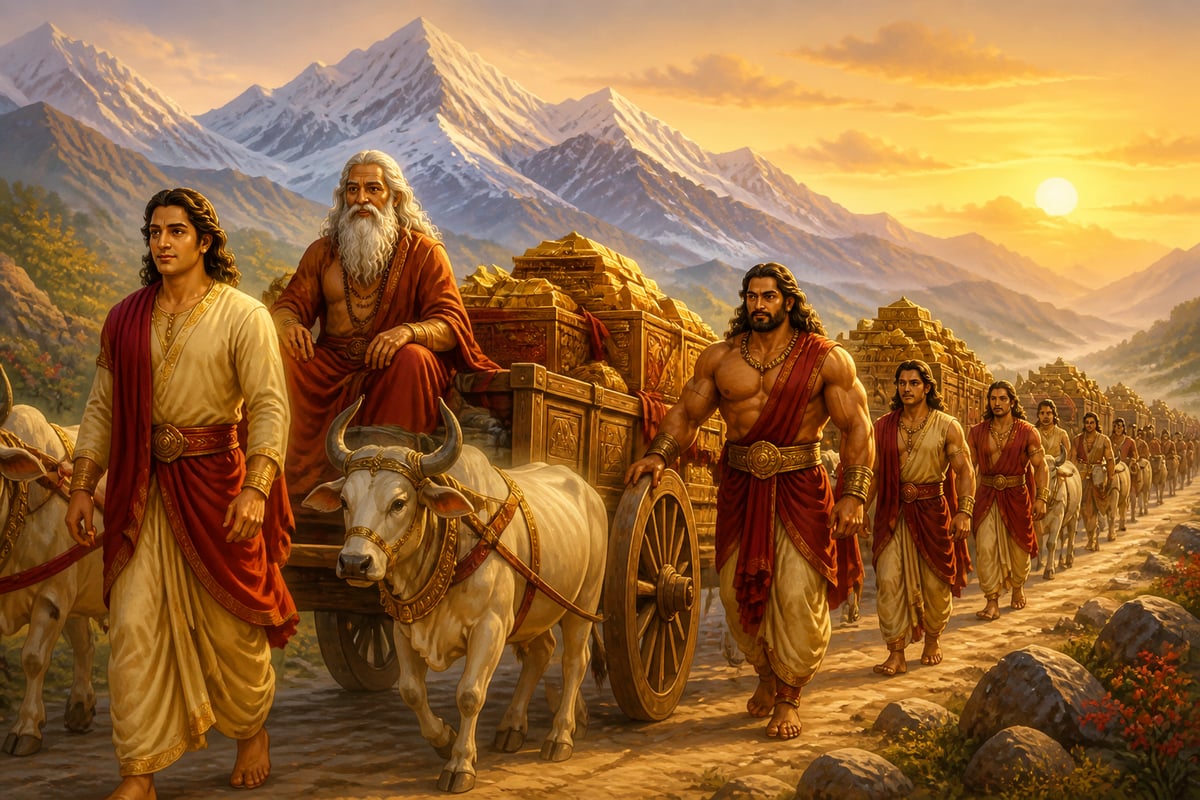
The gold gleamed with a light that seemed almost alive. It had lain undisturbed since the age of Marutta, thousands of years before, waiting for hands worthy to claim it. Now it would serve its destined purpose: to fund a sacrifice that would sanctify a war-won kingdom.
Yudhishthira stood before the treasure, remembering Bhishma's words about kingship. The grandfather had taught that a king's wealth was not his own but a trust held for the people. This gold would not fill palace vaults, it would flow outward, feeding the hungry, paying for rituals, restoring what war had broken.
"We did not win this treasure," Yudhishthira told his brothers. "It was given to us for a purpose. Every grain of it must serve dharma, not desire."
The Decision to Sacrifice
The decision to perform the Ashvamedha yajna had been made, but now it required execution. No mere temple ritual, the horse sacrifice was the most elaborate ceremony known to Vedic tradition, a year-long undertaking that tested not just a king's wealth but his very claim to rule.
The essential elements were daunting:
| Requirement | Purpose | Scale |
|---|---|---|
| The Horse | Symbol of royal power | A stallion of perfect quality, without blemish |
| The Army | To follow and protect | Arjuna with a full akshauhini |
| The Priests | To perform rituals | Hundreds of Brahmins led by Vyasa |
| The Wealth | To fund and give away | Gold, cattle, grain in vast quantities |
| The Time | For the horse to wander | One full year of wandering |
"If any king captures or kills the horse," Vyasa explained to the assembly, "it is a declaration of war. If the horse's protector is defeated, the sacrifice fails. But if the horse completes its journey and returns, the sacrificer's sovereignty is established beyond all challenge."
Selecting the Sacred Horse
The search for the perfect horse began with rituals. Priests chanted mantras as royal grooms examined every stallion in the Pandava stables. The requirements were precise: the horse must be young but not immature, black on the right ear but otherwise of a specific color prescribed by the shastras, with no marks of inauspiciousness.
After seven days of searching and praying, they found him.
He was a stallion of midnight black with a single white star on his forehead, a mark that the priests declared supremely auspicious. His name was Devadatta's Successor, descended from the divine horses of Indra's stable. When he moved, his muscles rippled like waves on dark water. When he stood still, he seemed carved from obsidian.
Nakula, the Pandava brother most skilled with horses, examined the animal personally.
"This one has the spirit of the wind," he reported. "He will not be easily caught. Whoever follows him will need not just martial skill but patience, the horse will go where he wills, not where we would choose."
The Ritual Preparations
Three months of preparation preceded the horse's release. The priests constructed a massive sacrificial arena on the banks of the Ganga near Hastinapura. Yupa posts, the sacred pillars to which offerings would be bound, rose in precise geometric patterns. Fire pits were dug according to calculations that dated back to the Rig Veda itself.
Draupadi oversaw the household preparations. Though she had lost all her sons, though grief still lived in her eyes, she performed her duties as chief queen with the precision that Bhishma had once praised. Subhadra assisted her, and together they ensured that the women's rituals were conducted flawlessly.
The queens of subordinate kingdoms arrived to participate, for this was not merely a Pandava affair. The entire Bharatavarsha was being reconstituted after the war, and the Ashvamedha was the ceremony of reconstitution. Kings who had survived Kurukshetra on either side came to witness, their very presence an acknowledgment of Yudhishthira's supremacy.
Arjuna's Commission
There was never any question about who would follow the horse. Arjuna was the obvious choice, the greatest warrior of the age, wielder of the Gandiva bow, friend and devotee of Krishna. Only he possessed both the martial prowess to defeat any challenger and the diplomatic skill to avoid unnecessary conflict.
But Arjuna himself hesitated.
"Brother," he said to Yudhishthira, "I am weary. Abhimanyu is dead. Krishna has returned to Dwaraka. The war consumed something in me that I have not yet recovered. Is there not another who could take this duty?"
Yudhishthira understood. He placed his hand on Arjuna's shoulder.
"There is no other. Bhima is needed here to protect the capital. Nakula and Sahadeva must manage the kingdoms. And you alone have the reputation that will give kings pause before challenging. Most will submit when they see your banner, not from fear alone, but from respect."
"Remember what Krishna taught you on the battlefield," Yudhishthira added gently. "You fought then when you wanted to withdraw. Fight now for the same reasons, not because you desire victory, but because it is your duty."
Arjuna closed his eyes. When he opened them, the hesitation had been replaced by resolve.
"I will follow the horse. I will fight only when I must and offer peace when I can. And when the year is done, I will bring him home."
The Binding Rituals
On the day of release, the sacrificial arena overflowed with observers. Kings, priests, merchants, and common folk had gathered to witness the beginning of what would be remembered for generations.
The horse stood in the center of the arena, decorated with garlands but not yet sanctified. Priests surrounded him, their chants rising in the ancient Vedic meters that predated even the Mahabharata's events.
Vyasa himself, the great sage who had composed this very epic, led the critical mantras:
"Let this horse wander free as the sun wanders the sky. Let him cross rivers and mountains, forests and deserts. Whoever opposes his path opposes the sun itself. Let the king who releases him become the sovereign of all lands the horse touches."
Ghee was poured on the sacred fires. The smoke rose straight up, an auspicious sign that the gods approved. Gold coins were distributed to the Brahmins. Cattle were gifted to the poor. For this moment at least, the bloodshed of Kurukshetra seemed distant.

The Release
The moment came. The ropes were cut. The garlands were removed. The horse, feeling suddenly free, reared once, his front hooves pawing the air as if testing the wind, and then he ran.
He ran toward the east, toward the rising sun, toward the lands that had once belonged to Karna and before him to unknown kings of the dawn. The gathered assembly watched as the magnificent animal grew smaller and smaller, a dark shape against the morning light, until he vanished over the horizon.
Arjuna mounted his own horse, a white stallion named Meghapushpa, "Cloud Flower", and raised his hand in salute to his brothers.
"I go," he said simply. "One year from today, either I return victorious, or you receive news of my defeat."
"You will not be defeated," Bhima growled. "Any king fool enough to challenge you will regret it for however long he lives, which will not be long."

Draupadi stepped forward and touched Arjuna's feet, an unusual gesture from wife to husband, reversing the normal order. But she was not blessing him as a wife; she was acknowledging him as the warrior who would avenge, through legitimate sovereignty, the humiliation she had suffered in the Kaurava court.
"Go safely," she said. "And return to a kingdom worthy of your sacrifice."
The Nature of the Challenge
As Arjuna rode out with his army following at a distance, he considered what lay ahead. The Ashvamedha was not merely a military campaign. It was a test of multiple virtues:
- Courage: To face any challenger without hesitation
- Restraint: To avoid unnecessary bloodshed when submission was offered
- Wisdom: To recognize which battles were worth fighting
- Endurance: To follow the horse for an entire year, regardless of terrain or weather
- Faith: To trust that the sacrifice would achieve its purpose
The horse would enter many kingdoms. Some kings would immediately submit, offering tribute and acknowledgment of Yudhishthira's sovereignty. Others would test Arjuna's resolve with words before submitting. A few would fight.
And at least one encounter, Arjuna knew, would change everything he understood about himself and his family. But that knowledge lay in the future. For now, there was only the road, the horse, and the duty that Krishna had taught him to embrace without attachment.
The Kingdom Waits
Back in Hastinapura, the remaining Pandavas settled into a rhythm of waiting. The sacrificial fires would be maintained continuously for the entire year, an army of priests taking shifts to ensure the flames never died. The queens performed daily rituals. The treasury was prepared for the vast distributions that would occur when the horse returned.
Yudhishthira, for the first time since the war, found moments of peace. He visited Parikshit daily, watching the infant who would one day inherit all of this. He met with subordinate kings who came to pledge allegiance. He administered justice, remembering Bhishma's teachings on rajadharma.
But always, part of his mind followed the black horse and his brother, wondering where they were, what challenges they faced, whether the sacrifice would succeed.
"A king must learn patience," Vidura counseled him. "You cannot control what happens in distant lands. You can only ensure that what happens here is worthy of whatever sacrifice Arjuna makes."
Yudhishthira nodded. The kingdom Arjuna would return to, if he returned, must be worth the journey. That was his task now: to build, to heal, to prepare for the future that Parikshit represented.
The Ashvamedha had begun. The horse ran free. And across Bharatavarsha, kings looked to the east and wondered when the black stallion would appear on their borders.
Living traditions
While the literal Ashvamedha is no longer performed, its symbolism persists in Indian political and corporate culture. Leaders who undertake ambitious initiatives that 'test' their authority across regions invoke the Ashvamedha framework metaphorically. The emphasis on legitimacy through demonstrated service rather than mere power remains central to Indian leadership philosophy. The ritual's environmental elements, the horse wandering freely through natural terrain, have even been invoked in discussions about sustainable development and respect for natural boundaries.
- Ashvamedha Parva Recitation: Traditional recitations of the Ashvamedhika Parva during auspicious occasions, particularly during major yajnas or when a new venture is being inaugurated, invoking the blessings of successful completion
- Yajna Sthal at Kurukshetra: Traditional site associated with various yajnas performed after the Mahabharata war. The area contains multiple sacred tanks (kundas) where rituals were traditionally performed.
- Sannihit Sarovar: The sacred tank where it is believed all tirthas (holy waters) gather during lunar eclipses. Associated with the purification rituals that accompanied the Ashvamedha and other post-war ceremonies.
Reflection
- Arjuna hesitated before accepting his duty, admitting he was weary. Have you ever had to continue with a responsibility despite wanting to rest? How did you find the resolve to continue, and what sustained you through that period?
- The Ashvamedha was meant to establish legitimate sovereignty through demonstrated service, not just military power. In your own areas of influence, family, work, community, how do you distinguish between authority you hold and authority you've earned through service?
- Marutta's treasure was hidden for ages, waiting for a worthy purpose. Is there something in your life, a skill, a resource, a connection, that might be waiting for its true purpose? How would you recognize that purpose when it appears?