Uttarayana: The Northern Journey

Sun turns north at solstice

After fifty-eight days of waiting, the moment arrives. The winter solstice passes and the sun begins its northern journey. Bhishma, who has held death at bay through sheer will, now prepares for his final departure. As sages, kings, and gods gather to witness this extraordinary moment, the grandsire delivers his ultimate teachings on the journey of the soul and the cosmic significance of leaving during the light half of the year.

The Dawn of Uttarayana

Fifty-eight sunrises had painted the sky above Kurukshetra since Bhishma fell. Fifty-eight sunsets had found him still teaching, still giving, still waiting. On the fifty-ninth dawn, something changed.

Yudhishthira arrived at the arrow bed as usual, but found the air different, charged with an energy that made the hairs on his arms stand up. Bhishma's eyes, which had grown dim with pain and exhaustion over the weeks, now blazed with a fierce, almost terrible light.

"It has turned," Bhishma said, his voice stronger than it had been in days. "The sun has begun its northern journey. Uttarayana has begun."

The winter solstice had passed in the night. While the world slept, the great cosmic wheel had turned. The sun, which had been traveling south since the summer, had reached its lowest point and now began climbing north again.

The Gathering

Word spread across Hastinapura, across the surviving camps, across all the kingdoms that had sent warriors to die at Kurukshetra. The grandsire would depart today.

By midday, the plain around the arrow bed had become a vast assembly. The five Pandavas stood closest, their eyes red with unshed tears. Krishna stood beside Arjuna, his face serene but watchful. The great sages had gathered, Vyasa, Narada, Asita, Devala, and countless others whose names would be remembered for millennia.

Draupadi came, the woman who had seen her sons slaughtered, who had lost almost everything. Kunti came, the mother who had hidden secrets that broke kingdoms. Gandhari came, the blindfolded queen whose curse still echoed through time.

And others came whom mortal eyes could barely perceive, the Vasus, the celestial beings to whom Bhishma truly belonged. Ganga herself, invisible to most but not to her son, hovered near, waiting to receive him.
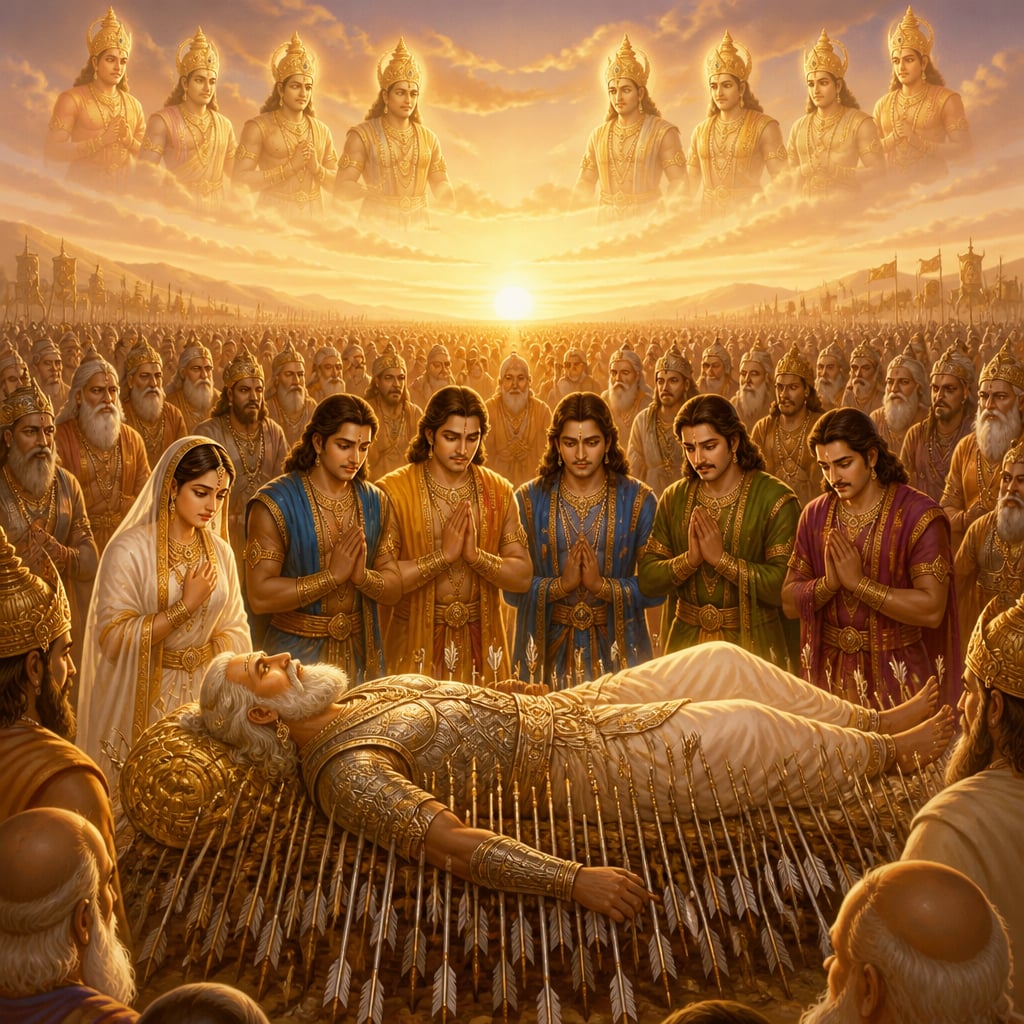
Bhishma on his bed of arrows is surrounded by a vast assembly at the dawn of Uttarayana, the Pandavas closest, Draupadi and the sages and kings in concentric rings, the eight Vasus faint in the sky above.

The Final Morning

Bhishma looked at the vast assembly and smiled, a smile of completion, of fulfillment, of a duty about to be discharged.

"I have lived long," he said. "Perhaps too long. I have seen the golden age of Shantanu and the iron age of his descendants. I have watched dharma honored and dharma violated. I have served kings both wise and foolish. Now the time has come to go."

Yudhishthira stepped forward, his voice breaking. "Pitamaha, we are not ready. We still have so much to learn."

Bhishma's eyes softened. "A teacher's greatest fear, and a teacher's greatest joy, students who want more. But child, I have given you everything I have. What remains, you must discover for yourself."

The Teaching on Death

As the sun climbed toward noon, Bhishma spoke of the one subject he had not yet addressed: death itself.

"People fear death," he said, "because they do not understand it. They think of it as an ending. But it is a doorway."

He explained the ancient teaching: those who die during Uttarayana, when the sun travels north, find an easier passage. Their souls travel the path of light, through the flame, to the day, to the bright half of the month, to the six months of the northern course, to the year, to the sun, to the moon, to lightning, and from lightning to Brahman.

"This is the Devayāna," Bhishma said, "the path of the gods. Those who die during Dakshinayana, when the sun travels south, take the path of smoke, they return to be reborn. But those who die in the light go to the light and return no more."

"And you have waited all these days," Arjuna whispered, "for this moment."

"I have waited all my life for this moment," Bhishma corrected. "The boon of icchā-mrityu was not just about choosing when to die. It was about understanding that this choice itself is the final dharma, aligning one's departure with the cosmic order."

The Cosmic Alignment

Krishna spoke then, his voice carrying clearly across the vast assembly.

"What Pitamaha does today is rare among mortals. Most are carried away by death like leaves in a flood. But one who has mastered the self can choose the moment of departure, and in that choosing, complete the final yoga."

Bhishma looked at Krishna with something like gratitude. "You know, Keshava. You have always known. The thousand names I recited, they were preparation for this moment. When the soul departs, if it departs with the Divine Name on its lips, the pathway is illumined."

He began to withdraw his senses, starting from his feet. The Pandavas watched in awe as a golden light began to glow around the arrow bed. The arrows themselves, those instruments of agony, seemed to shimmer and fade.

The Meaning of Uttarayana

Before withdrawing completely, Bhishma paused to deliver one final teaching:

"Uttarayana is not just an astronomical event. It is a metaphor for the spiritual journey. The soul that has been traveling south, downward into matter, into darkness, into forgetting, must eventually turn north, upward toward light, toward remembrance, toward home."

"Everyone must make this turn. For some it happens at death. For the wise, it happens while living. The moment you turn from selfishness to selflessness, from ignorance to wisdom, from fear to love, that is your personal Uttarayana. That is when your northern journey begins."

Vyasa, the great sage who was recording everything for posterity, stepped forward. "Grandsire, is there anything you wish preserved that we have not yet recorded?"

Bhishma's eyes seemed to look beyond the physical assembly, into some vast space where all knowledge exists. "I have spoken of dharma, of giving, of sacrifice, of truth. I have recited the thousand names of the One who has no name. What remains cannot be spoken, it can only be experienced. Preserve the words, Vyasa, but remind those who read them that the words are fingers pointing at the moon. They must look at the moon, not the finger."

The Last Teachings

Bhishma giving each Pandava his final blessing

As the sun reached its zenith, Bhishma called each of the Pandavas to him one last time.

To Yudhishthira: "Rule with dharma, but remember that dharma itself evolves. What was righteous in my time may need adaptation in yours. The letter of the law is less important than its spirit."

To Bhima: "Your strength is legendary, but your greatest battle will be with your own nature. The anger that made you victorious in war can destroy you in peace. Channel it into protecting the weak."

To Arjuna: "You were the greatest warrior, but your true greatness lies not in what you did but in why you hesitated. That moment of doubt before the battle, when you questioned everything, that was your finest hour. Never lose the capacity to question."

To Nakula: "Beauty and skill are gifts, but wisdom is earned. You have been overshadowed by your brothers in the songs that will be sung, but know that I have seen your quiet strength. In the shadows, you have held them together."

To Sahadeva: "You who know what is to come, your burden is the heaviest. To see the future and be unable to change it requires a courage different from battle. Bear it with grace."

The Night of Vigil

As afternoon stretched toward evening, a strange thing happened. The sun, which should have been setting, seemed to pause. Later, sages would debate whether this was Krishna's intervention, or Bhishma's own spiritual power, or simply a mercy from the cosmos for a departing soul.

The night vigil of oil lamps around the arrow bed

The entire night became a vigil. No one slept. Bhishma continued to withdraw his consciousness, layer by layer, sense by sense. The Pandavas chanted the Vishnu Sahasranama he had taught them. The sages performed rituals of departure. The celestial beings sang songs that mortals could barely hear but deeply felt.

At dawn, as the sun rose for the first time in the northern sky since the solstice, Bhishma opened his eyes one final time.

"Ganga," he whispered, seeing what others could not. "Mother."

And then, with a sound that some described as the breaking of a great wave and others as the ringing of a distant bell, the soul of Bhishma departed.

The arrows that had held him fell to the ground, empty. Where the grandsire had lain, there was only light, a pillar of golden radiance that rose toward the northern sky and slowly faded into the blue.

The Vasus had taken their brother home.


In the next lesson, we will witness the aftermath of Bhishma's departure, the rituals, the grief, the transformation of Kurukshetra from a battlefield to a place of pilgrimage, and the final lessons his death teaches to the living.

Living traditions

The phrase 'waiting for one's Uttarayana' has entered Indian languages as an idiom for waiting for the perfect moment to act. Bhishma's choice of death timing influences contemporary discussions in India about death with dignity, conscious dying, and palliative care. Makara Sankranti's growing international celebration (as the International Kite Festival in Gujarat) spreads awareness of the Uttarayana concept globally.

Reflection

More in Anushasana Parva

All lessons in Anushasana Parva · The Mahabharata course