Satya: The Power of Truth
Truth as highest dharma
Bhishma proclaims truth as the foundation of all dharma, yet immediately complicates his teaching. Through stories and paradoxes, he reveals that satya is not simple honesty but a subtle art: knowing when truth serves dharma and when it might destroy it. For Yudhishthira, still haunted by his wartime lie about Ashwatthama, these teachings carry the weight of personal reckoning.
The Weight of a Lie
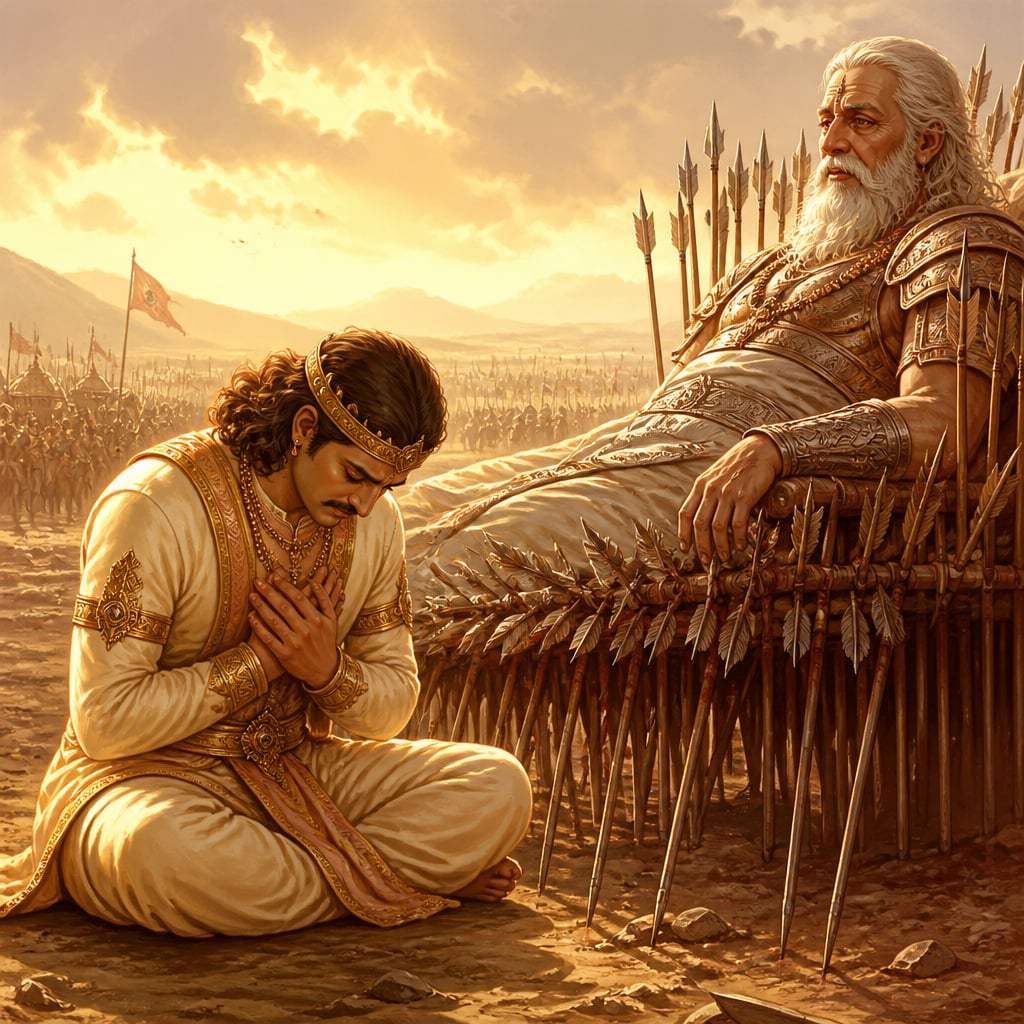
The morning brought clouds to Kurukshetra, unusual after so many clear days. Yudhishthira walked to Bhishma's side carrying more than his usual burden. Today's teaching would touch his deepest wound.
"Grandfather," he said as he settled beside the arrow-bed, "I have listened to your words on giving and sacrifice. But there is something that troubles me more than all the deaths of war."
Bhishma opened his eyes. In their depths, Yudhishthira saw knowing.
"You wish to speak of Drona," the grandsire said. "Of the lie that killed him."
Yudhishthira's face contorted. "I said 'Ashwatthama is dead', then added, barely audibly, 'the elephant.' I spoke truth and falsehood in the same breath. Krishna told me Drona could not be defeated while he held weapons, so we had to break his spirit. And so I, Dharmaraja, the King of Righteousness, I lied."
"And Drona heard only the first part. He believed his son was dead. He dropped his weapons in grief, and Dhrishtadyumna, "
"Beheaded him while he sat in meditation." Yudhishthira's voice cracked. "My teacher. The man who taught me archery. Dead because I deceived him. Tell me, grandfather, tell me about truth. Because I no longer know what it is."
The Highest Dharma
Bhishma was silent for a long moment. When he spoke, his voice carried the weight of centuries.
"Satyam eva jayate nanritam, Truth alone triumphs, not falsehood. This is the foundation upon which all dharma rests."
"Then I am damned," Yudhishthira whispered.
"Listen first. Understand before you judge yourself."
Bhishma explained that satya, truth, was considered the supreme virtue because reality itself was built upon it. The laws that governed the cosmos, the seasons that followed their cycles, the justice that (eventually) rewarded good and punished evil, all these depended on truth. Without satya, nothing could be relied upon. Contracts became meaningless. Promises became empty. Trust became impossible.
"The sages say that truth is the boat that carries us across the ocean of samsara," Bhishma continued. "It is the light by which we navigate. It is the ground on which all other virtues stand. A charitable man who lies corrupts his charity. A brave warrior who lies corrupts his valor. Without truth, nothing is what it seems."
| Virtue | Without Truth |
|---|---|
| Dana (Charity) | Becomes manipulation |
| Shaurya (Bravery) | Becomes theater |
| Vidya (Knowledge) | Becomes deception |
| Bhakti (Devotion) | Becomes hypocrisy |
| Dharma itself | Becomes adharma |
Yudhishthira listened with growing despair. If truth was so essential, then his wartime deception had corrupted everything he had fought for.
The Complication
But Bhishma was not finished.
"And yet," the grandsire said, "truth is not simple. Let me tell you a story."
The Sage and the Robbers
Long ago, a sage named Kaushika lived in a forest. He had taken a vow never to speak anything but the absolute truth, not even a white lie, not even an omission.
One day, a traveler came running through the forest, clearly fleeing for his life. "Please," he gasped, "hide me! Robbers are pursuing me. They will kill me if they find me."
Kaushika pointed to a large hollow tree. The traveler concealed himself inside.
Minutes later, the robbers arrived, brutal men with blood on their swords.

"Sage," they demanded, "we know you speak only truth. Did a man come this way? Where is he?"
Kaushika faced an impossible choice. To lie would violate his vow. To tell the truth would cause the traveler's death.
He told the truth.
The robbers dragged the traveler from the tree and cut his throat before the sage's eyes.
"What happened to Kaushika?" Yudhishthira asked, already knowing the answer would be unexpected.
"He went to hell," Bhishma replied. "His truthfulness, practiced without wisdom, had caused an innocent man's death. The gods ruled that his satya was actually asatya, because truth that serves adharma is not truth at all."
Truth and Dharma
Yudhishthira's mind reeled. "Then when is truth true?"
Bhishma's answer was precise:
"Satyam bruyat priyam bruyat na bruyat satyam apriyam, Speak truth, speak what is pleasant; but do not speak truth that is unpleasant, nor pleasant falsehood."
"Wait," Yudhishthira interrupted. "You just said truth is the highest dharma. Now you say we shouldn't speak unpleasant truth? Which is it?"
"Both. And this is why satya requires wisdom, not merely habit."
Bhishma explained the hierarchy. Truth was the highest virtue, but virtue itself existed to serve dharma. Dharma meant the well-being of all beings, the proper functioning of society, the alignment with cosmic order. Truth served dharma in most cases. But in rare cases, as with Kaushika, literal truth violated deeper truth.
"The truth that killed the traveler was vacha-satya, truth of speech only. But it contradicted dharma-satya, the truth of righteousness. When these conflict, dharma-satya must prevail."
The Lie That Serves Dharma
Yudhishthira felt a door opening, but he was afraid to walk through it.
"So my lie about Ashwatthama..."
"Was it a lie?" Bhishma asked. "Or was it a terrible necessity?"
"Both?"
"Perhaps. Consider: Drona was invincible as long as he fought. His divine weapons were killing thousands of your soldiers every hour. The war could not be won while he stood. And the war had to be won, not for your throne, but because Duryodhana's rule meant the triumph of adharma."
"Krishna said the same thing."
"Krishna speaks for the universe itself. He sees what we cannot see. When he counseled deception, he did so knowing the full weight of cosmic stakes."
But Bhishma did not entirely absolve Yudhishthira.
"The deception was necessary," he said. "But it still wounded you, and that wound is appropriate. A king who lies easily, who feels no cost in deception, is dangerous. Your suffering is not punishment; it is proof that your soul remains oriented toward truth. The lie hurt because you are Dharmaraja. If it had not hurt, you would not deserve that name."
The Spectrum of Satya
Bhishma then taught Yudhishthira to distinguish between levels of truth:
Vacha-Satya (Truth of Speech): Saying what is literally accurate. The most basic level, but also the most easily misused.
Mano-Satya (Truth of Mind): Aligning one's thoughts with reality. Not deceiving oneself. Seeing things as they are, not as one wishes them to be.
Karma-Satya (Truth of Action): Acting in accordance with one's words and beliefs. Integrity between profession and practice.
Dharma-Satya (Truth of Righteousness): Aligning with the cosmic order. Sometimes this requires speaking harshly; sometimes it permits silence or even misdirection when higher goods are at stake.
"The sage Kaushika had vacha-satya," Bhishma observed, "but lacked dharma-satya. He spoke literal truth while violating essential truth. The robbers thanked him for his honesty, and murdered an innocent man."
When to Bend Truth
Yudhishthira asked the question he most needed answered: "When is it permissible to speak less than truth?"
Bhishma listed the traditional exceptions:
To save a life: As Kaushika should have done. Protecting the innocent from harm overrides verbal accuracy.
To prevent greater harm: If truth would cause violence, destruction, or widespread suffering disproportionate to its benefit.
In jest and entertainment: Poets and storytellers do not lie when they tell fables. Everyone understands the convention.
When speaking to enemies in war: Though even here, certain limits apply, one should not falsely offer surrender or safe passage.
To protect the innocent from power: A servant asked by an unjust master whether a fugitive slave passed by need not incriminate the fugitive.
"But notice," Bhishma warned, "each of these exceptions involves serious stakes. They are not licenses for casual dishonesty. The businessman who cheats customers, the spouse who conceals infidelity, the politician who deceives constituents, none of these fall under the exceptions. They are simply liars."
Living Truth
Bhishma shifted from exceptions to essence.
"The deepest satya is not about words at all. It is about being. A person of truth lives without masks. Their inner and outer selves align. They do not perform virtues while harboring vices. They do not claim beliefs they do not hold."
"Sat, the root of satya, means 'being' or 'existence.' To practice satya is to be real. Untruth is a kind of non-existence, a denial of what is. The liar creates a false world and tries to live in it. But false worlds collapse."
Yudhishthira thought of Duryodhana, who had built his entire life on the lie that he deserved what the Pandavas had earned. That lie required ever-larger lies to sustain it, the dice game, the exile, the refusal to share even five villages. Eventually the lie demanded war, and the war destroyed everything.
"Truth is ultimately practical," Bhishma said. "Lies require maintenance. They demand more lies to support them. They create anxiety in those who tell them, the fear of discovery, the need to remember which version was told to whom. The truthful person carries no such burden. Their world is stable because it aligns with reality."
The Healing of Yudhishthira
At last, Bhishma addressed Yudhishthira's specific wound directly.
"You lied about Ashwatthama. This was a violation of your nature, and that is why it hurt so much. But consider: you lied once, under impossible pressure, for a purpose larger than yourself. You have not become a liar. One act of deception in a lifetime of truthfulness does not define you."
"But Drona, "
"Drona was a warrior who had chosen his side. He knew the risks of battle. He was killing your men by the thousands. You found a way to stop him without facing him in combat that you would have lost. Was there a better option? If there was, I do not see it."
Bhishma's voice grew gentle.
"The wound you carry is karma. It will not disappear. But karma can be worked with. You will never lie again, this I know. Your commitment to truth will be fiercer for having violated it once. This is the strange mathematics of spiritual growth: sometimes our greatest strengths emerge from our worst failures."
"Rule with truth, Yudhishthira. Speak truthfully to your ministers. Judge truthfully in your courts. Live truthfully in your heart. Let the one lie you told be the last lie you ever tell. And if the cosmos judges you harshly for Drona's death, meet that judgment with the same honesty you bring to everything else. The truthful man does not hide from consequences."

Yudhishthira bowed, tears streaming down his face. For the first time since the war, he felt something loosen in his chest. Not forgiveness exactly, but perhaps the possibility of forgiveness, somewhere ahead on the long road.
The Final Teaching
As Yudhishthira prepared to leave, Bhishma offered one more teaching.
"There is a satya beyond all the satya we have discussed. It is the truth of your own nature, your svadharma. To live against one's essential nature is the deepest lie. The warrior who pretends to be a priest, the artist who pretends to be a merchant, the introvert who pretends to be an extrovert, these are lies against the self."
"Find your truth, grandson. Not just in words, but in being. Become what you essentially are, and speak from that place. Then even your silence will be truthful, and your words will carry the weight of your whole life."
The clouds over Kurukshetra began to part. Tomorrow, Bhishma would speak of patience, the tapas that had kept him alive all these weeks, waiting for the sun to turn north. But today, truth was enough.
Somewhere in his conscience, Yudhishthira felt the shade of Drona watching. He did not know if the teacher's spirit had forgiven him. He only knew that he would live the rest of his life trying to earn that forgiveness, not through words, but through the relentless practice of truth in everything he did.
Living traditions
Gandhi built his entire political philosophy on 'Satyagraha', literally 'holding onto truth.' He drew directly from the Anushasana Parva's teachings, including its nuances about when apparent resistance to truth actually serves higher truth. Contemporary discussions of whistleblowing, civil disobedience, and conscientious objection often invoke similar principles: that truth-telling serves not mechanical rule-following but the deeper cause of justice. The Indian judicial system's oath-taking and the constitutional emphasis on truth as a national value trace their lineage to Bhishma's bedside teachings.
- Satya Vrata (Vow of Truthfulness): Many traditional Hindus and Jains take formal vows of truthfulness as part of their spiritual practice. These vows vary in stringency but typically include commitments to avoid lying, exaggeration, and deceptive silence. Advanced practitioners may take vows similar to Kaushika's absolute truthfulness, though teachers usually counsel wisdom alongside the vow.
- Satya Narayana Temples: Temples dedicated to Vishnu as the embodiment of truth. Pilgrims visit to take vows, seek forgiveness for past untruths, and pray for the strength to live truthfully. The temple at Annavaram is particularly associated with the stories of truth-telling found in the Anushasana Parva.
- Courts of Justice: Indian courts display 'Satyameva Jayate' prominently, connecting the legal system to the Mahabharata's teachings on truth. Witnesses traditionally swear on sacred texts to tell the truth, invoking the same cosmic principle Bhishma taught, that reality itself rewards truthfulness and punishes falsehood.
Reflection
- The sage Kaushika told the truth to murderers and was punished for it. Have you ever been in a situation where telling the complete truth would have caused harm? What did you do, and how do you feel about that choice?
- Bhishma taught that living truth, being authentic, matters more than verbal truth. Where in your life is there a gap between who you present yourself to be and who you actually are? What would it take to close that gap?
- Yudhishthira was haunted by one lie for the rest of his life. Is there a moral failure in your past that continues to trouble you? How has that failure shaped your subsequent choices?