Tapas: The Patient Warrior

Bhishma waits for Uttarayana

Fifty-eight days on a bed of arrows. How does a man endure such suffering? Bhishma reveals the secret: tapas, the transformative power of patient endurance. As the sun creeps toward its northern turn, the grandsire teaches the thousand names of Vishnu and shows that waiting itself can become the highest form of worship.

The Bed of Arrows

Fifty-six days had passed.

Yudhishthira no longer noticed the arrows. When he first came to Bhishma's side after the war, the sight had been almost unbearable, the grandsire suspended on a bed of iron-tipped shafts, each one driven deep into his flesh by the strength of Arjuna's bow. Blood had pooled beneath him. Flies had gathered. It had seemed impossible that any man could survive such wounds.

Yet here was Bhishma, voice strong, mind clear, still teaching.
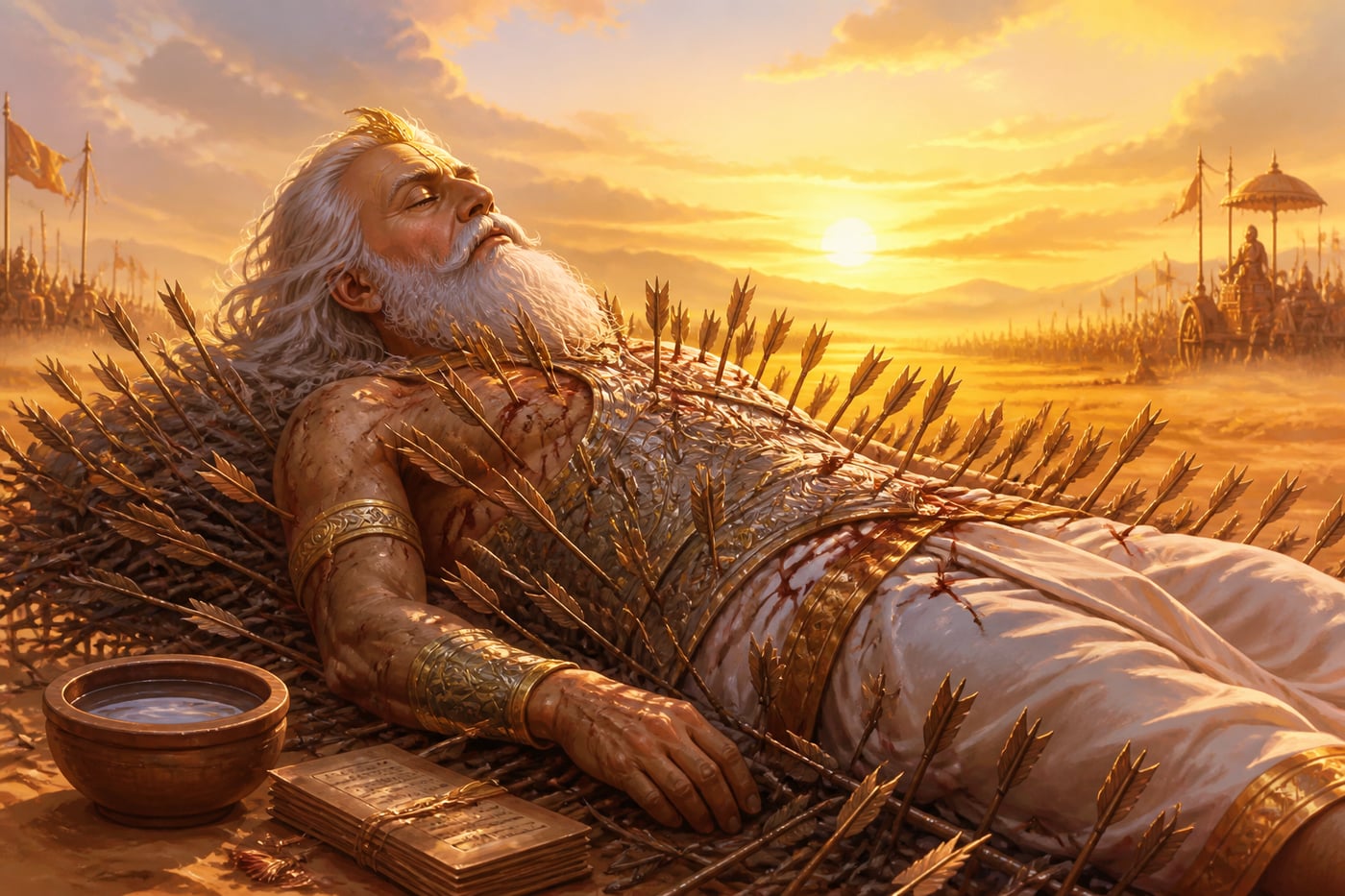
Bhishma serene on the arrow bed in deep tapas

"How?" Yudhishthira finally asked the question that had haunted him since the war's end. "Grandfather, how are you still alive? Any other man would have died within hours."

Bhishma turned his head, a small movement that must have cost him immense pain, and smiled.

"Tapas," he said. "The same power that has sustained me through a lifetime of celibacy, through the burden of watching my dynasty destroy itself, through every agony I have ever known. Tapas is patience made sacred. It is suffering transformed into strength."

The Meaning of Tapas

The Sanskrit word tapas came from the root tap, to heat, to burn. The sages who practiced tapas were literally generating inner fire through their discipline. This fire could accomplish what ordinary effort could not.

"Think of metal," Bhishma said. "Iron cannot be shaped at room temperature. It is too hard, too resistant. But heat the iron in fire, and it becomes malleable. The blacksmith can then forge it into sword or plowshare, armor or ornament. The fire transforms the metal's nature."

Without Tapas With Tapas
Pain is suffering Pain becomes purification
Waiting is frustration Waiting becomes preparation
Obstacles are defeat Obstacles become training
Desire rules the self The self rules desire

"So too with the human being. Ordinary, undisciplined, we are rigid, slaves to our desires, our fears, our comforts. But apply the fire of tapas, and we become malleable. We can be shaped into something greater than we were."

Why Wait for Uttarayana?

Yudhishthira asked the practical question: "But why endure this at all? You have the power to leave your body whenever you choose. Ganga herself gave you that boon. Why suffer for fifty-six days, soon to be fifty-eight, when death could come immediately?"

"Because when matters as much as what," Bhishma replied. "There are two paths for the departing soul. The southern path, Dakshinayana, when the sun moves south after the summer solstice. And the northern path, Uttarayana, when the sun turns north after the winter solstice."

He explained the ancient teaching:

"Those who depart during Uttarayana, when light is increasing, follow the path of the gods. They ascend through fire, light, day, the bright fortnight, the six months of the sun's northern course, and reach Brahman, never to return. Those who depart during Dakshinayana follow the path of the ancestors. They return to be born again."

Arjuna himself had struck down Bhishma on the tenth day of the war, during Dakshinayana. Had Bhishma died then, his soul would have taken the southern path. Instead, he chose to wait.

"I have lived long enough," the grandsire said. "I have no more karma to work out in future births. I seek the final liberation, the point of no return. So I wait. I endure. I practice my final tapas, not for power or boons, but simply for the right moment to die."

The Practice of Patience

But how did one actually do tapas? Yudhishthira had never mastered this art. His patience was limited; the years of exile had tested it to breaking.

Bhishma's teachings were practical:

Accept what is. "I do not fight the arrows. I do not wish them away. I have accepted that this bed is mine until Uttarayana. That acceptance itself removes half the suffering. Most pain is resistance to what we cannot change."

Focus on purpose. "Every moment of my suffering serves a goal: to transmit this wisdom to you, to wait for the auspicious moment, to complete my dharma. When pain has meaning, it becomes bearable. When it is meaningless, even small pain destroys us."

Withdraw from the body. "Through years of practice, I have learned to shift my consciousness. I am not this body, Yudhishthira. I am the witness watching this body. The arrows pierce flesh, but what am I? Not flesh. The pain registers in nerves, but what am I? Not nerves. I observe the pain as a stranger observes a distant fire. It burns, but it does not burn me."

Remember what matters. "When the body screams, I remember: I am Gangadatta, son of the sacred river. I am the keeper of vows. I once held this cosmos in my willpower alone, refusing to die for my father's happiness, refusing pleasure for my dynasty's sake. What are fifty-eight more days compared to a lifetime of tapas?"

The Thousand Names

As the days shortened and Uttarayana approached, Bhishma gave Yudhishthira a final gift: the Vishnu Sahasranama, the thousand names of the Supreme.

"You have asked me what a king should do when all else fails," Bhishma said. "When enemies surround him, when counsel is confused, when dharma itself seems unclear, what then?"

"Yes, grandfather."

"Then let him turn to the source of dharma itself. Let him remember the one who is beyond kings and kingdoms, beyond war and peace, beyond even death. Let him recite these thousand names, each one a doorway to the infinite."

And Bhishma began:

"Vishvam Vishnu Vashatkaro Bhoota-bhavya-bhavat-prabhuhu..."

The names flowed: The All-Pervading One. The Sustainer. The Lord of Past, Present, and Future. The Source of Light. The Destroyer of Sins. The Giver of Refuge. Name after name, each revealing a facet of the Divine, a thousand facets making one jewel.

Bhishma on the arrow bed recites the thousand names of Vishnu aloud to Yudhishthira seated beside him with folded palms while Krishna and a semicircle of sages listen in the soft late-morning light.

Yudhishthira listened, his lips moving to memorize each sacred syllable. Here was not merely a list but a technology of consciousness: by contemplating these names, the mind was lifted from its small concerns into the vastness of the cosmic. By chanting these names, the tongue was sanctified. By hearing these names, the heart was purified.

"When you are lost," Bhishma said, "when you do not know what to do, when the burden of kingship becomes too heavy, chant these names. They will remind you that you are not alone, that you are held by something greater, that even your failures are part of a pattern you cannot fully see."

Krishna Speaks

Krishna, who had been listening in silence, now addressed Yudhishthira directly:

"What my grandfather has given you is precious beyond measure. These names are myself in verbal form. To chant them is to invoke my presence. To contemplate them is to dwell in my heart. Through all the ages to come, whoever recites this Sahasranama with devotion will find refuge."

The Lord of the Universe was speaking of himself, and yet there was no arrogance in his voice, only assurance.

"Yudhishthira, you have carried much guilt since the war. You have wondered whether the kingdom was worth the cost. Let me tell you: I was present at every moment. I guided every arrow. I watched every fall. Nothing that happened was outside my awareness or my will. You did not act alone; you were my instrument."

"Then why do I suffer?" Yudhishthira asked.

"Because suffering is how instruments become sharper. You suffer because you care. You suffer because you are not yet complete. When you are complete, when you have integrated all that has happened, forgiven all that needs forgiving, understood all that needs understanding, the suffering will transform into wisdom. This is tapas: the fire that does not destroy but purifies."

The Final Teaching on Patience

As the sun dipped lower on the horizon, Bhishma offered his synthesis:

"All that I have taught you, dana, tyaga, satya, requires tapas to practice. Generosity is easy when resources are abundant; it becomes tapas when you give from scarcity. Sacrifice is easy when it costs nothing; it becomes tapas when it costs everything. Truth is easy when consequences are pleasant; it becomes tapas when truth brings suffering."

"Tapas is dharma in the fire of resistance. When the world pushes back, when the body rebels, when the mind screams for relief, that is when dharma becomes tapas. That is when practice becomes power."

He spoke of his own life: the burning discipline required to maintain celibacy when beautiful women offered themselves, the patience demanded when Dhritarashtra's blindness and Duryodhana's arrogance pushed the kingdom toward ruin, the endurance needed now, arrow-pierced, waiting for the sun to turn.

"I have no regrets," the grandsire said. "Every sacrifice strengthened me. Every restraint expanded my capacity. Every pain purified some old impurity. I am not the same man who took his vow on the banks of the Ganga so many years ago. The fire has done its work. I am ready."

Counting the Days

Yudhishthira counting the days until Uttarayana

Yudhishthira looked at the sky. The winter solstice was nearly here. One more day, perhaps two, and then Uttarayana would begin.

"You have taught me so much," he said. "I am not sure I can absorb it all."

"You cannot," Bhishma said gently. "Not now. But the seeds are planted. They will grow in their own time. When you face a crisis ten years from now, some word I spoke today will surface in your memory. When you counsel your own grandson, some teaching will flow through you that you do not remember learning. This is how wisdom works, slowly, across lifetimes."

"Will I see you again? After you go?"

"Perhaps. Perhaps not in forms you recognize. But know this: I am not disappearing. I am merely changing form. The river returns to the ocean, but the water does not cease to exist. The soul returns to Brahman, but the soul does not end. We will meet in the place where there is no separation."

The old warrior closed his eyes. The pain was constant now, a deep, burning ache that never relented. But within that pain, he found something strange: peace. The waiting was almost over. The teaching was almost complete. Soon the sun would turn north, and with it, so would he.

"Tomorrow or the day after," he murmured. "The priests are watching the stars. They will tell us when the moment arrives. Until then... I wait. This is my final tapas. This is my greatest teaching: that patience, practiced to its ultimate conclusion, becomes indistinguishable from faith."

Yudhishthira bowed and withdrew, carrying with him the thousand names of Vishnu and the image of a man who had transformed his death-bed into a teaching throne. Behind him, Bhishma returned to his meditation, counting not the arrows in his flesh but the hours until liberation.

Living traditions

The Vishnu Sahasranama has entered global spiritual practice through yoga centers, meditation retreats, and online platforms. Apps offering guided recitation, word-by-word meaning, and audio chanting have made this ancient practice accessible worldwide. The teaching that patience and discipline (tapas) can transform suffering into strength has influenced modern psychology, appearing in discussions of resilience, post-traumatic growth, and stress management. Bhishma's demonstration that consciousness can transcend bodily limitation resonates with contemporary research on meditation, pain management, and the mind-body connection.

Reflection

More in Anushasana Parva

All lessons in Anushasana Parva · The Mahabharata course