Dana: The Glory of Giving

Bhishma teaches charity

As the teachings continue on the battlefield, Bhishma turns to the sacred subject of Dana, the dharma of giving. From his bed of arrows, the grandsire reveals that true charity transforms both giver and receiver, that the manner of giving matters as much as the gift, and that generosity practiced rightly can purify the heaviest karma.

The Continuation of Wisdom

The sun had risen and set many times over Kurukshetra since Bhishma began his teachings. What had started with the duties of kings in the Shanti Parva now flowed into deeper waters. Yudhishthira sat at the feet of his grandsire, his earlier despair slowly transforming into something else, not peace, not yet, but the first stirrings of purpose.

Bhishma, despite the arrows piercing his body, showed no sign of weariness. If anything, the approach of his chosen death seemed to lend urgency to his words. There was still so much to transmit, so many teachings that had sustained the dharma through countless generations.

"You have learned the duties of rulers," Bhishma said, his voice steady despite his wounds. "You have understood the nature of justice and the weight of the crown. But now, Yudhishthira, let us speak of something that can redeem even the heaviest sin, the sacred act of dana."

Yudhishthira leaned forward. This was the question that haunted him still: Could anything wash away the blood of Kurukshetra?
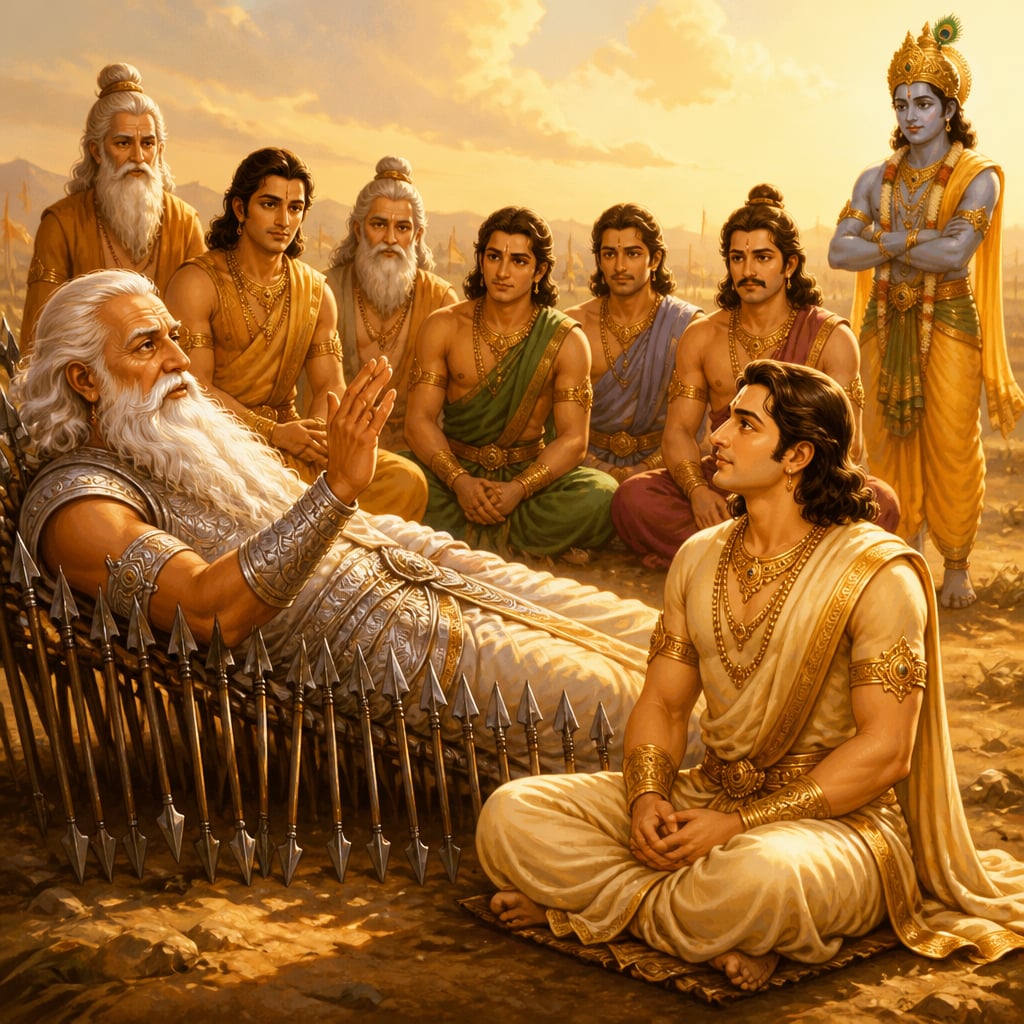
Bhishma on his bed of arrows raises a hand to teach Yudhishthira about dana while the Pandavas, sages, and Krishna look on in the warm Kurukshetra light.

The Three Types of Giving

Bhishma began with a fundamental teaching: not all giving is equal.

"There are three types of dana," the grandsire explained, "corresponding to the three gunas that govern all existence."

Type Nature Example Result
Sattvic Dana Given with joy, to worthy recipients, at proper time and place, without expectation Feeding the hungry, supporting scholars, maintaining temples Purifies the giver, elevates both parties
Rajasic Dana Given reluctantly, or for show, or expecting something in return Donations for fame, gifts to gain favor, charity announced publicly Mixed results, binds to karma
Tamasic Dana Given with contempt, to unworthy recipients, or at wrong time and place Throwing coins at beggars with disgust, funding adharma Increases sin, degrades giver

"The gift of gold given with arrogance," Bhishma continued, "weighs less in the scales of dharma than a handful of grain offered with love. The gods see not what leaves your hand, but what leaves your heart."

The Paradox of Generosity

Yudhishthira interrupted with a question that had long troubled him.

"Grandfather, if giving depletes one's wealth, how can it bring prosperity? The mathematics seem wrong."

Bhishma smiled, a rare expression on that pain-marked face.

"Ah, you think like an accountant. But dana operates by different laws. Let me tell you what I have seen across my centuries of life."

He spoke of kings who hoarded gold and lost their kingdoms, while those who gave freely found their treasuries mysteriously replenished. He spoke of merchants who discovered that generosity attracted more customers than cunning. He spoke of sages whose voluntary poverty made them the richest men in wisdom.

"Wealth is like water," Bhishma said. "Held in the hand, it slips away. Channeled through giving, it flows back tenfold. The miser's gold rusts in his vaults; the generous man's gift multiplies in ways he never imagined."

But this was not mere mysticism. Bhishma explained the practical mechanism: a generous king earns the loyalty of his people, who then work harder to fill his treasury. A charitable merchant builds reputation that brings customers across continents. A giving family creates bonds of gratitude that protect them in times of need.

"The universe keeps accounts," the grandsire concluded, "but not in the way merchants do. It rewards the open hand and punishes the closed fist, though sometimes the punishment is simply the spiritual death of living only for oneself."

What Should Be Given

The teachings grew more specific. Bhishma listed the traditional categories of dana:

A humble family sharing food with a wandering ascetic

Anna-dana (the gift of food) ranked highest, for it preserved life itself. "He who feeds the hungry," Bhishma declared, "feeds the gods dwelling in every creature."

Vidya-dana (the gift of knowledge) was equally sacred, perhaps more so, for food sustains the body while wisdom transforms the soul. "If you can teach a man to fish," the grandsire said in words that would echo across millennia, "you have given him more than a thousand fish."

Abhaya-dana (the gift of fearlessness) meant protecting those in danger, giving refuge to the hunted, standing with the oppressed. "This gift costs more than gold," Bhishma acknowledged. "It may cost your comfort, your reputation, even your life. But it is the dana of heroes."

Other worthy gifts included:

The Attitude of the Giver

But Bhishma warned that even the right gift could become worthless through wrong attitude.

An arrogant king donating cows to uncomfortable brahmins

"I have seen kings donate thousands of cows while insulting the Brahmins who received them. I have seen wealthy men build temples but carve their names larger than the deity's. These are not donors, they are merchants, buying heaven with their egos."

The true giver, Bhishma explained, possessed specific qualities:

Shraddha (faith): Believing that giving is right, regardless of visible results. The donor who doubts pollutes his own gift.

Daya (compassion): Giving not from obligation but from genuine feeling for the recipient's need. Cold charity warms no one.

Anasuya (non-envy): Giving without resentment that the recipient now has what was yours. The jealous giver takes back his merit with his attitude.

Aparigraha (non-possessiveness): Understanding that wealth was never truly yours, you are merely its temporary custodian, and giving is simply fulfilling your role.

"When a wealthy man gives," Bhishma said, "let him remember that his wealth came from the labor of others, the resources of the earth, the circumstances of fate. He is not giving from himself; he is redistributing what was never entirely his."

Dana and Karma

Yudhishthira asked the question that burned within him: "Can dana wash away the sins of war?"

Bhishma's answer was careful, neither dismissive nor falsely encouraging.

"Dana can reduce karma, but not erase it. Think of karma as debt. Through wise giving, you can pay down the principal, earn goodwill that softens consequences, build merit that balances against demerit. But the original action still happened. The arrow still flew. The life still ended."

He saw Yudhishthira's face fall and added:

"But do not despair. The purpose of dana is not to buy your way out of consequences, that would make it a transaction, and transactions are rajasic at best. The purpose is to transform your nature. A man who gives generously becomes generous. His character changes. And karma ultimately flows from character."

The grandsire spoke of kings who had committed terrible sins but redeemed themselves through lifetimes of generous rule. Not because their gifts outweighed their crimes on some cosmic scale, but because the practice of giving had transformed them into different men, men who could no longer commit such crimes.

"Your war, Yudhishthira, cannot be undone. But you are still becoming. The question is not 'Can I erase Kurukshetra?' but 'What kind of king will Kurukshetra's survivor become?' Dana is part of the answer."

The Recipient Matters

Bhishma was clear that not all recipients deserved dana.

"Do not give to those who will use your gift for adharma. Do not fund the cruel, the destructive, the enemies of dharma. Your charity becomes their weapon, and you share in their sin."

He listed worthy recipients:

"But even here," Bhishma cautioned, "use wisdom. The professional beggar who could work but chooses to exploit sympathy, your dana enables his degradation. The temple priest who has grown fat while his congregation starves, your gift feeds corruption. Give with open heart but open eyes."

The Promise of Tomorrow

As the day's teaching ended, Bhishma made a promise that made Yudhishthira's heart quicken.

"Tomorrow, grandson, I will tell you a story that illuminates everything I have said today. A story of a family so poor they had nothing but a handful of grain, and how their sacrifice was judged by a most unusual witness."

"What witness, grandfather?"

"A mongoose," Bhishma said, "whose body was half gold. But that is for tomorrow."

Yudhishthira bowed and withdrew, his mind churning with all he had heard. Dana, giving, seemed so simple, yet Bhishma had revealed it as a complete path, a way of transforming both self and society. Could this be part of his penance? Could generous rule redeem a blood-soaked victory?

The grandsire closed his eyes, gathering strength for another day. The arrows pained him less now, or perhaps he had simply moved beyond the body's complaints. There was teaching yet to do, wisdom yet to transmit. And then, when the sun turned north, there would be the final gift: the release of his own life, given back to the cosmos that had lent it to him for so long.

Living traditions

The Anushasana Parva's teachings on dana have shaped India's culture of giving in ways that persist today. The tradition of offering food at temples, the practice of feeding guests before eating oneself, the expectation that weddings and celebrations include meals for all who attend, these customs trace back to Bhishma's teachings. Modern Indian philanthropy, from the Tata Trusts to the Azim Premji Foundation, often explicitly references dharmic concepts of trusteeship and giving. The parva's influence extends to the Indian diaspora, where community feeding programs and educational scholarships continue the tradition of structured, principled dana.

Reflection

More in Anushasana Parva

All lessons in Anushasana Parva · The Mahabharata course