Relevance in 2026 and Beyond

Ancient Instructions for Modern Crises

How Bhishma's teachings on charity, truth, sacrifice, and conscious living apply to a world grappling with AI disruption, climate crisis, wealth inequality, and the search for meaning in an age of distraction.

When Everything You Know Might Be Wrong

You're fifty-three years old. You've spent thirty years becoming an expert in your field, maybe you're an accountant, a radiologist, a software developer. Then, in late 2022, ChatGPT arrives. Within eighteen months, tools do in seconds what took you hours. Your certainty about your value, your career, your very identity begins to crumble.

This isn't a hypothetical. It's happening now, across every profession, to millions of people who did everything right.

What does a 3,000-year-old text about a dying warrior have to offer in this moment?
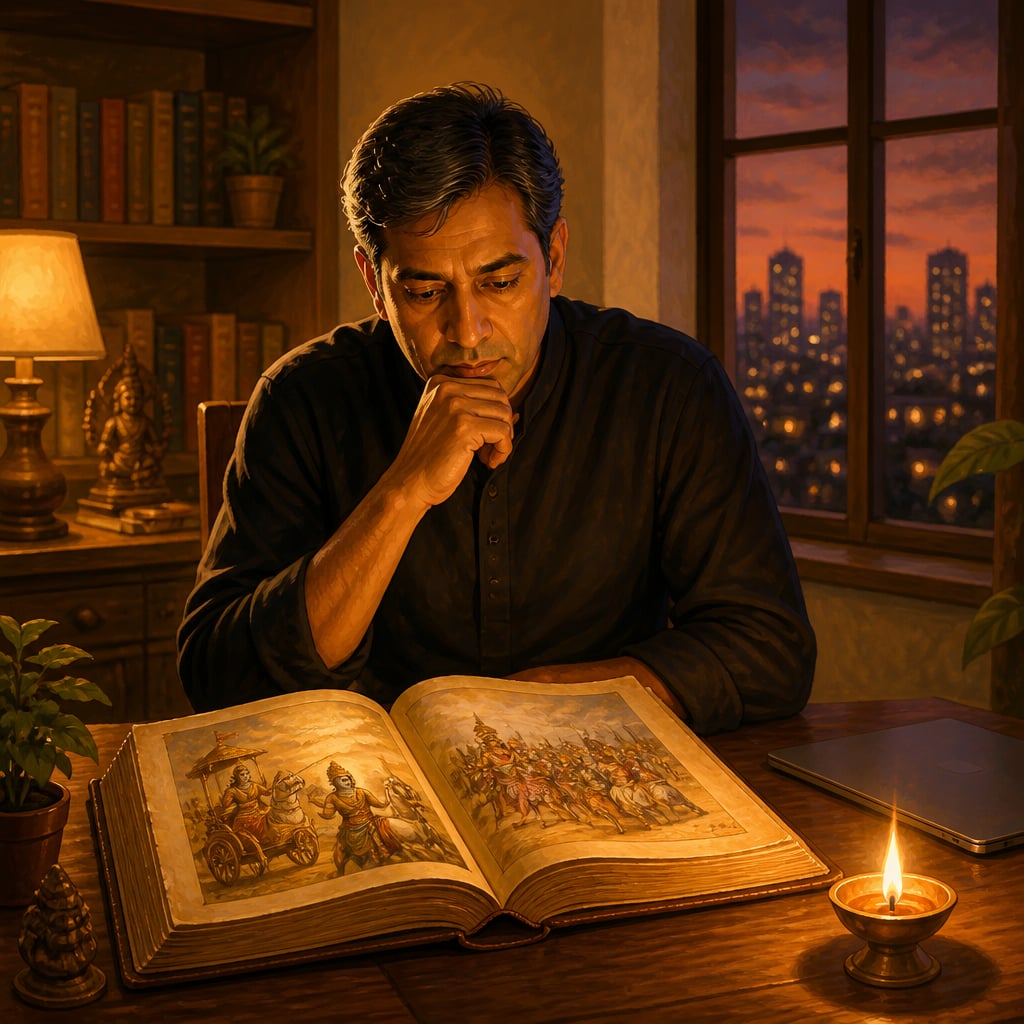
A middle-aged Indian professional in plain dark contemporary attire sits alone at a wooden desk in a softly lit home study at evening, contemplating a thick well-worn illustrated Mahabharata open before them beside a small brass diya.

More than you might expect.

The Modern Challenge: Multiple Simultaneous Disruptions

We're living through something unprecedented: multiple foundational shifts happening simultaneously. AI is reshaping work faster than any previous technology. Climate change is forcing systemic rethinking of everything from supply chains to city planning. Wealth concentration has created a world where Oxfam reports the richest 1% own more than the bottom 90% combined. And underneath it all, a crisis of meaning, rates of anxiety and depression have doubled since 2019 in many developed nations.
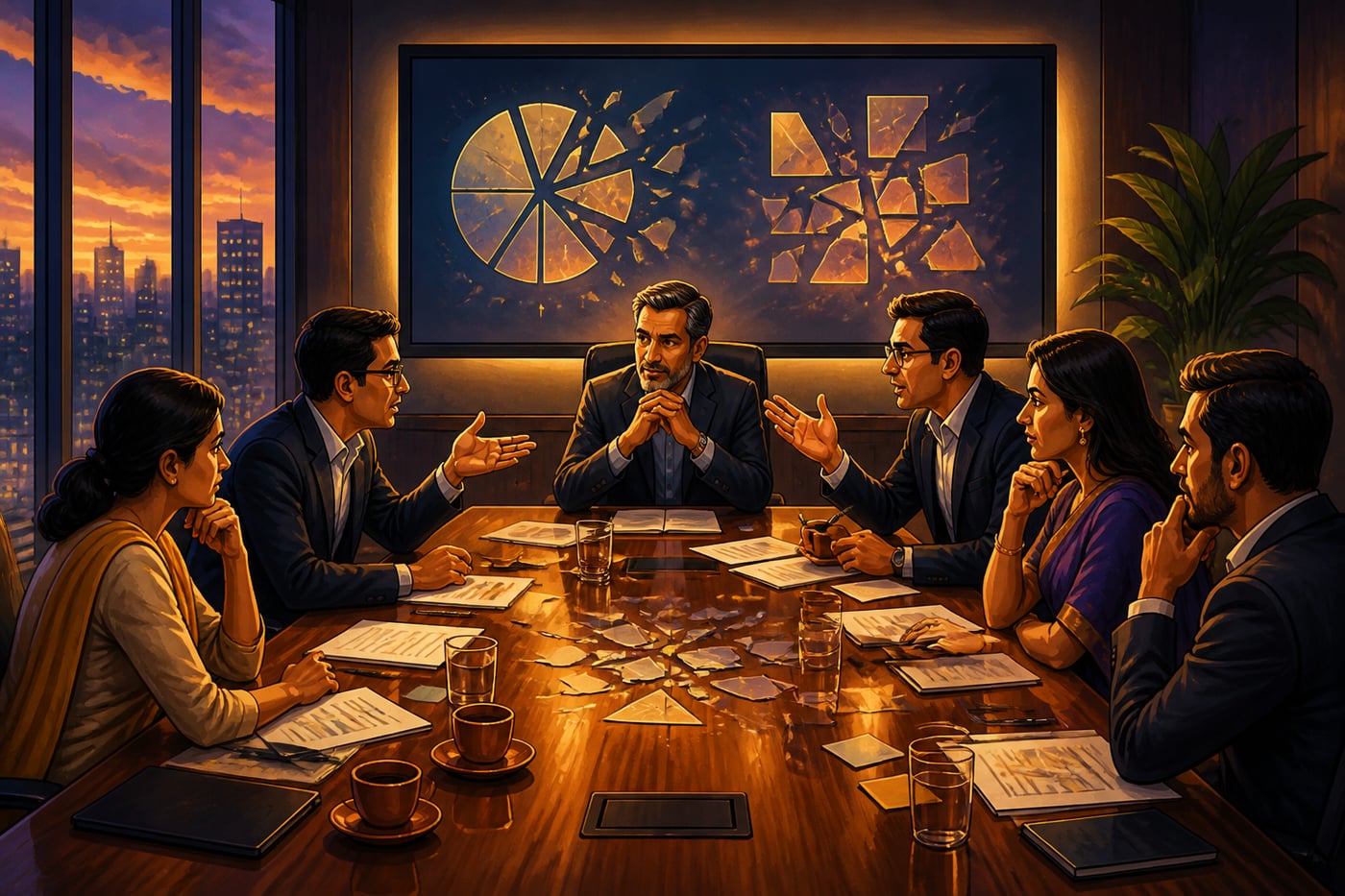
A modern boardroom in organizational disruption

The OpenAI board crisis of November 2023 offered a stark preview: the most important AI company nearly imploded over fundamental questions about purpose, governance, and what we owe each other. Sam Altman was fired and reinstated within five days, but the deeper questions remain unanswered. What's the purpose of technological advancement? Who benefits? What do we owe future generations?

These aren't technical problems. They're the same questions Yudhishthira brought to Bhishma's arrow bed.

What Bhishma Actually Taught

The Anushasana Parva isn't a collection of rules. It's a framework for navigating exactly these kinds of moments, when the ground shifts beneath you and the old certainties fail.

Bhishma taught dana (giving), not as charity but as a fundamental reorientation of what ownership means. He taught satya (truth), not as rigid honesty but as alignment between word, thought, and action. He taught tapas (disciplined endurance), not as punishment but as the capacity to maintain purpose through difficulty. And he demonstrated icchā-mrityu (conscious death), not as morbid dwelling but as the ultimate freedom of choosing how one responds to the inevitable.

Most remarkably, he taught all this while lying on a bed of arrows, having just fought on the losing side of a war he never believed in. His authority came not from victory but from how he handled defeat.

The Bridge: Ancient Framework, Modern Application

On Wealth and Giving

When Bhishma taught Yudhishthira about dana, he wasn't talking about charity galas. He described giving as the antidote to attachment, the recognition that we're temporary custodians of resources, not permanent owners.

MacKenzie Scott's approach to philanthropy since her divorce from Jeff Bezos offers an interesting parallel. Rather than building foundations with her name on them, she's given away over $14 billion with minimal conditions, trusting recipients to know their needs better than she does. Her 2020 essay on Medium explicitly rejected "deserving poor" narratives.

This isn't Bhishma's exact teaching, he operated in a different economic context, but the underlying principle resonates: holding wealth lightly, giving without creating dependence, recognizing that the giver receives more than they give.

On Truth in a Post-Truth Era

Bhishma's teaching on satya becomes more, not less, relevant when facts themselves are contested. He distinguished four levels: speaking truth (vacha-satya), thinking truth (mano-satya), acting truly (karma-satya), and contextual truth (dharma-satya).

The Kaushika story he told, about a sage whose rigid honesty got innocents killed, anticipated our current debates about misinformation. When does sharing factually accurate information become harmful? When does silence become complicity?

These questions plagued social media companies throughout 2023-2024 as they struggled with content moderation policies. There's no algorithm for dharma-satya, it requires judgment, context, and the willingness to be wrong.

On Endurance Through Disruption

Bhishma's fifty-eight days on the arrow bed weren't passive waiting. He transformed a period of helplessness into the most significant teaching of his life.

Compare this to what organizational psychologists call "liminal periods", transitional states where old identities have dissolved but new ones haven't formed. Adam Grant's research on languishing during the pandemic identified this state affecting millions. The Bhishma model offers an alternative to mere endurance: use liminal periods for transmission, for teaching, for giving away what you've learned.

On Facing Endings Consciously

Perhaps most countercultural: Bhishma's approach to death. In a culture that medicalizes death, hides it in hospitals, and considers it a failure, his conscious departure stands as a radical alternative.

The death positivity movement, gaining traction through organizations like The Order of the Good Death, echoes aspects of this teaching, not seeking death, but refusing to let fear of it distort how we live. Atul Gawande's "Being Mortal" brought similar questions to mainstream medicine.

Addressing Skepticism

Fair objections exist. Bhishma taught in a feudal context with different economic assumptions. His views on women and caste reflected his era's limitations. The Mahabharata itself shows him failing spectacularly, sitting silent while Draupadi was humiliated, fighting for a cause he knew was wrong.

These aren't problems to explain away. They're invitations to engage critically rather than devotionally. The question isn't "What would Bhishma do?" but "What principles from Bhishma's teaching remain useful after we've filtered out the cultural context?"

Dana as non-attachment to outcomes. Satya as alignment rather than rigidity. Tapas as purposeful endurance rather than mere survival. Conscious engagement with mortality as a clarifier of values.

These principles don't require believing in karma, reincarnation, or divine intervention. They require only the recognition that how we give, how we speak truth, how we endure difficulty, and how we relate to our own mortality shapes the quality of our lives.

Your Practice Begins Now

Three starting points:

  1. The Dana Inventory: This week, give something away that costs you nothing financially but represents an attachment, time, attention, expertise. Notice what shifts.

  2. The Satya Audit: For one day, track the gap between what you say, what you think, and what you do. Don't judge, just observe.

  3. The Mortality Question: Ask yourself what you would teach if you knew you had fifty-eight days left. What wisdom would you want to transmit? To whom?

Bhishma's arrow bed was a specific historical circumstance. But the questions he faced, how to live with integrity when the world doesn't cooperate, how to give when you feel you have nothing, how to maintain purpose when the ground keeps shifting, these questions are always ours.

The teachings await. The practice begins whenever you choose.

More in Anushasana Parva

All lessons in Anushasana Parva · The Mahabharata course