Ujjayini: The First Meridian
Ancient India's prime meridian and two jyotirlingas
Discover why Ujjain was considered ancient India's Greenwich - the reference point for astronomical calculations. Explore the unique situation of two jyotirlingas (Mahakaleshwar and Omkareshwar) being located near each other, and the Simhastha Kumbh Mela.
The Center of Ancient Calculations
Long before Greenwich became the world's prime meridian in 1884, Indian astronomers had their own zero-point for measuring longitude: Ujjayini (modern Ujjain). For over two thousand years, when Indian mathematicians calculated planetary positions, they measured eastward and westward from this sacred city.
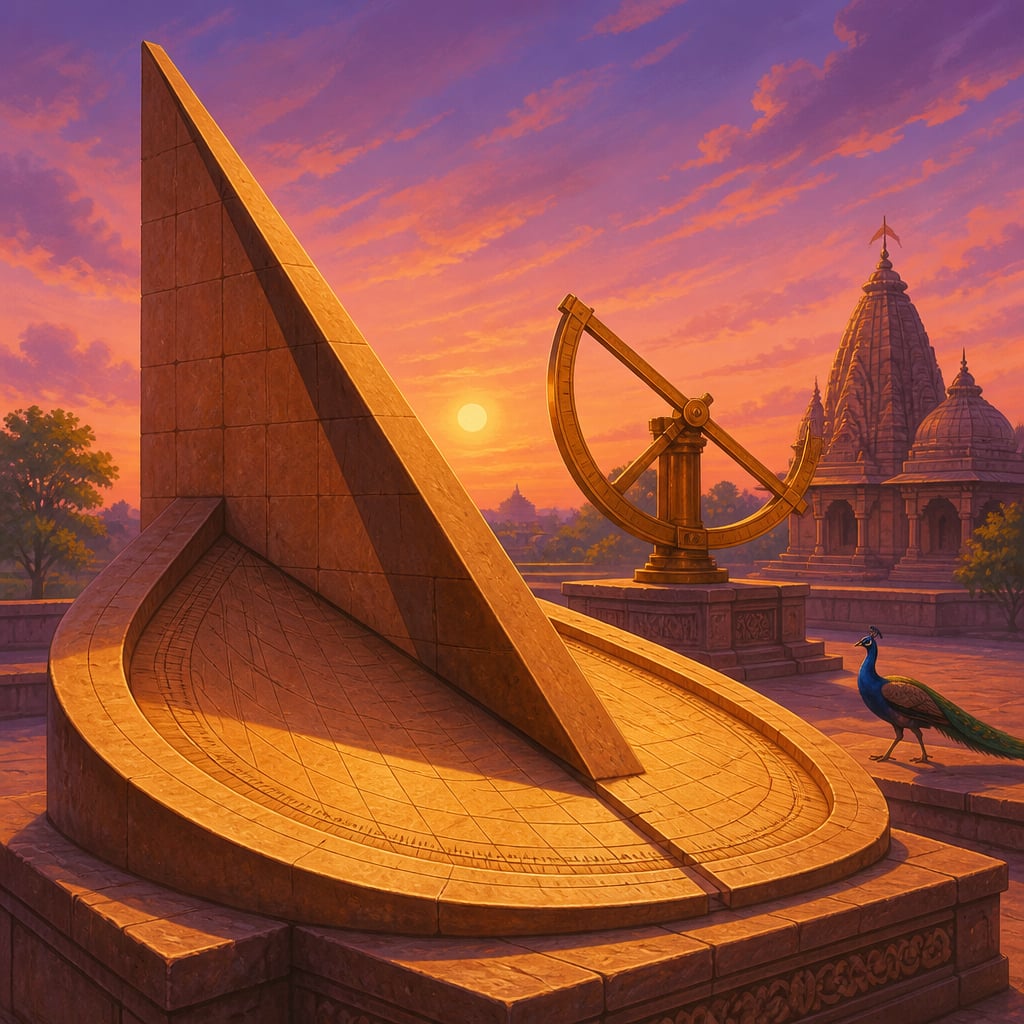
Why Ujjain? The city sits at the intersection of the Tropic of Cancer and India's central longitude. Ancient astronomers noticed that on the summer solstice, the sun passes directly overhead at noon, casting no shadow. This astronomical precision made Ujjain the natural choice for cosmic calculations.
The Vedanga Jyotisha Connection
The Vedanga Jyotisha, one of the six limbs of Vedic knowledge, established Ujjain as the reference point for Indian astronomy. This wasn't arbitrary. The text states that Ujjain lies on a line passing through Lanka, Ujjayini, and Meru, a cosmic axis connecting the earthly and celestial realms.
The word jyotisha (astronomy) shares its root with jyotirlinga (pillar of light). Both point to the same truth: understanding cosmic cycles is essential for understanding Shiva's nature. The jyotirlinga at Ujjain isn't merely coincidental, it marks where earthly geography aligns with celestial order.
Two Lingas, One Sacred Region
No other region in India hosts two jyotirlingas within 140 kilometers of each other. Mahakaleshwar at Ujjain and Omkareshwar on the Narmada form a unique spiritual axis:
- Mahakaleshwar: The Lord of Time who devours death itself
- Omkareshwar: The primordial sound Om made manifest in stone
Together they represent Kala (time) and Shabda (sound), the two fundamental dimensions through which the universe unfolds. Time without sound is silent dissolution. Sound without time cannot manifest. The proximity of these lingas teaches that spiritual realization requires mastery of both dimensions.
Simhastha Kumbh: The Celestial Alignment
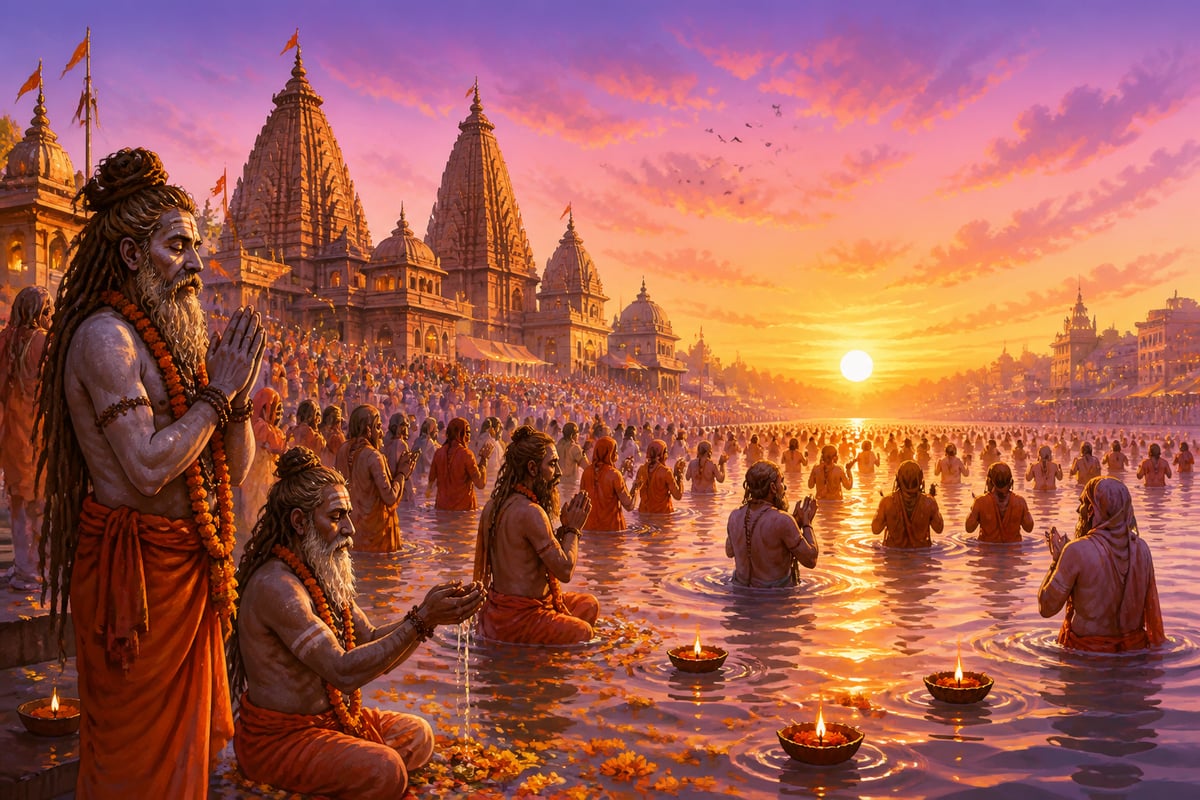
Every twelve years, when Jupiter enters the zodiac sign of Leo (Simha), Ujjain hosts the Simhastha Kumbh Mela, one of the four great gatherings where millions bathe in the Shipra River for liberation.
The mythology speaks of celestial nectar (amrita) falling on four sites during the churning of the cosmic ocean. But the astronomical reality is equally profound: Jupiter's twelve-year cycle mirrors the solar year's relationship to the zodiac, creating a grand harmonic that ancient seers recognized as auspicious for spiritual transformation.
During Simhastha, pilgrims often visit both Mahakaleshwar and Omkareshwar, understanding that the journey between death (kala) and creation (om) is the essence of spiritual practice.
The Jantar Mantar of Ujjain
Maharaja Jai Singh II, the astronomer-king of Jaipur, built astronomical observatories across India in the 18th century. His Ujjain observatory (Jantar Mantar) was specifically placed to honor the city's ancient primacy in Indian astronomy.
The great Samrat Yantra (supreme instrument) there still accurately calculates local time. Standing beside it, one understands why our ancestors built jyotirlingas, instruments for measuring not external time, but the internal rhythms of consciousness aligned with cosmic cycles.
Kalidasa's Beloved City

The great poet Kalidasa made Ujjayini the setting for his masterpiece Meghaduta (The Cloud Messenger). In it, a yaksha (celestial being) in exile asks a passing cloud to carry his message to his beloved in Ujjayini.
Kalidasa describes the city's magnificence: the Mahakaleshwar temple where devotees gather at dusk, the Shipra's banks lined with flowering trees, the sound of evening bells mixing with music from pleasure gardens. For Kalidasa, Ujjayini wasn't merely a city, it was the axis mundi, where heaven touched earth.
The Synthesis of Time and Sound
This chapter began with Mahakaleshwar, where we confronted time and mortality. It continued with Omkareshwar, where we discovered sound as the fabric of existence. Now at Ujjayini, we understand the synthesis:
Time (kala) and sound (shabda) are not separate forces, they are complementary aspects of Shiva's nature.
The first vibration of Om initiated time. Time structures the unfolding of sound into meaning. At Ujjain, where ancient astronomers measured time by the stars while pilgrims chanted Om at Mahakaleshwar, these dimensions converge.
What Ujjayini Teaches
Ujjain is more than a pilgrimage site, it's a teaching about sacred geography. The ancients didn't randomly place temples. They observed where cosmic forces concentrated, where the earth's geography aligned with celestial patterns, and there they established tirthas (crossing points).
Two jyotirlingas near one city. The prime meridian of Indian astronomy. The Kumbh Mela that draws millions. Kalidasa's immortal poetry. These aren't coincidences, they're evidence that Ujjayini is a teertha-kshetra, a field where spiritual crossing becomes possible.
To visit Ujjain is to stand at ancient India's cosmic center, where calculations of time and meditations on eternity meet, where the primordial sound Om and the Lord of Time dwell within a single sacred landscape.
Key figures
Kalidasa
Sanskrit poet and dramatist, considered the greatest in classical Indian literature
Sawai Jai Singh II
Maharaja of Jaipur (1688-1743), astronomer-king who built observatories across India
Lagadha
Ancient sage credited with composing the Vedanga Jyotisha, the foundational text of Indian astronomy
Historical context
Vedic Period to Present
Living traditions
Ujjain remains India's foremost center for traditional astrology (jyotisha). The city hosts numerous schools teaching Vedic astrology, and astrologers from across India trace their lineage to Ujjain. During major planetary alignments, national media regularly consults Ujjain's pandits. The city's Vikram University has a dedicated department for Jyotish studies, preserving the ancient link between this city and celestial observation.
- Sapta Tirtha Yatra: Pilgrimage to the seven sacred sites of Ujjain: Mahakaleshwar, Harsiddhi, Chintaman Ganesh, Gopal Mandir, Gadkalika, Kaal Bhairav, and Mangalnath. Completing all seven is believed to grant moksha.
- Dual Jyotirlinga Darshan: Many pilgrims visit both Mahakaleshwar and Omkareshwar in a single yatra, recognizing them as complementary, the Lord of Time and the Lord of Sound. The 140 km journey is seen as connecting Kala and Shabda.
Reflection
- What serves as your personal 'prime meridian', the fixed reference point from which you measure your life's direction and progress?
- How might seemingly opposing forces in your life (work/rest, ambition/contentment, tradition/innovation) actually be complementary like Kala and Shabda?
- If you were to create a 'sacred geography' for your life, places and times where you feel most connected to your purpose, what would it include?