Omkara: The Sacred Sound Made Stone
The island shaped like Om in the Narmada River
Journey to Omkareshwar, located on Mandhata Island which naturally resembles the sacred Om symbol. Explore why this is considered the holiest spot on the Narmada River and the temple's connection to cosmic sound.
The Sound That Became an Island
From Ujjain, the journey south leads to the Narmada River, one of India's holiest waterways, considered even more purifying than the Ganges by some traditions. Here, where the Narmada splits around a hill, an island naturally formed in the shape of the sacred syllable ॐ (Om). On this Om-shaped island stands Omkareshwar, the jyotirlinga of sacred sound.
This is not mythology imposed on geography. Aerial photographs confirm what pilgrims have known for millennia: Mandhata Island genuinely resembles the Devanagari symbol for Om. The river flows around it in curves that trace the sacred letter. Nature itself, it seems, wrote Om in stone and water.

The Mythology of Omkareshwar
The Mountain's Devotion
The Shiva Purana tells of Vindhya, the mountain range that stretches across central India. Once, Vindhya grew jealous of Mount Meru, the cosmic mountain around which sun and moon revolve. Vindhya began growing taller, attempting to block the sun's path and force celestial bodies to orbit him instead.
The gods, alarmed, asked sage Agastya to intervene. Agastya traveled south, and as he approached, Vindhya bowed in respect. The sage asked Vindhya to remain bowed until he returned, and never came back. Vindhya remains stooped to this day.
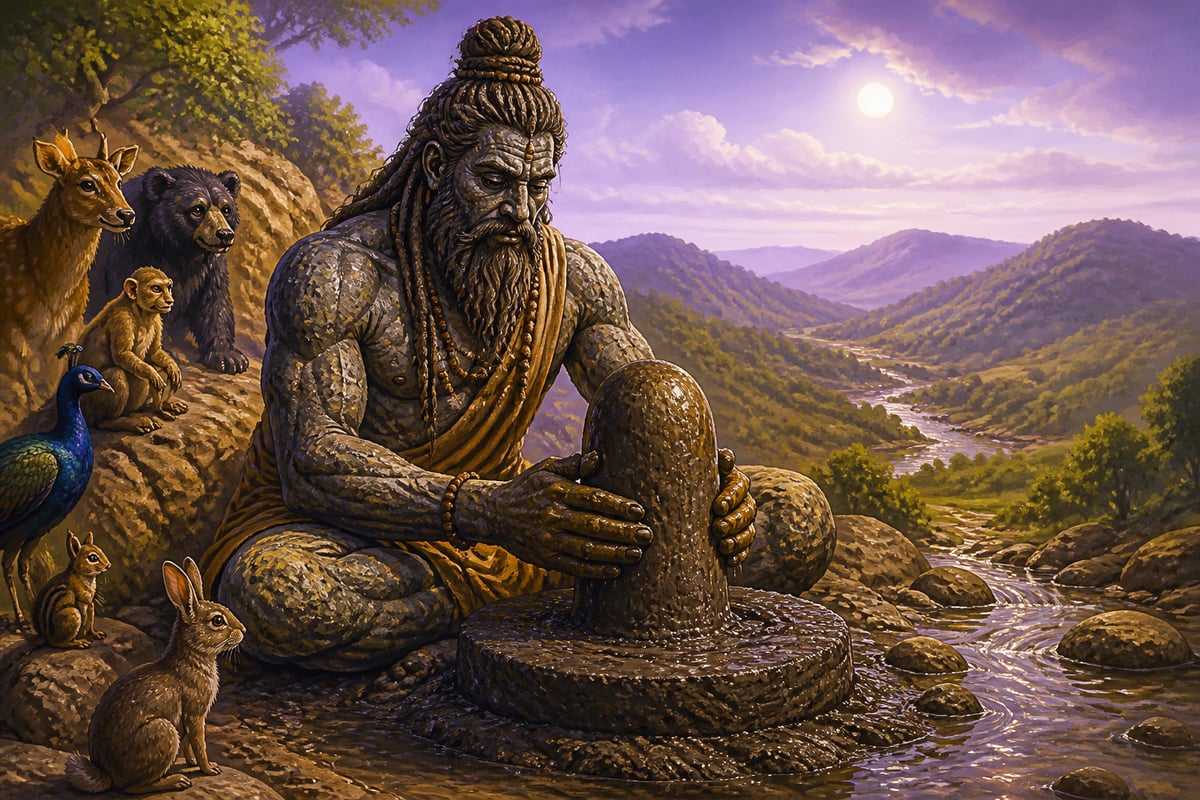
But before this humbling, Vindhya had performed intense tapas (austerities) to Shiva, creating a massive linga of sand and mud. Pleased with the mountain's devotion, Shiva manifested as the jyotirlinga at this spot. The island took the shape of Om, the primordial sound from which Shiva emerges.
The King's Legacy
The island is also called Mandhata, after the legendary king Mandhata of the Ikshvaku dynasty (Rama's lineage). According to tradition, King Mandhata performed severe penance here for many years, eventually merging with the island itself. The mountain-island bears his name, and the jyotirlinga honors both the sage-king's devotion and the primordial sound.
Om: The Sound Behind All Sounds
Why Om Matters
To understand Omkareshwar, one must understand Om, not as a religious symbol but as a metaphysical reality. Om (or Aum) is considered the sound from which all creation emerged. When the Upanishads declare 'In the beginning was the Word,' they mean Om.
The three letters A-U-M represent:
- A: Creation, waking state, Brahma
- U: Preservation, dream state, Vishnu
- M: Dissolution, deep sleep, Shiva
- Silence after: Turiya, the transcendent fourth state beyond the three
Om is thus the complete cycle of existence compressed into a single sound. When you chant Om, you are not merely making a noise, you are participating in the fundamental vibration of reality.
Shiva as Omkara
At Omkareshwar, Shiva is specifically worshipped as the lord of Om, the deity who embodies the primordial sound. While other jyotirlingas emphasize different aspects (Mahakaal emphasizes time, Kedarnath emphasizes mountains), Omkareshwar emphasizes shabda brahman, the supreme reality as sound.
This has profound implications. Most spiritual paths treat material reality as illusion and seek silence beyond sound. The Omkareshwar teaching is different: the world IS sound, and by understanding the nature of sound, we understand the nature of reality. The material world is Om made manifest.
The Sacred Narmada
India's Most Sacred River?
The Narmada holds a unique position among sacred rivers. While the Ganges receives more pilgrims, traditional texts sometimes rank Narmada higher in purity:
"The Saraswati purifies in three days, the Yamuna in seven, the Ganges immediately upon bathing, but the Narmada purifies by mere sight."
This is darshan shakti, the power of sacred seeing. Even looking at the Narmada from a distance is said to purify accumulated karma.
The River That Flows Against Time
Unlike most Indian rivers that flow east, the Narmada flows west, against the 'normal' direction, toward the setting sun. This westward flow connects symbolically to Omkareshwar's location in the chapter on time: the river flows toward dissolution (the western direction of endings), yet creates sacred space along its banks.
The Narmada parikrama, the circumambulation of the entire river from source to sea and back, is one of India's longest pilgrimages, taking 3-5 years on foot. Many sadhus spend their entire lives walking this circuit.
Narmada Lingas
Every stone in the Narmada is considered a natural Shiva linga. The river's current polishes ordinary rocks into smooth, elongated shapes that naturally resemble lingas. These Narmadeshwar lingas are collected and worshipped throughout India, considered self-manifested (swayambhu) without need for formal consecration.
Omkareshwar sits at the spiritual heart of this sacred river, the point where the linga-creating Narmada embraces an Om-shaped island.
The Temple Complex
Architecture and Layout
The main Omkareshwar temple sits on Mandhata Island, accessed by boat or footbridge from the town. The temple's shikhara (tower) rises above the island's highest point, visible from both banks of the river.
The jyotirlinga resides in the garbhagriha (inner sanctum), a naturally-formed linga of blackish-brown stone. Unlike many temple lingas that are periodically replaced, this one is considered eternal, the same linga that emerged when Vindhya's penance bore fruit.
The temple complex includes multiple shrines to various deities, reflecting centuries of accumulated worship. The Siddhanath temple, Gauri Somnath temple, and numerous smaller shrines dot the island, creating a pilgrimage circuit.
The Controversy: One Linga or Two?
Omkareshwar presents a unique puzzle in jyotirlinga tradition. On the island sits the Omkareshwar temple. But just across the river, on the mainland, sits the Mamleshwar (or Amareshwar) temple, also claiming jyotirlinga status.
Some traditions count them as a single jyotirlinga appearing in two locations. Others count them separately, suggesting that one or the other should be on the canonical list. Still others maintain that both together constitute one jyotirlinga, requiring visits to both temples for complete darshan.
We'll explore this controversy in our next lesson.
The Shiva Tattva: Sound and Reality
What Omkareshwar Teaches
If Mahakaleshwar teaches about time, Omkareshwar teaches about sound, specifically, the nature of reality as vibration. Modern physics agrees: at the quantum level, matter is vibration. What appears solid is actually oscillating energy. The ancient teaching that the universe is shabda (sound) receives unexpected support from contemporary science.
Om is not a sound we make; it is the sound we recognize. When we chant Om, we align our own vibration with the fundamental frequency of existence. The practice doesn't create something new, it tunes us to what already is.
From Chanting to Listening
The Omkareshwar teaching progresses in stages:
- Speaking Om: Actively producing the sound
- Hearing Om: Listening to the sound, including the silence after
- Recognizing Om: Hearing the Om-nature in all sounds
- Being Om: Realizing that the listener, the sound, and the silence are one
The island shaped like Om is an invitation to progress through these stages. The visible Om (island) leads to the audible Om (chanting at the temple) leads to the silent Om (meditation on the nature of sound) leads to the realized Om (understanding that all this is vibration, and you are that vibration too).
The Nada Yoga Connection

Omkareshwar is particularly sacred for practitioners of Nada Yoga, the yoga of sound. This tradition uses internal sounds (heard in deep meditation) as vehicles for transcendence. At Omkareshwar, with the Narmada's constant flow providing natural white noise, practitioners report especially clear access to the inner nada (subtle sound).
The river's sound drowns external noise while stimulating internal listening. The visual Om of the island reinforces the concept being contemplated. Environment and practice align perfectly.
Key figures
Omkareshwar
Shiva as the Lord of Om; the deity of the primordial sound; the jyotirlinga manifesting at the Om-shaped island
Vindhya
The mountain range personified; whose penance to Shiva resulted in the emergence of the Omkareshwar jyotirlinga
Mandhata
The legendary king of the Ikshvaku dynasty who performed penance at this site and merged with the island
Historical context
Ancient origins; temple architecture dating to 11th-12th century CE
Living traditions
Omkareshwar has become a destination for both traditional pilgrims and modern seekers interested in sound-based spiritual practices. The Nada Yoga tradition finds this location especially conducive to practice. Recent bridge construction has improved access while efforts continue to preserve the island's sacred atmosphere. Environmental initiatives focus on keeping the Narmada clean and protecting the natural linga-stones.
- Omkareshwar Parikrama (Island Circumambulation): Pilgrims circumambulate Mandhata Island on foot, visiting various temples and shrines along the 7-km path. The parikrama passes through ancient sites, bathing ghats, and meditation caves, allowing devotees to trace the shape of Om with their own footsteps.
- Collecting Narmadeshwar Lingas: Devotees collect small, oval-shaped stones from the Narmada riverbed to use as home worship objects. These 'Bana lingas' are naturally formed by the river's current and considered swayambhu (self-manifested).
- Om Chanting at Dawn: Groups of devotees gather at the riverfront ghats before sunrise to chant Om collectively. The sound reverberates across the water, amplified by the natural acoustics of the river valley. The practice continues until sunrise.
- Omkareshwar Temple (Main): The main jyotirlinga temple housing the sacred linga. The temple sits atop the island's highest point, with the garbhagriha containing the ancient swayambhu linga. Multiple subsidiary shrines surround the main temple.
- Mamleshwar Temple: The 'other' temple claiming jyotirlinga status. Some traditions consider both temples together as one jyotirlinga, requiring visits to both for complete darshan. Contains an ancient linga and important shrines.
- Siddhanath Temple: An ancient temple with exquisite carvings dating to the 11th-12th century. The sculpture work here rivals Khajuraho in quality. Important stop during the island parikrama.
- Mahakaleshwar, Ujjain: The closest jyotirlinga to Omkareshwar. Many pilgrims visit both in a single trip, Mahakaleshwar (Lord of Time) and Omkareshwar (Lord of Sound). Together they teach that time and vibration are the fundamental aspects of manifest reality.
Reflection
- The Omkareshwar teaching is that reality is fundamentally vibrational, sound rather than substance. How might this understanding change your relationship with the material world?
- An island naturally formed in the shape of Om. Is this meaningful design or meaningless coincidence? What does your answer reveal about your assumptions regarding the universe?
- The Mandukya Upanishad says 'All this is Om.' If every sound contains Om, what happens when you listen to ordinary sounds, traffic, conversation, silence, as expressions of the primordial vibration?