Mahakaleshwar: Where Time Dissolves

The only south-facing jyotirlinga and Lord of Time

Explore Mahakaleshwar in Ujjain, the only jyotirlinga that faces south - the direction of Yama, god of death. Learn the story of demon Dushana's defeat, why Shiva is worshipped here as Mahakaal (Lord of Time), and the temple's unique cosmic significance.

The City Where Time Bows

In the heart of Madhya Pradesh lies Ujjain, one of India's seven sacred cities and home to the only jyotirlinga that faces south. While other Shiva temples orient their sanctums north or east, Mahakaleshwar alone gazes toward the direction of Yama, the god of death. This architectural anomaly reveals the temple's deepest teaching: Shiva here is Mahakaal, the Lord of Time itself, before whom even death must bow.
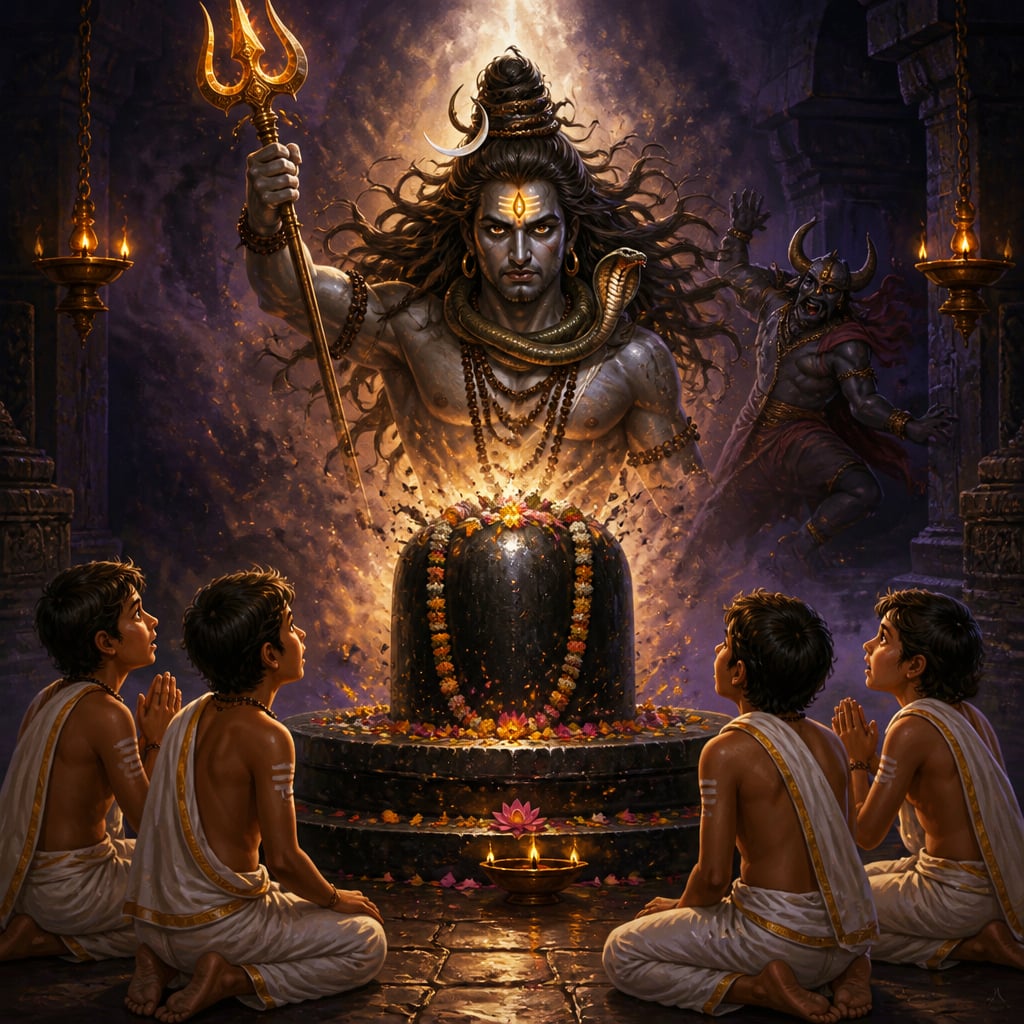
Mahakaal emerges from the lingam

Ujjain's ancient name was Avantika, and it served as the capital of the Avanti kingdom mentioned in Buddhist and Jain texts. But its significance runs deeper than politics. For over two thousand years, Indian astronomers considered Ujjain the prime meridian, the reference point from which all astronomical calculations began. The city that measured time would naturally become home to Time's master.

The Legend of Demon Dushana

The Terror of Avantika

The Shiva Purana recounts how the demon Dushana terrorized the city of Avantika. Born from the boons granted by Brahma, Dushana had grown invincible against gods and men. He established his rule over the Avanti region, forcing the residents to abandon Vedic rituals and worship of the devas.

Among his victims was a devout Brahmin named Vedapriya, whose four sons, Devapriya, Priyamedha, Suvrata, and Sulabha, maintained their devotion to Shiva despite the demon's persecution. When Dushana learned of their continued worship, he marched upon them with his army.

The Emergence of Mahakaal
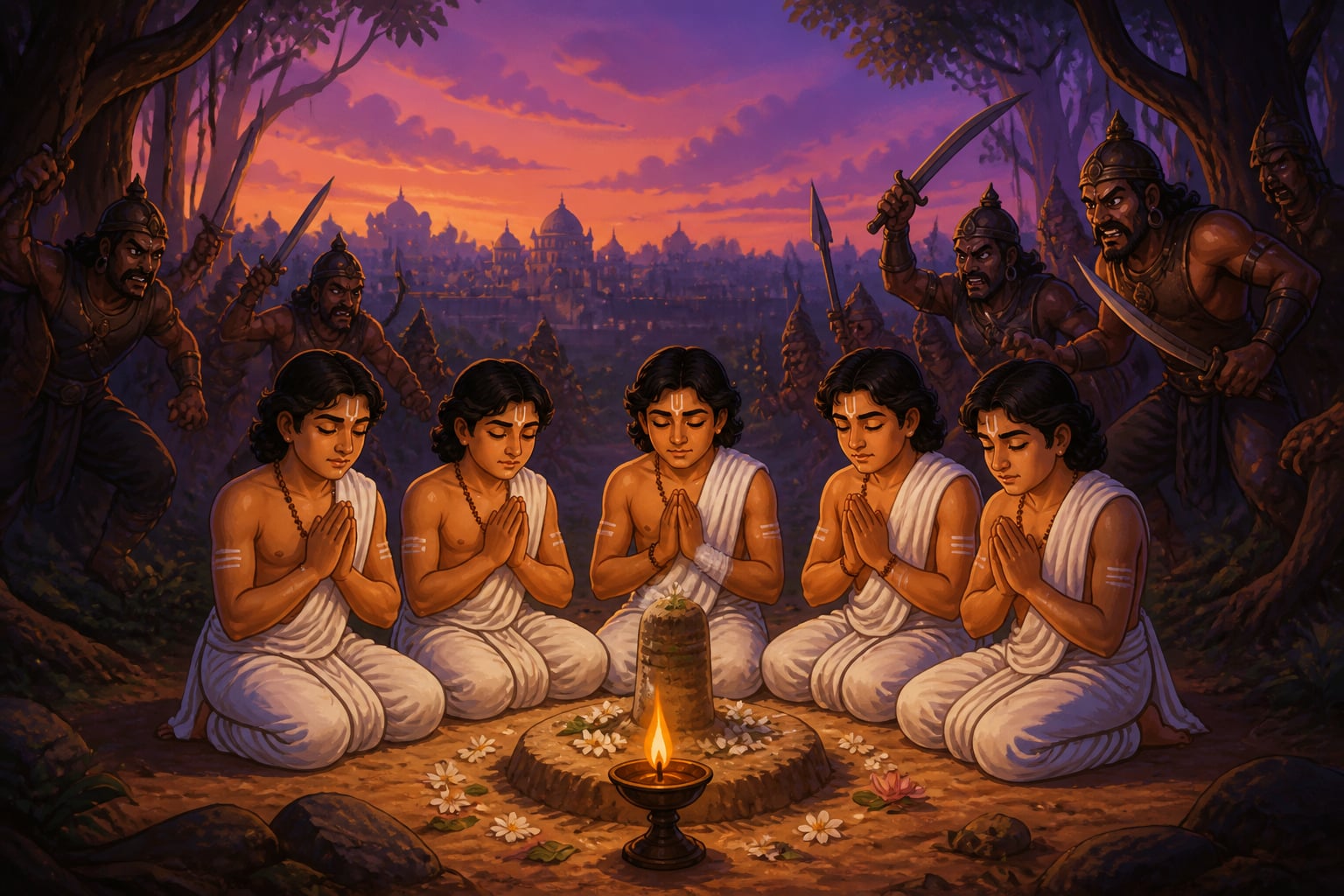
Brothers praying as Dushana's army surrounds

As the demon's forces surrounded the devotees, the brothers intensified their prayers to Shiva. The ground began to tremble. From the earth itself emerged a massive linga of blazing light, the jyotirlinga that would become Mahakaleshwar. From this pillar of radiance, Shiva manifested in his terrifying Mahakaal form.

The battle was swift. Mahakaal's roar alone scattered Dushana's armies. With a single strike, the demon was reduced to ash. But rather than return to Kailash, Shiva announced he would remain in Avantika forever, protecting devotees from the tyranny of time and death. The linga that emerged from the earth remains, self-manifested (swayambhu), requiring no formal installation by priests.

The Only South-Facing Jyotirlinga

The Direction of Death

In Vastu Shastra and Hindu cosmology, south is the direction of Yama, lord of death. Facing south signifies dominion over death itself. While ordinary mortals fear the southern direction, Mahakaal faces it directly, because time encompasses death but is not bound by it.

This orientation makes Mahakaleshwar unique among all jyotirlingas. Devotees entering the sanctum face north, symbolically turning their backs on death as they approach the deity who transcends it. The temple's architecture embodies its philosophy: here, the normal rules of existence are inverted.

Dakshinamukhi, The South-Facing One

The term 'dakshinamukhi' (south-facing) carries additional meaning. 'Dakshina' also means 'the right side' and 'skill' or 'capability.' Shiva as Dakshinamurti is the supreme teacher who transmits knowledge through silence. At Mahakaleshwar, both meanings converge: the south-facing lord who teaches mastery over time through the silent wisdom of presence.

The Temple Through History

Ancient Glory

The original Mahakaleshwar temple was renowned across the ancient world. Kalidasa, the greatest Sanskrit poet, composed his epic 'Meghaduta' describing Ujjain's glory, with Mahakaal as its protective deity. The temple was patronized by the Paramara dynasty, and Ujjain flourished as a center of learning, astronomy, and spirituality.

Destruction and Resurrection

In 1235 CE, the Delhi Sultanate forces under Iltutmish destroyed the temple complex. For centuries, the original structure lay in ruins, though worship continued at a smaller shrine. The present temple was rebuilt in the Maratha period (18th century) under the patronage of the Maratha general Ranoji Shinde.

Mahakaleshwar temple over Rudra Sagar lake

The current five-story structure rises magnificently over the Rudra Sagar lake. The sanctum containing the jyotirlinga lies in the lowest level, underground, appropriate for a linga that emerged from the earth itself. Above it rise successive floors dedicated to Omkareshwar, Nagchandreshwar, and finally the shikhara (tower) that marks the temple's presence across Ujjain's skyline.

The Shiva Tattva: Beyond Time

What Mahakaal Teaches

Every jyotirlinga embodies a specific aspect of Shiva's teaching. At Mahakaleshwar, the teaching is about time, not merely physical time measured by clocks, but kala as the fundamental principle of change, causation, and dissolution.

The word 'Mahakaal' means 'Great Time' or 'Beyond Time.' This seeming contradiction contains the teaching: Shiva is both the flow of time that dissolves all things AND the timeless awareness in which time appears. Just as the screen remains unchanged while movies play upon it, consciousness remains unchanged while time unfolds within it.

The Paradox of Presence

The south-facing orientation points to the practical application: facing mortality transforms how we live. Modern psychology confirms what the Mahakaal tradition teaches, memento mori, remembering death, makes us more alive. The temple that faces death becomes the gateway to deathless awareness.

This is why the Bhasma Aarti, performed with cremation-ground ashes at 4 AM, is the temple's most sacred ritual. By bringing death into worship itself, the ritual enacts what the philosophy describes: time and death are not enemies to be avoided but teachers to be embraced. In their embrace, the timeless is revealed.

Key figures

Mahakaal

Shiva as the Lord of Time; the fierce form who emerged to destroy Dushana and protect devotees

Dushana

The demon who terrorized Avantika; his destruction by Mahakaal led to the establishment of the jyotirlinga

Vedapriya

The devout Brahmin whose sons' devotion to Shiva caused Mahakaal to manifest

Historical context

Ancient period through Maratha reconstruction (18th century)

Living traditions

Mahakaleshwar remains one of India's most visited temples, drawing millions annually. The temple administration has modernized booking systems for Bhasma Aarti while preserving ancient rituals unchanged. Ujjain continues to host one of India's four Kumbh Melas, maintaining its role as a major pilgrimage center. The city's association with time has inspired modern research into ancient Indian astronomy.

Reflection

More in Mahakala: Lords of Time and Death

All lessons in Mahakala: Lords of Time and Death ยท The Twelve Jyotirlingas course