Dvaya Mandira: Two Temples, One Linga?

The Omkareshwar and Mamleshwar debate

Explore the unique situation where two temples - Omkareshwar on the island and Mamleshwar on the southern bank - are sometimes considered to together form the jyotirlinga. Learn about Adi Shankaracharya's connection to this sacred site.

The Puzzle of Two Temples

At most jyotirlinga sites, the question 'Where is the jyotirlinga?' has a simple answer. At Omkareshwar, it does not. Two temples, separated by the Narmada River, both claim jyotirlinga status. Are they one linga manifesting in two places? Two distinct lingas? Or something that transcends the one-versus-two question entirely?
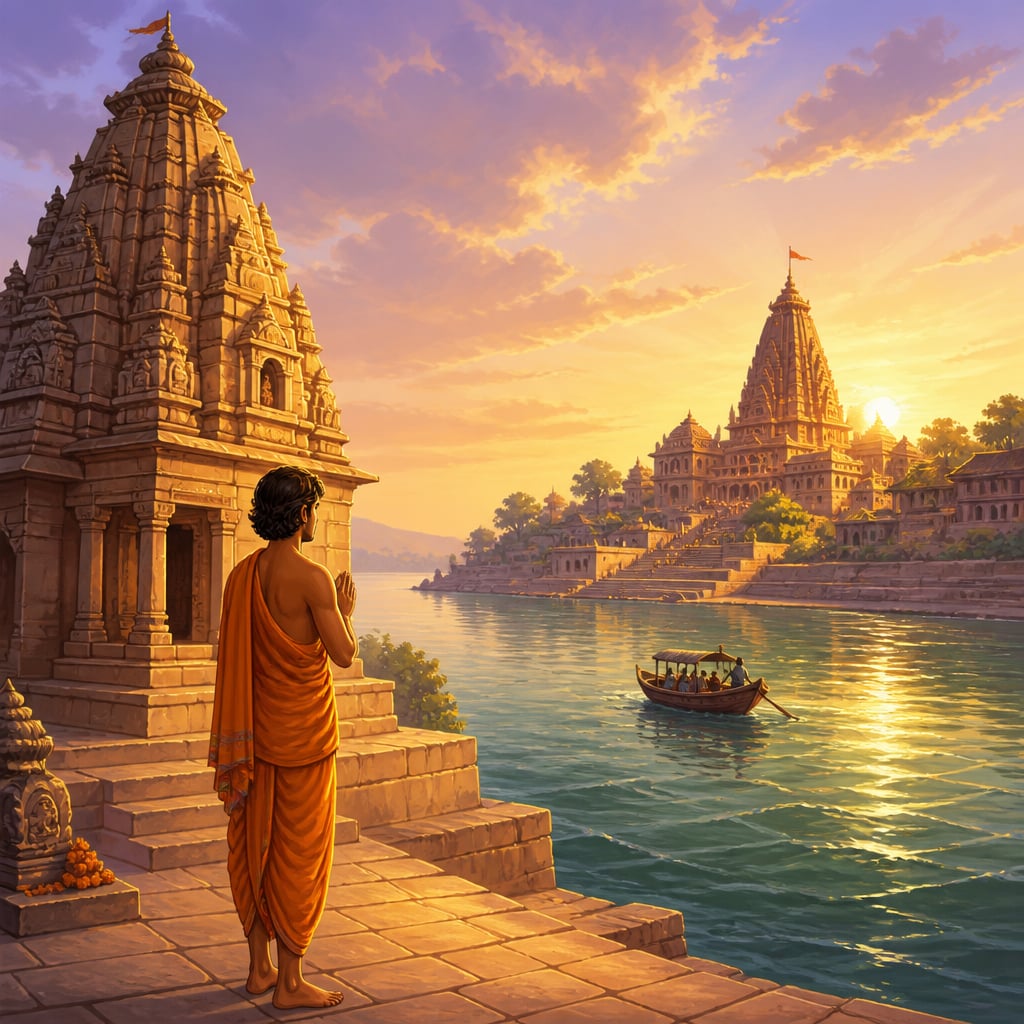
Pilgrim on the ghat facing two temples across the Narmada

This puzzle is not merely academic. For pilgrims, it determines the requirements for complete darshan. For philosophers, it illustrates fundamental questions about unity and multiplicity. And for spiritual seekers, it points to a teaching beyond the debate itself.

The Two Temples

Omkareshwar: The Island Temple

On Mandhata Island, the main Omkareshwar temple houses a linga said to have emerged when Vindhya's penance pleased Shiva. This is the temple most pilgrims visit first, accessible by footbridge from the town, crowned by a shikhara visible from both banks.

The linga here is large, naturally formed, and sits in an underground sanctum. The temple complex includes numerous subsidiary shrines, ancient ghats, and the sacred parikrama path circling the Om-shaped island. When people speak of 'visiting Omkareshwar,' they usually mean this temple.

Mamleshwar: The Southern Bank Temple

Directly across the river, on the southern bank, sits Mamleshwar temple (also called Amareshwar). This older, more austere temple houses a linga that predates the island temple by some accounts. The name 'Mamleshwar' derives from 'Amaleshwar' (the pure lord) or possibly from a local king named Mamla.

Mamleshwar is quieter, less touristed, and has a more intimate atmosphere. The linga here is also ancient and naturally formed. Some traditional texts identify THIS linga, not the island temple's, as the original jyotirlinga.

The Various Traditions

View One: Omkareshwar Alone Is the Jyotirlinga

Many pilgrims and texts consider only the island temple as the canonical jyotirlinga. Arguments include:

This view treats Mamleshwar as an important but secondary temple, worth visiting but not essential for jyotirlinga darshan.

View Two: Mamleshwar Alone Is the Jyotirlinga

A minority tradition holds that Mamleshwar is the original jyotirlinga, with the island temple being a later development. Arguments include:

This view is less common today but maintained by certain scholarly traditions.

View Three: Both Together Form One Jyotirlinga

The most distinctive tradition holds that Omkareshwar and Mamleshwar together constitute the jyotirlinga, that the divine presence split across the river, requiring visits to both temples for complete darshan.

This 'dvaya mandira' (two-temple) concept suggests:

Many traditional guides and priests recommend visiting both temples, considering darshan incomplete with only one.

View Four: The Question Itself Is the Teaching

For Advaita Vedantins, the two-temple puzzle illustrates the nature of reality itself. Is there one linga or two? Both and neither. The apparent multiplicity (two temples) doesn't negate the underlying unity (one jyotirlinga), just as waves don't negate the ocean.

This view sees the debate as itself instructive, pointing beyond categories of one and many toward the non-dual awareness that perceives both as its own expressions.

Adi Shankaracharya's Connection

The Great Teacher at Omkareshwar

Adi Shankaracharya (788-820 CE), the great systematizer of Advaita Vedanta, has deep connections to Omkareshwar. According to tradition, Shankara came here as a young man seeking his guru. He met Govindapada, the disciple of Gaudapada, author of the Mandukya Karika, in a cave on Mandhata Island.

Shankara meeting Govindapada at the cave

The meeting is described vividly in hagiographies: Shankara arrived at the cave entrance and was asked by the sage within, 'Who are you?' Shankara's answer, not giving his name but describing his true nature as pure consciousness, impressed Govindapada so deeply that he accepted the young seeker as his disciple.

Enlightenment at Omkareshwar?

Some traditions locate Shankara's enlightenment experience at Omkareshwar. After years of study with Govindapada, Shankara is said to have realized the non-dual nature of reality while meditating here. The convergence of the Om-shaped island, the teachings of the Mandukya Upanishad (which Gaudapada had commented upon), and Govindapada's transmission all came together.

Whether or not this is historically accurate, the association is spiritually significant. The philosopher who most clearly articulated advaita (non-duality) received his teaching at a site where one-and-two remain perpetually in question.

Govindapada's Cave

The cave where Govindapada is said to have lived and taught is still visited by pilgrims. Located on Mandhata Island, it offers a glimpse into the ascetic setting where India's most influential philosopher received his training. The cave is small, dark, and unremarkable, except for what happened within it.

The Non-Dual Teaching

Beyond One and Two

The Omkareshwar-Mamleshwar situation perfectly illustrates Shankara's advaita philosophy:

This is precisely what Shankara taught about reality itself. The world of multiplicity is not illusion, it's real at its level. But at the ultimate level, only non-dual awareness exists. Wisdom lies in holding both truths simultaneously.

The Island as Om, Revisited

Recall that Mandhata Island forms the shape of Om. Now consider: Om has three parts (A-U-M) plus the silence after. Three apparent divisions; one sound. The very symbol the island traces embodies the teaching the temple debate illustrates.

The two temples are like the letters of Om, distinct and unified, separate and whole. The pilgrimage to both is like chanting the complete mantra, incomplete if you stop partway through.

Practical Implications for Pilgrims

Should You Visit Both Temples?

The practical question for pilgrims: is visiting Mamleshwar necessary for complete jyotirlinga darshan?

Traditional answer: Yes. Most knowledgeable guides and priests recommend visiting both, considering the pilgrimage incomplete otherwise. The two temples are close enough (10-15 minute walk via footbridge) that visiting both is easy.

Philosophical answer: The 'need' to visit both can itself become attachment. If you truly understand that one jyotirlinga manifests everywhere, every location is complete. But if you're uncertain enough to ask the question, you're probably not at that level of realization, better to visit both.

Practical suggestion: Visit both. If nothing else, Mamleshwar's quieter atmosphere offers a contemplative counterpoint to the busier island temple. The walk between them, crossing the Narmada, is itself a meditation.

Order of Visitation

Some traditions specify visiting Mamleshwar first (as the older temple), then crossing to Omkareshwar. Others reverse this. Most pilgrims simply go to whichever is more convenient first.

The philosophical teaching: the order doesn't ultimately matter, but the awareness you bring to each does. Visit both with full presence rather than one with rushed attention.

What the Debate Teaches

Beyond Resolution

The Omkareshwar-Mamleshwar debate has no 'correct' resolution, and this may be the point. Sacred traditions often preserve ambiguity not because they couldn't achieve consensus but because the ambiguity itself teaches.

The debate teaches:

The River Between

Notice that what separates the two temples is the Narmada, the river whose darshan alone purifies, whose every stone is a natural linga. The 'division' between the temples is itself sacred.

This suggests: the apparent gap between one and two, unity and multiplicity, is not an obstacle but a sacred space. The river doesn't divide the jyotirlinga, it reveals its nature.

Key figures

Adi Shankaracharya

The great teacher who systematized Advaita Vedanta; received initiation from Govindapada at Omkareshwar

Govindapada

Shankara's guru who lived in a cave at Omkareshwar; transmitted Gaudapada's teachings

Gaudapada

Author of the Mandukya Karika; Govindapada's teacher; great-grand-guru of Shankara

Historical context

7th-9th century CE (Shankara's lifetime); temples of various earlier periods

Living traditions

Omkareshwar remains an important site for Advaita Vedanta studies. Multiple ashrams offer courses on Shankara's philosophy, attracting both Indian and international students. The two-temple puzzle continues to be discussed in philosophical circles as an illustration of non-dual principles. Modern pilgrims increasingly visit Govindapada's cave as awareness of Shankara's connection to the site spreads.

Reflection

More in Mahakala: Lords of Time and Death

All lessons in Mahakala: Lords of Time and Death ยท The Twelve Jyotirlingas course