Silanisamsa: The Patient Elephant
An elephant who endured abuse for seven years
A magnificent white elephant lives in the forest, known for his gentle nature and wisdom. When a lost forester stumbles upon him, the elephant kindly carries the man home. But the forester proves ungrateful, returning again and again to exploit the elephant's kindness, selling his tusks for ivory. For seven long years, the elephant endures this abuse without complaint. His patience becomes legendary, teaching that true strength lies not in retaliation but in restraint.
The White Elephant of the Forest
In the mountains of the Himalayas, in a forest so deep that sunlight barely touched the ground, there lived an elephant unlike any other.
His skin gleamed white as fresh snow. His tusks curved like twin crescent moons. His eyes held the deep calm of forest pools. The other animals called him Silanisamsa - "The Virtuous One" - because his patience and kindness seemed boundless.
Silanisamsa spent his days peacefully. He bathed in cool streams, ate sweet grasses, and helped any creature that needed help. When a deer was trapped in vines, he freed it with his trunk. When birds needed protection from storms, they sheltered beneath his great body.
"Why are you so kind?" a young elephant once asked him.
"Because kindness makes the forest a better place," Silanisamsa replied. "And because it makes me a better elephant."

The Lost Forester
One monsoon day, a forester from a distant village lost his way in the mountains. For three days he wandered, soaked by rain, scratched by thorns, weak with hunger. By the fourth day, he could barely walk.
"I'm going to die here," he thought. "No one will ever find me."
Then he saw the white elephant.
Silanisamsa was pulling down branches so a family of monkeys could reach the fruit. When he saw the exhausted human, he approached gently.
The forester trembled. Wild elephants were dangerous. Everyone knew that.
But this elephant did something unexpected. He knelt down.
"Climb on," his kind eyes seemed to say.
The forester, too weak to refuse, pulled himself onto the elephant's broad back. Silanisamsa rose and began walking.

For two days, the elephant carried the man through the forest. He knew every path, every stream, every shortcut. When the forester was thirsty, he stopped at a spring. When the man was hungry, he shook down ripe mangoes.
Finally, they reached the edge of the forest, within sight of human roads.
Silanisamsa knelt again, letting the man slide off. Then he turned to go back to his forest home.
The forester watched him disappear among the trees.
"What a magnificent creature," he thought. "And those tusks... they must be worth a fortune."
The First Betrayal
Weeks later, a merchant in the village offered a high price for ivory. The forester remembered the white elephant.
"I could never kill such a creature," he told himself. "But perhaps... just a piece of his tusk? He was so gentle. He wouldn't hurt me."
He returned to the forest with a saw.
Silanisamsa was surprised to see the man he had saved. He approached trustingly, remembering the help he had given.
The forester held up his saw.
"I need just a little ivory. You have so much. Please?"
Silanisamsa understood. He bowed his great head, bringing his tusks within reach.
"Take what you need," his eyes said.
The forester sawed off a piece and hurried away without even saying thank you.
Silanisamsa felt the pain. But deeper than the pain was a sadness at the man's ingratitude. Still, he thought: "Perhaps he is in need. Perhaps this will help his family."
Seven Years of Patience
But the forester returned.
Again and again. Month after month. Year after year.
Each time, he took more ivory. Each time, he offered no thanks, no kindness, no word of gratitude. He simply took what he wanted and left.
The other animals watched in horror.
"Why do you allow this?" a tiger asked. "You could crush him with one foot!"
"If I crushed him," Silanisamsa replied, "I would no longer be myself. His greed is his problem. If I responded with violence, anger would become my problem too."
"But he's hurting you!"
"Yes. But not as much as I would hurt myself if I abandoned my nature. I am patient. That is who I am. I will not let his cruelty change me."
For seven years, this continued. The elephant's magnificent tusks grew shorter and shorter. The forester grew richer and richer.
And still, whenever the man appeared with his saw, Silanisamsa bowed his head and let him take what he wanted.
The Forest's Response
By the seventh year, the forester had grown bold. The elephant had never once threatened him. He felt invincible.
"This time," he thought, "I'll take the rest. Everything that's left."
He approached Silanisamsa with a larger saw.
The elephant looked at him with those same deep, peaceful eyes. He saw the greed, the ingratitude, the complete absence of remorse. And still, he felt no hatred.
But the forest had been watching.
As the forester began to saw, the earth beneath him trembled. The legends say the ground opened up - not through any action of the elephant, but through the natural weight of seven years of terrible karma.
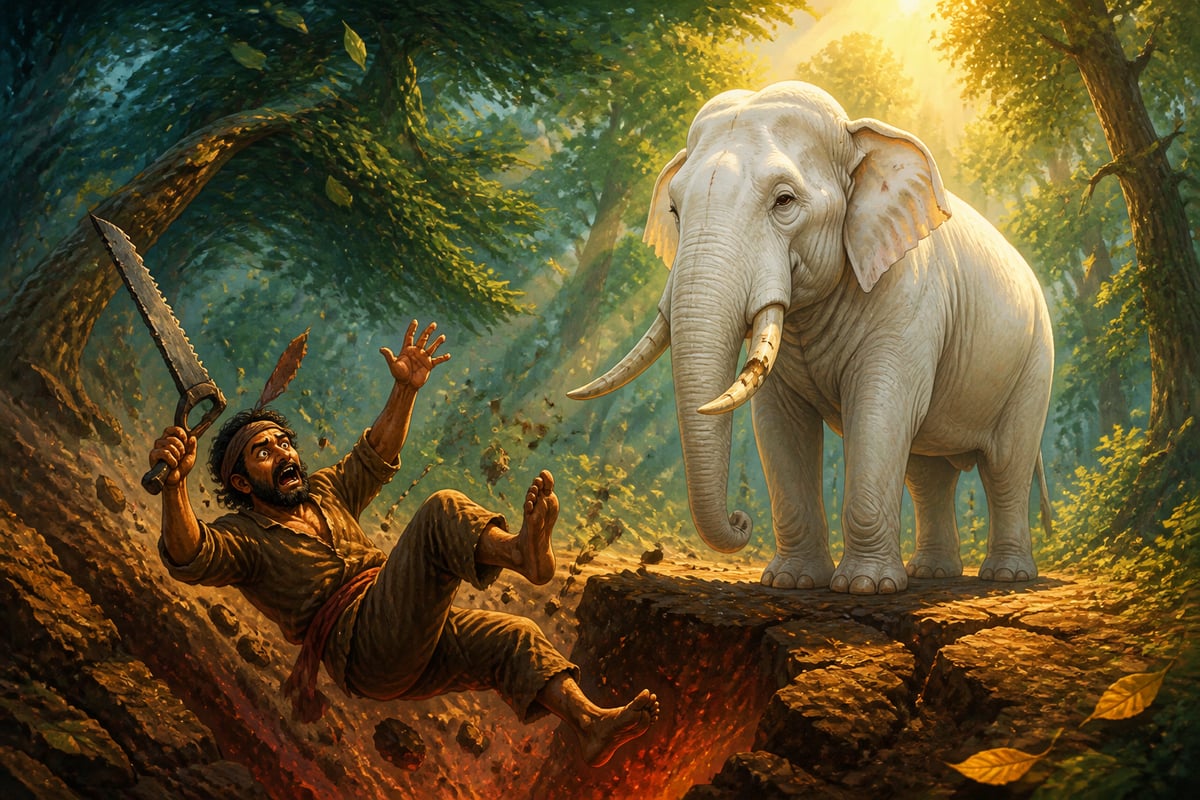
The forester fell, screaming, into the darkness below.
Silanisamsa looked at the hole where the man had stood. He felt no satisfaction, no relief. Only a deep sadness that it had come to this.
"I did not harm him," he thought. "His own actions harmed him. I only remained true to myself."
The Wisdom
Silanisamsa's story asks a challenging question: Is patience always the right response?
The elephant had the power to stop the forester at any time. One swing of his trunk could have ended the abuse. But he chose not to - not from weakness, but from a commitment to who he was.
The elephant understood something profound: we don't control what others do to us, but we control who we become. If he had killed the forester, he would have solved one problem while creating another. He would have become violent. The forester's greed would have infected him with rage.
Instead, he remained patient. And his patience outlasted the forester's greed.
In Your Life
Someone might take advantage of your kindness. A friend might keep borrowing things and never return them. A classmate might copy your homework without asking. Someone might keep making promises they never keep.
When this happens, you have choices. You can explode in anger - which might solve the immediate problem but changes who you are. You can become bitter and stop being kind to anyone - which lets one person's behavior poison your whole life. Or you can set boundaries while remaining true to your values.
Silanisamsa's patience doesn't mean you have to be a doormat. The elephant eventually saw consequences come to the forester - he didn't have to deliver them himself. In your life, you can be patient AND set limits. You can refuse to become cruel AND protect yourself.
The question isn't whether you allow mistreatment. It's whether you let mistreatment change your character. The forester's greed destroyed the forester. But through seven years of exploitation, Silanisamsa's kindness never wavered.
What you endure matters less than what you become.
Reflection
- Has someone ever taken advantage of your kindness? How did you respond, and would you do anything differently?
- The tiger asked Silanisamsa why he didn't crush the forester. The elephant said it would change who he was. Do you think there are actions that would be justified but still wrong to take because of what they'd do to your character?
- The story says the earth 'naturally' swallowed the forester due to his karma. Do you believe that bad actions eventually have consequences even if no one punishes them? Or is that just a comforting story?