Kshantirishi: The Forgiving Sage
Arms and legs severed, yet still forgiving
Deep in the forest dwells Kshantirishi, the sage of patience. When a cruel king discovers him teaching the royal women, he demands to know what virtue the sage practices. 'Patience,' replies the sage. The king decides to test this claim in the most brutal way imaginable - severing the sage's limbs one by one. Yet even as his body is destroyed, Kshantirishi feels only compassion for his torturer, praying for the king's eventual awakening.
The Hermit in the Forest
Deep in the Himalayan foothills, where rivers tumbled over rocks and ancient trees touched the sky, there lived a hermit named Kshantirishi - the Sage of Forgiveness.
He had left his wealthy family decades ago, seeking something gold could not buy. In his forest hermitage, he had found it: perfect peace.

People came from distant villages to hear him speak. They would sit on moss-covered stones while the sage explained the power of forgiveness.
"Anger is like drinking poison and hoping the other person dies," he would say. "When we hold grudges, we chain ourselves to the past. Forgiveness sets us free."
"But Rishi," a young woman once asked, "what if someone does something truly terrible? Must we forgive that too?"
The sage smiled gently.
"True forgiveness is not pretending the harm didn't happen. It's choosing not to carry the burden of hatred. Even if justice demands consequences, we can let go of the poison in our own hearts."
The Cruel King
King Kalinga ruled the neighboring kingdom with cruelty and suspicion. He trusted no one, loved no one, and saw enemies everywhere.
One spring day, the king took his court ladies into the forest for pleasure. While he drank wine and fell asleep, the women wandered off - and found Kshantirishi's hermitage.

The sage was sitting beneath a great sal tree, radiating such calm that the women felt their own worries dissolve. They sat down to listen.
"Fear and anger are twins," Kshantirishi was saying. "Behind every angry person is a frightened one. When someone lashes out at you, they are showing you their pain."
"How do we respond to such people?" one woman asked.
"With understanding. With patience. If you meet hatred with hatred, you both suffer. If you meet hatred with compassion, at least one of you is free."
The women were enchanted. For hours they sat, drinking in wisdom they had never heard in the king's court.
The King Awakens
King Kalinga woke to find his women gone. Rage and jealousy ignited in his heart as he followed their tracks through the forest.
He burst into the clearing to find them sitting at the feet of a ragged hermit, listening as if hypnotized.
"What is this?" he roared, his hand on his sword.
The women scrambled up, terrified.
Kshantirishi alone remained calm. He looked at the furious king with eyes full of compassion - as if seeing not a threat, but a suffering human being.
"Who are you?" the king demanded. "What poison have you been putting in their ears?"
"I am Kshantirishi, a seeker of truth. I teach forgiveness."
"Forgiveness!" The king spat the word. "What a worthless teaching. The weak forgive because they cannot fight. The strong take revenge."
"Perhaps," the sage said quietly. "Or perhaps the truly strong are those who can fight but choose not to. Any fool can strike back. It takes strength to stay peaceful."
The king's face darkened.
"You think you're strong? You think patience is power? Let us test your philosophy."
The Test of Forgiveness
What followed was meant to break the sage - to prove his teaching hollow.
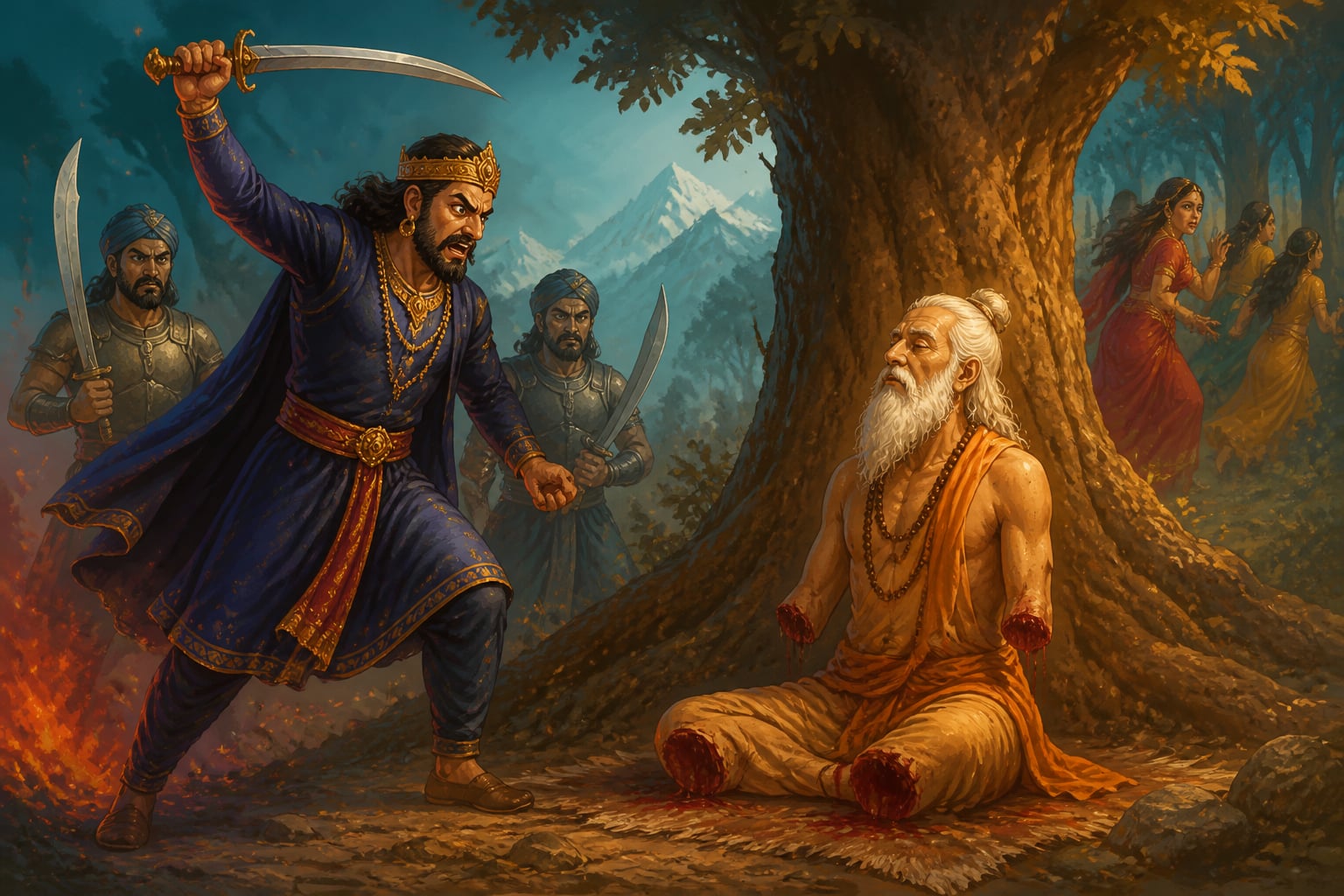
"Cut off his hand," the king ordered his guards.
Kshantirishi did not resist. As the blade fell, his face showed pain - but no anger.
"Do you hate me now?" the king asked.
"No," the sage replied. "I see a man in great pain, lashing out at the world. I feel sorry for you."
Furious, the king ordered the other hand removed. Then one foot. Then the other.
Through it all, Kshantirishi neither cursed nor begged. His voice grew weaker, but his words remained the same.
"I forgive you. I pray for your awakening. I hope someday you find the peace that forgiveness brings."
The king stood over the broken body, waiting for hatred, expecting curses.
"How?" he finally asked. "How can you not hate me? I have destroyed you!"
"You have destroyed my body," Kshantirishi whispered. "But hatred would destroy my soul. That is a victory I will not give you. I die in peace. Can you say the same?"
The Earth's Response
The ancient stories say that when Kshantirishi died, the earth itself rebelled against the injustice. The ground opened beneath King Kalinga, pulling him down to face the consequences of his terrible karma.
But the sage's last words proved prophetic. His forgiveness had planted a seed. In some tellings, the king's descendants sought out Kshantirishi's teachings. The violence of one generation became the compassion of the next.
The Wisdom
Kshantirishi's story asks a question that has no easy answer: Is there a limit to forgiveness?
The sage didn't forgive because the king deserved it. He forgave because he refused to become a prisoner of hatred. Every moment spent hating is a moment spent suffering. Kshantirishi died with a peaceful heart, while the king - though outwardly victorious - remained tormented by his own cruelty.
Forgiveness isn't about the other person. It's about freeing yourself.
This doesn't mean there are no consequences for wrongdoing. Justice can exist alongside forgiveness. We can hold people accountable while releasing the poison of hatred from our own hearts.
In Your Life
Someone will hurt you. Maybe a friend will betray a secret. Maybe a bully will humiliate you. Maybe someone you trust will let you down.
When that happens, you'll have a choice. You can hold onto your anger, replaying the hurt over and over, planning revenge, making yourself miserable. Or you can decide that their actions don't control your heart.
Forgiveness doesn't mean what they did was okay. It doesn't mean you have to be their friend again. It means you're choosing to put down the burden of hatred so you can walk forward freely.
Kshantirishi forgave the king not because the king earned forgiveness, but because the sage refused to let the king's cruelty turn him into something he wasn't. His body was destroyed, but his spirit remained untouched.
That's the real power of forgiveness: it takes back the power someone else tried to steal.
Reflection
- Is there someone in your life you haven't forgiven? How does holding onto that hurt affect you on a daily basis?
- The sage said 'behind every angry person is a frightened one.' Do you think this is true? Can you think of a time when your own anger came from fear?
- Kshantirishi forgave the king even though the king never apologized or changed. Does forgiveness require the other person to deserve it, or is it something we do for ourselves regardless of them?