Abhyaṅga: Sacred Self-Massage Becomes Spa Treatment

How a daily act of self-love became a luxury service you pay someone else to perform

Explore how abhyaṅga, originally a daily self-massage practice every household performed, became the foundation of the luxury spa industry. Discover why the word 'sneha' means both 'oil' and 'love,' and what's lost when self-care becomes something you outsource.

The Practice You Were Supposed to Do Yourself

In traditional Indian households, the morning oil massage wasn't a luxury, it was as routine as brushing teeth. Grandmothers would heat sesame oil on winter mornings, apply it to their own bodies with practiced efficiency, let it soak while they did other tasks, then bathe. No appointment needed. No tip required. No one else involved.
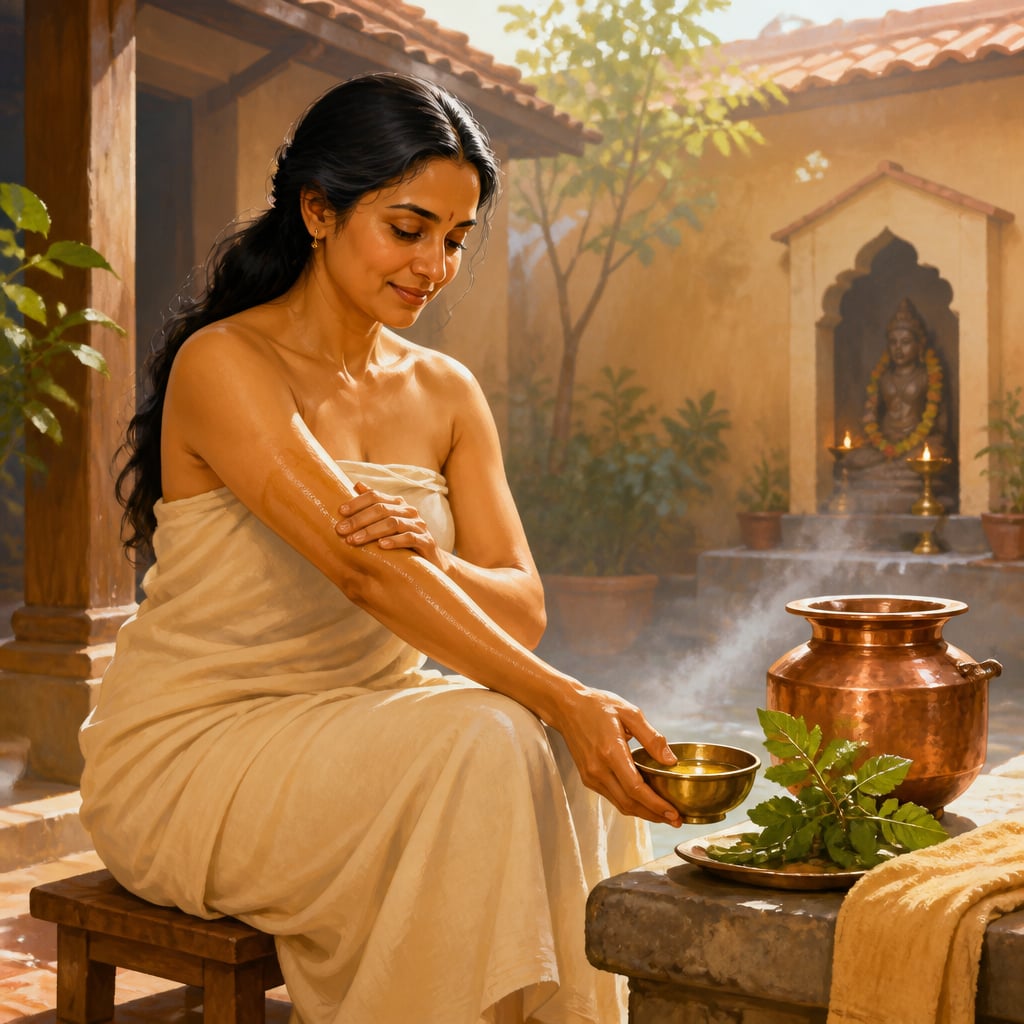
Woman performing self abhyanga

This was abhyaṅga as the texts describe it: a daily self-practice (svābhyaṅga) that took 15-20 minutes, cost almost nothing, and was considered essential for health maintenance. The Aṣṭāṅga Hṛdaya lists it among the foundational practices of dinacaryā, the daily routine that keeps the body in balance.
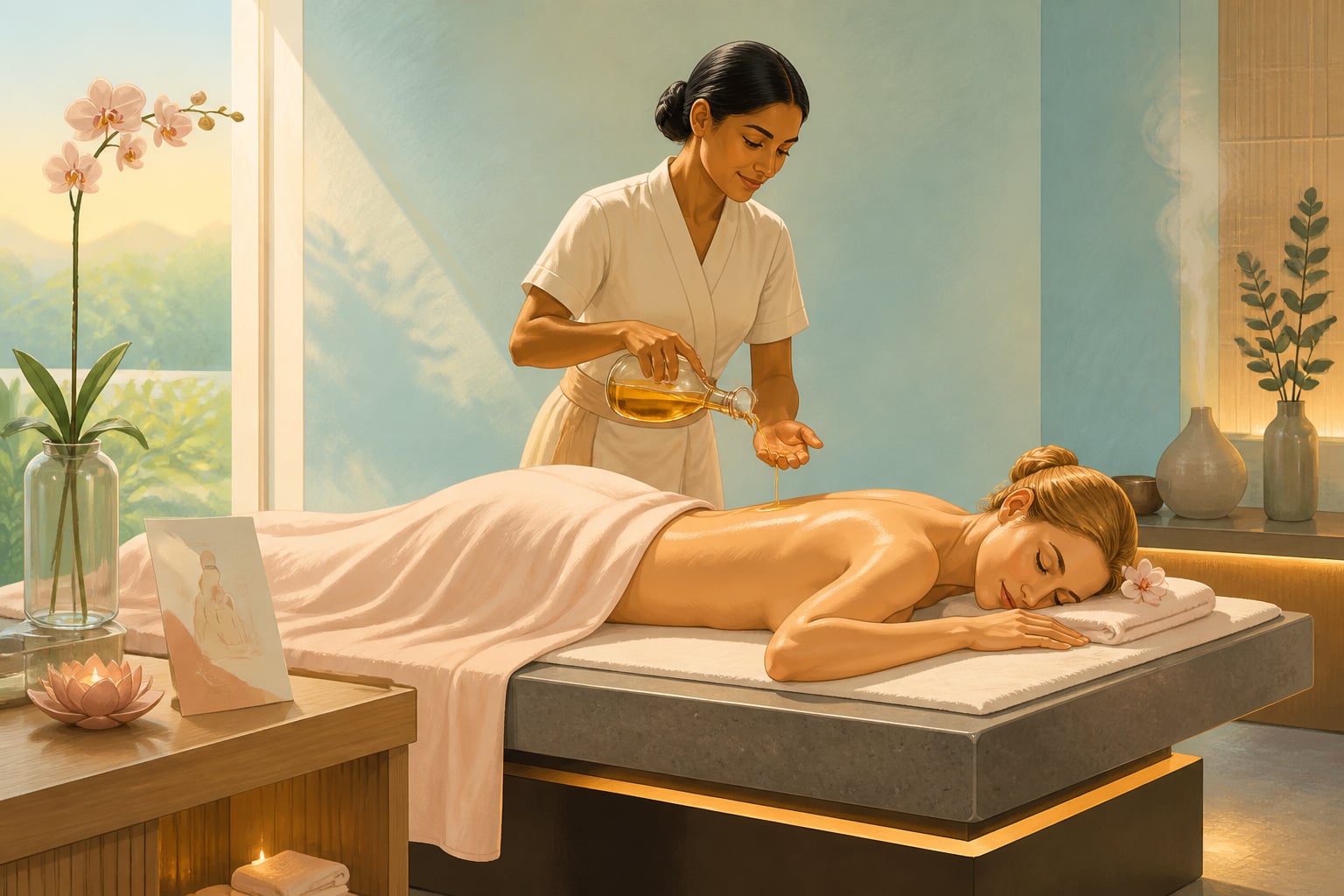
A luxury Western spa offering a sixty-minute Abhyanga massage

Now consider: at a luxury spa in any major city, 'Abhyanga Massage' commands $150-300 per hour. It's performed by someone else, requires scheduling, involves travel, and happens perhaps monthly if you're fortunate. The same practice that Indian grandmothers did daily for the cost of a few rupees of oil has become a premium wellness experience accessible to few.

This isn't entirely a story of commercialization corrupting an ancient practice, though that's part of it. It's also a story about how we've collectively forgotten that certain forms of care can only be given to ourselves, by ourselves. And in that forgetting, we've outsourced something that was never meant to be outsourced.

Sneha: The Word That Means Oil and Love

The Sanskrit word for oil is sneha (स्नेह). It's also the word for love, affection, tenderness. This isn't coincidence or metaphor, it's linguistic evidence of how deeply the tradition understood what oil massage actually is.

When you apply warm oil to your own body with attention and care, you're not just lubricating skin. You're practicing self-love in its most literal form. The warmth, the touch, the time taken, these are expressions of regard for your own body. The texts understood that this dimension couldn't be outsourced. A massage therapist, however skilled, cannot love your body for you.

The Caraka Saṃhitā is explicit about this. It describes abhyaṅga as a practice that creates sneha in both senses, it oleates the body AND cultivates affection toward it. This dual meaning gets entirely lost when abhyaṅga becomes something someone else does to you while you lie passively on a table.

What the Texts Actually Prescribe

The classical texts describe abhyaṅga with characteristic precision:

Timing: Best performed in the morning before bathing, as part of dinacaryā. The oil needs time to penetrate, traditionally, you'd apply it, then do other morning activities, allowing 15-30 minutes before bathing. Some texts recommend waiting until you've exercised or sweated lightly.

Direction: Long strokes on the limbs (toward the heart), circular motions on joints and abdomen. The direction matters, it follows the flow of blood and lymph, supporting circulation rather than opposing it.

Oil Selection: This is where Āyurveda's sophistication shows. Sesame oil (tila taila) is the default, warming, penetrating, suitable for most people and most seasons. But the texts specify: coconut for Pitta types or in summer, mustard for Kapha types or in winter, medicated oils for specific conditions. The modern spa's generic 'massage oil' ignores this entirely.

Areas of Focus: Special attention to the head (śirobhyaṅga), ears (karṇa pūraṇa), and feet (pādābhyaṅga). These areas are considered gateways, the head to the sense organs and mind, the ears to Vāta balance, the feet to the whole body through marma points.

Who Should NOT Do It: The texts include contraindications, during acute illness, immediately after meals, during menstruation (traditionally), with certain skin conditions. These nuances disappear when abhyaṅga becomes a generic spa service offered to anyone who can pay.

The Journey to the Spa

How did a daily self-practice become a luxury service? Several factors converged:

Colonial Disruption: British colonial influence marginalized traditional practices. The daily oil bath, once universal across India, became associated with 'backwardness' in urban, educated classes. Modern soap replaced oil; quick showers replaced ritual bathing. What grandmothers knew was forgotten in a generation.

Western Discovery: As yoga and Āyurveda reached Western audiences in the late 20th century, abhyaṅga came too. But Western culture had no context for daily self-massage. What made sense was professional massage, something Americans already understood from Swedish massage traditions.

The Spa Industry: The global spa industry, worth $130+ billion, recognized Āyurvedic treatments as premium offerings. 'Ayurvedic massage' became a category, exotic, ancient, expensive. The self-practice origins were irrelevant to this business model; what mattered was that it could be sold.

'Ayurvedic' Mass Market Oils: Drugstore shelves now stock 'Ayurvedic massage oil', typically generic formulations with Indian-sounding ingredients, no constitutional consideration, and no connection to traditional preparation methods. These products gesture toward tradition while stripping away everything that made the tradition work.

What's Preserved and What's Lost

Preserved: Professional abhyaṅga does provide benefits. The pressure and strokes improve circulation, the oil nourishes skin, the experience can be deeply relaxing. Scientific studies confirm effects on cortisol levels, blood pressure, and perceived stress. None of this is fake.

Lost: The self-relationship dimension disappears entirely. When someone else massages you, you're a passive recipient. When you massage yourself, you're an active participant in your own care. The texts don't describe abhyaṅga as 'receiving treatment', they describe it as doing something for yourself.

Lost: Constitutional specificity vanishes. A traditional grandmother would know that her Vāta-type grandchild needed warming sesame oil while her Pitta-type grandchild needed cooling coconut. A spa offers the same oil to everyone, or bases selection on scent preference rather than constitution.

Lost: Daily frequency becomes impossible. Few people can afford daily professional massage, even fewer have time for it. What was meant to be quotidian becomes occasional at best.

Lost: The integration with dinacaryā. Self-abhyaṅga was one element in a complete morning routine, alongside tongue scraping, oil pulling, elimination, and bathing. Extracting it as a standalone spa treatment removes it from this context.

The Economics of Self-Care vs. Outsourced Care

Let's do the math:

Traditional Self-Abhyaṅga:

Modern Spa Abhyaṅga:

The spa version costs 25-50 times more and happens 1/30th as often. Even accounting for the skill of a trained therapist, the math doesn't favor outsourcing.

But the real cost isn't financial, it's relational. Every day you don't practice self-abhyaṅga is a day you've missed an opportunity to tend to your own body with your own hands. That relationship between self and body, cultivated through daily touch, cannot be purchased.

The Touch You Cannot Outsource

Here's what the spa industry cannot sell you: the experience of caring for your own body.

When you warm oil in your palms and apply it to your feet, you're paying attention to your feet in a way that rarely happens otherwise. You notice: Is the skin dry? Are there rough patches? Does this area feel tender? This noticing IS the practice. It's not preparation for the practice, it's the thing itself.

A massage therapist, however attentive, cannot develop your relationship with your own body. They can work on your body. But self-abhyaṅga works with your body, as a collaboration, a conversation.

The texts describe this beautifully: abhyaṅga creates snigdhata (oiliness/suppleness) not just in the body but in one's relationship to the body. You become 'oiled' toward yourself, softer, more affectionate, more forgiving. This happens through the act of self-touching, not through being touched.

Practicing Authentically

Knowing this history, how might you engage more authentically?

Start with self-practice: Even if you enjoy spa massage, establish a self-abhyaṅga practice first. Begin with just feet and scalp if full-body feels overwhelming. The relationship with your own body is the foundation.

Choose oil constitutionally: Don't grab whatever's labeled 'massage oil.' Learn your dominant doṣa (constitution) and select accordingly. Sesame for Vāta, coconut for Pitta, mustard or sesame for Kapha. Season matters too, warming oils in winter, cooling in summer.

Integrate, don't isolate: Self-abhyaṅga belongs in a morning routine, not as a standalone event. Wake, eliminate, scrape tongue, practice abhyaṅga, let oil penetrate while you do other tasks, then bathe. The integration is part of the teaching.

Reclaim the sneha: As you apply oil, consciously practice the dual meaning. This is oil AND love. You are caring for your own body. This dimension doesn't require belief, just attention.

Be skeptical of products: 'Ayurvedic massage oil' on a drugstore shelf is marketing, not tradition. Seek traditionally prepared oils from reputable sources, or simply use high-quality cold-pressed sesame or coconut oil. Simplicity is authentic; complexity is often commercial.

The Deeper Teaching

Abhyaṅga's transformation from self-care to spa-service reveals something about our culture's relationship with self-tending.

We're comfortable outsourcing. Need relaxation? Book a massage. Need food? Order delivery. Need entertainment? Stream content. The idea that certain things can only be done for ourselves, by ourselves, feels almost countercultural.

But the texts are clear: some forms of care resist outsourcing. You cannot pay someone to love your body for you. You cannot schedule self-relationship. The grandmother oiling her own skin before dawn wasn't performing a spa treatment on herself, she was enacting a philosophy that said: my body deserves my attention, daily, without exception.

The spa industry has its place. Professional massage offers genuine benefits. But abhyaṅga as the texts describe it, daily, self-administered, constitutional, integrated, offers something different: a practice through which you develop your primary healing relationship, the one between you and your own body.

That relationship, unlike a spa appointment, is always available. The oil is cheap. The time is minimal. The only requirement is the willingness to touch yourself with care.

Sneha: oil and love. The same word, because they were never meant to be separated.

We live in a culture of outsourcing. Need food? Order delivery. Need relaxation? Book a spa. But some forms of care resist delegation. When you touch your own feet with warm oil and attention, you're doing something no one can do for you, attending to your own body with your own hands. This isn't about saving money on spa visits; it's about developing a relationship with your physical self that only you can cultivate.

Mass-market 'Ayurvedic massage oils' offer the same formula to everyone, often a generic base with appealing fragrance. This isn't Āyurveda; it's marketing using Āyurvedic terms. True practice asks: What does MY body need today? A Pitta person using warming sesame oil in summer increases heat; a Vāta person using coconut in winter increases cold. The individualization is the practice.

Key figures

Vāgbhaṭa

Author of the Aṣṭāṅga Hṛdaya, which contains the most influential description of dinacaryā including the daily abhyaṅga prescription. His text became the standard reference for Āyurvedic daily practices.

The Aṣṭāṅga Hṛdaya's dinacaryā chapter remains the primary source for traditional daily routine. Vāgbhaṭa's integration of abhyaṅga with other practices created the comprehensive morning sequence still followed in traditional households.

Caraka

Compiler of the Caraka Saṃhitā, which establishes the theoretical foundation for understanding abhyaṅga as both physical practice and cultivation of self-affection (sneha).

The Caraka Saṃhitā provides the constitutional framework for oil selection and identifies abhyaṅga's role in preventing disease through daily practice. His integration of physical and emotional benefits established abhyaṅga as holistic self-care.

Suśruta

Author of the Suśruta Saṃhitā, which explicitly connects the double meaning of sneha (oil and love) in the context of abhyaṅga, clarifying that self-love arises through physical self-care.

As the surgical authority in Āyurveda, Suśruta's endorsement of abhyaṅga established it as medical recommendation, not just folk practice. His precise language about sneha's dual meaning has become central to understanding the practice's depth.

Case studies

The Mathematics of Self-Care: Daily vs. Monthly

Consider two professionals seeking the benefits of oil massage: **The Traditional Practitioner**: Meera, 42, learned abhyaṅga from her grandmother. Every morning, she warms a tablespoon of sesame oil, applies it to her body with practiced efficiency (feet, legs, arms, torso, ending with head), lets it absorb while she makes tea and reviews her schedule (15 minutes), then showers. Cost: approximately ₹500/month for quality sesame oil ($6). Time: 15-20 minutes daily, integrated into morning routine. Frequency: daily - 365 times per year. Total annual cost: ₹6,000 ($72). Relationship with her body: ongoing daily conversation. **The Modern Consumer**: James, 42, discovered 'Ayurvedic massage' at a luxury spa. He books monthly 90-minute sessions at $250 each. The therapist uses the spa's signature 'Ayurvedic blend' (generic base oil with lavender). The experience is deeply relaxing; he leaves feeling pampered. Cost: $250/session. Frequency: monthly - 12 times per year. Total annual cost: $3,000. Plus travel time, booking hassles, and the week-three tension that builds before the next appointment. Relationship with his own body: delegated to a professional.

Ashtanga Hridayam (Sutra Sthana 1.25) states that Panchakarma is the supreme therapeutic intervention because it removes disease from the root rather than suppressing symptoms. The traditional model was embedded in a community healthcare system (Vaidya tradition) funded by local rulers, making it accessible regardless of economic status.

The spa industry has successfully rebranded a daily self-practice as a luxury service. This isn't villainy - spas provide real benefits. But it obscures the original teaching: abhyaṅga was never meant to be expensive, occasional, or performed by others. The transformation from self-care to purchased-care is a cultural loss masquerading as progress.

Meera touches her own body with care 365 times per year for $72 total. James receives care 12 times per year for $3,000. Both receive genuine benefits. But Meera has developed something James hasn't: the ongoing relationship between her hands and her body, the daily acknowledgment that her physical self deserves her own attention. This relationship cannot be purchased at any price point.

The global massage therapy market exceeds $20 billion annually, yet most consumers receive monthly treatments from strangers rather than daily self-care. Abhyanga's model of affordable, self-administered daily practice offers 30x more frequent body contact at 2% of the annual cost.

India's Panchakarma wellness tourism market was valued at $2.8 billion in 2023, with Kerala alone attracting 1.2 million medical tourists annually. The average Panchakarma retreat generates 8x the revenue of standard tourism per visitor.

Historical context

Classical Āyurveda to Modern Wellness Industry (c. 600 BCE - Present)

Living traditions

The daily oil bath tradition persists in traditional Indian households but has largely been lost in urbanized, Westernized contexts. The spa industry has repurposed abhyaṅga as 'Ayurvedic massage', a premium service rather than basic hygiene. Mass-market 'Ayurvedic' massage oils proliferate, often without constitutional consideration or traditional preparation. Meanwhile, a small counter-movement promotes authentic self-abhyaṅga through traditional Āyurvedic education, emphasizing the practice's original form as daily, self-administered, and constitutionally specific.

Reflection

More in Śodhana: From Sacred Purification to Detox Culture

All lessons in Śodhana: From Sacred Purification to Detox Culture · Indian Wellness Traditions: Modern Connections course