Tulasī: From Temple Courtyards to Tea Boxes

The sacred plant that became 'holy basil' herbal tea

How tulasī, the sacred plant worshipped daily in millions of Indian households, transformed into 'holy basil' stress-relief tea and supplements.

Two Mornings, One Plant
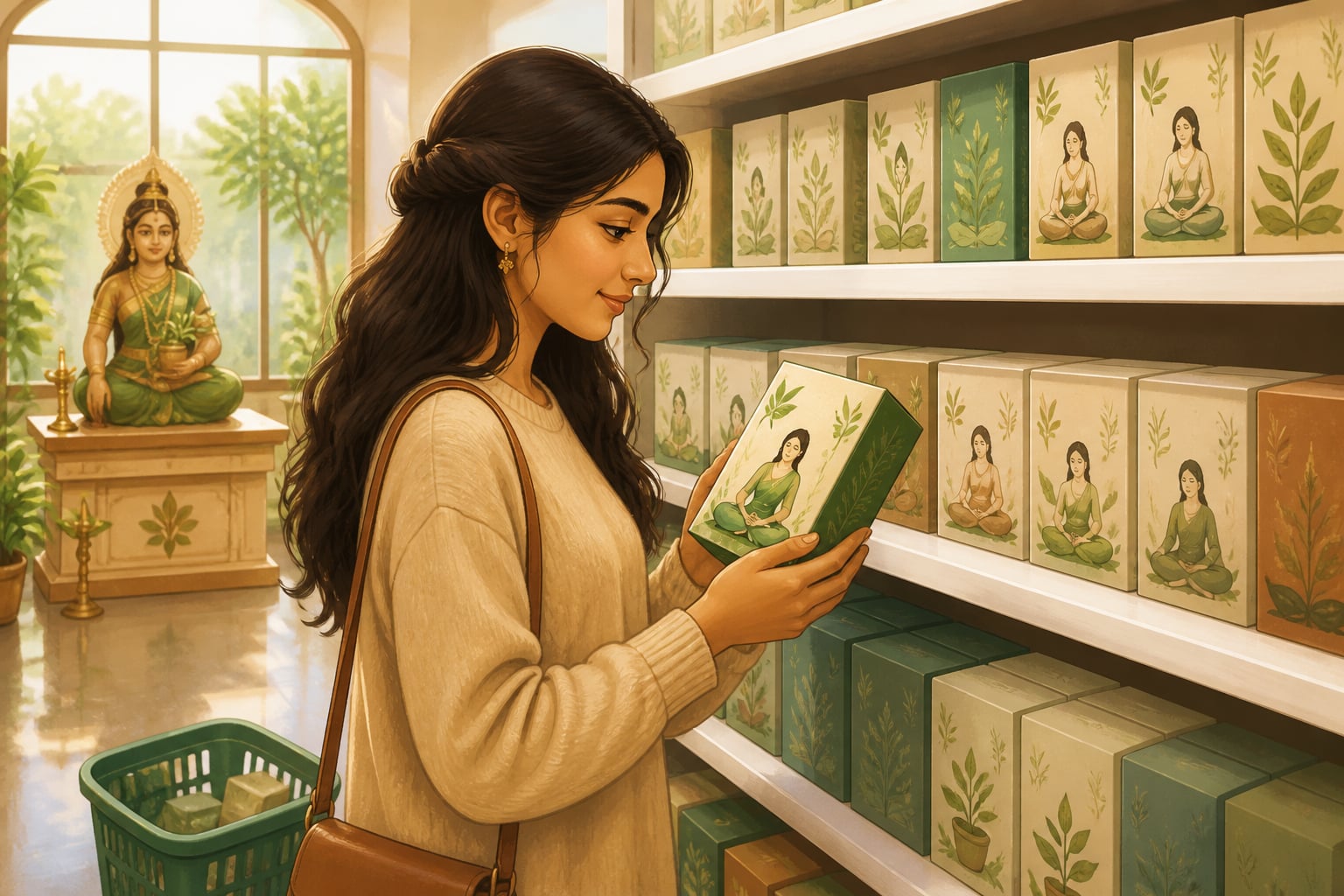
A young woman browsing holy basil tea boxes at an Austin Whole Foods

In a Whole Foods in Austin, Texas, a woman browses the tea aisle. She picks up a box labeled 'Holy Basil Stress Relief Tea.' The packaging shows calming purple and green leaves. The description promises 'adaptogenic support for modern stress' and 'sacred herbs from ancient India.' She reads the ingredients, 'Organic Tulsi (Holy Basil)', and drops it in her cart. It will sit in her cupboard next to chamomile and peppermint, another herbal option for evenings when she needs to unwind.

Six thousand miles away, in a village in Uttar Pradesh, an elderly woman rises before dawn. She walks to her courtyard where a raised platform holds a tulasī plant in a decorated clay pot. She has performed this ritual every morning for sixty years, as did her mother, and her grandmother before her.

She lights a small oil lamp. She offers water to the plant, circling it three times. She touches her forehead to the platform's edge. She doesn't call this 'holy basil', she calls her Tulasī Mātā. Mother Tulasī. She is not making tea; she is performing puja to a deity.
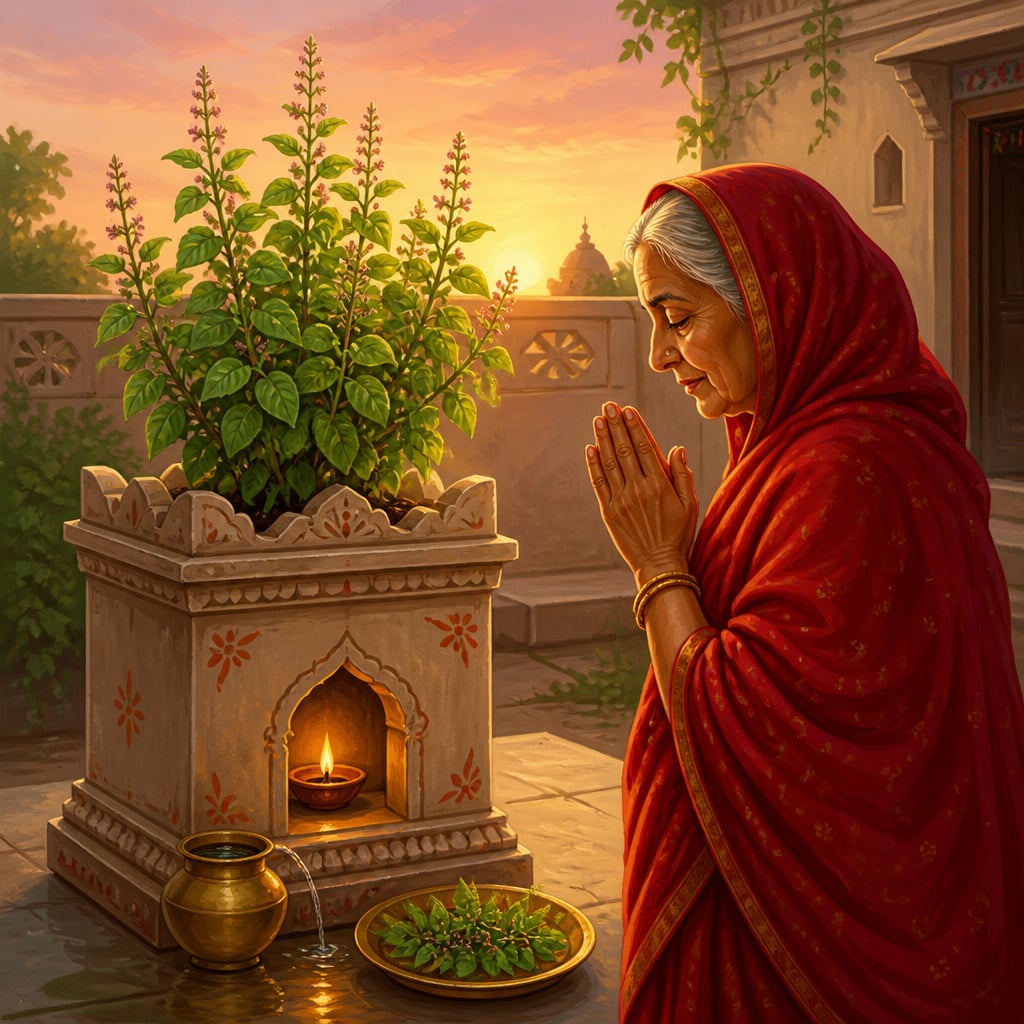
Uttar Pradesh grandmother offering morning prayer at her tulasi vrindavan

In Hindu tradition, tulasī is not merely a sacred plant, she is a goddess. An incarnation of Lakṣmī, consort of Viṣṇu. The plant is a living form of divine feminine presence. The woman in the courtyard is not communing with an herb; she is greeting the goddess who protects her household.

The woman in Austin and the woman in Uttar Pradesh are both interacting with the same species, Ocimum tenuiflorum. But they inhabit entirely different relationships with it. One sees a stress-relief herb. The other sees the goddess who makes her home sacred.

This is the story of how a deity became a tea.

The Divine Plant

To understand tulasī's journey, we must first understand what she is to the billion people who reverence her.

Tulasī is not merely 'considered sacred' in the way some traditions consider certain trees or animals lucky. She is worshipped. Daily puja is performed to her. Marriages are conducted in her presence. No Hindu ritual is complete without her leaves. She has her own festival, Tulasī Vivāha, when she is ceremonially married to Viṣṇu each year.

The mythology varies by region, but common threads include:

Vṛndā's Transformation: In one prominent narrative, Vṛndā was a devoted wife whose faithfulness protected her demon husband Jalandhar from the gods. Through divine intervention, her chastity was broken, and in her grief, she immolated herself. From her ashes arose tulasī, and Viṣṇu declared that she would be worshipped in every Hindu household, eternally united with him.

Lakṣmī's Presence: Tulasī is understood as a form of Lakṣmī, wherever tulasī grows, Lakṣmī resides. This is why traditional households keep tulasī in the courtyard: her presence ensures prosperity, purity, and divine protection.

Viṣṇu's Beloved: Tulasī leaves are essential in Viṣṇu worship. No offering to Viṣṇu is complete without them. The Padma Purāṇa states that Viṣṇu does not accept any offering lacking tulasī.

This isn't metaphor or poetic license. For hundreds of millions of people, the tulasī plant is a living deity. The woman performing morning puja isn't symbolically honoring an herb, she is worshipping the goddess present in her courtyard.

The Medicinal Dimension

Tulasī is also, of course, a powerful medicinal plant. Āyurvedic texts classify it clearly:

Rasa (Taste): Kaṭu (pungent), Tikta (bitter)

Guṇa (Qualities): Laghu (light), Rūkṣa (dry), Tīkṣṇa (sharp)

Vīrya (Potency): Uṣṇa (heating)

Vipāka (Post-digestive effect): Kaṭu (pungent)

This profile makes tulasī a Kapha-reducing herb, excellent for respiratory conditions, congestion, coughs, and sluggish digestion. Its heating quality stimulates agni (digestive fire) and metabolism. Its sharp quality cuts through accumulated toxins.

Traditional medical uses include:

But here's the crucial point: in traditional practice, these medicinal uses were never separate from tulasī's sacred identity. You didn't choose between worshipping tulasī and using her medicinally, you did both. The morning puja included taking a few leaves for health. The medical preparation was received as prasāda (sacred offering). The plant's healing power was understood as inseparable from her divine nature.

The Three Tulasīs

Western markets typically sell 'tulsi' or 'holy basil' as if it were a single thing. Traditional knowledge recognizes distinct varieties:

Three tulasī plants compared side by side: Kṛṣṇa, Rāma, and Vana

Kṛṣṇa Tulasī (कृष्ण तुलसी) - 'Dark Tulasī': Purple-leafed variety, considered more potent medicinally. Also called Śyāma Tulasī. Used for stronger therapeutic applications, particularly respiratory conditions.

Rāma Tulasī (राम तुलसी) - 'Light Tulasī': Green-leafed variety, milder in taste and effect. More commonly used in daily household worship and gentle daily consumption.

Vana Tulasī (वन तुलसी) - 'Wild Tulasī': A different species (Ocimum gratissimum) sometimes grouped with tulasī. Stronger medicinal properties, less commonly used in worship.

Commercial products often combine varieties or don't specify which they contain. Traditional practice would select the variety appropriate to the purpose, Kṛṣṇa for acute illness, Rāma for daily wellness, specific preparations for specific conditions.

The Journey West: From Courtyard to Commerce

How did a goddess become an herbal tea?

Colonial Documentation: British botanists and pharmacologists documented tulasī's medicinal properties, separating 'useful' chemistry from 'native superstition.' The sacred context was noted as curious folklore, not as integral to understanding the plant.

Botanical Classification: Western taxonomy named the plant Ocimum sanctum (now Ocimum tenuiflorum), 'sanctum' acknowledging its sacred status, but the classification itself removed it from its living religious context into a category system based on morphology, not meaning.

Herbal Medicine Interest (1970s-90s): As Western interest in herbal medicine grew, tulasī attracted attention for its adaptogenic and immune-supporting properties. Research papers appeared. The plant entered Western herbal materia medica as 'holy basil', the name preserving a trace of its sacred identity.

Commercial Development (2000s-present): Companies began selling tulasī products. Organic India, founded in the 1990s in India by Americans, became a major player with their 'Tulsi Tea' line. The packaging often references the plant's sacred status, 'revered in India for thousands of years', while positioning it as just another herbal option.

The Adaptogen Wave: As 'adaptogen' became a marketing buzzword, tulasī joined ashwagandha and others in the category. 'Holy basil' stress-relief formulas proliferated. The deity became a functional ingredient.

The Sacred-Secular Gap

The woman in Austin isn't wrong to drink tulasī tea. The plant does have stress-reducing properties. Research confirms effects on cortisol, anxiety, and immune function. She'll receive genuine benefit.

But consider what's lost:

The Living Relationship: Traditional households don't consume tulasī, they have a relationship with her. The plant in the courtyard is tended daily, worshipped, spoken to. She's a family member, a protector, a living presence. The tea bag contains plant material; it doesn't contain relationship.

The Sacramental Context: Taking tulasī leaves after puja is receiving prasāda, sacred offering. The leaves have been offered to the divine and returned sanctified. A tea bag steeped in hot water hasn't undergone this transformation.

The Prohibition on Harm: Traditional practice includes strict rules about how tulasī may be touched and harvested. Leaves are never plucked in the evening or on certain days. The plant is never harmed unnecessarily. Commercial cultivation follows agricultural logic, not sacred protocol.

The Complete Understanding: Tulasī's medicinal power was traditionally understood as an expression of her divine nature, not separate from it. The goddess heals because she is the goddess. Reducing her to 'active compounds with adaptogenic properties' strips the meaning that made the practice coherent.

None of this means Westerners should stop drinking tulasī tea, or that commercial products are worthless. It means understanding that something was lost in translation, something that billions of people still maintain, every morning, in courtyards across India.

What Modern Research Confirms

The science validates specific effects:

The research doesn't capture what can't be measured: the psychological effect of daily relationship with a living plant, the community dimension of shared ritual, the meaning-making that transforms leaf-consumption into something larger than biochemistry.

Growing Your Own: The Living Tradition

Perhaps the most authentic way to engage with tulasī, whatever your background, is to grow her yourself.

Tulasī is remarkably easy to grow. She thrives in pots on sunny windowsills or balconies. She asks for regular water, good drainage, and warmth. In exchange, she offers leaves you can use daily, a plant you can tend and watch grow, and, if you're open to it, a relationship that extends beyond utility.

Growing basics:

Daily use:

If you're moved to acknowledge her sacredness:

The living plant tradition is what commercial products can't replicate. A tulasī plant on your windowsill is closer to what the grandmother in Uttar Pradesh has than any tea bag can be.

Practicing with Awareness

If you use tulasī products, fresh or commercial, here's how to practice with fuller awareness:

Know what you're consuming: Is it Kṛṣṇa, Rāma, or mixed varieties? How was it processed? The product that says 'tulsi' may be far removed from the fresh plant.

Consider growing your own: Even one pot on a sunny windowsill connects you to the living tradition.

Respect the sacred dimension: You don't need to worship tulasī. But knowing that millions do, that this 'stress relief tea' is someone's goddess, may shift how you hold the relationship.

Use appropriately: Tulasī is heating. If you run hot (Pitta constitution), use moderately. For respiratory issues, use more freely. Match the medicine to your need.

Connect to the complete tradition: Tulasī's power in traditional understanding comes from relationship, daily attention, care, gratitude. The tea bag gives you compounds; the living plant offers relationship.

The Question of Translation

Can a goddess become a tea? The market says yes, and millions buy tulasī products with no knowledge of her divine identity. The tea provides benefit. The research validates effects. The transaction is complete.

But something doesn't translate. The grandmother in the courtyard and the woman at Whole Foods are not doing the same thing, even though the same plant is involved. One is in relationship with a deity; the other is consuming an herb. One participates in a tradition unbroken for centuries; the other is trying something new that might help with stress.

The commercial translation isn't theft, tulasī freely offers her gifts to all who approach. But it is reduction. The fullness of what tulasī is, sacred plant, household deity, incarnation of Lakṣmī, medical treasure, living relationship, narrows to 'adaptogenic herb for stress relief.'

The question isn't whether to drink tulasī tea. The question is whether you want to know what you're drinking, and whether that knowledge might open a relationship deeper than consumption.

Growing tulasī reconnects you to the living tradition. Purchase a plant or start from seeds (available at Indian groceries or herb nurseries). Provide sun, regular water, and warmth. Pinch flower buds to encourage leaves. Harvest by gently pinching leaves, never strip the plant. In cold climates, bring indoors before frost. The plant rewards attention, traditional growers say she thrives when loved.

At the first sign of cold or respiratory infection: steep 5-7 fresh tulasī leaves (or 1 tsp dried) in hot water for 5-10 minutes. Add fresh ginger and honey. Drink 2-3 cups daily. For sore throat, chew fresh leaves slowly. For congestion, inhale steam from tulasī tea. This isn't replacing medical care for serious illness, but for routine colds, traditional methods often work faster than waiting it out.

Key figures

Vṛndā

The devoted wife who became tulasī according to Puranic mythology. Her story establishes tulasī's identity as both goddess and plant, explaining why she is worshipped daily in Hindu households.

The Vṛndā narrative, found primarily in the Brahma Vaivarta Purāṇa and Padma Purāṇa, establishes tulasī worship. Her mythological 'marriage' to Viṣṇu becomes the annual Tulasī Vivāha festival. Her protective presence in households derives from her story's promise of divine blessing.

Bhāvamiśra

Author of the Bhāvaprakāśa, which provides the standard Āyurvedic pharmacological profile of tulasī alongside the devotional material in Purāṇas.

The Bhāvaprakāśa's tulasī entry became the standard Āyurvedic reference. His verse on tulasī's properties, pungent, bitter, heating, Kapha-reducing, guides traditional medical application. Modern research often validates what Bhāvamiśra documented five centuries ago.

Case studies

From Deity to Tea Bag: The Most Dramatic Sacred-to-Secular Translation

Among all the Āyurvedic herbs that have entered Western markets, tulasī represents the most dramatic case of sacred-to-secular translation. Other herbs are medicinal plants with cultural significance. Tulasī is a goddess. The Padma Purāṇa declares that Viṣṇu himself said: 'Tulasī is dearer to me than Lakṣmī.' The Brahma Vaivarta Purāṇa states that wherever tulasī leaves are present, that place becomes as sacred as Vaikuṇṭha (Viṣṇu's heaven). The plant is married to Viṣṇu annually in a wedding ceremony performed by millions. She is spoken to, prayed to, and tended as a family member who happens to be divine. Now consider the tea box on the Whole Foods shelf. The label might mention that tulasī is 'revered in India' or 'sacred to Hindus.' But the framing is functional: 'stress relief,' 'adaptogenic support,' 'immune support.' The deity has become an ingredient. This translation isn't wrong in a moral sense - tulasī freely offers her benefits to all, and the commercial products do provide medicinal value. But it represents a category collapse that deserves acknowledgment. In traditional understanding, tulasī's medicinal power derives from her divine nature. She heals because she is the goddess. Separating her healing properties from her sacred identity - extracting the 'active compounds' while discarding the 'religious context' - misunderstands what she is. The woman buying stress-relief tea isn't doing anything wrong. But she might benefit from knowing that 500 million people would never dream of reducing what she's holding to 'adaptogenic support.' For them, she is Viṣṇupriyā - Viṣṇu's beloved. The tea bag contains a goddess, whether the label mentions it or not.

Ayurveda's Dravyaguna Shastra (pharmacology) classifies herbs not just by chemical properties but by rasa (taste), virya (potency), vipaka (post-digestive effect), and prabhava (special action). This multi-dimensional classification system considers the whole herb's effect on the whole person, in contrast to modern pharmacology's focus on isolated active compounds.

The tulasī case isn't unique - it's extreme. Similar sacred-to-secular translations occur with other plants (peyote to mescaline, ayahuasca to 'psychedelic therapy'). The question is how to honor origins while allowing access. Perhaps the answer isn't either/or but both/and: use the tea, but know what you're drinking. Receive the benefit, but acknowledge the source. The label says 'holy basil' - maybe take the 'holy' part seriously.

Tulasī's journey reveals what can and cannot translate across cultural boundaries. The phytochemistry translates - the same molecules produce the same effects worldwide. The functional benefits translate - stress relief, immune support. But the sacred identity doesn't translate without context. You can drink tulasī tea without knowing she's a goddess, and the chemistry will still work. But knowing adds a dimension that changes the practice - from consumption to relationship.

Tulsi tea is now a $500+ million global category, yet most consumers have no idea they are steeping a plant that 600 million Hindus consider a living form of the divine. The sacred dimension is invisible on the product label, and with it goes the intentionality that traditional use considered essential to efficacy.

A 2022 WHO report found that 80% of the global population uses some form of traditional medicine, with India's AYUSH sector contributing $18.1 billion to the national economy in 2023.

Historical context

Vedic Period to Present (c. 1500 BCE - Present)

Living traditions

Tulasī worship continues unbroken in over 100 million Indian households. Simultaneously, she has become a global herbal product through companies like Organic India, which sells tulasī tea worldwide. The challenge, and perhaps the opportunity, is holding both: commercial accessibility for those who want tulasī's benefits, and awareness of her sacred dimension for those who want complete relationship. The grandmother's courtyard and the Whole Foods aisle need not be enemies; but knowing what connects them enriches engagement with both.

Reflection

More in Auṣadhi: From Sacred Plants to Superfoods

All lessons in Auṣadhi: From Sacred Plants to Superfoods · Indian Wellness Traditions: Modern Connections course