Haridrā: Sacred Yellow Root Becomes 'Golden Milk'

Tracing turmeric from Vedic rituals to modern wellness lattes

How haridrā (turmeric), a sacred herb in Indian rituals and Āyurvedic medicine for millennia, became the global phenomenon of 'golden milk' and curcumin supplements. Includes the landmark 1995 Turmeric Patent Case.

The $6 Golden Latte

A Williamsburg wellness cafe serving a six-dollar turmeric latte

In a wellness cafe in Williamsburg, Brooklyn, a young woman orders a 'turmeric latte' for $6. The chalkboard menu describes it as 'anti-inflammatory, antioxidant-rich, immunity-boosting.' The barista steams oat milk, adds a scoop of turmeric powder from a jar labeled 'superfood blend,' and tops it with a sprinkle of cinnamon. The drink glows a trendy yellow-orange. The customer photographs it for Instagram, captions it 'golden milk vibes,' and sips contentedly.

Six thousand miles away, in a village in Tamil Nadu, a grandmother kneels beside her grandson who has scraped his knee playing cricket. She reaches into her kitchen, mixes turmeric powder with a little ghee and neem, and applies the paste directly to the wound. 'Manjal,' she says, the Tamil word for turmeric, 'it will heal.' She doesn't call it anti-inflammatory. She doesn't know about curcumin. She knows what her grandmother taught her: this golden root heals wounds, purifies blood, and protects from infection. She also knows that tonight, she'll add turmeric to the rice, as she does every night, because food and medicine were never separate categories in her kitchen.
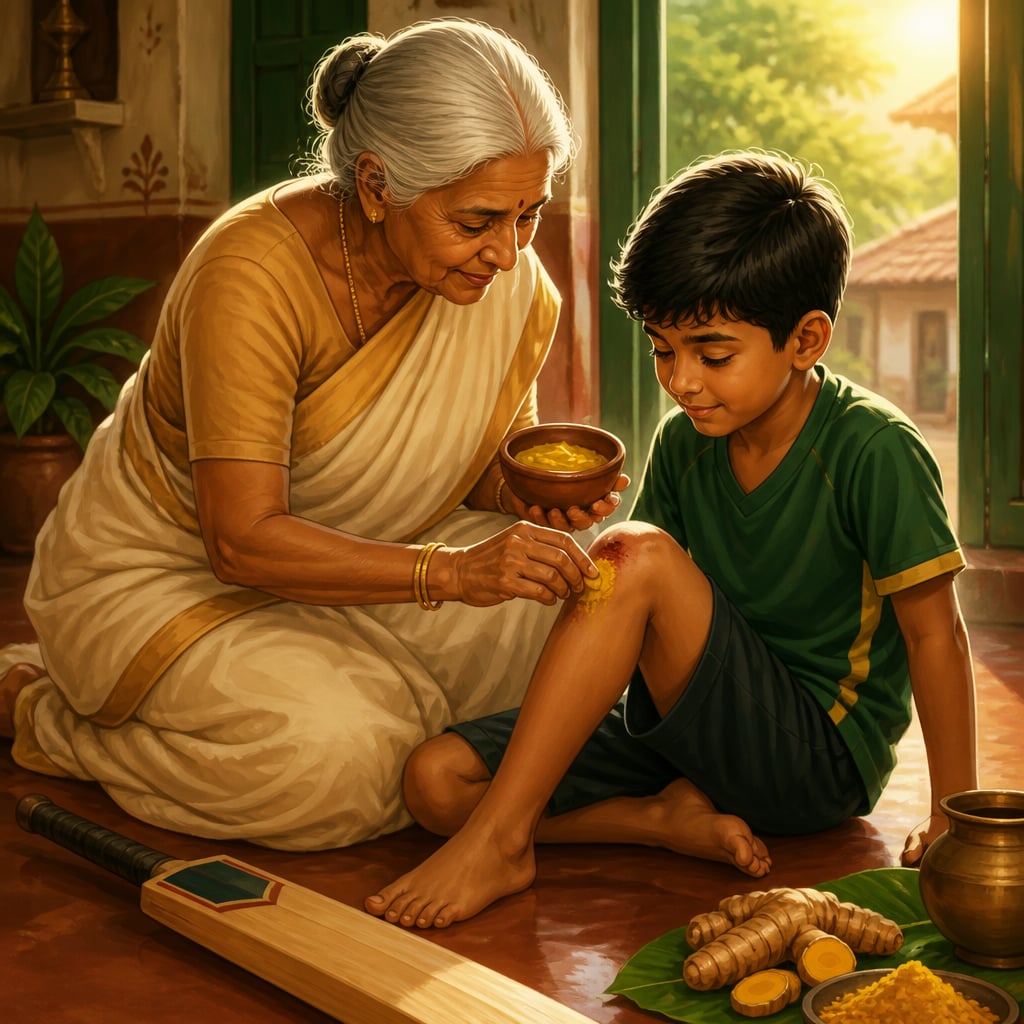
Tamil Nadu grandmother applying fresh turmeric paste to her grandson's scraped knee

These two scenes, the $6 latte and the grandmother's knee, bracket the journey of haridrā, the sacred yellow root. It's a journey that spans 4,000 years, passes through sacred texts and kitchen shelves, triggers an international patent war, and culminates in the $2 billion curcumin supplement industry. Along the way, something was gained: millions of people now know turmeric exists. And something was lost: they know it as a superfood, not as a sacred medicine with protocols refined over millennia.

This is the story of that journey.

Haridrā in Sacred Tradition

Turmeric's Sanskrit name, haridrā (हरिद्रा), connects to 'hari', one of Viṣṇu's names, associated with the golden-yellow color of divinity. This wasn't coincidental naming. In traditional understanding, turmeric's color wasn't merely pigment but manifestation of sacred energy.

The Atharva Veda, among the oldest texts in any living tradition (c. 1200-1000 BCE), mentions turmeric as a protective and purifying substance. The Kāma Sūtra recommends turmeric for enhancing skin beauty. The Suśruta Saṃhitā, the foundational text of surgery, prescribes turmeric for wound healing, the very use that would, two millennia later, become the subject of a US patent.

But turmeric's role in Indian life extended far beyond medicine. Consider:

In Weddings (Haldi Ceremony): Before the wedding, both bride and groom are anointed with turmeric paste. This isn't mere cosmetic tradition, turmeric purifies the skin, creates a protective barrier, and symbolically purifies the person for the sacred union. The yellow color marks them as 'touched by the divine.'

In Daily Cooking: Turmeric appears in virtually every Indian meal, not for flavor (its taste is subtle) but for preservation, digestion, and continual low-level medicinal benefit. The practice of cooking turmeric in oil (the 'tadka' or tempering) isn't just technique, it's sophisticated bioavailability optimization, making fat-soluble compounds accessible.

In Rituals and Worship: Turmeric is applied to deities, used to mark sacred boundaries, and included in puja offerings. The golden color represents the sun, knowledge, and the presence of the divine.

In Folk Medicine: Every Indian household knew turmeric's applications: wound healing, skin conditions, coughs and colds, digestive disturbances, menstrual regulation. Grandmothers didn't need clinical trials, they had centuries of observational knowledge.

This integration of the sacred, culinary, and medicinal represents something fundamentally different from 'turmeric supplements for inflammation.' The plant was woven into life itself.

The Dravyaguṇa Profile of Haridrā

Classical Āyurvedic texts analyze turmeric through the five-dimensional Dravyaguṇa framework we explored in the previous lesson:

Rasa (Taste): Tikta (bitter), Kaṭu (pungent)

Guṇa (Qualities): Laghu (light), Rūkṣa (dry)

Vīrya (Potency): Uṣṇa (heating)

Vipāka (Post-digestive effect): Kaṭu (pungent)

Prabhāva (Special properties): Varṇya (complexion-enhancing), Viṣaghna (anti-toxic), Kuṣṭhaghna (anti-skin disease), Vraṇaropana (wound-healing)

This profile tells the trained practitioner exactly how to use turmeric:

The classical texts also specified preparation methods: with ghee for absorption, with honey for respiratory conditions, with milk for general tonification. Each preparation modified the profile for specific purposes.

The Journey West: From Kitchen to Laboratory

How did a root sacred to a billion people become a supplement in a bottle?

Colonial Documentation (1800s): British pharmacologists in India began cataloguing 'native remedies,' including turmeric. They noted its medicinal uses with scientific curiosity and colonial condescension. The Pharmacographia Indica (1868-1893) documented turmeric's traditional applications while dismissing the theoretical framework as 'native superstition.'

Chemical Isolation (1815-1900s): European chemists isolated curcumin from turmeric in 1815. By the early 20th century, the molecular structure was characterized. The plant became a source of extractable compounds.

Pharmaceutical Research (1970s-1990s): Scientists began studying curcumin's mechanisms. Anti-inflammatory effects. Antioxidant properties. Anti-cancer potential in vitro. The research accelerated. By 2020, over 15,000 papers had been published on curcumin alone.

Supplement Industry Boom (1990s-present): The Dietary Supplement Health and Education Act (1994) opened the floodgates. Turmeric/curcumin products proliferated. The global market now exceeds $2 billion. 'Golden milk' lattes appeared in Western cafes, often without any connection to the traditional practice they unknowingly reference.

The 1995 Turmeric Patent Case: David vs. Goliath

In 1995, the United States Patent and Trademark Office granted Patent 5,401,504 to two researchers at the University of Mississippi Medical Center. The patent claimed exclusive rights to 'use of turmeric in wound healing.'

Read that again: a US patent on the wound-healing properties of turmeric, knowledge documented in the Suśruta Saṃhitā over 2,000 years ago, known to every grandmother in India, published in classical texts available in any Sanskrit library.

This wasn't the first attempt to patent traditional Indian knowledge. Neem-based pesticide formulations, basmati rice naming, and various Āyurvedic compounds had all faced patent claims. But the turmeric case became a turning point.

India's Challenge: The Council of Scientific and Industrial Research (CSIR), led by Dr. Raghunath Anant Mashelkar, filed a formal challenge with the USPTO. Their argument was simple but required meticulous documentation: this isn't novel invention, it's prior art, documented in texts that predate modern medicine.

Dr. Mashelkar presenting Sanskrit evidence at the USPTO turmeric patent hearing

The Evidence: CSIR submitted 32 references, ancient Sanskrit texts, Āyurvedic pharmacopoeias, papers published in Indian medical journals decades earlier. They demonstrated unbroken traditional knowledge of turmeric's wound-healing properties stretching back millennia.

The Ruling (1997): After re-examination, the USPTO revoked the patent. The patent holders didn't contest. The reasoning was clear: you cannot patent what humanity has known for thousands of years.

The Aftermath: The victory cost India an estimated $10,000 in legal fees, a fraction of what fighting future cases would cost. More importantly, it established precedent. And it catalyzed a revolutionary response: the Traditional Knowledge Digital Library (TKDL).

From Victory to Prevention: The TKDL

The turmeric case revealed a systemic vulnerability: patent examiners couldn't search traditional knowledge because it wasn't in their databases. Sanskrit texts, Āyurvedic pharmacopoeias, and regional language publications were invisible to the patent system.

India's response was to make the knowledge visible.

The Traditional Knowledge Digital Library (TKDL), launched in 2001, documented traditional formulations in formats searchable by patent examiners worldwide. It transcribed knowledge from Sanskrit, Hindi, Arabic, Persian, and Urdu texts into five international languages. It classified formulations using International Patent Classification codes.

The numbers are staggering:

The turmeric case didn't just save one patent. It created a system to prevent future appropriation of traditional knowledge.

What the Golden Milk Trend Gets Right, and Misses

Let's be fair to the wellness cafe in Brooklyn. The 'golden milk' trend has introduced millions of people to turmeric who might never have encountered it otherwise. Some genuine benefits flow from this:

What's Preserved:

What's Lost:

The Constitutional Matching: Traditional use always considered who was taking turmeric. Its heating, drying nature makes it excellent for Kapha conditions but potentially problematic for Vāta (dry, anxious) constitutions or aggravated Pitta (already inflamed). The latte makes no such distinctions.

The Preparation Knowledge: Traditional 'golden milk' (haldi doodh) was turmeric cooked in whole milk or milk with ghee, fat that made curcumin bioavailable. It included black pepper (which contains piperine, enhancing absorption 2,000%). Modern lattes often use oat milk (no fat) and skip pepper (no piperine). The 'superfood' becomes less effective than grandmother's recipe.

The Dosage Context: Traditional use was small amounts daily in cooking plus therapeutic doses for specific conditions. Modern supplements offer 500-1000mg curcumin, doses that would have been considered therapeutic, not preventive, requiring vaidya supervision.

The Sacred Dimension: Haridrā wasn't just medicine, it was sacred substance, connected to divine energy, used in rituals that reinforced its meaning. This dimension is entirely absent from 'anti-inflammatory superfood' framing.

Practicing with Awareness

Knowing this history doesn't mean abandoning modern turmeric products. It means using them wisely:

For Traditional Preparation (recommended as daily practice):

For Supplement Use (when therapeutic doses are needed):

For Authentic Connection:

The Ongoing Story

The turmeric story isn't finished. Patent challenges continue. The curcumin market grows. Research expands into new applications. Traditional practitioners work to preserve complete knowledge while scientific reductionism continues its extraction.

Somewhere in Tamil Nadu, a grandmother is still applying manjal to scraped knees. She doesn't know about patents or lattes or curcuminoids. She knows what works. She knows it's sacred. And she knows that the yellow stain on her grandson's skin will fade in a few days, and the wound will heal cleanly, as it has for every child in her family for as long as anyone can remember.

The question isn't whether the $6 latte is 'wrong' and the grandmother is 'right.' The question is whether we can hold both, the accessibility of modern products and the depth of traditional knowledge. Whether we can drink our golden lattes while knowing what haridrā actually is. Whether we can benefit from curcumin while understanding it's a fragment of something larger.

The turmeric patent case showed that traditional knowledge could defend itself legally. The deeper question is whether it can survive culturally, whether the sacred can persist alongside the superfood, whether 4,000 years of wisdom can coexist with $6 wellness lattes.

That question isn't answered in courtrooms. It's answered in how each of us chooses to engage with what we've been given.

The modern 'golden milk latte' often misses key elements: it may use non-fat milk (blocking absorption), skip black pepper (missing piperine's 2000% absorption enhancement), and add sweeteners that may not be traditionally indicated. Understanding the traditional preparation reveals not folk superstition but sophisticated pharmacology.

For minor cuts and scrapes, a paste of turmeric powder mixed with a small amount of coconut oil or ghee can be applied directly. This isn't a replacement for proper wound care in serious injuries, but for everyday kitchen cuts and playground scrapes, grandmother's method often works faster than antibiotic ointments, and without developing resistant bacteria.

Key figures

Dr. Raghunath Anant Mashelkar

Director General of the Council of Scientific and Industrial Research (CSIR) from 1995-2006. Led India's challenge to the turmeric patent and subsequently championed the creation of the Traditional Knowledge Digital Library (TKDL).

Beyond TKDL, Dr. Mashelkar advocated for recognizing traditional knowledge as prior art in international patent law. His efforts influenced WIPO discussions on traditional knowledge and genetic resources. He demonstrated that developing countries could defend intellectual heritage through strategic documentation and legal action.

Suśruta

Ancient surgeon and author of the Suśruta Saṃhitā, the foundational text of surgery. His documentation of turmeric's wound-healing properties became crucial evidence in the 1995 patent case, proving knowledge existed over two millennia before the patent claim.

The Suśruta Saṃhitā's chapters on wound healing (Cikitsāsthāna) detail various preparations and applications of turmeric. These protocols address different wound types, stages of healing, and complications, not simplistic 'apply turmeric to cuts' but nuanced surgical guidance.

Case studies

The 1995 Turmeric Patent Case: India's David Defeats Goliath

On March 28, 1995, the United States Patent and Trademark Office granted Patent No. 5,401,504 to Suman K. Das and Hari Har P. Cohly of the University of Mississippi Medical Center. The patent title: 'Use of turmeric in wound healing.' The claimed invention: applying turmeric to wounds to promote healing. The patent seemed routine. Two researchers had documented turmeric's wound-healing properties, filed for protection, and received it. The USPTO examiner found no prior art - no earlier documentation of the same invention. But in India, the news triggered outrage. How could Americans patent what every Indian grandmother knew? How could 'wound healing with turmeric' be called an invention when Suśruta had documented it 2,500 years earlier? The Council of Scientific and Industrial Research (CSIR), led by Dr. R.A. Mashelkar, decided to fight. This was unprecedented - challenging a granted US patent required navigating unfamiliar legal territory, with no guarantee of success. CSIR submitted a request for re-examination, presenting 32 references documenting prior knowledge. The evidence included: - Sanskrit verses from Suśruta Saṃhitā describing turmeric for wounds - Traditional Āyurvedic pharmacopoeia entries on haridrā - Papers published in Indian medical journals predating the patent - Documentary evidence of common household use across India The USPTO re-examination began in 1996. The fundamental question: Was this 'invention' actually novel, or was it traditional knowledge dressed in patent language? In 1997, the USPTO cancelled all claims of the patent. The patent holders didn't appeal. The evidence was overwhelming: what they claimed as invention was actually knowledge that had been practiced, documented, and transmitted across South Asia for millennia. India had spent approximately $10,000 on legal fees - a tiny fraction of what defending future patents would cost. More importantly, the case established precedent: traditional knowledge counts as prior art. It can defeat patents. And it sparked the creation of TKDL - a system to prevent such patents from being granted in the first place.

The Charaka Samhita and Sushruta Samhita together document over 1,100 plant-based formulations developed over millennia. These texts emphasize that medicinal knowledge belongs to the paramapara (lineage tradition) and exists for the welfare of all beings, a concept fundamentally incompatible with modern patent exclusivity.

The case isn't merely historical. Biopiracy attempts continue: patent applications on yoga poses, traditional plant uses, and indigenous agricultural practices regularly appear. The TKDL has blocked over 150 such applications since its creation. But the turmeric case raised larger questions still being debated: Can traditional knowledge be 'owned'? Should it be defensive (preventing others' patents) or offensive (enabling communities to profit)? How do you protect collective heritage in systems designed for individual ownership?

The turmeric patent case reveals the collision between two knowledge systems: patent law, which assumes innovation is modern, documented in databases, and owned by individuals; and traditional knowledge, which is ancient, documented in manuscripts and oral tradition, and held collectively. The USPTO examiner found 'no prior art' not because none existed, but because the databases didn't include Sanskrit texts. India's victory demonstrated that traditional knowledge can be defended - but only if documented in forms the patent system recognizes.

India's TKDL has blocked over 200 biopiracy attempts since 2001, but thousands of traditional formulations remain unprotected globally. The turmeric patent case established the legal precedent, yet the broader challenge of protecting collective knowledge within individual-patent frameworks persists.

India's Traditional Knowledge Digital Library (TKDL) has prevented over 200 patent claims on traditional formulations since 2001, saving an estimated $150 million in potential biopiracy losses.

Historical context

Vedic Period to Modern Era (c. 1200 BCE - Present)

Living traditions

Turmeric remains central to Indian daily life, in cooking, medicine, and ritual. The TKDL system created after the patent case now protects traditional knowledge internationally. Research continues to validate traditional applications while revealing new mechanisms. The challenge today: ensuring that as turmeric goes global, its full context, sacred, medicinal, culinary, travels with it, rather than just isolated compounds in bottles.

Reflection

More in Auṣadhi: From Sacred Plants to Superfoods

All lessons in Auṣadhi: From Sacred Plants to Superfoods · Indian Wellness Traditions: Modern Connections course