Dravyaguṇa: Pharmacology Before Laboratories

Understanding the systematic science of Āyurvedic pharmacology

An introduction to Dravyaguṇa Vijñāna, the classical Āyurvedic system of understanding herbs through rasa, guṇa, vīrya, vipāka, and prabhāva, predating modern pharmacology by millennia.

The Overwhelmed Shopper

She stands in the supplement aisle of a CVS pharmacy, phone in hand, increasingly frustrated. The search was supposed to be simple: buy turmeric for the inflammation her doctor mentioned. Instead, she faces an entire shelf of yellow bottles. Turmeric capsules. Turmeric gummies. Turmeric liquid. Turmeric with black pepper. Turmeric with ginger. Curcumin extract. 'Enhanced bioavailability' curcumin. Liposomal curcumin. The prices range from $8 to $65.

She picks up a bottle advertising '95% curcuminoids' and reads the back. It promises 'standardized extract for maximum potency.' Another bottle claims 'whole root turmeric for traditional benefits.' A third boasts 'patented absorption technology.' All of them feature the same confident health claims. None of them answer her actual questions: Which one is right for her? How much should she take? When? With food or without? And why are there so many versions of what should be a simple plant?

Overwhelmed shopper in a CVS pharmacy supplement aisle holding a curcuminoid turmeric bottle

What she doesn't know, what the bottles certainly don't tell her, is that 2,500 years ago, physicians in India developed a sophisticated system for answering exactly these questions. That system didn't isolate 'active ingredients' or patent absorption technologies. Instead, it understood the whole plant through a multi-dimensional framework that modern pharmacology is only beginning to appreciate. The science was called Dravyaguṇa Vijñāna, the knowledge of substances and their qualities.

This is the story of the pharmacology that existed before laboratories, and what we lost when we forgot it.

The Five Dimensions of Dravyaguṇa
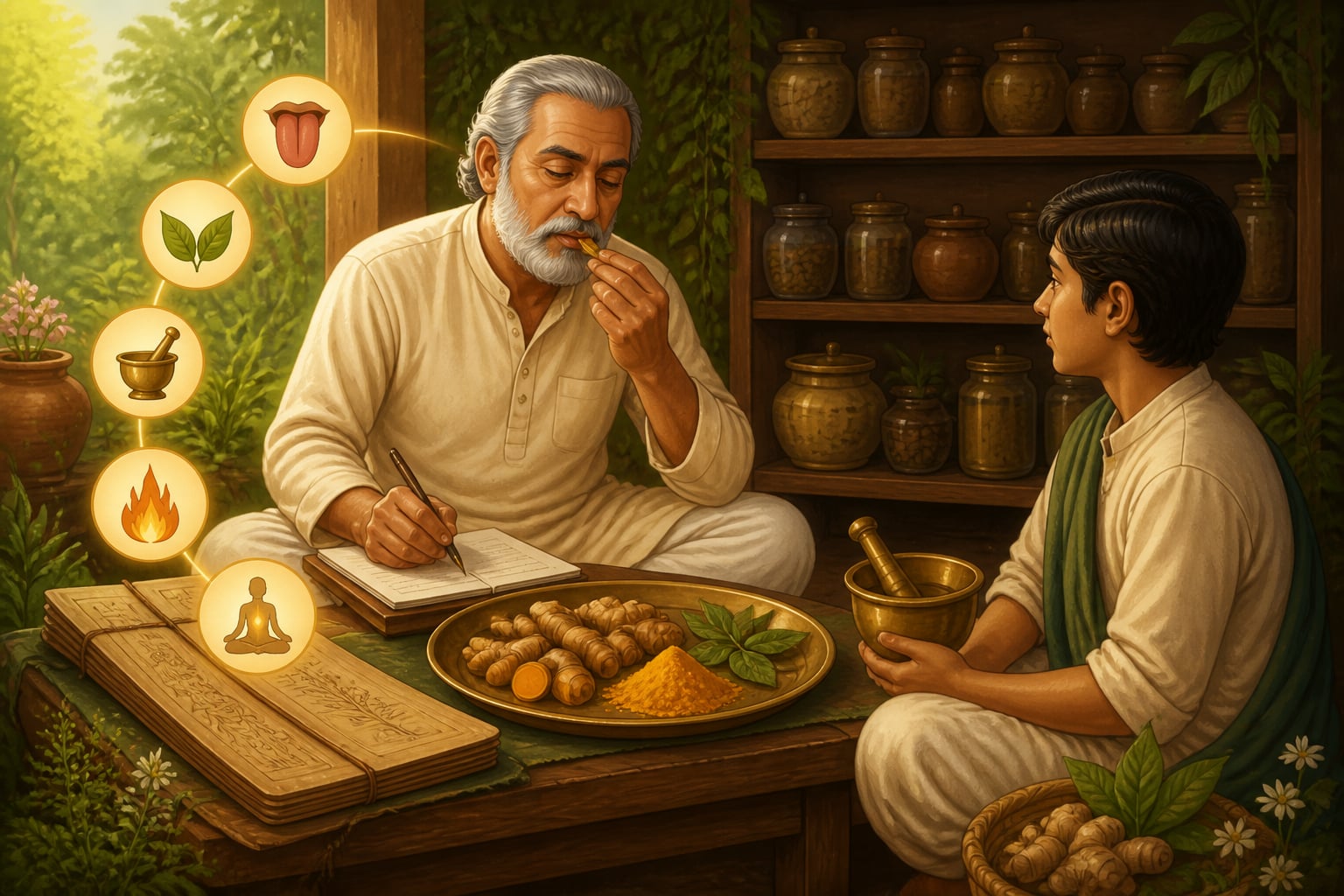
A vaidya analyzing turmeric through the five dimensions of Dravyaguṇa

Modern pharmacology asks one primary question about a substance: What is its active ingredient, and what does that molecule do? This approach, revolutionary when it emerged in the 19th century, has given us antibiotics, vaccines, and life-saving medications. But it's also led to the strange situation in that CVS aisle: a single plant reduced to a single compound, sold in a dozen formulations, with no framework for choosing between them.

Classical Āyurveda asked different questions. When a vaidya (physician) encountered a medicinal substance, they analyzed it through five dimensions:

1. Rasa (रस), Taste

Not just flavor, but therapeutic taste. Six rasas are recognized: sweet (madhura), sour (amla), salty (lavaṇa), pungent (kaṭu), bitter (tikta), and astringent (kaṣāya). Each rasa has specific effects on the body and mind. Sweet builds tissue and calms the mind. Bitter detoxifies and reduces inflammation. Pungent stimulates digestion and circulation. The rasa of a substance immediately indicates its broad therapeutic category.

Turmeric's primary rasa? Bitter (tikta) and pungent (kaṭu), which tells the trained vaidya immediately that it will be detoxifying, inflammation-reducing, and digestion-stimulating.

2. Guṇa (गुण), Qualities

Twenty fundamental qualities organized in ten pairs of opposites: heavy/light, cold/hot, oily/dry, dull/sharp, stable/mobile, soft/hard, clear/slimy, smooth/rough, subtle/gross, solid/liquid. These qualities determine how a substance interacts with the body's tissues and doshas.

Turmeric is light (laghu), dry (rūkṣa), and sharp (tīkṣṇa). This means it won't aggravate Kapha (which is heavy and oily) but might aggravate Vāta (which is already dry) if used excessively or without proper preparation.

3. Vīrya (वीर्य), Potency

The heating or cooling energy of a substance, its fundamental thermogenic effect on the body. This isn't about physical temperature but metabolic impact. Heating substances increase agni (digestive fire) and circulation. Cooling substances reduce inflammation and calm pitta.

Turmeric has uṣṇa vīrya, heating potency. This makes it excellent for sluggish digestion but potentially problematic for someone with excess heat (pitta aggravation).

4. Vipāka (विपाक), Post-Digestive Effect

Here's where it gets sophisticated. The vipāka is the taste that emerges after complete digestion and metabolism, which may differ from the initial rasa. Sweet and salty rasas typically have sweet vipāka (building, nourishing). Sour rasa has sour vipāka (heating, potentially aggravating). Bitter, pungent, and astringent rasas typically have pungent vipāka (lightening, reducing).

Turmeric's vipāka is pungent (kaṭu), meaning its long-term effect is reducing and lightening, not building. This is why Āyurveda doesn't recommend turmeric as a primary supplement during pregnancy or for emaciated individuals who need building, not reducing.

5. Prabhāva (प्रभाव), Special Potency

Some substances have effects that can't be explained by the other four dimensions, unique actions that seem almost magical. This is prabhāva, the 'special potency' that defies systematic prediction. Modern science might call these 'idiosyncratic pharmacological effects.'

Turmeric's prabhāva includes its remarkable wound-healing capacity (which led to the infamous patent case we'll explore in the next lesson) and its ability to purify the blood, effects that transcend its basic rasa-guṇa-vīrya-vipāka profile.

The Logic of the System

This five-dimensional analysis isn't arbitrary mysticism. It's a sophisticated predictive framework. Once you know a substance's rasa, guṇa, vīrya, vipāka, and prabhāva, you can predict:

The woman in the CVS aisle has none of this information. The bottles tell her about milligrams and standardization. They don't tell her that turmeric's heating potency might aggravate her tendency toward acid reflux, or that its drying quality could worsen her dry skin if taken without appropriate oily accompaniment (anupāna).

What Modern Science Confirms, and Misses

Here's what's remarkable: modern research increasingly validates specific Dravyaguṇa predictions. Turmeric's anti-inflammatory effects (predicted by its bitter rasa), its digestive benefits (predicted by its heating vīrya), its wound-healing properties (its prabhāva), all confirmed by peer-reviewed studies.

But modern research also reveals what's lost in the 'active ingredient' approach. Turmeric contains over 300 identified compounds. Curcumin, the darling of supplement marketing, is just one of them, comprising about 3% of the root. Studies show that whole turmeric extract often outperforms isolated curcumin, suggesting the other compounds matter. The traditional practice of taking turmeric with black pepper (which contains piperine, enhancing absorption by 2,000%) and with fat (turmeric is fat-soluble) isn't folk superstition, it's sophisticated bioavailability optimization.

The Dravyaguṇa framework assumed the whole plant was the medicine. Modern science isolated what it could measure, patented what it could synthesize, and marketed what it could standardize. Both approaches have value. But the woman in the CVS aisle is working with only one, and it's not giving her what she needs.

The Journey West: From Vaidya to Vitamin Aisle

How did we get from sophisticated constitutional analysis to '95% curcuminoids'?

The story involves colonialism, chemistry, and commerce.

Colonial Period (1800s): British pharmacologists in India began documenting Āyurvedic substances, extracting what they considered 'active principles' while discarding the theoretical framework as 'native superstition.' The Pharmacographia Indica (1868-1893) catalogued Indian medicinal plants using Western chemical analysis.

Pharmaceutical Era (1900s): As the pharmaceutical industry grew, natural products became sources for drug discovery. Scientists screened traditional remedies for patentable compounds. The whole-plant wisdom of Dravyaguṇa was irrelevant to this process, you can't patent a framework, only molecules.

Supplement Boom (1990s-present): The Dietary Supplement Health and Education Act (1994) created the modern supplement industry. Āyurvedic herbs entered Western markets, but without Āyurvedic knowledge. Turmeric became curcumin. Ashwagandha became withanolides. The sophisticated matching of herb to constitution disappeared, replaced by marketing claims and standardized extracts.

Practicing with Awareness

Knowing this history changes nothing about the CVS aisle, unless we let it change how we think about herbal medicine.

What the Dravyaguṇa framework offers:

Constitutional matching: Before asking 'what does this herb do?', ask 'what is my constitution, and what imbalance am I addressing?' A cooling herb for a heating condition. A grounding herb for an anxious mind. A building herb for depletion, a reducing herb for excess.

Preparation matters: The same herb in different preparations (powder, decoction, medicated ghee, fermented) has different effects. This isn't about bioavailability technology, it's about matching delivery to need.

Anupāna consciousness: What you take an herb with matters as much as the herb itself. Turmeric with warm milk and ghee (traditional 'golden milk') is a completely different medicine than turmeric capsules swallowed with water.

Timing awareness: When you take an herb affects what it does. Before meals, with meals, after meals, at specific times of day, these aren't arbitrary instructions but applications of how substances interact with digestive fire (agni) at different states.

What modern supplements offer:

Standardization: You know exactly how much active compound you're getting.

Convenience: Pills are easier than preparing decoctions.

Research backing: Many modern formulations are based on clinical trials.

Accessibility: You don't need a vaidya to buy them.

The sophisticated practitioner uses both, modern convenience informed by traditional wisdom.

The Unexplored Territory

The Dravyaguṇa system contains knowledge that modern pharmacology hasn't yet mapped. The concept of prabhāva, effects that transcend chemical analysis, suggests dimensions of plant medicine we don't fully understand. The emphasis on constitution-specific prescribing anticipates personalized medicine by millennia. The sophisticated preparation methods (we'll explore anupāna in depth in Lesson 7) represent formulation science of remarkable subtlety.

In the lessons that follow, we'll trace specific substances: turmeric, ashwagandha, tulsi, brahmi, triphala. For each, we'll see how traditional knowledge has been validated, commercialized, and sometimes corrupted. We'll explore the patent battles, the billion-dollar markets, and the traditional practitioners keeping the full science alive.

The woman in the CVS aisle doesn't need to become an Āyurvedic scholar. But she might benefit from knowing that the confusing array of products before her represents fragments of a coherent system, a system that asked better questions than 'how many milligrams?' and offered better answers than 'standardized for potency.'

The forgotten pharmacology isn't actually forgotten. It's waiting in the classical texts, practiced by traditional vaidyas, and increasingly studied by researchers who sense that 'active ingredient' isn't the whole story. The question is whether we're ready to learn what was lost when we traded dravyaguṇa for drugstores.

Before purchasing any herbal supplement, pause and ask four questions informed by Dravyaguṇa principles: (1) What is my constitution, and what imbalance am I addressing? (2) What are this herb's main qualities, is it heating or cooling, drying or moistening, heavy or light? (3) Does this match what I need, or might it aggravate something? (4) What form and preparation is appropriate for my situation?

An Indian home spice cabinet of haldi, jeera, dhania, kalonji, methi, and pippalī

Your spice cabinet is a pharmacy organized by Dravyaguṇa principles. Cumin (cooling, digestive) balances the heating nature of chili. Turmeric (heating, drying) is always combined with oil or ghee in traditional cooking to balance its drying quality. Black pepper (heating, penetrating) enhances absorption of other spices. These aren't random combinations, they're sophisticated pharmaceutical formulations encoded in cuisine.

Key figures

Caraka

Compiler/redactor of the Caraka Saṃhitā, the foundational text of Āyurvedic internal medicine. His systematic presentation of Dravyaguṇa principles established the framework used for two millennia.

The Caraka Saṃhitā's chapters on dravyaguṇa (particularly Sūtrasthāna chapters 1, 26, and 27) remain the primary source for classical pharmacological principles. His emphasis on rational analysis over mere empiricism established Āyurveda as a systematic science rather than folk tradition.

Suśruta

Author of the Suśruta Saṃhitā, the foundational text of Āyurvedic surgery. While primarily surgical, his work includes extensive pharmacological discussions, particularly regarding wound-healing and tissue-regenerating substances.

The Suśruta Saṃhitā's Cikitsāsthāna (treatment section) and Sūtrasthāna provide extensive materia medica organized by therapeutic application. His wound-healing formulations, including turmeric preparations, represent sophisticated pharmaceutical compounding.

Vāgbhaṭa

Author of the Aṣṭāṅga Hṛdaya and Aṣṭāṅga Saṅgraha, which synthesized Caraka and Suśruta's teachings into a more accessible format. His work became the primary Āyurvedic text in many regions.

The Aṣṭāṅga Hṛdaya's Sūtrasthāna chapters on dravyaguṇa remain the most commonly studied introduction to Āyurvedic pharmacology. His clear summaries of rasa, guṇa, vīrya, vipāka, and prabhāva became the standard teaching framework.

Case studies

Turmeric's 300 Compounds: Reductionism Meets Holism

In 1985, researchers isolated curcumin from turmeric and began testing its anti-inflammatory effects. The results were promising: curcumin inhibited COX-2 enzymes, reduced NF-κB activation, and showed anti-cancer properties in vitro. Pharmaceutical companies took notice. By 2020, over 15,000 scientific papers had been published on curcumin alone. But problems emerged. Curcumin has notoriously poor bioavailability - most of it passes through the body unabsorbed. Companies developed 'enhanced bioavailability' formulations: curcumin with piperine, liposomal curcumin, nanoparticle curcumin. The supplement industry now offers dozens of competing 'solutions' to a problem created by isolating the compound in the first place. Meanwhile, researchers began noticing something curious: whole turmeric extracts often outperformed isolated curcumin in clinical trials. The other 300+ compounds in turmeric - turmerones, ar-turmerone, curcuminoids beyond curcumin - appeared to matter. Some enhanced curcumin's absorption. Some had independent anti-inflammatory effects. Some worked synergistically in ways that single-compound analysis couldn't predict. The Dravyaguṇa framework had always assumed the whole plant was the medicine. Traditional preparations - turmeric cooked in ghee, taken with warm milk, combined with black pepper - achieved 'enhanced bioavailability' through food matrix effects that modern formulations try to replicate with technology. The ancient preparation methods weren't primitive versions of curcumin capsules - they were sophisticated delivery systems for the whole plant's therapeutic potential.

Charaka Samhita classifies haridra (turmeric) as a Krimighna (anti-parasitic) and Vishaghna (detoxifying) herb, always prescribed as part of compound formulations, not in isolation. The traditional preparation method of cooking turmeric with ghee and black pepper (trikatu) addresses the bioavailability problem that modern pharmaceutical research spent decades rediscovering.

The $2 billion curcumin supplement market is built on the reductionist paradigm. Understanding the Dravyaguṇa perspective doesn't mean rejecting supplements - standardization and convenience have real value. But it does mean asking: Is this isolated extract the best way to receive this plant's benefits? Would traditional preparations serve me better? The answer varies by person and purpose, but the question itself is valuable.

The curcumin story illustrates both the power and limits of reductionist pharmacology. Isolation enabled precise research and standardization. But it also created problems (poor bioavailability) that required technological solutions (absorption enhancers) that traditional preparations had already solved through whole-plant use and appropriate anupānas. Dravyaguṇa's assumption that substances work as integrated wholes, not isolated molecules, is increasingly validated by modern research.

Supplement companies sell isolated curcumin capsules with patented absorption enhancers, while traditional haldi doodh (turmeric milk with fat and black pepper) achieves comparable bioavailability at a fraction of the cost. The formulation wisdom encoded in kitchen traditions often outperforms laboratory solutions.

The global turmeric supplements market reached $1.3 billion in 2023. Over 3,000 published studies on curcumin exist, yet bioavailability remains only 1-2% without traditional preparation methods like combining with black pepper (piperine increases absorption by 2,000%).

Historical context

Classical Āyurvedic Period (c. 600 BCE - 700 CE)

Living traditions

Dravyaguṇa Vijñāna is taught as a core subject in all Āyurvedic colleges across India, producing thousands of practitioners annually who learn this framework. The World Health Organization has partnered with India to develop international standards for Āyurvedic practice, including Dravyaguṇa principles. Meanwhile, pharmacognosy researchers increasingly study traditional formulations using modern analytical methods, often validating classical Dravyaguṇa predictions about plant synergies and constitutional effects.

Reflection

More in Auṣadhi: From Sacred Plants to Superfoods

All lessons in Auṣadhi: From Sacred Plants to Superfoods · Indian Wellness Traditions: Modern Connections course