Anupāna: The Lost Art of Herbal Preparation
Why traditional preparation methods matter more than isolated compounds
The sophisticated Āyurvedic science of anupāna (vehicle substances) and traditional preparation methods, the context that modern supplements often strip away. Introduces TKDL (Traditional Knowledge Digital Library) and its role in protecting this knowledge.
Same Herb, Different Results
Priya and her cousin Anita both decided to try ashwagandha for stress. They even bought the same brand, the same dose, at the same time.
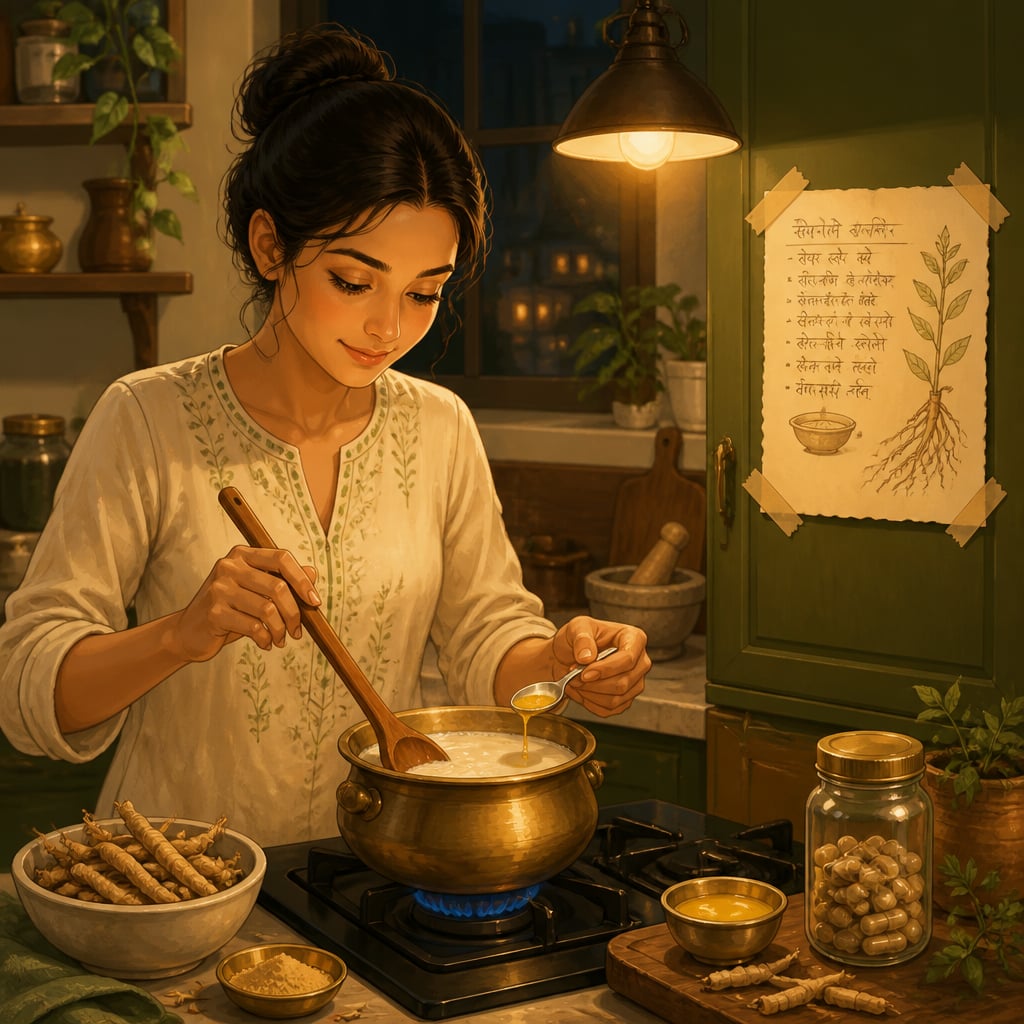
Priya follows her grandmother's advice. Each night, she simmers a teaspoon of ashwagandha powder in a cup of warm milk with a little ghee. She lets it cool slightly, adds a touch of honey, and drinks it slowly before bed. Within a week, she notices: deeper sleep, calmer mornings, a sense of groundedness she hasn't felt in months.
Anita takes the modern approach. She swallows two ashwagandha capsules with cold water on an empty stomach before her morning commute. Within a week, she notices: jitteriness, mild stomach upset, and if anything, more anxiety than before. She concludes that ashwagandha 'doesn't work for her' and moves on to the next supplement.
Same herb. Same dose. Same time period. Dramatically different results.
The difference isn't the ashwagandha. The difference is everything else: the warm milk versus cold water, the ghee versus nothing, the evening timing versus morning, the slow sipping versus quick swallowing. In traditional terminology, the difference is anupāna, the vehicle, the carrier, the context in which the herb is taken.
Anita didn't fail with ashwagandha. She failed to use anupāna. And this failure is nearly universal in modern supplementation. We've extracted the herbs while discarding the sophisticated science of how to take them.
This is the story of what was lost, and how India is working to preserve it.
What Is Anupāna?
Anupāna (अनुपान) literally means 'that which follows drinking' or 'that which accompanies medicine.' It refers to the substance, water, milk, ghee, honey, specific decoctions, taken along with or after medicine to:
- Carry the herb to specific tissues (some compounds are fat-soluble, some water-soluble)
- Modify the herb's action (cooling vehicles temper heating herbs; heating vehicles activate cooling herbs)
- Protect against side effects (ghee with heating herbs prevents irritation; honey with heavy herbs prevents sluggishness)
- Enhance absorption (fat-soluble compounds need lipid carriers; certain combinations enhance bioavailability)
- Direct the herb to specific locations (different vehicles guide herbs to different organ systems)
Classical texts are remarkably specific about anupāna. The Caraka Saṃhitā dedicates an entire section to it. The specification isn't general advice, it's precise prescription: this herb, with this vehicle, at this time, for this condition.
Common Anupānas and Their Functions
Traditional practice uses a range of vehicles, each with specific properties:

Warm Water (uṣṇa jala) The most neutral anupāna. Supports digestion, promotes circulation, and helps herbs dissolve and absorb. Appropriate for most purposes when no specific vehicle is indicated.
Cold Water (śīta jala) Used with heating herbs when you want to temper their fire. Also used in Pitta conditions where cooling is desired. Rarely used as a general vehicle, cold water can dampen digestive fire.
Milk (kṣīra) Nourishing, building, Vāta-calming. Ideal for rasāyana herbs (ashwagandha, shatavari) where you want to build tissue. The fat in milk enhances absorption of fat-soluble compounds. Traditional 'golden milk' (turmeric in milk) uses this principle.
Ghee (ghṛta) The premier vehicle for deep tissue penetration. Ghee carries compounds across cell membranes and even the blood-brain barrier. Enhances herbs for nervous system (brahmī ghṛta) and reproductive system. Balances Vāta and Pitta, builds ojas.
Honey (madhu) Scraping, reducing, Kapha-clearing. Used when you want to enhance cleansing action. Honey also has antimicrobial properties and helps herbs reach respiratory tissues. Never heated (traditional Āyurveda considers heated honey toxic).
Jaggery (guḍa) Mildly nourishing and building. Used when a sweeter vehicle is needed without honey's reducing quality. Good for children's medicines and for making bitter herbs palatable.
Specific Decoctions Sometimes the anupāna is a prepared decoction, ginger water, cinnamon tea, specific herbal preparations. These specialized vehicles direct herbs to particular organ systems or enhance specific actions.
The Science Behind Traditional Practice
Modern pharmacology validates what traditional practice encoded:
Fat-Soluble Compounds Need Fat Many active compounds in herbs (curcuminoids in turmeric, withanolides in ashwagandha, bacosides in brahmī) are fat-soluble. Taking them with water leaves most unabsorbed. Taking them with ghee, milk, or oil dramatically increases bioavailability. Traditional preparations, cooking herbs in ghee, taking with warm milk, accomplished 'enhanced bioavailability' centuries before supplement companies invented the term.
Piperine Enhancement Black pepper (pippalī, marica) appears in many traditional formulas. Modern research shows why: piperine increases absorption of many compounds by up to 2000%. The traditional combination of turmeric with black pepper (as in golden milk) is sophisticated pharmacokinetic optimization.
Thermal Processing Matters Cooking herbs in ghee (as in medicated ghṛtas) creates chemical transformations. Maillard reactions produce new compounds. Fat extraction pulls different substances than water extraction. The cooking process isn't primitive, it's pharmaceutical processing.
Timing Affects Action Classical texts specify timing precisely: before meals (dīpanapācana, to kindle digestive fire), with meals (to aid digestion), after meals (to support specific tissues), before bed (for overnight action). Modern chronopharmacology confirms that drug absorption and effect vary significantly with timing relative to meals and circadian rhythm.
What Modern Supplements Miss
The supplement industry has extracted herbs from their traditional context:
No Anupāna Guidance Most supplement bottles say 'take with water.' This ignores centuries of refined knowledge about which vehicle suits which herb. Ashwagandha with cold water on an empty stomach (as Anita took it) may be poorly absorbed and irritating. Ashwagandha in warm milk with ghee (as Priya took it) delivers the herb as traditional practitioners intended.
No Constitutional Matching The same supplement is sold to everyone. Traditional practice would ask: What's your constitution? What's your current imbalance? The anupāna might differ based on the answer. Ashwagandha with honey for Kapha types; ashwagandha with ghee for Vāta types.
No Preparation Transformation Capsules contain raw or simply extracted herb. Traditional medicated ghees and fermented preparations (ariṣṭas) involve processing that transforms the herb's action. These prepared forms may work differently than simple extracts.
No Timing Specification Most supplements lack timing guidance beyond 'once daily.' Traditional practice specified morning, evening, before meals, after meals, each timing affecting how the herb works.
Anita's failure wasn't with ashwagandha. It was with a supplement industry that sells herbs without the operating instructions.
The TKDL: Protecting What Remains
The turmeric patent case (1995-1997) revealed a vulnerability: traditional knowledge wasn't in databases that patent examiners could search. Ancient wisdom documented in Sanskrit was invisible to the modern IP system.

India's response was revolutionary: the Traditional Knowledge Digital Library (TKDL).
Launched in 2001, TKDL documented traditional formulations from Āyurveda, Unani, Siddha, and Yoga in formats searchable by patent offices worldwide. The project transcribed knowledge from Sanskrit, Hindi, Arabic, Persian, and Urdu texts into five international languages, classified using International Patent Classification codes.
The numbers are staggering:
- 290,000+ formulations documented, each including the herbs used, preparation methods, and anupāna specifications
- 150+ patent applications withdrawn or rejected based on TKDL evidence
- Access agreements with patent offices of the US, EU, UK, Germany, Japan, Canada, and Australia
- 2,500+ medicinal plants with their traditional preparations documented
Critically, TKDL doesn't just document WHAT herbs to use, it documents HOW. The preparation methods, the vehicles, the timing, the dosages. The knowledge that Anita didn't have when she swallowed her ashwagandha capsules is preserved in TKDL's archives.
The database serves dual purposes: it prevents biopiracy (you can't patent what's already documented as prior art) and it preserves knowledge (future practitioners can access preparation methods that might otherwise be lost).
The Anupāna Quick Reference
For the herbs we've explored in this chapter, here are traditional anupāna guidelines:
Turmeric (Haridrā)
- For inflammation: Warm milk with ghee and black pepper (traditional golden milk)
- For wounds (external): Paste with ghee or coconut oil
- For digestion: Warm water with honey
- Avoid: Cold water alone, which limits absorption
Ashwagandha (Aśvagandhā)
- For building/strength: Warm milk with ghee before bed (traditional kṣīrapāka)
- For calming/Vāta: With ghee, which enhances nervous system penetration
- For reducing/Kapha: With honey, which prevents heaviness
- Avoid: Cold water on empty stomach (poor absorption, potential irritation)
Tulasī
- For respiratory conditions: Hot water as tea, with honey (after cooling) and ginger
- For immunity: Fresh leaves chewed, or tea with warm water
- For fever: Hot water infusion to promote sweating
- Avoid: Large doses during pregnancy (traditional caution)
Brahmī
- For memory/cognition: Ghee preparation (brahmī ghṛta) for deep nervous system penetration
- For general use: Warm milk with ghee
- For children: Milk with honey (after cooling)
- Avoid: Large doses without fat (limited absorption of fat-soluble compounds)
Triphalā
- For general cleansing: Warm water before bed
- For enhanced cleansing (Kapha): Warm water with honey
- For nourishing balance (Vāta): Warm water with ghee
- Avoid: Large doses during pregnancy, during acute diarrhea
Practicing with Awareness
You don't need to become an Āyurvedic practitioner to apply anupāna principles. Simple guidelines:
Fat-soluble herbs with fat: Turmeric, ashwagandha, brahmī, take with meals containing fat, or with ghee/milk.
Heating herbs with caution: If an herb is heating (like ginger or turmeric), consider cooling vehicles (milk) if you run hot.
Building herbs with building vehicles: Rasāyana herbs (ashwagandha, shatavari) work best with nourishing vehicles like milk and ghee.
Cleansing herbs with cleansing vehicles: Detox formulas (triphalā) often work well with warm water or honey.
Timing matters: Rasāyana herbs often work best before bed. Digestive herbs often work best with meals.
Simple beats complex: If unsure, warm water is the safest default. Don't overthink, but don't ignore anupāna entirely.
The Complete Picture
Throughout this chapter, we've traced the journey of sacred plants to superfoods:
- Turmeric from Vedic rituals to curcumin capsules
- Ashwagandha from rasāyana to 'adaptogen'
- Tulasī from temple courtyards to tea boxes
- Brahmī from gurukula to nootropics
- Triphalā from daily practice to microbiome support
In each case, something was preserved (the herbs themselves, some therapeutic benefit) and something was lost (constitutional matching, sacred context, preparation wisdom).
Anupāna represents the most practical loss. The herbs are available; the knowledge of how to take them is scattered.
But the knowledge isn't gone. It's preserved in classical texts. It's documented in TKDL's 290,000+ formulations. It's practiced by traditional vaidyas in India. It's available to anyone willing to look beyond the supplement bottle.
Priya's grandmother knew what the supplement industry forgot: the herb alone is incomplete. The same ashwagandha can calm or agitate, nourish or deplete, work or fail, depending on how it's taken.
The art of anupāna isn't lost. It's waiting. The question is whether we're willing to recover what convenience discarded.
Closing This Chapter
We began this chapter with a woman standing confused in a CVS aisle, overwhelmed by turmeric options. We end with the understanding that her confusion was justified: the bottles contained fragments of a complete system, sold without the operating instructions.
The herbal supplement industry has made sacred plants accessible to millions. This is genuinely valuable. But accessibility without education creates the situation we have: people trying herbs, often incorrectly, and concluding they 'don't work.'
The path forward isn't rejecting modern supplements, it's supplementing them with traditional wisdom. Know your herbs. Know your constitution. Know your anupāna. What you take matters. How you take it matters at least as much.
The grandmother stirring ashwagandha into warm milk knows something the capsule bottle can't tell you. The knowledge is there if you want it. It's been documented, preserved, and protected.
The question is whether you'll use it.
Apply this framework to any herb: For building/strengthening herbs (rasāyanas like ashwagandha): use warm milk or ghee. For cleansing/reducing herbs (like triphalā): use warm water or honey. For cooling/anti-inflammatory herbs (like āmalakī): warm water or room-temperature preparations. For heating/stimulating herbs (like ginger): use with caution if you run hot; milk can temper. When unsure: warm water is always acceptable.
Even if you use capsules or tablets, you can improve delivery: Take fat-soluble herbs (turmeric, ashwagandha, brahmī) with meals containing fat, or with a teaspoon of ghee. Take cleansing formulas (triphalā) with warm water rather than cold. Take building herbs (rasāyanas) at night rather than morning. Avoid cold water for most herbs, room temperature minimum, warm water preferred.
Key figures
Dr. V.K. Gupta
Director of the Traditional Knowledge Digital Library (TKDL) project. Led the initiative to document 290,000+ traditional formulations, including their anupāna specifications, in formats searchable by international patent offices.
TKDL preserves not just which herbs to use but how to use them, the preparation methods, vehicles, and timing that constitute anupāna wisdom. This documentation ensures that traditional knowledge isn't lost even as living transmission declines. The database is both legal shield (preventing patents) and knowledge repository (preserving practice).
Śāraṅgadhara
Author of the Śāraṅgadhara Saṃhitā, which provides the most systematic treatment of anupāna in classical literature. His definitions and classifications of vehicle substances became standard references.
The Śāraṅgadhara Saṃhitā's pharmaceutical sections, including anupāna, dosage forms, and preparation methods, became the primary teaching text for Āyurvedic pharmacy. When TKDL documents 290,000+ formulations with their vehicles, many trace back to principles Śāraṅgadhara articulated seven centuries ago.
Case studies
The Traditional Knowledge Digital Library: 290,000 Formulations Preserved
After the turmeric patent victory in 1997, India's scientific leadership recognized a systemic problem: traditional knowledge documented in Sanskrit was invisible to patent examiners. Winning individual cases was expensive and reactive. A better solution would prevent patent applications from succeeding in the first place. The Traditional Knowledge Digital Library (TKDL) was born from this insight. The project began in 2001 with an ambitious goal: document traditional formulations from Āyurveda, Unani, Siddha, and Yoga in formats patent examiners could search. This required: **Linguistic translation**: Converting Sanskrit, Hindi, Arabic, Persian, and Urdu texts into English, French, German, Spanish, and Japanese - the languages of international patent offices. **Classification mapping**: Translating traditional categories into International Patent Classification (IPC) codes, making formulations findable through patent search systems. **Comprehensive documentation**: Recording not just which herbs to use, but preparation methods (including anupāna), dosages, timing, and therapeutic applications. A formulation without its context isn't complete knowledge. **Legal framework**: Negotiating access agreements with patent offices worldwide, balancing open searchability (for prior art purposes) with protection against further appropriation. By 2020, TKDL contained: - 290,000+ formulations from traditional texts - Coverage of 2,500+ medicinal plants - Documentation from 150+ classical books - Access agreements with patent offices of the US, EU, UK, Germany, Japan, Australia, and Canada The impact has been concrete: over 150 patent applications have been withdrawn, rejected, or amended based on TKDL evidence. Companies attempting to patent traditional knowledge now find their applications flagged by examiners who can search TKDL. Critically, TKDL preserves the complete knowledge - including anupāna. When the database documents 'ashwagandha for strength,' it includes the traditional preparation (kṣīrapāka), the vehicle (milk with ghee), the timing (evening), and the dosage. This isn't just patent protection; it's knowledge preservation. The grandmother stirring ashwagandha into warm milk knows something that could be lost in a generation. TKDL ensures that even if living transmission fades, the knowledge remains accessible - in formats that both patent offices and future practitioners can use.
The Charaka Samhita, Sushruta Samhita, and Ashtanga Hridayam form the Brihat Trayi (Great Triad) of Ayurvedic texts, representing over 3,000 years of systematized medical knowledge. The TKDL initiative translates this oral-to-written tradition into a format that modern patent systems can reference, protecting collective wisdom from individual appropriation.
TKDL shows that traditional knowledge can coexist with modern IP systems when properly documented. It also provides a resource for anyone wanting to practice traditional methods authentically - the formulations are documented with their complete context, not just active ingredients. For the student of this chapter, TKDL represents where this knowledge lives if you want to go deeper than any single course can take you.
TKDL represents a new approach to traditional knowledge: not hiding it (which allows patents to claim 'novelty') but making it visible in systems that recognize prior art. The database also demonstrates that traditional knowledge isn't vague folk wisdom - it's precise enough to document systematically, including preparation methods and anupāna specifications that modern supplements often ignore.
As AI-powered drug discovery platforms scan millions of compounds for new therapeutics, the TKDL's 290,000 documented formulations represent a structured dataset that machine learning could mine for combination patterns. Traditional knowledge databases may become unexpectedly valuable inputs for computational pharmacology.
India's TKDL database now contains 4.5 lakh formulations from classical Ayurvedic, Unani, Siddha, and Yoga texts, documented in 34 million pages across 5 languages, making it the world's largest traditional knowledge repository.
Historical context
Classical Period to Contemporary (c. 500 BCE - Present)
Living traditions
Anupāna knowledge survives in traditional practice (families who maintain grandmother's methods), classical texts (available in translation), institutional preservation (TKDL), and Āyurvedic education (where pharmaceutical science includes vehicle selection). The knowledge hasn't disappeared, it's just not on supplement bottles. For those willing to look beyond convenience, the complete science remains accessible.
- Traditional Knowledge Digital Library: While TKDL's full database is accessible only to patent offices (to prevent misuse), its principles and sample content are publicly available. Understanding TKDL's existence and purpose connects you to the institutional effort to preserve traditional knowledge, including preparation methods.
- Traditional Āyurvedic Pharmacies: Traditional pharmacies produce medicated ghees, ariṣṭas (fermented preparations), and other classical formulations according to traditional methods. Visiting their facilities reveals how anupāna is integrated into pharmaceutical production, the preparations themselves embody vehicle science.
Reflection
- Think about how you currently take supplements or herbs. Do you use any vehicle besides water? Has this lesson changed how you might approach supplementation?
- Priya and Anita had opposite experiences with the same herb. What does it mean that HOW you take something can matter as much as WHAT you take? Does this principle extend beyond herbs to other areas of life?
- TKDL documents 290,000+ formulations with their preparation methods. What is gained and what is lost when oral tradition becomes digital database? Can living knowledge be preserved in archives?