Aśvagandhā: From Rasāyana to 'Adaptogen'
How an ancient rejuvenative became the world's favorite stress supplement
The journey of aśvagandhā from its classical role as a rasāyana (rejuvenative) in Āyurveda to its modern rebranding as an 'adaptogen' for stress and performance. Examines the $1.5B+ market and how 'adaptogen' terminology obscures origins.
The Gummy That Grew in Grandmother's Garden
Rahul stares at his laptop screen at 11 PM, the glow reflecting off the dark circles under his eyes. He's a software engineer at a Bangalore startup, three months into a project that was supposed to take six weeks. His Slack notifications never stop. His sleep is fragmented. His doctor mentioned 'burnout' at his last checkup.
A podcast ad plays while he commutes: 'Ashwagandha, the ancient adaptogen for modern stress. Clinically proven to reduce cortisol. Just two gummies a day.' He orders a bottle from Amazon that night. The next week, he begins his new regimen: two orange-flavored gummies with his morning chai.

What Rahul doesn't know, what the podcast didn't mention, is that the plant in those gummies once grew in his grandmother's backyard in Karnataka. His paatti used to make a preparation from the same root, but it looked nothing like gummies. She'd cook the powder in milk with ghee and a little jaggery, give it to his grandfather during winter months, and call it something Rahul barely remembers: a word like 'strength-giver' or 'horse-power.'
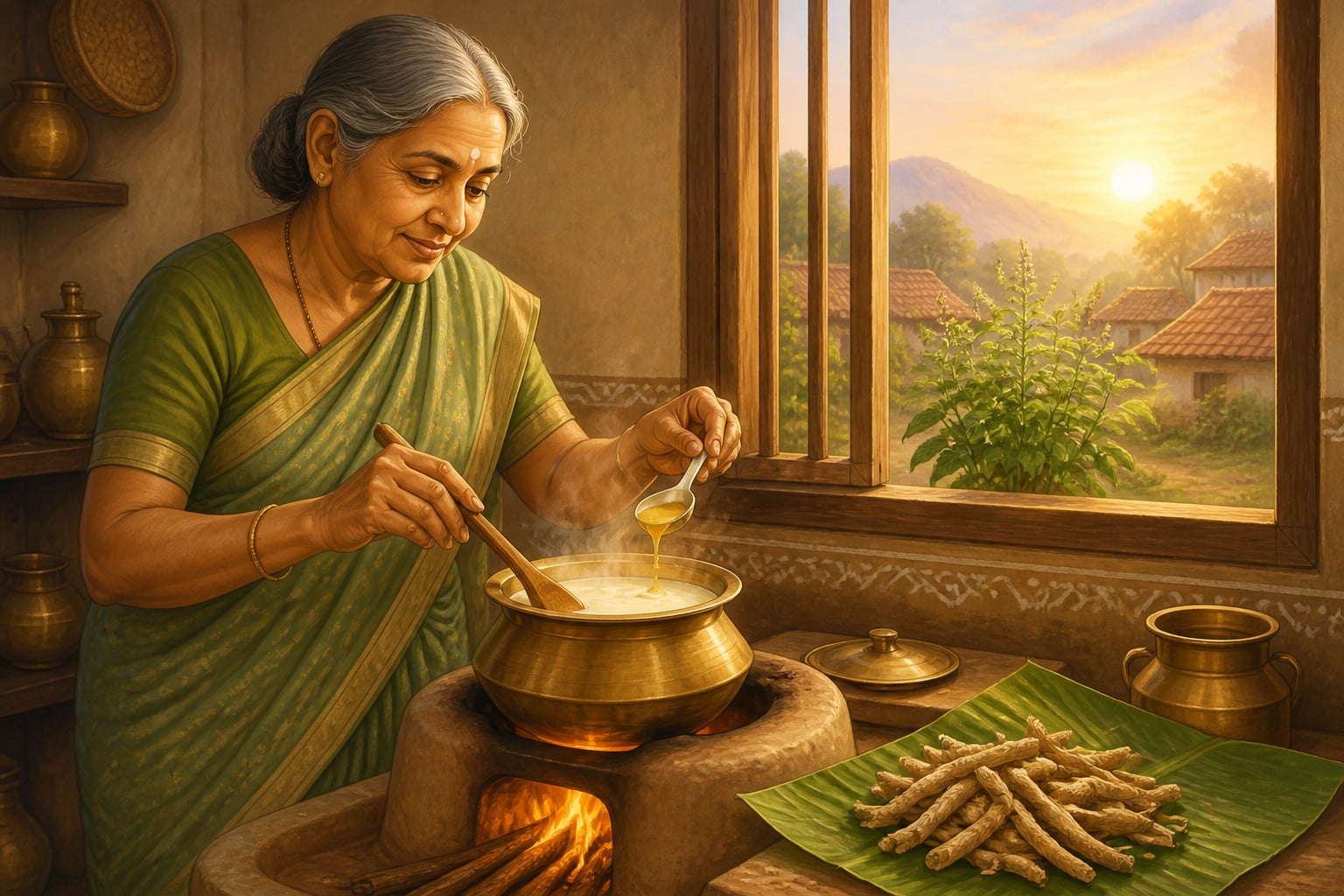
What she was making was aśvagandhā kṣīrapāka, ashwagandha cooked in milk, a classical rasāyana preparation documented in Sanskrit texts over 2,000 years ago. She didn't call it an 'adaptogen.' She didn't know about cortisol. She knew it built strength, supported sleep, and helped her husband through the stresses of his work as a schoolteacher.
Rahul is taking the same plant his grandmother used. But he's taking it differently, for different reasons, with different expectations, informed by different frameworks. His grandmother was practicing Āyurveda. He's consuming an 'adaptogen', a term invented by Soviet scientists in 1947 that has successfully obscured 3,000 years of Indian medical knowledge.
This is the story of how that happened.
What Is Aśvagandhā?
The name tells you almost everything.
Aśvagandhā (अश्वगंधा) means 'smell of a horse', from aśva (horse) + gandhā (smell). Fresh ashwagandha root does have a distinctively horsey, earthy scent. But the name carries deeper meaning: this is the herb that gives you the strength and vitality of a horse. In classical understanding, aśvagandhā doesn't just reduce stress, it builds fundamental strength, enhances reproductive vitality, and rejuvenates the entire system.
The plant (Withania somnifera) is a small shrub native to India, the Middle East, and parts of Africa. The root is the primary medicinal part, though leaves are also used. It grows easily in dry conditions, it may literally have grown in Rahul's grandmother's backyard.
In Āyurvedic classification:
Rasa (Taste): Tikta (bitter), Kaṣāya (astringent), Madhura (sweet)
Guṇa (Qualities): Laghu (light), Snigdha (unctuous/oily)
Vīrya (Potency): Uṣṇa (heating)
Vipāka (Post-digestive effect): Madhura (sweet)
This profile is unusual: bitter-astringent tastes typically indicate reducing herbs, but ashwagandha's sweet vipāka and oily quality make it building and nourishing. It's a rare combination, reducing excess while building strength. This is why classical texts classify it as a rasāyana: a rejuvenative that doesn't just treat disease but enhances fundamental vitality.
Rasāyana: The Category Modern Marketing Forgot
The Caraka Saṃhitā devotes an entire section to rasāyana, the science of rejuvenation. The term comes from rasa (essence, vitality) + ayana (path, means of obtaining). Rasāyana isn't about treating specific diseases; it's about enhancing the fundamental substrate of health.
Classical rasāyana therapy was elaborate:
- Preparation phase: The patient would undergo purification (pañcakarma) to clear channels and prepare the body.
- Controlled environment: Ideally, rasāyana was taken in a specially constructed hut (kuṭī pravesika) where light, air, and stimulation were controlled.
- Specific preparations: The herb would be prepared in milk, ghee, or other anupānas suited to the individual.
- Extended duration: Treatment continued for weeks or months, not days.
- Lifestyle integration: Diet, sleep, and activities were all regulated during the therapy.
The goal wasn't 'stress relief', it was comprehensive rejuvenation: enhanced immunity, improved cognition, better reproductive health, increased longevity, and what the texts call 'medha' (intelligence) and 'smṛti' (memory).
Aśvagandhā was a premier rasāyana herb. The Caraka Saṃhitā specifically recommends it for building strength, supporting reproductive health, and enhancing ojas (vital essence). It was given to the weak, the convalescent, the elderly, and those depleted by overwork or stress, not as a quick fix, but as part of comprehensive restoration.
This is what got reduced to 'adaptogen gummies for stress.'
The Invention of 'Adaptogen'
The word 'adaptogen' was coined in 1947 by Soviet scientist Nikolai Lazarev. He was studying substances that increased 'nonspecific resistance' to stress, compounds that helped the body adapt to various stressors without targeting specific symptoms.
Lazarev's research was practical: the Soviet military wanted substances that could enhance soldier endurance and resilience. His work, and that of his student Israel Brekhman, focused initially on Siberian ginseng (Eleutherococcus senticosus) and later expanded to include other herbs.
The adaptogen concept was genuinely useful: it described herbs that (1) produce a nonspecific response to stress, (2) have a normalizing effect regardless of the direction of change, and (3) are safe for long-term use. Many traditional herbs fit this definition.
But here's what happened linguistically: 'adaptogen' became a scientific-sounding term that effectively replaced indigenous categories. When ashwagandha entered Western markets, it wasn't introduced as a rasāyana, a term carrying 3,000 years of theoretical and practical meaning. It was introduced as an 'adaptogen', a term invented 70 years ago by Soviet scientists studying different plants.
The substitution wasn't malicious. Marketers needed vocabulary their audience understood. 'Adaptogen' sounded scientific, modern, validated. 'Rasāyana' sounded foreign, mystical, unproven.
But the substitution had consequences. 'Adaptogen' carries none of the contextual meaning of rasāyana:
- No constitutional matching (rasāyana therapy was individualized)
- No preparation protocols (rasāyana required specific anupānas and cooking methods)
- No treatment context (rasāyana was part of comprehensive rejuvenation, not isolated supplementation)
- No understanding of when NOT to use it (rasāyana had contraindications)
Rahul knows he's taking an adaptogen for cortisol. He doesn't know he's taking a rasāyana that his constitution may or may not need, in a form that may or may not be appropriate, without any of the supporting practices that made traditional use effective.
The $1.5 Billion Market
The ashwagandha supplement market now exceeds $1.5 billion globally and continues growing at 10-15% annually. Key players include:
KSM-66: A branded extract marketed as 'full-spectrum' ashwagandha root extract. Produced by Ixoreal Biomed in India. Claims extensive clinical research backing. Used in many premium supplements.
Sensoril: A patented extract from both root and leaf, standardized for withanolide glycosides. Produced by Natreon Inc. Marketed for stress and cognitive benefits.
Generic Extracts: Numerous suppliers offer standardized extracts (typically 2.5-10% withanolides) at commodity prices.
The market structure is revealing:
- Knowledge origin: India (3,000+ years of documented use)
- Cultivation: Primarily India (Rajasthan, Madhya Pradesh, Maharashtra)
- Extraction and formulation: Increasingly India, but also China, US, Europe
- Marketing and branding: Predominantly Western companies
- Retail margins: Highest in Western markets
- Value capture: Significantly weighted toward branded extracts and finished products, less toward raw material farmers

Indian farmers sell dried ashwagandha root for approximately $3-5 per kilogram. That same kilogram, extracted and formulated into branded supplements, might retail for $500-1000 in Western markets. The value multiplication happens through extraction, standardization, encapsulation, branding, and distribution, processes that largely occur outside traditional knowledge systems.
Who Should NOT Take Ashwagandha
Here's what the gummy bottle doesn't tell you:
Ashwagandha has a heating potency (uṣṇa vīrya). It's building and strengthening. In Āyurvedic terms, it increases Kapha (heaviness, stability) while potentially aggravating Pitta (heat, intensity) in some individuals.
Traditional contraindications include:
High Pitta conditions: If you already run hot, tendency toward inflammation, acid reflux, skin rashes, irritability, loose stools, ashwagandha's heating quality may aggravate these. The gummy bottle says 'supports stress response.' It doesn't say 'may worsen your acid reflux.'
Kapha excess: If you tend toward heaviness, congestion, sluggish digestion, and weight gain, ashwagandha's building quality may increase these tendencies. It's strengthening, but if you don't need more substance, it may create excess.
Āma (toxicity): In Āyurvedic assessment, if someone has significant āma (metabolic toxicity, indicated by coated tongue, sluggish digestion, body aches), rasāyana herbs aren't given first. The channels need clearing before building. Taking ashwagandha with āma present may 'feed the toxins' rather than nourish the tissues.
Pregnancy: Traditional texts advise caution during pregnancy. While some preparations are used carefully in specific contexts, general supplementation isn't recommended.
Thyroid conditions: Ashwagandha may affect thyroid hormone levels. Those with hyperthyroidism or taking thyroid medications should consult practitioners before use.
Signs you might be taking ashwagandha inappropriately:
- Increased heat symptoms (heartburn, skin issues, irritability)
- Heaviness, congestion, or weight gain
- Digestive sluggishness
- Feeling 'wired but tired', overstimulated rather than genuinely calm
Rahul might benefit from ashwagandha, or it might be exactly wrong for his constitution. The gummy format, the cortisol-reduction framing, and the lack of constitutional assessment mean he's essentially guessing. Traditional use would have involved a vaidya who assessed his prakṛti (constitution), vikṛti (current imbalance), and determined whether ashwagandha was indicated, and if so, in what form and dosage.
Traditional Preparation vs. Modern Products
How you take ashwagandha matters almost as much as whether you take it.
Traditional preparations:
Aśvagandhā kṣīrapāka (ashwagandha cooked in milk): The root powder is simmered in milk, often with ghee. The fat enhances absorption, the cooking process transforms the herb, and the milk provides nourishing context. Taken warm, usually before bed.
Aśvagandhā ghṛta (ashwagandha ghee): Herb cooked into clarified butter, used for deeper nourishment and building. Particularly indicated for Vāta conditions (anxiety, dryness, weakness).
Aśvagandhāriṣṭa: A fermented preparation where ashwagandha is combined with other herbs and allowed to undergo natural fermentation. The process creates a self-generated alcohol that enhances extraction and bioavailability while adding additional compounds from the fermentation.
Modern products:
Standardized extracts (KSM-66, Sensoril, etc.): Root and/or leaf extracted with solvents, standardized for withanolide content. Delivered in capsules or tablets. Convenient, consistent, but missing the whole-root complexity.
Root powder: Closer to traditional, but often taken in capsules (no cooking, no anupāna) or mixed into non-traditional vehicles (smoothies, energy bars).
Gummies: Extracted ashwagandha in a gelatin or pectin base with sweeteners and flavoring. Convenient, palatable, but far removed from traditional preparation. The heating involved in gummy manufacturing, the additives, and the lack of appropriate anupāna raise questions about whether the product delivers what the herb traditionally offered.
The difference isn't just philosophical. Cooking ashwagandha in milk:ghee changes its chemistry. The fats extract different compounds than water or alcohol. The Maillard reactions during cooking create new substances. The milk provides nourishing context that balances ashwagandha's heating quality. Traditional preparation wasn't primitive, it was sophisticated pharmaceutical processing encoded in kitchen technique.
What Modern Research Validates, and Misses
Over 1,400 studies on ashwagandha have been published. Research confirms:
- Cortisol reduction in chronically stressed adults
- Improved sleep quality
- Reduced anxiety symptoms
- Enhanced muscle strength and recovery in athletes
- Improved cognitive function in some populations
- Effects on thyroid hormones
This research is valuable. It validates what traditional practitioners observed and provides mechanistic understanding of how the herb works.
But research focus has been narrow:
Studied: Isolated effects on cortisol, anxiety scales, strength metrics, things easily measured in short trials.
Understudied: Rasāyana effects, the comprehensive rejuvenation that unfolds over months of proper use. The reproductive health benefits prominent in classical texts. The ojas (vital essence) enhancement that doesn't map easily onto biomarkers. The constitutional specificity that determines who benefits versus who is harmed.
The research also can't study what isn't done: the synergistic effects of proper preparation, appropriate anupāna, lifestyle integration, and vaidya guidance that characterized traditional use. Clinical trials study ashwagandha extract in capsules. They don't study aśvagandhā kṣīrapāka taken after pañcakarma purification in a controlled environment over three months.
So the research validates that ashwagandha does something. It doesn't capture what ashwagandha was traditionally used to do.
Practicing with Awareness
If you're considering ashwagandha, or already taking it, here's how to practice with fuller awareness:
Assess constitutional appropriateness:
- Do you tend toward heat (inflammation, acidity, irritability)? Ashwagandha may aggravate.
- Do you tend toward heaviness (congestion, weight gain, sluggishness)? Ashwagandha may increase.
- Do you tend toward dryness, anxiety, weakness, depletion? Ashwagandha may genuinely help.
Consider preparation:
- If using extracts: Take with warm milk or milk with ghee if possible, rather than just water.
- If using powder: The traditional kṣīrapāka preparation (simmered in milk) is superior to capsules.
- If using gummies: Recognize you're getting convenience at the cost of traditional preparation wisdom.
Watch for signs of mismatch:
- Increasing heat symptoms
- Digestive heaviness
- Feeling stimulated rather than genuinely calm
- Worsening sleep despite the herb's reputation for sleep support
Consider the full rasāyana context:
- Are you also addressing diet, sleep, and lifestyle?
- Is supplementation compensating for problems that need different solutions?
- Would purification or cleansing be more appropriate before building?
Consult if possible:
- A qualified Āyurvedic practitioner can assess whether ashwagandha is indicated for your specific situation
- Even a brief consultation provides what no supplement label can: constitutional assessment
The Incomplete Translation
Rahul finishes his first bottle of gummies. His sleep seems slightly better. He's not sure if he feels less stressed or if he just expects to feel less stressed. He orders another bottle.
He's participating in a practice that is genuinely useful, ashwagandha does have real effects on stress physiology. But he's participating without the framework that made traditional use safe and effective. He doesn't know if his constitution suits the herb. He doesn't know if the gummy format delivers what the plant offers. He doesn't know that his grandmother's preparation, ashwagandha cooked in milk, was probably more effective than his high-tech supplement.
The $1.5 billion ashwagandha market is built on genuine therapeutic potential extracted from genuine traditional knowledge. The research validates real effects. The products provide real convenience. Millions of people receive real benefit.
But something is also lost in translation. The word 'adaptogen' erases the word 'rasāyana', and with it, the constitutional specificity, the preparation wisdom, and the comprehensive rejuvenation context that made traditional use an art rather than a pill.
The adaptogen market isn't theft, it's incomplete translation. The question is whether we can recover what was lost: not by rejecting modern products, but by using them with traditional awareness. By knowing that ashwagandha isn't just an adaptogen, it's a rasāyana, and that word carries meaning the gummy bottle can't contain.
Before taking ashwagandha, honestly assess: Am I depleted, anxious, weak, and struggling with stress? (Ashwagandha may help.) Or am I already hot, inflamed, acidic, and irritable? (Ashwagandha may aggravate.) Am I heavy, congested, and sluggish? (Ashwagandha may build too much.) Constitutional matching isn't optional mysticism, it determines benefit versus harm.
If using ashwagandha powder: Simmer 1/2-1 tsp in 1 cup milk with 1 tsp ghee for 5-10 minutes. Add a little honey or jaggery after cooling slightly. This kṣīrapāka preparation is closer to traditional use than capsules. The fat enhances absorption, the cooking transforms the herb, and the milk balances heating quality. Take before bed, ashwagandha supports sleep.
Key figures
Nikolai Lazarev
Soviet toxicologist who coined the term 'adaptogen' in 1947. His research on substances that increased 'nonspecific resistance' to stress created the conceptual category that would later absorb ashwagandha and other traditional herbs.
The three criteria Lazarev established for adaptogens, nonspecific resistance to stress, normalizing effect, safety, remain the category's definition. His student Israel Brekhman further developed the concept through research on Siberian ginseng. Together, they created the scientific vocabulary that now frames how Westerners understand traditional tonic herbs.
Bhāvamiśra
Author of the Bhāvaprakāśa, a comprehensive Āyurvedic text that synthesized earlier knowledge and incorporated new substances. His pharmacological sections provide detailed profiles of ashwagandha and other herbs.
The Bhāvaprakāśa's Nighaṇṭu (pharmacological lexicon) organizes hundreds of substances systematically. Bhāvamiśra's concise verse on ashwagandha, quoted in this lesson, demonstrates how classical texts transmitted complex pharmacological information in memorable format.
Case studies
The Invention of 'Adaptogen': How a Soviet Term Replaced 3,000 Years of Āyurveda
In 1947, Soviet toxicologist Nikolai Lazarev was searching for substances that could enhance soldier resilience - compounds that would help troops adapt to stress, cold, and exertion without the side effects of stimulants. He needed a term for this category of substances. He coined 'adaptogen' from the Latin 'adaptare' (to adjust). Lazarev's student, Israel Brekhman, developed the concept further through research on Siberian ginseng (Eleutherococcus senticosus). They established criteria: an adaptogen must (1) produce a nonspecific response to stress, (2) have a normalizing effect regardless of the direction of imbalance, and (3) be safe for long-term use. The concept was genuinely useful. It described real phenomena observed in traditional tonic herbs worldwide. But it was also culturally unmarked - it didn't reference any particular tradition's understanding. When ashwagandha entered Western markets in the 1990s-2000s, it arrived as an 'adaptogen' - not as a rasāyana. The substitution seemed natural: 'adaptogen' was scientific, established, English. 'Rasāyana' was foreign, mystical, requiring explanation. But the substitution erased meaning. 'Rasāyana' carries 3,000 years of context: - Constitutional specificity (rasāyana therapy was individualized) - Preparation protocols (rasāyana herbs required specific anupānas) - Treatment context (rasāyana was comprehensive rejuvenation, not supplementation) - Contraindications (rasāyana wasn't for everyone) 'Adaptogen' carries none of this. It's a functional category: 'helps you adapt to stress.' It provides no guidance about who should take it, how to prepare it, when not to use it, or what the larger therapeutic context should be. Today, the ashwagandha market exceeds $1.5 billion. KSM-66 and Sensoril are household names among supplement users. Scientific papers number in the thousands. And almost none of this discourse uses the word 'rasāyana' or acknowledges the 3,000-year framework from which ashwagandha comes. The herb was preserved. The science was validated. The market flourished. But something was also lost: the comprehensive understanding that made traditional use safe, effective, and intelligently matched to individual need.
Charaka Samhita's concept of Rasayana (rejuvenation therapy) encompasses what modern science calls adaptogenic effects. Ashwagandha is classified as Balya (strength-giving), Medhya (intellect-promoting), and Nidrajanana (sleep-inducing), a multi-system approach that the single-target adaptogen label fails to capture.
The adaptogen terminology isn't going away - it's too established. But practitioners and consumers can hold both frames: ashwagandha is an adaptogen (functionally accurate) AND a rasāyana (traditionally accurate). The scientific research validates certain effects. The traditional understanding provides guidance that research hasn't yet captured. Using both frames together produces wiser practice than using either alone.
Terminology shapes thinking. 'Adaptogen' frames ashwagandha as a stress-management tool - a single-purpose substance for a specific modern problem. 'Rasāyana' frames it as a comprehensive rejuvenative within an integrated medical system. Both frames capture something real. But the 'adaptogen' frame now dominates, and with it comes a narrower understanding of what the plant offers and requires.
The $12.4 billion adaptogen market sells ashwagandha as a standalone stress supplement, stripped from the rasayana framework that specified dosage by constitution, seasonal timing, and dietary context. Consumers get a fraction of the benefit because they receive the molecule without the method.
The global adaptogen market reached $12.4 billion in 2023. Clinical trials on ashwagandha (Withania somnifera) showed a 30% reduction in cortisol levels and 23% improvement in stress scores across 12 RCTs.
Historical context
Classical Āyurvedic Period to Modern Era (c. 500 BCE - Present)
Living traditions
Ashwagandha remains integral to Āyurvedic practice in India, used in classical formulations according to traditional protocols. Simultaneously, the extract market grows globally, with KSM-66 and Sensoril becoming major brands. Research continues to validate traditional applications while the gap between traditional understanding (constitutional matching, proper preparation, comprehensive rasāyana therapy) and commercial practice (standardized extracts for everyone) persists. The challenge: preserving traditional wisdom while benefiting from modern accessibility.
- Arya Vaidya Pharmacy, Coimbatore: One of India's leading traditional Āyurvedic pharmacies, producing classical formulations including ashwagandha preparations according to traditional methods. Visiting their production facility offers insight into how rasāyana herbs are prepared outside the extract-and-capsule paradigm.
- Ashwagandha Growing Regions: Ashwagandha cultivation in India centers in these dry regions. Visiting farming communities during harvest season (winter) connects you to the plant's origins and the farmers whose knowledge and labor support the global market.
Reflection
- If you've taken or considered ashwagandha, what prompted you? Was it marketed to you as an 'adaptogen' for stress? Knowing it's traditionally a rasāyana for comprehensive rejuvenation, does anything shift in how you might approach it?
- The term 'adaptogen' (1947) replaced 'rasāyana' (3,000+ years old) in how Western markets discuss these herbs. What is gained and what is lost when new terminology replaces traditional categories? Is this inevitable in cross-cultural transmission?
- Traditional rasāyana therapy was individualized: the vaidya assessed the patient's constitution before prescribing. Modern supplements are mass-market: the same product for everyone. Is personalization essential, or is it an outdated luxury? Can mass-market supplements ever be truly therapeutic?