Zero's Journey West: From Bharat to Arabia to Europe
How Al-Khwarizmi and others transmitted India's gift to the world
Trace the transmission of zero from India to Baghdad's House of Wisdom, through North Africa, and finally to Europe where it faced centuries of resistance.
The Delegation at the Caliph's Court
In 773 CE, an Indian embassy entered the throne room of Caliph al-Manṣūr in the newly built city of Baghdad. The capital was eleven years old. Its round walls were still raw, the Tigris ran past unbridged, and the caliph was assembling a library and a court of scholars on a scale the Mediterranean had not seen since Alexandria. The delegation was led by an astronomer-mathematician whose Sanskrit name Kanaka the Arab chroniclers would render as Kankah. He carried palm-leaf manuscripts, bound and tied. One of them, the later historians Ibn al-Adami and al-Bīrūnī would identify, was a copy of Brahmagupta's Brāhmasphuṭasiddhānta, the 628 CE work that contained the first systematic rules for arithmetic with zero.
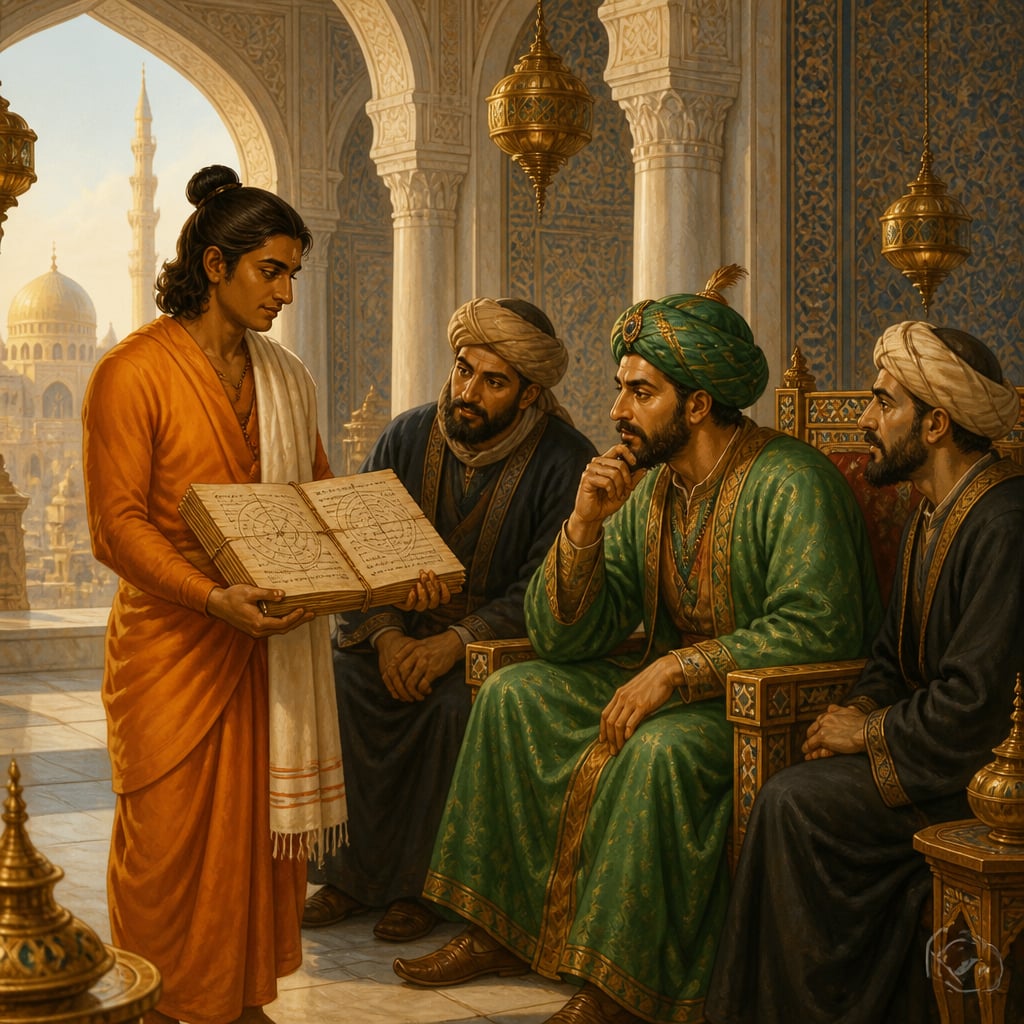
Al-Manṣūr ordered the text translated from Sanskrit into Arabic. The translation became known as the Sindhind, an Arabic corruption of the Sanskrit siddhānta. For the next two centuries it was the foundation on which Arab astronomy and arithmetic were built.
Look at the numbers on a contract or a bank statement today. You are looking at Indian numerals. The shapes have been rounded and squared by a thousand years of copying. The language you use to speak them is European. But the ideas are Indian, and the journey from Bhillamāla in Rajasthan to a keyboard in your hand runs through three civilizations and takes nine hundred years. It begins with Kankah's leather satchel in al-Manṣūr's court.
The Man Whose Name Became a Verb
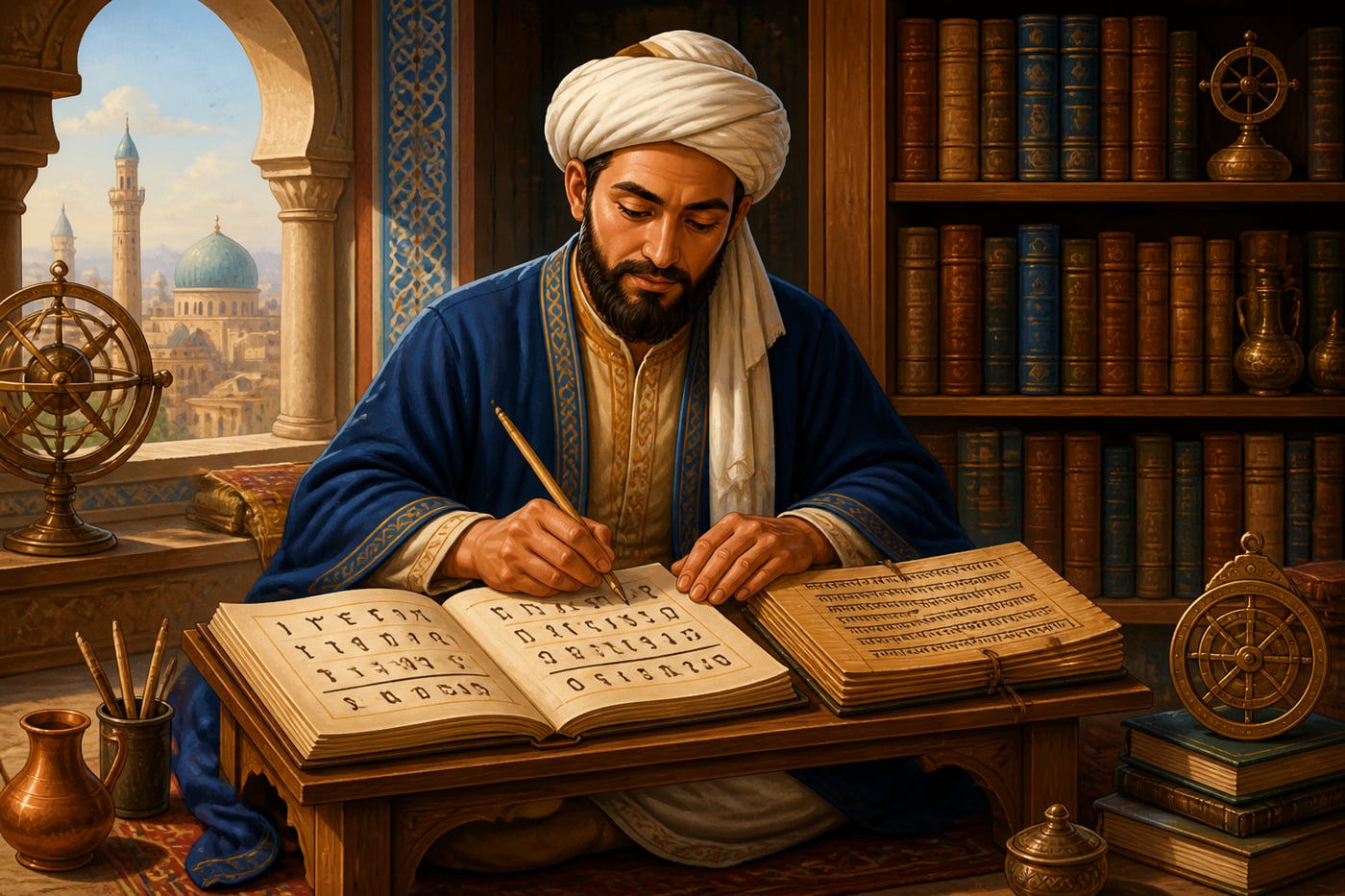
Fifty years after Kankah's mission, a Persian scholar named Muḥammad ibn Mūsā al-Khwārizmī, attached to the House of Wisdom in Baghdad under Caliph al-Ma'mūn around 820 CE, became the first person outside India to write a systematic guide to the Indian number system in a non-Indian language. His treatise was titled Kitāb al-ḥisāb al-hindī, the Book on Reckoning in the Indian Manner. He wrote a second book, Kitāb al-jabr wa-l-muqābala, from which the word algebra would eventually be derived.
The hindī book reached Latin Europe in the 12th century as Liber algorismi de numero Indorum. Latin scribes could not pronounce the author's name, so they turned al-Khwārizmī into algorismi, and then into algorism, and finally into algorithm. Every time you hear the word algorithm, you are hearing a Latinised Persian rendering of a Khwarezmian town's name, attached to a method its author called the Indian method.
Al-Khwārizmī himself was scrupulously clear about where the method came from. His book opens with an acknowledgment that he is merely explaining what the Indians had already worked out. The rules for writing numbers using nine digits and a circle for nothing were, he wrote, the reckoning of the Hindus. The decimal place-value rule he was teaching was the one Āryabhaṭa had stated in 499 CE in a single line:
स्थानात्स्थानं दशगुणं स्यात्।
sthānāt sthānaṃ daśaguṇaṃ syāt
Each place shall be ten times the previous.
Āryabhaṭīya, Gaṇitapāda 2
The Long Detour Through al-Andalus
From Baghdad the Indian numerals moved west along the trade and scholarly routes of the Islamic world. By the 10th century they had crossed North Africa and entered al-Andalus, the Muslim territories of what is now Spain and Portugal. In the libraries of Cordoba and Toledo they encountered a small number of Latin Christian scholars who had come south specifically to learn what the Islamic world knew.
One of them was a French monk named Gerbert of Aurillac, who studied in al-Andalus around 967 CE. He returned to Christian Europe carrying the Indian decimal system in his head, built an abacus with numbered counters to teach it, and used it to solve astronomical problems his Latin-educated contemporaries could not touch. In 999 CE he was elected Pope as Sylvester II. He died three years later, and within a generation rumours were circulating that he had learned his mathematics from a demon named Meridiana in al-Andalus. Nobody in Latin Europe had ever seen calculations that fast and that accurate, so they concluded it must be sorcery.
Gerbert's attempt to bring Indian numerals to Europe did not take. The Roman numeral system remained dominant for another two centuries.
1202 CE: Fibonacci and the Modus Indorum

The real breakthrough came through commerce, not scholarship. A young Italian from Pisa named Leonardo, whose father was a customs officer in the North African trading port of Bugia in what is now Algeria, spent his youth learning arithmetic from Arab teachers. In 1202 CE, back in Pisa, he published a thick manual of practical computation titled Liber Abaci. In its preface, Leonardo, later nicknamed Fibonacci, explains that he is teaching the modus Indorum, the method of the Indians, which he has found superior to every other method of calculation he has encountered. He does not call it Arab mathematics. He calls it Indian mathematics, because that is what his Arab teachers had called it.
Liber Abaci spread through Italian merchant schools over the next century. By the 14th century, European accountants were using the Indian system to track the trade that was enriching Florence, Venice, and Genoa.
The Resistance and the Quiet Victory
Not everyone was pleased. In 1299 CE, the Arte del Cambio, the guild of bankers in Florence, passed a statute forbidding its members from using the new Indian numerals in official accounts and requiring them to go on writing sums in Roman numerals or in longhand. The stated reason was that Indian digits were too easy to forge, since a zero could be turned into a six or a nine with a single stroke. The real reason was institutional inertia.
The ban held for almost a century. Then arithmetic simply overwhelmed the rule. Merchants who could multiply six-digit numbers on paper in minutes had an unanswerable advantage over merchants who were still sliding beads. By 1500 CE the Roman numerals had retreated into inscriptions, chapter headings, and ceremonial contexts, which is roughly where you still find them today.
Modern Echoes
The word zero in English carries a Sanskrit fingerprint. Śūnya became the Arabic ṣifr, which became the Latin zephirum, which split in Italian into zero and in English into cipher. Unicode today encodes the digits 0 through 9 as code points U+0030 through U+0039, shapes descended directly from Devanagari and Brāhmī numerals through Arabic and Latin transmissions. UNESCO's Memory of the World register recognises the decimal place-value system as one of the most consequential inventions in human history. The misnomer 'Arabic numerals' is slowly giving way in academic writing to 'Hindu-Arabic numerals' or simply 'Indian numerals', a correction that al-Khwārizmī and Fibonacci would both have welcomed, since both of them named the source correctly in their original texts.
Kankah set out from his court in India with a satchel of palm-leaf books and walked into a Baghdad throne room. The journey he started in 773 CE has not stopped since. The numerals he carried are now in fifteen billion devices on earth. Europe called them Arabic because Europeans learned them from Arabs. Al-Khwārizmī called them Indian because he was honest about where he had learned them. The label is not history. It is a receipt for the most recent leg of a much longer journey.
Key figures
Kankah (Kanaka)
c. 773 CE, India and Baghdad
Muḥammad ibn Mūsā al-Khwārizmī
c. 780 to 850 CE, Khwarezm and Baghdad
Leonardo of Pisa (Fibonacci)
c. 1170 to 1250 CE, Pisa and Bugia
Case studies
Kankah's Mission: The 773 CE Delegation That Launched Arab Mathematics
In 773 CE, an Indian embassy arrived at the court of Caliph al-Mansur in the recently founded city of Baghdad. The delegation was led by an Indian astronomer-mathematician whose Sanskrit name Kanaka was rendered into Arabic as Kankah. He carried with him Sanskrit treatises, one of which is identified by the later Arab scholar Ibn al-Adami and by al-Biruni as a version of Brahmagupta's Brahmasphutasiddhanta, the 628 CE work that contained the first systematic rules for arithmetic with zero and signed numbers. Al-Mansur, a caliph obsessed with collecting knowledge from every civilization his empire touched, ordered the texts translated into Arabic. The resulting translation was called the Sindhind, a corruption of the Sanskrit siddhanta. It became the standard reference for Arab astronomers and arithmeticians for the next two centuries.
India's tradition of paramparā, the formal transmission of knowledge from teacher to student across generations, did not stop at linguistic or cultural borders when invited. Kankah's mission was not a leak or a conquest but a legitimate handoff, a paramparā extended into a new tongue. The Indian scholar went voluntarily, at the caliph's invitation, with texts intended for translation and teaching. This is exactly how Indian philosophical texts had spread into Buddhist Central Asia in earlier centuries. The same cultural machinery was now carrying the decimal system westward, and the Indian habit of naming the source rode with it.
Every Arab mathematician for the next two centuries worked from the Sindhind or a text derived from it. Fifty years after Kankah's delegation, al-Khwarizmi would use this tradition to write his own Book on Reckoning in the Indian Manner. Without the 773 CE mission, Arab mathematics would have continued to rely on the Greek-Egyptian Almagest tradition of Ptolemy, and the Indian decimal system might have taken several more centuries to reach the Mediterranean.
The most consequential acts of cross-civilizational transmission are often single delegations, single meetings, single books that happened to be in the right hands at the right court. When a civilization sends its best scholars with its best texts to the court of another, the effects can rearrange what humanity counts as its own for the next thousand years.
Al-Biruni's Taḥqīq mā li'l-Hind, written around 1030 CE, is the primary Arab source that names Kankah and dates his mission to the reign of al-Mansur (754 to 775 CE). Most modern historians of science place the delegation at 773 CE.
Gerbert of Aurillac: The Pope Accused of Sorcery for Doing Arithmetic
Around 967 CE, a young Benedictine monk from Aurillac in southern France traveled across the Pyrenees into the Muslim-ruled territories of al-Andalus to study arithmetic, astronomy, and geometry. His name was Gerbert, and he spent three years at the monastery of Ripoll in the Spanish March learning what he could from Latin translations of Arabic scientific texts. Among what he learned was the Indian decimal system, which had arrived in al-Andalus a century earlier through Baghdad. Gerbert returned to France and began teaching the new numerals at the cathedral school of Reims. He built a counting device called the abacus of Gerbert, a board with columns marked with Indian numerals from one to nine, with a blank column where zero would go. In 999 CE he was elected Pope as Sylvester II, the first Frenchman and the first scholar-scientist to hold the office.
The Indian tradition treats rigorous calculation as an ordinary and respectable activity, one among the many uses of human intellect, closer to craftsmanship than to mysticism. A Brahmagupta or an Āryabhaṭa does not claim divine revelation for his rules, he derives them. Latin Europe in the 10th century had no such tradition of lay mathematical expertise. In a world where anyone who could multiply four-digit numbers was outside the ordinary range of monastic learning, a mathematically competent pope was not understood as a scholar but as an anomaly, and anomalies in the Latin Christian imagination were explained by the devil. The rumors that Sylvester II had learned his arts from a demon in al-Andalus say less about him than about the philosophical poverty of the intellectual world he returned to.
Gerbert's introduction of the Indian decimal system did not take root. After his death in 1003 CE, the church and the European universities retained Roman numerals for another two centuries. The whispered accusations of sorcery hung over his memory for even longer. As late as the 12th century, the chronicler William of Malmesbury was still repeating the story that Sylvester II had sold his soul to a demon named Meridiana in exchange for his mathematical abilities.
When a civilization encounters a technology it cannot explain with the categories it already owns, it often reaches for magic or suspicion rather than admit a gap in its own learning. Gerbert was not a sorcerer. He was a monk who had gone to Spain and studied hard. The moment you or your institution reaches for witchcraft as an explanation is usually a signal that the real explanation is a training gap you have not yet closed.
Gerbert was the first Latin Christian on record using the Indian decimal system in Europe. Roman numerals remained the default in European bookkeeping for another three centuries, meaning that his introduction was roughly three hundred years ahead of Europe's eventual adoption.
Fibonacci's Liber Abaci: The Italian Merchant Who Named the Source
Leonardo of Pisa was born around 1170 CE, the son of an Italian customs officer named Guglielmo Bonacci who had been posted to the North African trading port of Bugia, a city in what is now Algeria. The young Leonardo grew up in Bugia, where his father's work required constant computation with weights, measures, and currencies from a dozen civilizations. He was taught arithmetic by Arab merchants and scholars in the port, and they taught him in the Indian manner. As a young adult he traveled through Egypt, Syria, Byzantium, Sicily, and Provence, everywhere comparing what he had learned against what local merchants were using. In 1202 CE, back in Pisa, he published Liber Abaci, the Book of Calculation, the text that would eventually convert European commerce to the Indian decimal system.
The opening lines of Liber Abaci contain a quiet act of honest attribution that deserves to be famous. Fibonacci does not describe the method he is teaching as Arab or Mediterranean or his own innovation. He calls it modus Indorum, the method of the Indians, and credits his Arab teachers only for having introduced him to it. This is the same scholarly honesty that al-Khwarizmi had displayed four centuries earlier when he titled his own book The Reckoning of the Hindus. The Indian habit of paramparā, of naming the source, has survived the journey from Bhillamala to Baghdad to Bugia to Pisa, carried by every competent transmitter along the way.
Liber Abaci became the standard manual for Italian merchant schools over the next century. By 1300 CE the major Italian trading houses in Florence, Venice, Genoa, and Milan were using Indian numerals for inventory, currency conversion, and double-entry bookkeeping. The Florentine banking guild's 1299 ban was specifically a reaction to how fast Liber Abaci was spreading. By 1500 CE, Roman numerals had been displaced from European commerce almost everywhere. The misnomer 'Arabic numerals' that stuck in European labeling is not Fibonacci's fault. He named the source correctly. Later generations of European copyists did not.
Attribution is a small act that costs almost nothing and preserves centuries of civilizational memory. Fibonacci could have called his method Arab. He could have called it his own. He called it Indian, because that is what it was. The next time you carry an idea from one setting to another, borrow Fibonacci's grammar: name the source, name the messenger, and let the reader see both.
Historical context
628 CE to 1202 CE, from Brahmagupta's formalization of zero to Fibonacci's Liber Abaci
Post-Harsha fragmentation had left northern India divided among regional powers such as the Gurjara-Pratiharas, the Palas, and the Rashtrakutas, yet mathematical production continued unbroken. The astronomical observatory at Ujjain remained active throughout this period. Brahmagupta's hometown Bhillamala (modern Bhinmal in Rajasthan) was part of the Gurjara country, and his successors taught students who carried siddhanta texts to courts as far east as Ujjain and as far west as Baghdad. Mahāvīra composed the Gaṇitasārasaṅgraha in the Rashtrakuta court at Manyakheta around 850 CE, and Bhāskara II would write the Līlāvatī and Bījagaṇita in the same continuous tradition in 1150 CE, forty years before Fibonacci.
Living traditions
The Unicode standard encodes the digits 0 through 9 as code points U+0030 through U+0039, shapes descended directly from Devanagari and Brahmi numerals through Arabic and Latin transmissions. Every programming language, every spreadsheet, and every price tag in the world runs on the grammar Brahmagupta formalized in 628 CE. UNESCO's Memory of the World register recognizes the decimal place-value system as one of the most consequential inventions in human history. The misnomer 'Arabic numerals' is slowly giving way in academic writing to 'Hindu-Arabic numerals' or simply 'Indian numerals,' a correction that al-Khwarizmi and Fibonacci would both have welcomed, since both of them named the source correctly in their original texts.
- Bhinmal (Ancient Bhillamala): The small town in western Rajasthan where Brahmagupta composed the Brahmasphutasiddhanta in 628 CE. The Brahmasphutasiddhanta is the text whose rules for arithmetic with zero traveled to Baghdad with Kankah in 773 CE and seeded the Arab mathematical tradition. A local memorial to Brahmagupta stands in the town, along with surviving step-wells and older Jain temples from the Gurjara period.
- Camposanto and Piazza dei Miracoli: The medieval heart of the city where Leonardo of Pisa published Liber Abaci in 1202 CE. A statue of Fibonacci stands in the Camposanto Monumentale adjacent to the Leaning Tower. The nearby Museo dell'Opera del Duomo houses medieval manuscripts from the Pisan mathematical tradition he launched.
Reflection
- Pick one technology or idea you use every day. Do you actually know where it was invented? How does knowing or not knowing the origin change your relationship to the tool?
- Why do you think the Florentine bankers' guild banned Indian numerals in 1299 CE even though the numerals were demonstrably more efficient? What would it have taken for them to make the switch voluntarily?
- What does the transmission of Indian numerals through Arabic scholarship and European commerce tell us about how knowledge should move between civilizations? Is accurate attribution a form of dharma?