Shunyata: The Philosophy Behind the Number
How Buddhist and Jain philosophy gave birth to mathematics' most revolutionary concept
Discover how the philosophical concept of shunyata (emptiness and void) in Buddhist, Jain, and Upanishadic traditions laid the intellectual foundation for zero as a number.
The Monk Near the Krishna
Around 200 CE, in a stone-floored monastery on the banks of the Krishna river in what is now Andhra Pradesh, a monk named Nāgārjuna sat down at his writing slate to refute a charge that had followed him for years. His opponents accused him of preaching nihilism, of teaching that nothing exists at all. The accusation cut close. If it stuck, his entire school would be dismissed as a clever way of saying nothing. The slate was warm from his palm. Outside, the river ran low in the late dry season.
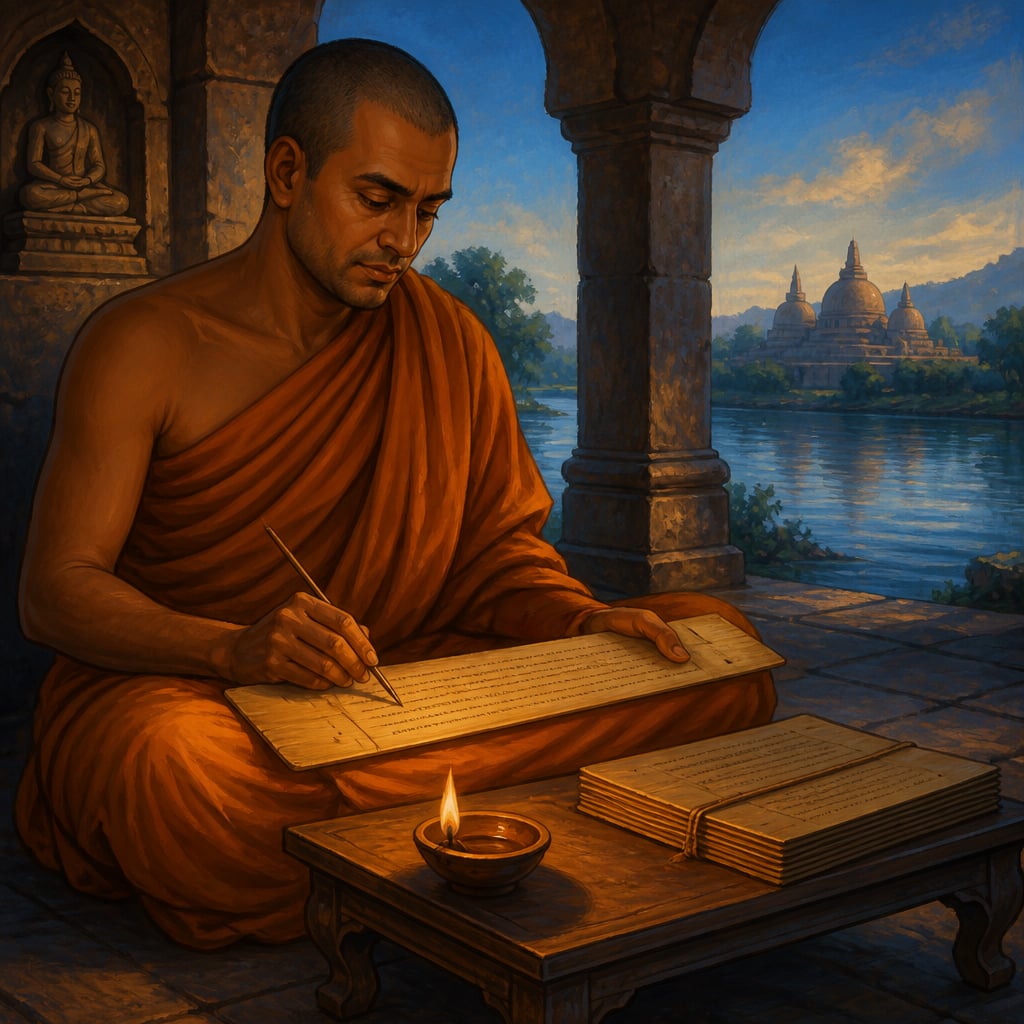
His reply would be a book of compressed Sanskrit verse, the Mūlamadhyamakakārikā, the Fundamental Verses on the Middle Way. And a single word, śūnya, would travel eighteen centuries before a mathematician in 628 CE borrowed it to name a new kind of number.
Before India gave the world zero, it had to do something harder. It had to make 'nothing' thinkable. Most civilizations never took that step. The Greeks, for all their geometric brilliance, stared at the idea of zero and recoiled. Aristotle declared that nature abhorred a vacuum, and Greek mathematics refused to treat absence as an object of study. The Babylonians, who needed placeholder notation for their base-sixty system, sometimes left a blank column and sometimes used a double-wedge sign, but they never committed to 'nothing' being a number you could compute with. The Chinese used counting rods and could represent the absence of a digit by leaving a space, but space was treated as the absence of a thing, not a thing in itself. The Romans, whose numerals still mark the chapters of old books, had no concept of zero at all.
India was different. For roughly seven centuries before Brahmagupta, Indian philosophers had been working through a set of questions that the Mediterranean world found unanswerable. What is nothing? Is absence a kind of presence? Can 'not being' be studied, named, and reasoned about?
The Buddhist Breakthrough: Shunyata
Nāgārjuna's reply to his accusers, when he wrote it down, was that every phenomenon you can point to is śūnya. Empty. Without intrinsic, self-contained existence. This did not mean nothing exists. It meant that nothing exists in and of itself. Everything arises in dependence on other things, which themselves arise in dependence on still other things. A table is empty of being-a-table because it depends on wood, and carpentry, and the intention to put things on a surface. Pull out any dependency, and the table ceases to be a table.
He compressed the whole argument into a single verse:
यः प्रतीत्यसमुत्पादः शून्यतां तां प्रचक्ष्महे। सा प्रज्ञप्तिरुपादाय प्रतिपत्सैव मध्यमा॥
yaḥ pratītyasamutpādaḥ śūnyatāṃ tāṃ pracakṣmahe sā prajñaptir upādāya pratipat saiva madhyamā
Whatever arises in dependence, we declare to be emptiness. That dependent designation is itself the middle way.
Mūlamadhyamakakārikā 24.18
Nāgārjuna pushed this further. Even 'existence' and 'non-existence' were not ultimate, he argued. They were conceptual tools. The ground of things was neither being nor non-being, but śūnyatā, the emptiness from which all categories emerge.
Where Aristotle's logic had two values (true and false), Buddhist logic operated with four (true, false, both, neither), because shunyata could only be described by negating all categories at once. When a civilization's best philosophers spend centuries arguing that 'nothing' is a coherent object of study, its mathematicians eventually find it unremarkable to treat 'nothing' as a number.
The Jain Contribution: Akasha and Abhava
Jain philosophy made a parallel move. The Jain tradition, systematized by Umāsvāti in the Tattvārtha Sūtra around the 2nd century CE, identified ākāśa (space, or void) as one of the six fundamental substances of reality. Akasha was not merely the absence of matter. It was a positive category, with its own properties, discussable on its own terms.

More importantly, Jain philosophers developed a formal theory of abhāva, non-existence, as a legitimate source of knowledge. If a pot is absent from the floor, its absence is itself a fact you can know. Classical Greek philosophy, following Parmenides, had declared that non-being cannot be thought or spoken. To speak of 'nothing' was, for the Greeks, to speak nonsense. Jain philosophers flatly rejected this. They classified abhava into four kinds:
- Prior non-existence, before a thing comes to be
- Posterior non-existence, after it ceases
- Mutual non-existence, this is not that
- Absolute non-existence
This is exactly the conceptual move a mathematician needs. If 'no pot on the floor' is a fact, then 'no unit in this column' is also a fact. And if 'no unit in this column' is a fact, it can have a symbol. And if it has a symbol, it can be computed with.
The Upanishadic Intuition: Purna and Shunya

The Upanishads, composed between roughly 800 BCE and 200 BCE, had already wrestled with these questions centuries before Nāgārjuna and Umāsvāti. The opening mantra of the Īśā Upaniṣad contains a verse that has puzzled translators for two millennia: 'From fullness comes fullness. Take fullness from fullness, and fullness still remains.'
What the Upanishads point at is an intuition that Western mathematics would not formalize until Georg Cantor's work on infinite sets in the 1880s. Some quantities do not diminish when you subtract from them. In that strange territory, pūrṇa (the inexhaustible full) and śūnya (the uncreated empty) turn out to describe the same thing, because both resist the ordinary rules of subtraction.
The Brahman of the Upanishads is nirguṇa, without attributes. You approach it only by neti-neti, 'not this, not this'. This is theology doing what mathematics would later formalize: defining a quantity by what it is not, treating absence as a method of description.
Why Other Civilizations Failed
It is worth pausing to ask why Greek, Chinese, Babylonian, and Roman mathematicians, all of whom were technically competent, never took this step. The answer is not that they were less intelligent. The answer is that their metaphysics did not give them permission.
A Greek mathematician who proposed that 'nothing' be treated as a number would have been in direct conflict with Aristotelian philosophy, which grounded all reality in substances with fixed properties. A Chinese mathematician operating within a Confucian and Daoist framework could talk about wu (non-being) as a mystical counterpart to you (being), but not as a countable, manipulable thing. A Babylonian priest-astronomer could use a placeholder in a table but had no philosophical vocabulary for calling absence a number.
Only Indian philosophy had spent centuries making 'nothing' respectable. Only Indian philosophy had Buddhists treating shunyata as the ground of reality, Jains treating abhava as a formal pramana, and Upanishadic sages treating purna and shunya as interchangeable descriptions of the ultimate. In that soil, and only in that soil, could a mathematician later stand up and say: here are the arithmetic rules for zero.
From Philosophy to Mathematics
The transition is not abrupt. It is the slow accumulation of permission. By the 3rd to 4th century CE, the scribes of the Bakhshali Manuscript are using a dot to mark positions where no digit is needed. By 499 CE, Aryabhata is working with a full place-value system. And by 628 CE, Brahmagupta writes the first systematic rules for arithmetic with zero in the Brāhmasphuṭasiddhānta, naming his operations with the very same word, śūnya, that Buddhist philosophers had been using for five hundred years.
This is not a coincidence. The mathematician borrowed the philosopher's term because the philosopher had already done the conceptual work. Shunya the number is the grandchild of shunyata the philosophical category.
Modern Echoes
The same instinct that drew Nāgārjuna to śūnyatā runs quietly through modern computing. Tony Hoare introduced the NULL reference into the ALGOL W language in 1965. In 2009, he called it his 'billion-dollar mistake', because so many crashes and security holes had come from programs that did not know how to handle absence. Modern languages like Rust and Swift now treat nullability as a first-class distinction, with explicit grammar for the empty case. They are rebuilding, in software, the philosophical scaffolding the Jain epistemologists built in the 2nd century CE. And Christof Koch, the neuroscientist who calls consciousness 'the hard problem' because awareness cannot be located in time or space, is asking the same question the Upanishadic sages asked when they reached for neti-neti.
Back near the Krishna river, Nāgārjuna closed his slate and looked out at the slow water. He had refuted the charge of nihilism. He had named a category his accusers could not unsay. The word he chose for it would still be moving through the world's calculators four hundred years before Brahmagupta found it, and eighteen centuries before a programmer typed null for the first time.
Key figures
Nāgārjuna
c. 150 to 250 CE, South India
Umāsvāti
c. 2nd century CE
Brahmagupta
598 to 668 CE, Bhillamāla (Bhinmal, Rajasthan)
Case studies
Horror Vacui versus Śūnyatā: Why Greek Mathematics Never Got to Zero
In the 4th century BCE, Aristotle declared that nature abhors a vacuum (horror vacui), arguing that an empty space with no substance in it was a metaphysical impossibility. Greek physics and cosmology accepted this as a first principle for roughly two thousand years. Greek mathematics followed suit. Euclidean geometry treated magnitudes, Archimedean calculations treated weights, Diophantine arithmetic treated positive integers, but none of the major Greek mathematical traditions ever treated 'nothing' as a number that could be added, subtracted, or multiplied. At the same time, in India, Nāgārjuna and his Madhyamaka successors were arguing that emptiness (śūnyatā) was not only thinkable but was in fact the correct description of how reality is structured.
The two civilizations were not separated by technical competence. They were separated by what their best philosophers allowed their mathematicians to say. Aristotle's metaphysics grounded reality in substances with fixed properties. A 'nothing' that could be a substance was a contradiction in terms. Nāgārjuna's metaphysics grounded reality in dependent arising. A 'nothing' was simply an accurate description of any thing considered apart from its relations. Indian mathematicians inherited philosophical vocabulary in which shunya already meant 'a respectable kind of emptiness'. Greek mathematicians inherited philosophical vocabulary in which 'nothing' meant 'incoherent nonsense'. The vocabularies decided the mathematics.
For nearly fifteen hundred years, Greek-derived mathematical traditions operated without zero as a number. The Almagest of Ptolemy in the 2nd century CE used a placeholder symbol in astronomical tables but never promoted it to a computable quantity. Medieval European calculation inherited this gap and struggled with arithmetic that Indian merchants had long found trivial. It took the transmission of Indian numerals through the Islamic world, and finally Fibonacci's Liber Abaci in 1202 CE, for Europe to begin adopting what India had formalized in 628 CE.
The hardest part of a breakthrough is not the technical work. It is the philosophical permission that has to be granted before anyone is even allowed to try. Before you dismiss a field for being stuck on a problem, ask what metaphysical assumption is making the solution look impossible. That assumption, once named, is often easier to change than the problem itself.
Greek mathematics produced Euclid's Elements around 300 BCE, one of the most rigorous mathematical texts ever written, without a single use of zero as a number. India produced Brahmagupta's Brāhmasphuṭasiddhānta in 628 CE with the first systematic rules for arithmetic on zero. The gap was not intelligence. It was metaphysics.
Nāgārjuna's Catuṣkoṭi: The Four-Valued Logic That Let Zero Exist
In the 2nd century CE, Nāgārjuna systematized an approach to logical analysis that Buddhist thinkers called catuṣkoṭi, the 'four-cornered' method. For any proposition X, catuṣkoṭi allowed four answers: X is true, X is false, X is both true and false, or X is neither true nor false. Classical Greek and Latin logic, following Aristotle's law of non-contradiction and law of the excluded middle, permitted only the first two. This apparently abstract disagreement had a consequence no one anticipated: in a tradition where 'neither true nor false' was a sayable answer, 'neither something nor nothing' could also become a sayable description of a quantity. Once 'neither something nor nothing' was sayable, treating shunya as a number stopped feeling like a contradiction in terms.
The Madhyamaka tradition used catuṣkoṭi not as an exotic curiosity but as the working logic of its central thesis, śūnyatā. Nāgārjuna's argument was that propositions about 'existence' and 'non-existence' both fail to capture how things actually are, because things exist only in dependence on other things. The four-cornered method gave his philosophy a formal apparatus for saying this. Centuries later, Indian mathematicians inherited a conceptual universe in which 'the number that is neither the presence nor the absence of a quantity' was a thinkable object. Aristotle's logic would have choked on this. Nāgārjuna's logic welcomed it.
Classical Greek mathematics, bound to two-valued logic, never formalized zero. Every attempt to describe 'nothing' as a mathematical object ran into Parmenides' objection that non-being cannot be thought. Indian mathematics, working in a catuṣkoṭi-shaped intellectual climate, accepted 'nothing' as a perfectly sayable quantity and built the decimal place-value system on top of it. The four-cornered logic did not directly appear in the Brāhmasphuṭasiddhānta, but the conceptual permission it granted did.
The logic you inherit determines the objects you can even name. Before you try to solve a hard problem, ask whether your inherited rules of inference permit the answer to be stated at all. Sometimes expanding the logic is the first move, and the solution then becomes obvious in the expanded space.
Tony Hoare's Billion-Dollar Mistake: The Modern Cost of Nullability
In 1965, the British computer scientist Tony Hoare introduced the NULL reference into the ALGOL W programming language. The feature allowed a variable that should point to an object to instead point to nothing. Hoare called it the simplest thing he could think of. In 2009, speaking at a software conference, he called it his 'billion-dollar mistake'. Null pointer exceptions, he estimated, had caused countless system crashes, security vulnerabilities, and hours of debugging across the entire history of modern software. Languages like Rust, Swift, and Kotlin are still, sixty years later, redesigning themselves around the problem NULL created. And yet NULL is not going away. It is built into the operational grammar of computing, because programs must be able to say 'there is no object here'.
Hoare's NULL is the direct engineering descendant of Brahmagupta's shunya, which is the direct philosophical descendant of Nāgārjuna's śūnyatā, which is the direct logical descendant of Umāsvāti's abhāva. The fact that every programming language still struggles with nullability is not a failure of Hoare. It is the ongoing difficulty of doing what Indian philosophy pioneered two thousand years ago: giving 'nothing' a formal status without letting it break everything else. The Indian traditions handled this with rigorous philosophical scaffolding: the doctrine of dependent arising, the catuṣkoṭi, the formal theory of abhāva. Modern programming is still catching up to that level of care, and the cost of skipping steps is measured in dollars.
Tony Hoare's NULL is estimated to have caused billions of dollars in damages over six decades. Modern languages like Rust treat nullability as a first-class distinction, forcing programmers to declare whether a reference can be null and handle both cases explicitly. This is philosophically equivalent to the Jain classification of abhāva into formal types: recognizing that 'nothing' is not a single undifferentiated failure but a structured category with its own grammar. The solution the software industry is now converging on is a rediscovery of the conceptual move Indian philosophy made in the 2nd century CE.
When you borrow a category from one discipline into another, borrow its scaffolding too. Brahmagupta could use shunya safely because he inherited a philosophical infrastructure that had been refining 'emptiness' for five hundred years. Tony Hoare introduced NULL without that infrastructure, and his field has spent sixty years rebuilding it from scratch. Before importing a concept, ask what hidden work the source discipline did to make it usable.
Tony Hoare estimated the cumulative cost of null pointer errors at over one billion dollars. Rust, Swift, and Kotlin are among the modern languages designed specifically to eliminate a problem that did not exist in traditions that handled 'nothing' with more philosophical care.
Historical context
From Philosophical Śūnyatā to Mathematical Zero (2nd century BCE to 7th century CE)
The Gupta empire (c. 320 to 550 CE) created an intellectual climate where Buddhist, Jain, and Vedic schools debated openly. Nālandā and other monastic universities preserved and extended these philosophical conversations. Ujjain remained the mathematical and astronomical capital where Aryabhata worked in 499 CE and Brahmagupta would work a century later.
Zero became a number in India rather than Greece, China, or Babylon because Indian metaphysics had already done the hard work. By the time Brahmagupta wrote the rules for shunya, his culture had spent seven hundred years making 'nothing' respectable.
Living traditions
Every null pointer in modern code, every 'None' in Python, every empty set in mathematics descends conceptually from the Indian decision that absence is a legitimate category of thought. Contemporary computer science is still debating the consequences of Tony Hoare's 1965 introduction of NULL as a programmable value, a debate that would be inconceivable in a culture that never allowed 'nothing' to be named. Mathematical logic's use of negation in formal proofs, and set theory's treatment of the empty set as a foundational object, both carry forward the philosophical move first made by Nāgārjuna, Umāsvāti, and the Upanishadic sages.
- Nāgārjunakonda Archaeological Site and Museum: Traditionally associated with the teaching site of Ācārya Nāgārjuna, the founder of Madhyamaka Buddhism whose śūnyatā philosophy prefigured mathematical zero. The valley was submerged by the Nāgārjuna Sāgar reservoir in the 1960s, but key monuments were relocated to an island museum that preserves stupas, viharas, and inscriptions from the 2nd and 3rd centuries CE.
- Nālandā Mahāvihāra: The ruins of the ancient Buddhist university where śūnyatā philosophy was debated, refined, and taught for nearly a thousand years. Founded in the 5th century CE and destroyed in the 12th, Nālandā hosted scholars from across Asia and housed a library said to have held hundreds of thousands of manuscripts. Walking the red-brick foundations connects you to the intellectual environment that made zero possible.
Reflection
- In your own life, where have you dismissed something as 'nothing', 'empty', or 'just a gap' when it might actually have been important information?
- Why do you think Indian philosophers were uniquely willing to make 'emptiness' a respectable category of thought, while Greek and other traditions recoiled from it?
- Can absence be a form of knowledge? If 'no pot on the floor' is a fact, what other absences in our lives, systems, or institutions deserve the dignity of being named?