Shunya in Daily Life: The Number That Changed Everything
Appreciating India's gift in every transaction, calculation, and code
Reflect on how zero pervades modern life from banking to science to technology, and how acknowledging its Indian origin changes our understanding of mathematical history.
The Grocer at the Bill Book
On a Tuesday morning in April 2026, in a narrow rice shop off Charminar in Hyderabad, a grocer named Mahesh weighs out 205 kilograms of sona masuri rice for a wedding caterer. The shop smells of jute and parboiled grain. The fan above the counter ticks against its mounting. The price is 68 rupees per kilo. Mahesh writes the two numbers on the back of a bill book, lines up the columns, and computes 13,940 rupees in roughly ten seconds. He does not think about it. He has done it ten thousand times.
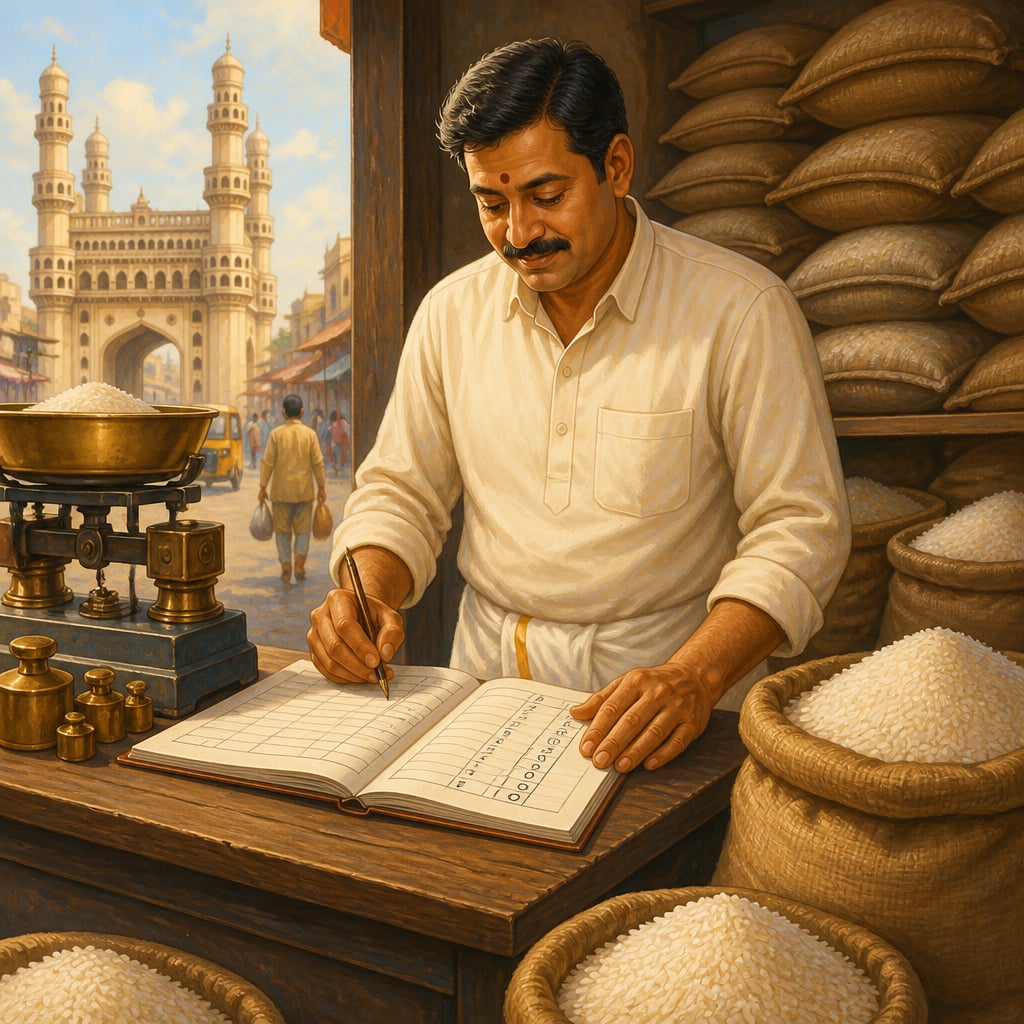
What he is doing is impossible in Roman numerals. LXVIII times CCV has no procedure. There are no columns. Each symbol means a fixed quantity regardless of where it sits in the line. Roman accountants, who were not stupid, used a physical abacus for arithmetic because the written notation was useless for computation. The reason Mahesh's notation works and a Roman accountant's does not is one tiny feature. Indian notation has a symbol for the column where no digit is. Roman notation does not.
The whole of his ten-second calculation rests on a decision made by Brahmagupta in 628 CE in the caravan town of Bhillamāla. Brahmagupta's decision rests on a philosophical decision made by Nāgārjuna in the 2nd century at his monastery near the Krishna river. Nāgārjuna's decision rests on a theological intuition made by Upanishadic sages centuries earlier still. Each layer made the next layer possible. Mahesh's bill book is the latest layer. It is also the proof that the chain still runs.
The Invisible Infrastructure
The word for technology that works so well it becomes invisible is infrastructure. Clean water is infrastructure. Electricity is infrastructure. A number system is also infrastructure, except even more thoroughly hidden, because you can at least see a power line. You cannot see a place value. You can only see what it enables.
Look at one ordinary morning in your own life and notice how many descendants of śūnya run through it:
- The bank balance the app reports to the rupee, showing zero in three of the four decimal columns
- The UPI reference number ending in a long string of digits, some of which are zeros
- The phone clock reading 07:00, where the zero tells you the minute hand is at the top
- The day's weather at 32°C, a scale whose entire architecture is hung from a zero chosen arbitrarily at the freezing point of water
- The 12-digit Aadhaar number on your identity card, the GST invoice, the pincode, the speedometer, the calorie count
Without zero, there are no columns. Without columns, there is no place value. Without place value, there is no algorithm you can do on paper. Without that algorithm, there is no commerce at scale, no accounting, no tax system a government can audit, no interest calculation a bank can verify, no invoice a small business can generate on its phone. The entire apparatus of modern economic life sits on the same chain that runs through Mahesh's bill book.
The Daily Arithmetic Bhaskara Gave Us

In 1150 CE, a mathematician named Bhāskara II, working in what is now Karnataka, wrote a textbook for his daughter and named it after her. The book was called Līlāvatī. It was not a treatise. It was a practical arithmetic handbook, written in elegant Sanskrit verse, and it contained problems about bees in lotus flowers, necklaces breaking into pieces, travellers on the road, and merchants dividing profits. For nearly eight hundred years, the Līlāvatī was the math textbook of the Indian subcontinent. Clerks, scribes, accountants, astrologers, and shopkeepers learned their trade from it.
Bhāskara's rules for zero in the Līlāvatī are the ones you still use. A number added to zero is unchanged. A number multiplied by zero is zero. And in his most original move, Bhāskara tried to describe what happens when you divide by zero:
अस्मिन् विकारः खहरे न राशावपि प्रविष्टेष्वपि निःसृतेषु।
asmin vikāraḥ khahare na rāśāv api praviṣṭeṣv api niḥsṛteṣu
In this quantity divided by zero, no change occurs though many are added or taken away.
Līlāvatī 5.47
He called the quantity khahara and compared it to the infinite and unchangeable Acyuta (Viṣṇu): a quantity that is not altered by the addition or removal of any finite amount. This is, in modern terms, the concept of a limit approaching infinity. Bhāskara reached it seven hundred years before European calculus did. He reached it because he already lived in a civilization where śūnya was a normal object to compute with, and so pushing on its edges was a natural thing to try.
Every time you hit the 0 key on a calculator and the answer comes out as expected, you are using a grammar that was stabilised in Sanskrit verse by a father writing a textbook for his daughter nine centuries ago.
The Reflex You Never Notice
There is a small but revealing habit in how people describe numerical systems. Westerners, when asked where their number system came from, often say Arabic numerals. In fact, this is what the Arabs themselves never called them. Al-Khwārizmī, whose 9th century book introduced these numerals to the Islamic world, called them al-arqām al-hindiyya, the Indian digits. The Persian polymath al-Bīrūnī, writing in the 11th century, was explicit. These came from India. Fibonacci, in his 1202 Liber Abaci, called them modus Indorum, the Indian method. Europe borrowed the numerals from the Arabs and called them Arabic for the same reason Europeans often do. The last hands on the baton get credited with the race.
Modern Echoes
It is tempting to treat the Indian origin of zero as a matter of national pride and then to stop there. That is too small a payoff for too big an idea. The acknowledgement is starting to land in places that matter. UNESCO's Memory of the World programme now lists the decimal place-value system among the most consequential inventions in human history. The Indian Government's National Mathematics Day on 22 December, declared in 2012 on Ramanujan's birth anniversary, includes Brahmagupta and Bhāskara II in its standard public talks. Academic textbooks, including Kim Plofker's Mathematics in India (Princeton, 2009) and George Gheverghese Joseph's The Crest of the Peacock, now use 'Hindu-Arabic numerals' or simply 'Indian numerals' instead of the older European misnomer. The misattribution is being unwound, slowly, by people who think the source is worth naming.
Back at his counter in Hyderabad, Mahesh tears off the carbon and hands the bill to the caterer. He has done what no Roman accountant could have done in the same ten seconds without help. The chain that runs from Nāgārjuna to Brahmagupta to Bhāskara to al-Khwārizmī to Fibonacci to a fan-cooled rice shop in Charminar is unbroken. Śūnya is India's oldest working export. It is still working. The least any of us can do is notice.
Key figures
Āryabhaṭa
476 to c. 550 CE, Kusumapura (modern Pataliputra, Bihar)
Mahāvīrācārya
c. 800 to 870 CE, Mysore region (under the Rāṣṭrakūṭa dynasty)
Bhāskara II (Bhāskarācārya)
1114 to 1185 CE, Bijapur region, Karnataka
Case studies
Negative Oil: The Day Zero Broke Wall Street
On 20 April 2020, the front-month futures contract for West Texas Intermediate crude oil closed at minus 37 dollars and 63 cents per barrel. For the first time in the history of the commodity, sellers were paying buyers to take oil off their hands, because pandemic-era storage had filled to capacity and holding the physical barrels had become more expensive than the barrels themselves. Within minutes of the settlement, trading systems at multiple banks, brokerages, and exchanges began crashing or refusing orders. The problem was not the direction of the price. It was a category error that no one had remembered to plan for. Price fields across thousands of spreadsheets, risk models, and matching engines had been defined with an implicit lower bound of zero. Negative values were literally unrepresentable. Interactive Brokers lost eighty-eight million dollars in a single session because its software could not handle orders at prices below zero. Retail traders were shown wrong balances, or no balances, for hours. Entire compliance systems had to be patched overnight to accept a value that mathematics had always permitted but software had quietly refused to name.
Brahmagupta, in the Brāhmasphuṭasiddhānta of 628 CE, was the first mathematician in history to write down formal rules for computing with negative numbers, positive numbers, and zero all on the same footing. He called the three categories dhana (wealth), ṛṇa (debt), and śūnya, and stated that any of them could stand above the line in a fraction, below the line, or on either side of an addition. Fourteen hundred years later, Wall Street's computers discovered that they had silently dropped half of Brahmagupta's scheme. They had kept positive numbers and zero but had assumed that a price, being a real-world thing, could never be a debt. The Indian mathematical tradition had insisted on the symmetry of all three since the seventh century. Modern finance relearned, at a cost of hundreds of millions of dollars in a single day, that the symmetry was not optional.
Within weeks of the April 2020 event, the CME introduced a new pricing framework explicitly allowing negative settlement. Every major exchange and clearing house now validates price fields for negative-number support. Interactive Brokers, JPMorgan, and Mizuho collectively absorbed hundreds of millions of dollars in losses attributable to systems that had implicitly assumed prices were bounded below by zero. Risk management textbooks quietly added a new category. Regulators updated their guidance. In the Indian mathematical tradition, this was never a surprise, because Brahmagupta had written the rules for symmetry between dhana and ṛṇa in 628 CE. The event was, in one sense, a very expensive rediscovery of a rule India had formalized thirteen centuries earlier.
The assumptions you forget to name are the ones that break you. Every real-world system carries hidden constraints about what kinds of numbers are allowed. Brahmagupta's insistence that wealth, debt, and shunya all deserved equal standing was a safety feature, not a philosophical luxury. Whenever you build a system, ask what values it silently refuses to name, and notice that the Indian tradition probably named them already.
A single April 2020 trading session cost Interactive Brokers 88 million dollars because its software had no representation for negative prices. Brahmagupta's 628 CE text had explicit rules for exactly this case.
MRI Machines and the Physics of Approaching Zero
Every modern magnetic resonance imaging machine, the one in the neurology ward of your nearest hospital included, depends on a magnet so strong that ordinary electromagnets cannot produce it. The solution is to wind the magnet from a superconducting alloy of niobium and titanium, then cool the coil to within roughly four kelvin of absolute zero using liquid helium at minus 269 degrees Celsius. At that temperature, the electrical resistance of the coil drops to zero, the current flows forever without loss, and the machine can generate the field strength (typically 1.5 to 3 Tesla) needed to see inside a human skull. The physics makes sense only if absolute zero, a temperature India's mathematical tradition already had a word for (parama-shunya, the ultimate emptiness, in later philosophical usage), is treated as a real and approachable limit rather than a conceptual impossibility. More than fifty million MRI scans are performed worldwide every year, each one running on a device whose operation rests on that single mathematical move.
The concept of zero as a real quantity that you could approach, manipulate, and calculate with was formalized in Brahmagupta's Brāhmasphuṭasiddhānta and operationalized in Bhāskara's Līlāvatī. Bhāskara's khahara verse, comparing quantities with zero divisors to the infinite Viṣṇu, is the first recorded treatment of a number behaving as a limit. Modern thermodynamics, through the work of William Thomson (Lord Kelvin) in 1848, rediscovered this logic as the concept of absolute zero, a temperature that matter can approach but never reach. The classical Indian insight, that shunya is real enough to reason about and never finite enough to be touched, is precisely the insight that makes low-temperature physics possible. Every MRI machine is a physical instantiation of Bhāskara's verse.
Worldwide, over fifty million MRI scans per year depend on superconducting magnets cooled to within a few kelvin of absolute zero. India alone performs millions of these scans annually. The entire imaging industry, valued at over ten billion US dollars globally, exists because physicists accepted that a limit which cannot be reached is still a quantity worth computing with. This is the same move Bhāskara made in 1150 CE when he gave khahara a name and a rule. The physics is modern. The mathematical permission is ancient.
Some of the most powerful tools in the world depend on being able to compute with quantities you can approach but never reach. The Indian tradition taught that such quantities are real, not paradoxes. Any time you notice a modern technology working because of a mathematical limit, you are seeing the practical payoff of Bhāskara's willingness to write rules for numbers other civilizations would not permit themselves to name.
Over 50 million MRI scans are performed globally each year, each relying on superconducting coils cooled to within 4 kelvin of absolute zero. The concept of a quantity that can be approached but never reached was first formalized in Bhāskara's Līlāvatī in 1150 CE.
Aadhaar: A Civilization Writing Its Citizens in Its Own Numerals
In 2009, the Indian government launched the Unique Identification Authority of India and began issuing twelve-digit Aadhaar numbers to residents. By 2024, more than 1.38 billion Aadhaar numbers had been issued, making it the largest biometric identity system in human history. The number itself is a twelve-digit decimal integer with a Verhoeff checksum in the last position. It uses the digits 0 through 9, in columns where each position is worth ten times the next. In other words, every Aadhaar number is written in the exact notation that Āryabhaṭa formalized in 499 CE and that Brahmagupta made arithmetic with in 628 CE. No other country in the world has assigned every one of its citizens a legal identity in a notation its own civilization invented. The United States uses nine digits. The European Union uses varying national schemes. India uses twelve digits, all of them native to the subcontinent's mathematical tradition, all of them unthinkable without shunya.
Āryabhaṭa, in 499 CE, stated the rule that makes any twelve-digit number readable: sthānāt sthānaṃ daśaguṇaṃ syāt, from place to place, each is ten times the previous. Without that rule, a twelve-digit number is an arbitrary string of marks. With it, the same string becomes a precise integer between one and one trillion, immediately recognizable, checksum-verifiable, and printable on a plastic card. The Aadhaar system is the largest instance in human history of a civilization using its own native mathematical invention to catalogue its own people. Every enrollment in a village in Jharkhand, every fingerprint scan at a ration shop in Tamil Nadu, every authentication at a bank kiosk in Maharashtra is a quiet confirmation that shunya works and that the rule for reading shunya within a sequence of digits still holds in 2026 exactly as Āryabhaṭa wrote it.
As of 2024, over 1.38 billion Aadhaar numbers have been issued, and roughly fifty million authentications per day run against the UIDAI backend. The system has processed more than one hundred billion authentications in total. Every one of these operations is an arithmetic computation on twelve-digit decimal numbers, and every such computation is an application of Āryabhaṭa's rule. An infrastructure unthinkable without shunya is now the civic backbone of a nation of 1.4 billion people.
Infrastructure at civilizational scale has a pedigree, whether its users notice or not. Every time you hand over your Aadhaar number at a bank, you are invoking a fifteen-hundred-year-old mathematical convention that happens to have been invented by your own civilization. The right response is not national pride but historical accuracy. When an idea works that well for that long, it deserves to be named.
Over 1.38 billion Aadhaar numbers issued. Approximately 50 million authentications per day. Every one a twelve-digit decimal integer read by the rule Āryabhaṭa stated in verse in 499 CE.
Historical context
From the Brāhmasphuṭasiddhānta to the Smartphone (628 CE to 2026 CE)
By the time Bhāskara II completed the Līlāvatī in 1150 CE, Indian arithmetic using shunya had been taught continuously for at least five centuries. Village schools (pāṭhaśālās), monastic universities (mahāvihāras), royal courts, and market towns all operated on the same decimal place-value system, using the same written digits with the same rules. The Mughal empire, the Vijayanagara empire, the Maratha confederacy, and the Colonial-era commercial houses all kept their accounts in this system. When India emerged from colonial rule in 1947, its banking, taxation, census, and civil administration inherited an unbroken arithmetic tradition stretching back to Āryabhaṭa. The Aadhaar project is the most recent and largest expression of this continuity.
The infrastructure of twenty-first century life is built on a convention India invented and a tradition India maintained. Every price tag, invoice, timestamp, MRI scan, trading screen, phone number, and identity card is an application of rules written down in Sanskrit verse between the fifth and twelfth centuries CE. Noticing this is not about national pride. It is about understanding what daily life actually rests on, and who put it there.
Living traditions
Every pincode, every GST invoice, every UPI transaction, every Aadhaar number, every bank balance, every airline ticket, every phone number, and every timestamp in India is written in the numeral system India invented. So is every price tag, receipt, and barcode on the rest of the planet. The Global Positioning System references its entire clock to a zero epoch moment on 6 January 1980. Every MRI machine cools a superconducting coil toward absolute zero. Every programming language has a literal for zero, usually the first thing any new programmer learns to type. None of these things would work, and most of them would not even be thinkable, without the decision India's mathematicians made between the fifth and the twelfth centuries CE to treat shunya as a real number and to write down the rules for using it. The legacy is not preserved in a museum. It is running in your pocket, in your hospital, in your bank, and in the satellite directly above you.
- Ramanujan Museum and Math Education Centre: A small but dedicated museum that traces the Indian mathematical tradition from Āryabhaṭa and Brahmagupta through Bhāskara and the Kerala school to Srinivasa Ramanujan. Exhibits include facsimiles of the Bakhshali Manuscript, replicas of Āryabhaṭa's astronomical instruments, and Ramanujan's notebooks. The museum runs school outreach programs that teach children to see daily arithmetic as a living inheritance of this tradition, not a foreign import.
- Āryabhaṭa Knowledge University and the Kusumapura region: Āryabhaṭa composed the Āryabhaṭīya in 499 CE at Kusumapura, the ancient name for the region of modern Patna. The modern Āryabhaṭa Knowledge University carries his name and hosts occasional exhibitions on classical Indian mathematics and astronomy. Walking the old city of Patna, Bihar's capital and once the imperial Mauryan and Gupta capital Pataliputra, puts you in the same landscape where the decimal place-value system was first written down.
- Bhāskarācārya's Ujjain (Vedh Shala observatory): Ujjain was the astronomical capital of classical India and the working base of Brahmagupta, Varāhamihira, and Bhāskara II across several centuries. The Vedh Shala (also called Jantar Mantar) is an 18th-century observatory built by Jai Singh II that still functions and is located near the same site where Bhāskara's Siddhāntaśiromaṇi was composed. Visiting the observatory and the old city puts you in the environment where the Līlāvatī's rules for zero were first taught.
Reflection
- Walk through a single ordinary morning in your life and count the number of times you use zero without noticing. What does the count tell you about how deeply the Indian mathematical tradition has quietly structured your day?
- Why does it matter that the Indian origin of zero is remembered accurately? If the infrastructure works, does the pedigree still need to be named?
- Bhāskara wrote rules for a number divided by zero and compared the result to the infinite, immutable Viṣṇu. In your own life, where have you encountered quantities that do not change under ordinary operations, that resist being added to or subtracted from? What are those quantities, and what makes them khahara-like?