Before Zero: How Civilizations Counted Without It
Roman numerals, Babylonian gaps, and why the world needed India's invention
Compare how different civilizations handled the absence of quantity and why only India developed zero as a full number with operational rules.
The Astronomer Without Zero
In Alexandria around 150 CE, in a stone-walled room of the Mouseion overlooking the harbour, a Greco-Roman astronomer named Claudius Ptolemy was trying to compute the position of Mars. His tools were the Babylonian sexagesimal system inherited from a thousand years of Mesopotamian record-keeping, a row of reed pens, and a wax tablet ruled into columns. Each column, by Babylonian rule, was sixty times the value of the column to its right. The math was elegant. The problem was the blanks.
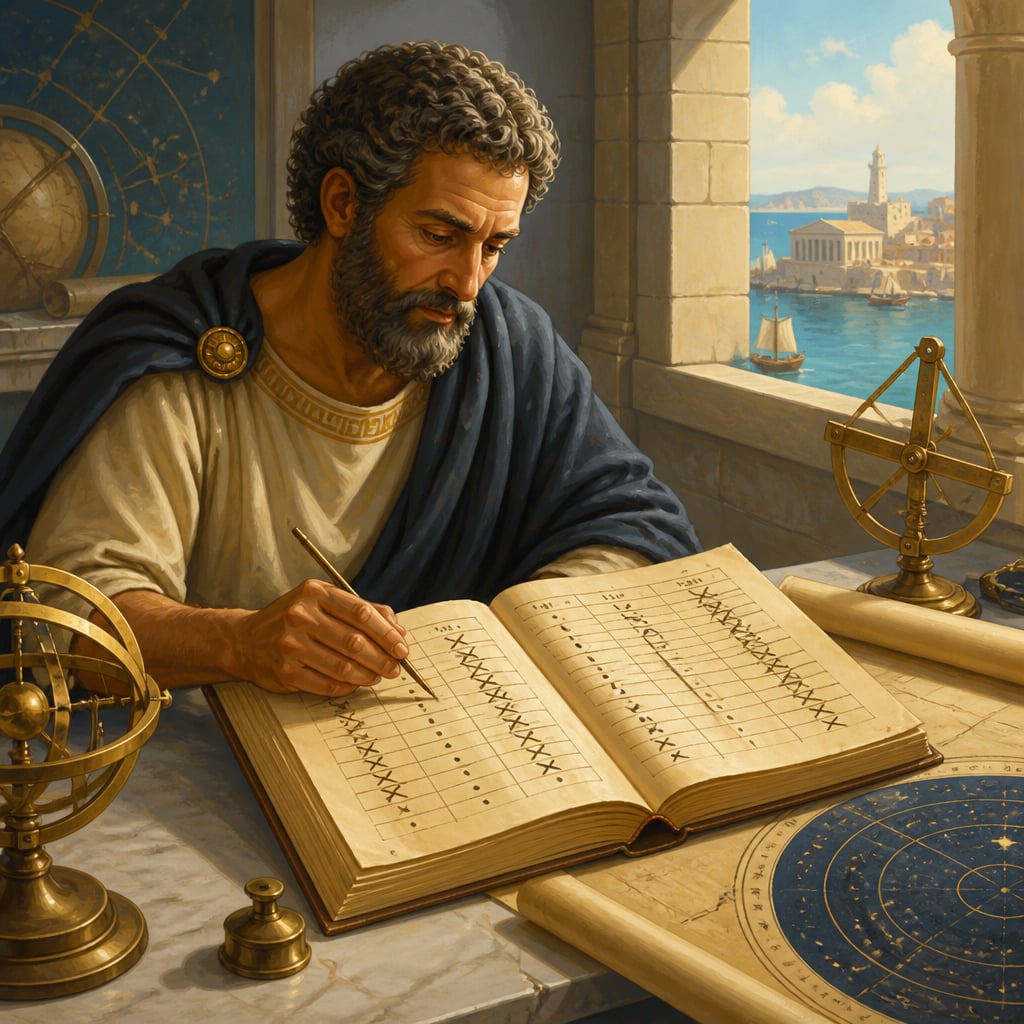
Some columns in his tables had no value. A planet would skip a unit. A recorded angle would happen to land on a round multiple of sixty. The Babylonians had marked this gap, when they marked it, with a double wedge. Ptolemy, writing in Greek, used a small circle, the letter omicron. Some scholars read it as standing for ouden, nothing. He used it in every table in the Almagest. He never used it in a proof. He never added it to anything. He never multiplied by it. He simply skipped over it when his pen reached one.
This was as close as the Mediterranean world got to zero in fourteen hundred years. For most of human history, and in most human civilizations, this was simply how counting was done. The question we should ask is not why India invented zero. It is why nobody else did. Several civilizations had the parts. None of them finished the machine.
Egypt: A Symbol for Every Pile
The oldest large-number system still visible on monuments is Egyptian hieroglyphic numeration, in use by roughly 3000 BCE. The Egyptians had a symbol for 1, a different symbol for 10, another for 100, another for 1,000, and so on up to a million. To write 327 you drew three 'hundreds' hieroglyphs, two 'tens', and seven 'ones'. To write 2,000 you drew two 'thousands'.
This is elegant for inscriptions. It is terrible for arithmetic. There is no notion of a column. There is no such thing as the 'tens place' because every tens-mark looks the same whether there are two of them or two hundred. Multiplication was done by doubling and halving, a clever trick that avoided the need for a multiplication table but became impossibly slow for large numbers. Division was worse. And zero, in this scheme, is not missing. It is unnecessary. If you had no hundreds, you simply did not draw a hundreds hieroglyph. The absence was the answer.
This is the first and simplest way to count without zero: refuse to need it. The cost is that your arithmetic never scales.
Babylon: A Wedge Where the Number Should Be

The Babylonians, by roughly 2000 BCE, were doing something very different. They had a true place-value system, but in base sixty rather than base ten. The same wedge-shaped cuneiform sign meant one thing in the ones column, sixty times as much in the sixties column, thirty-six hundred times as much in the next column, and so on. This was a genuine breakthrough. It let Babylonian astronomers compute planetary positions with accuracies that Greek mathematics would not match for a thousand years.
And yet the Babylonians had a gap, a literal one. If a number had no digit in a particular column, a scribe left a blank space. Sometimes. Other times they did not, which meant that 2 and 120 and 7,200 could all be written the same way and the reader had to guess from context. Sometime in the Seleucid period, around 300 BCE, Babylonian scribes introduced a placeholder: a pair of small wedges written in the empty column. This is sometimes celebrated as a proto-zero.
It was not. The double wedge was a punctuation mark, not a number. It could sit inside a number, but it was never written at the end, because a trailing zero was something Babylonian mathematics simply did not need to represent. You could not add the double wedge to something. You could not multiply by it. It had no arithmetic. It only prevented ambiguity in writing.
This is the second way to count without zero: invent a symbol for the gap, but deny it citizenship.
Greece and Rome: Refusal and Spectacle
Greek mathematics produced Euclid's Elements around 300 BCE, one of the most rigorous mathematical texts ever written. It contains no zero. The Greeks had two numbering systems. The older acrophonic system used the first letter of the word for each value. The later Ionic system used Greek letters with diacritics to represent numbers from 1 to 999. Neither system supported place value, and neither needed a zero. Ptolemy's omicron, the small circle from our opening, was the closest the tradition came. The omicron could appear in a table, but it never appeared in a proof.
Then there is Rome. The Roman numeral system, still used today on clock faces and movie copyright notices, uses letter values that add together, with subtractive shortcuts for numbers like IV and IX. There is no place value, no zero, and no general algorithm for multiplication. A Roman merchant who wanted to multiply CCCXXVII by CLXIV had two options. He could line up two abaci and move stones. Or he could pay a specialist.
Roman numerals are perfectly good for recording a finished total. They are terrible for computing one. The very act of multiplying in Roman numerals is so clumsy that medieval European universities would later teach arithmetic as a kind of magic trick reserved for trained professionals. When the Hindu numerals finally began to arrive in the thirteenth century, merchants who adopted them were suspected of fraud precisely because their calculations were fast, portable, and no longer required a trip to the counting house.
Meanwhile, in Bharat

While all this was happening elsewhere, Vedic India had already been naming very large numbers out loud for centuries. The Yajurveda's fire-altar mantras invoke decimal place names up through parārdha, a number on the order of a trillion. The Taittirīya Upaniṣad's enumeration of bliss multiplies by a hundred at each step. Pāṇini's grammar treats enumeration as a formal operation. By the time Āryabhaṭa wrote his Āryabhaṭīya in 499 CE, a full 129 years before Brahmagupta would formalize zero, he was able to state the decimal place-value rule in a single line:
स्थानात्स्थानं दशगुणं स्यात्।
sthānāt sthānaṃ daśaguṇaṃ syāt
Each place shall be ten times the previous.
Āryabhaṭīya, Gaṇitapāda 2
This is the line that no Babylonian, Greek, or Roman mathematician ever wrote down, because in their systems it was not true.
Why the Indian Move Was Different
Every one of these civilizations had pieces of the answer. Egypt had clear symbols. Babylon had place value. Greece had rigorous proof. Rome had practical record-keeping. What none of them had was the willingness to let a symbol for nothing join the society of numbers.
The Indian invention, when it finally came, was not the mark on the page. Several traditions had dots or circles that stood for empty positions. The Indian invention was the decision to treat that mark the same way every other digit was treated: something you could add to, subtract from, multiply, and divide. In the Brāhmasphuṭasiddhānta in 628 CE, Brahmagupta writes a sentence that no Babylonian scribe, no Greek geometer, and no Roman accountant had ever written. A number plus zero is that number. A number times zero is zero. Now go compute.
Modern Echoes
The consequences of that one decision still shape the world. The Gregorian calendar in your phone, designed by Dionysius Exiguus in 525 CE on a Roman-numeral foundation, has no year zero, which is why historians and astronomers still argue about whether the third millennium began in 2000 or 2001. The IEEE 754 floating-point standard, the rule every CPU on earth follows when handling decimals, includes explicit signed zero and signed infinity precisely because the Indian decision to treat absence as a number had to be carried into silicon. Even Tony Hoare's 1965 NULL, which he later called his 'billion-dollar mistake', is a recognisably Brahmaguptan move taken without Brahmagupta's care.
Back in his Alexandrian study, Ptolemy closed the Almagest with the omicron still sitting in his tables, doing nothing arithmetically, marking absence without naming it. The line between his counting system and the one we still use today would not be crossed for almost five hundred years. The next lesson is the moment it was crossed.
Key figures
Claudius Ptolemy
c. 100 to 170 CE, Alexandria, Roman Egypt
Āryabhaṭa
476 to 550 CE, Kusumapura (modern Patna, Bihar)
Leonardo of Pisa (Fibonacci)
c. 1170 to 1250 CE, Republic of Pisa
Case studies
Florence, 1299: When Europe Banned the Numbers It Would Eventually Need
In 1299 CE, the Arte del Cambio, Florence's guild of money-changers and bankers, passed a regulation called the Statuta Artis Campsorum. It forbade its members from keeping account books using Hindu-Arabic numerals, requiring them to record all entries in Roman numerals or Tuscan number-words instead. Florence was not a backward city. It was the banking capital of Europe, home to the Peruzzi and Bardi families, where double-entry bookkeeping would be invented within a century. The ban was deliberate, not ignorant. The guild argued that Arabic digits were too easy to forge. A 0 could be turned into a 6 or a 9 with a loop. A 1 could become a 7 with a stroke. In a contract written with Roman numerals, where CC was always CC and XXV was always XXV, fraud was harder to hide. The logic was impeccable. The consequence was that Florentine bankers, at the exact moment they were inventing the instruments of modern finance, were doing their arithmetic on counting boards because their own rules forbade them from writing down the digits they needed.
What Florence was really banning was arithmetic portability. Roman numerals are stable on the page but useless for computation. The calculations had to happen on an abacus or counting board, which is why every medieval countinghouse had a dedicated reckoner in its back room. Hindu-Arabic numerals were dangerous precisely because they collapsed the distance between writing and computation. A merchant who could write 3426 x 179 on paper could also compute it on paper. He no longer needed the specialist. Brahmagupta's arithmetic rules had made this compression possible in 628 CE. Florence, in 1299 CE, was still relitigating whether the compression was worth the fraud risk. The whole civilization was running on a counting technology that Indian mathematicians had retired almost seven hundred years earlier.
The ban was widely evaded. Italian merchants learning to compute with Hindu-Arabic numerals discovered they could work several times faster than their Roman-numeral-bound competitors. Within two centuries the Arabic numerals had become the default across commercial Europe. The shift was driven by the marketplace, not by the guilds. Florence's ban, and the similar regulations passed in Venice, Milan, and elsewhere, failed because the commercial advantage of the Indian system was simply too large to suppress.
When you inherit a technology from another civilization, you inherit the problems it already solved. The 1299 debate was not about whether the system worked. It was about whether European institutions were willing to catch up. The lag was governance, not competence. A productivity gain large enough will eventually route around any rule that tries to forbid it.
Florence's 1299 ban on Hindu-Arabic numerals in bank records came 671 years after Brahmagupta published the arithmetic rules for zero in 628 CE. In that window, India's mathematical system had already traveled through Baghdad, al-Khwarizmi, al-Andalus, and Fibonacci's Liber Abaci of 1202 CE, which explicitly credited 'the method of the Indians'.
Ptolemy's Omicron: The Placeholder That Never Became a Number
Around 150 CE, the astronomer Claudius Ptolemy, working in Alexandria, completed the Mathēmatikē Syntaxis, later known in the Arab world and medieval Europe as the Almagest. It was the most comprehensive astronomical work of the ancient Mediterranean and would remain the standard reference for planetary computation in Europe and the Islamic world for over 1,400 years. Ptolemy's tables of planetary positions required sexagesimal calculations inherited from Babylonian astronomy, and those calculations ran into the same ancient problem: what do you write in a column that has no value? The Babylonian scribes of the Seleucid period had introduced a double-wedge placeholder. Ptolemy, writing in Greek, adapted it. He placed a small circle, the letter omicron, in empty columns. Some modern scholars read this omicron as an abbreviation of the word ouden, nothing. Either way, Ptolemy had a working symbol for 'no units here'. He used it throughout the Almagest's tables. He never used it anywhere else.
The omicron was a typographical convenience, not a mathematical concept. It appeared in astronomical tables and disappeared everywhere else. There is no Greek theorem that operates on zero. There is no Euclidean proposition that involves 'nothing'. When Ptolemy needed to multiply by an omicron-containing number, he simply treated the omicron as 'skip this column' and carried the other columns through by hand. The symbol was a scribal courtesy, a way to align the rows of a table. It never joined the club of real numbers. Greek mathematical philosophy, inherited from Parmenides through Aristotle, did not permit non-being to be studied as an object. Euclid's Elements built the most rigorous mathematical edifice of the ancient world on a foundation that explicitly excluded 'nothing'. Ptolemy wrote inside that tradition. His omicron was a placeholder the way a comma is a pause: it structures the writing, but it is not itself a word.
For more than a thousand years, Ptolemy's omicron sat in the Almagest as the closest thing Greek mathematics ever came to a zero. It never propagated to other Greek mathematical texts. It never changed the foundations of Greek arithmetic. When Indian mathematics reached the Arab world through the 9th-century translations of the Brāhmasphuṭasiddhānta, Arab mathematicians recognized immediately that what the Indians had was categorically different from what the Greeks had. Al-Khwarizmi's On the Calculation with Hindu Numerals does not mention Ptolemy's omicron once. It transmits the Indian system whole, because the Indian system was the one that worked.
A symbol is not a concept. Ptolemy had the symbol. He did not have the concept. The distance between writing a mark for nothing and treating nothing as a number is not notational. It is metaphysical. Before you declare a breakthrough, ask whether your new symbol is actually doing computational work or just saving space on the page. Real breakthroughs change what you can compute, not just what you can write.
The Missing Year Zero: Why the Millennium Started in 2001
In December 1999, half the world celebrated the start of the third millennium. The other half pointed out that the millennium would not actually start until January 1, 2001. The reason, buried in medieval reckoning, was that the Gregorian calendar has no year zero. The year 1 BCE is followed directly by the year 1 CE. There is no gap, no zero, no empty year between them. This means that the first century ran from 1 CE to 100 CE, the second from 101 CE to 200 CE, and so on. By that accounting, the third millennium begins with 2001 CE, not 2000 CE. The confusion was not a minor pedantry. Governments planned celebrations, media outlets published countdowns, software engineers braced for Y2K, and almost nobody could explain cleanly why the date was ambiguous. The deep answer was that Dionysius Exiguus, the sixth-century Scythian monk who invented the Anno Domini system in 525 CE, did not know what to do with zero. Zero had not yet arrived in Europe. Dionysius counted from one, because that was the only thing his number system allowed him to do. His calendar became the Western calendar, and the gap he left is still buried in every historical date we use.
Dionysius was counting the way Brahmagupta would have told him not to. When Brahmagupta wrote his arithmetic rules a century later in 628 CE, the first operation he defined was that any number plus zero is that number. This apparently trivial statement is exactly what a calendar needs. It says that a year zero is a valid year, that it occupies real space between the years before and the years after, that it is not a gap in the timeline but a point on the timeline. Dionysius did not know this. He was building his calendar from Roman numerals, and Roman numerals did not include a zero. So he started from 1 AD and counted up, and he started from 1 BC and counted back, and the two number lines met like two ladders with no rung in between. This is the exact geometry Greek and Roman mathematics had always produced. It is also the exact geometry Indian arithmetic had already fixed.
The missing year zero still causes off-by-one errors in every serious historical dataset. Modern astronomical year numbering, defined by Jacques Cassini in 1740 to fix exactly this problem, inserts a year zero between 1 BCE and 1 CE and then labels earlier years with negative numbers. Astronomers use it. Historians do not. A database that computes 'years between 50 BCE and 50 CE' returns 99 in the civil calendar and 100 in the astronomical one. The 2000 versus 2001 millennium debate was a public instance of the same arithmetic mismatch, a small and enduring monument to the cost of building a calendar without zero.
Arithmetic decisions made by people who cannot conceive of zero propagate forward for centuries. Dionysius Exiguus was not an idiot. He was a skilled computist working with the best number system available in sixth-century Europe, which was the worst number system available anywhere in the civilized world of his day. His calendar is still in use because the institutional cost of replacing it is higher than the cost of tolerating its off-by-one errors. Every time you cannot decide whether the millennium started in 2000 or 2001, you are paying a tax on a design choice made 1,400 years ago by a monk who had no zero.
Modern astronomical year numbering inserts a year zero between 1 BCE and 1 CE. The civil Gregorian calendar does not. A computer that subtracts 50 BCE from 50 CE using the civil calendar returns 99 years. The same computation in astronomical numbering returns 100. This one-year gap is the longest-running typo in Western chronology and a direct consequence of Dionysius Exiguus not having access to Brahmagupta's 628 CE arithmetic.
Historical context
The Pre-Zero Arithmetic of the Ancient World (c. 3000 BCE to 7th century CE)
The Gupta age (c. 320 to 550 CE) saw Indian mathematics consolidate the decimal place-value system that Vedic ritual had been naming for centuries. By the time Āryabhaṭa wrote the Āryabhaṭīya in 499 CE, decimal computation with place value was already standard in Indian astronomical and mathematical texts. India was not inventing place value at this point. It was formalizing a technology implicit in Vedic number-naming and ready for Brahmagupta to complete.
Understanding what the other civilizations could and could not do is the only way to see what India actually added. The point is not that ancient people elsewhere were bad at counting. They were often brilliant at it. The point is that one specific move, the promotion of śūnya from a gap to a number, happened in exactly one place, and once it happened, the world's arithmetic was changed for good. Lesson 3 will show exactly how.
Living traditions
Every digital transaction, every piece of financial software, every programming language runs on the arithmetic Brahmagupta formalized in 628 CE and Āryabhaṭa had already been computing with in 499 CE. The Roman numeral system survives on clock faces and royal titles. The Greek alphabetic numerals survive in a few technical contexts. The Babylonian sexagesimal system survives in our 60-minute hour and 360-degree circle. But the working number system that drives global computation is Indian, transmitted through Arabic intermediaries into European mathematics, and from there into every programming language ever written. When a modern calculator shows 0 as a digit on its display, it is displaying a decision made in the Gupta age.
- Jantar Mantar, Jaipur: An observatory built by Maharaja Sawai Jai Singh II between 1724 and 1734 CE, containing the largest stone sundial in the world and nineteen precisely calibrated instruments for measuring time and celestial positions. The site is a physical monument to the Indian decimal mathematical tradition. Every instrument is calibrated in units that assume place-value arithmetic, and the Samrat Yantra sundial is accurate to about two seconds. Walking between the instruments is walking through the working grammar of Indian astronomical computation.
- The British Museum, Mesopotamia Galleries: The British Museum holds one of the world's largest collections of Babylonian cuneiform tablets, including mathematical and astronomical tablets from Seleucid-era Uruk and Babylon that show the famous double-wedge placeholder for empty sexagesimal columns. Seeing the tablets in person is the fastest way to understand why Ptolemy's omicron and Brahmagupta's śūnya are not the same thing. The Babylonian wedge marks a gap in writing. It never moves through an equation. Standing in front of a tablet makes the difference visible in a way no textbook does.
Reflection
- In your own work or daily life, where are you using the equivalent of Roman numerals: a system that functions but cannot scale? What would the Indian-style upgrade look like, and what is stopping you from adopting it?
- Why did the civilizations that came closest to zero, the Babylonians with their double wedge and the Greeks with their omicron, never take the final step? What is the difference between a placeholder and a number?
- When a society inherits a tool from another civilization centuries after it was first invented, what does the delay tell us about how ideas travel between cultures? Is the lag always about communication, or sometimes about readiness?