The Bakhshali Manuscript: Archaeological Evidence
The ancient birch-bark manuscript that rewrote zero's history
Explore the Bakhshali manuscript discovered in 1881, containing some of the earliest written zeros, and the debate over its dating.
The Farmer's Spade
In the summer of 1881, in a field near the village of Bakhshali in the Yusufzai subdivision of Peshawar District, a tenant farmer struck a small stone enclosure while digging. Inside, protected from the elements by the earth and the stone, lay a stack of roughly seventy folios of birch bark, brittle with age and covered in a script he could not read. He had no way of knowing he had just uncovered the earliest surviving mathematical manuscript from early India.
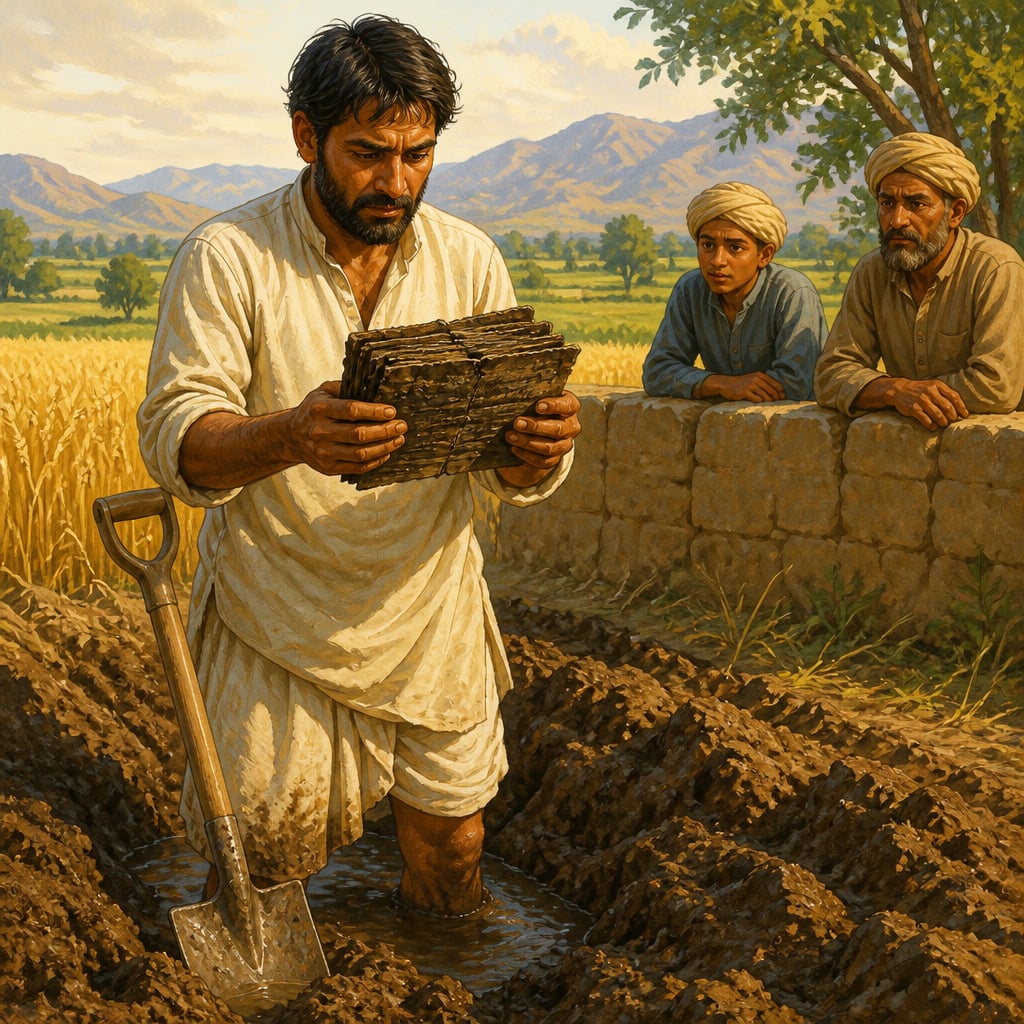
He took the bundle to his local revenue officer, who passed it to the Assistant Commissioner at Mardan, who forwarded it through Major-General A.A. Tregear to Rudolf Hoernle at the Indian Museum in Calcutta. Hoernle read Sanskrit. He read Śāradā. The first time he looked carefully at the pages, he understood that he was holding something nobody had expected to find: a mathematical manuscript from early India, written in verse, worked through with examples, and, on page after page, using a single dot to mean 'there is no digit here'.
This lesson is about that dot.
What the Manuscript Actually Contains
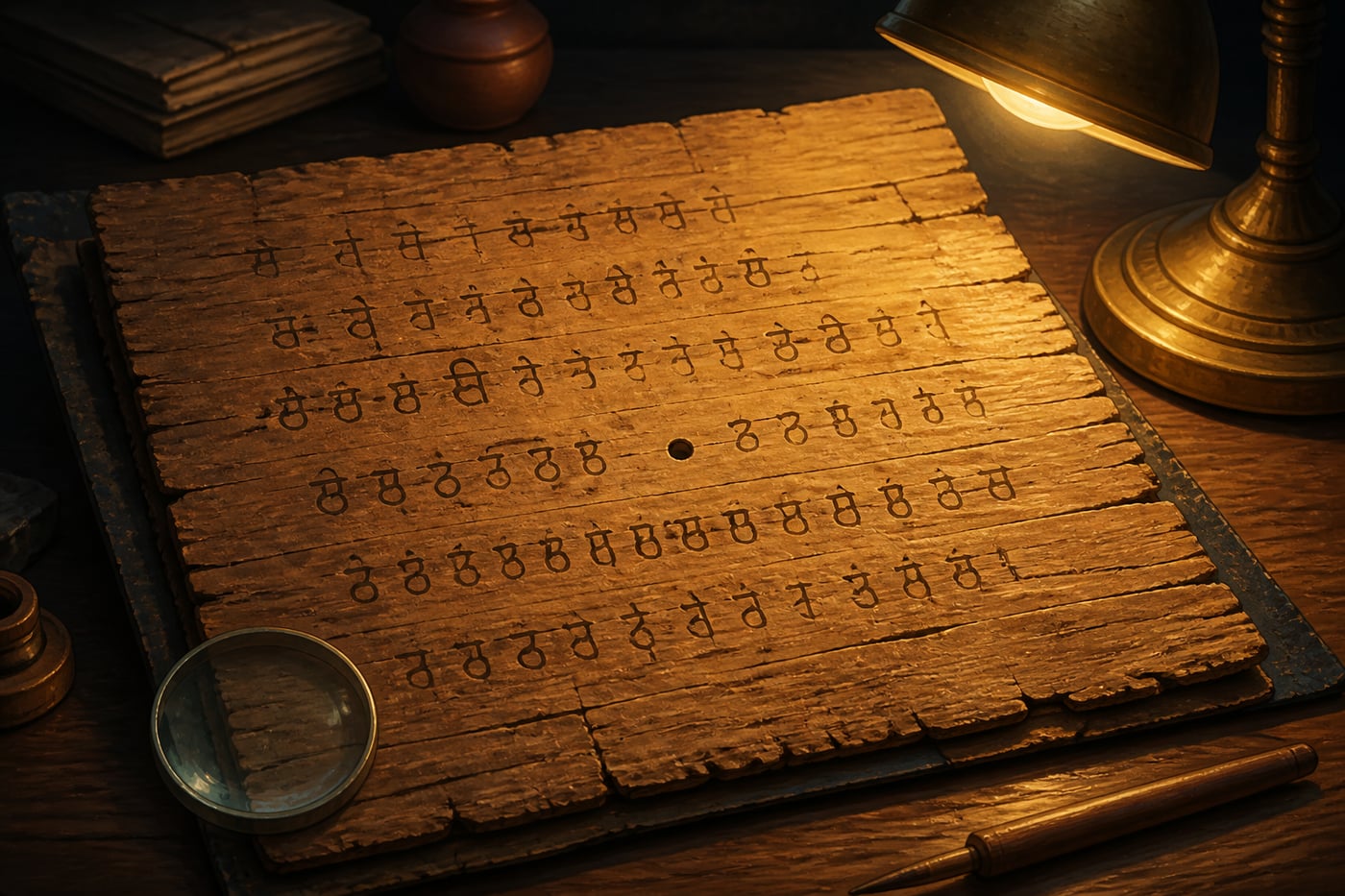
The Bakhshali Manuscript, now preserved at the Bodleian Library in Oxford under shelfmark MS. Sansk. d. 14, is a practical handbook. It teaches arithmetic and early algebra by working through problems. There are merchants dividing profits. There are soldiers sharing rations. There are systems for extracting square roots by iteration, using a formula so accurate that modern historians have compared it to the Newton-Raphson method a thousand years early. There are solutions to linear equations, and rules for handling fractions.
What sets the manuscript apart, though, is not the problems it solves. It is how it writes its answers. When a digit is missing, the scribe writes a dot. This dot, called bindu in Sanskrit, is the direct physical ancestor of the circle we now use for zero. The dot is not only a placeholder. It appears as a standalone quantity in the middle of calculations. The scribes were doing, on birch bark, what Brahmagupta would later formalize in rules. They were computing with nothing, and they were doing it casually, without any sense that the operation required defence.
The script is Śāradā, a north Indian alphabet used from roughly the 8th century onward. The language is a hybrid Sanskrit that mathematicians used for practical texts rather than temple verse. Takao Hayashi's 1995 critical edition, the definitive modern study, documents roughly a thousand problems, many of them partial. Leaves are missing. What survives is enough to establish that whoever compiled this text was already comfortable with the full decimal place-value system that Āryabhaṭa would later state in a single line:
स्थानात्स्थानं दशगुणं स्यात्।
sthānāt sthānaṃ daśaguṇaṃ syāt
Each place shall be ten times the previous.
Āryabhaṭīya, Gaṇitapāda 2
The Bakhshali scribes were a working example of exactly the notation Āryabhaṭa takes for granted. Text and artifact describe the same living mathematical practice.
The Dating Controversy
For most of the twentieth century, the manuscript was dated to somewhere between the 9th and the 12th century CE. G.R. Kaye, who published an edition in 1927, placed it at the late end of this range. Hoernle had favoured the early end. The disagreement was technical, based on script analysis, and for nearly ninety years it stayed unresolved.

In September 2017, the Bodleian Library announced the result of a radiocarbon test. Researchers had directly dated three folios of the manuscript:
- The oldest folio returned a date of 224 to 383 CE
- A second folio came back at 680 to 779 CE
- A third at 885 to 993 CE
If the oldest folio was correctly dated, part of the Bakhshali Manuscript was not a medieval text at all. Part of it was from the 3rd or 4th century CE, which would make it the oldest surviving document anywhere in the world to carry a symbol for zero. The earliest known zero had just jumped back by several hundred years, overnight.
The announcement made international headlines. It also drew immediate pushback from historians of Indian mathematics, including Kim Plofker and Agathe Keller, who argued that the carbon results could not be reconciled with the paleographic evidence. The script style on the oldest folio, they noted, looked much later than the 3rd century. Their counter-hypothesis was that the manuscript is a bound composite, with folios of different ages stitched together later, so that the birch bark on one page is older than the text written on it. That debate is not yet settled, and it is not likely to be settled without more samples and more tests.
Why the Evidence Matters
What the Bakhshali Manuscript demonstrates, beyond any particular date, is that the dot for zero was already in use in practical Indian arithmetic before it appears in the formal treatises historians traditionally cite. The physical object confirms what Brahmagupta's Brāhmasphuṭasiddhānta and Āryabhaṭa's Āryabhaṭīya imply: by the time systematic rules were being written, scribes had already been using the symbol in everyday calculation. This is what archaeology does for mathematical history. It catches a tradition in the act of thinking, without the polish of later commentary, and it leaves a date on the evidence.
Before the 2017 announcement, the oldest confirmed written zero in the world was the Chaturbhuja Temple inscription at Gwalior, carved in 876 CE. It is a small land grant recording a garden of 270 by 187 hastas donated to the temple, and a daily offering of 50 flower garlands. The zeros in those numerals are clearly written, perfectly circular, and they sit inside a stone wall you can still touch today. For more than a century, that inscription was the benchmark. Then a dot on a piece of birch bark, carbon-dated in a laboratory, pushed the benchmark back by up to six hundred years in a single press release.
Modern Echoes
The Bodleian's 2017 announcement was carried by the BBC, the Guardian, and Scientific American, with Marcus du Sautoy at Oxford as the public face of the result. The same accelerator mass spectrometry technique that dated the Bakhshali bark is now standard in any field that needs an absolute date for an undated artifact, from the Dead Sea Scrolls to early Buddhist palm-leaf fragments. Every modern historian of science working in India today cites Bakhshali, in either dating, as a reminder that a single carbon test in a laboratory can move a benchmark that survived a hundred years of textual debate.
The dot is still inside the manuscript at Oxford, behind glass, too brittle to handle in ordinary daylight. The farmer who pulled it out of the stone enclosure in 1881 was the first link in a chain of unknowing hands that ended in a Bodleian conservation room. The chain is what kept the dot alive. The next time you type a zero, remember that its oldest physical ancestor came out of a Pakistani field on the edge of an empire, carried by people who could not read it but knew it should not be thrown away.
Key figures
Rudolf Hoernle
1841 to 1918, Germany and British India
Takao Hayashi
b. 1949, Japan
Marcus du Sautoy
b. 1965, United Kingdom
Case studies
The 1881 Bakhshali Find: How a Farmer's Spade Rewrote the History of Zero
In the summer of 1881, a tenant farmer working a field near the village of Bakhshali in the Yusufzai subdivision of Peshawar District, then under British administration, struck a small stone enclosure while digging. Inside, protected from the elements by the earth and the stone, lay a stack of roughly seventy folios of birch bark covered in a script he could not read. He had no way of knowing he had just uncovered the earliest surviving mathematical manuscript from India. He took the bundle to his local revenue officer, who passed it to the Assistant Commissioner at Mardan, who forwarded it through Major-General A.A. Tregear to Rudolf Hoernle at the Indian Museum in Calcutta. Every link in that chain was made by people who did not know what they were holding, but who recognized that it should be held carefully.
Indian tradition has always distinguished between śruti (what is heard and transmitted orally) and the material trace. The Vedas are śruti by design, preserved without a single written word for centuries. But practical sciences like gaṇita were carried by pāṇḍulipi, physical manuscripts on birch bark and palm leaf, produced by scribes and passed hand to hand until they crumbled. The Bakhshali find is the random survival of one such pāṇḍulipi in a stone enclosure, preserved by accident across fourteen centuries or more. The tradition expected its mathematical texts to be taught, copied, and replaced. It did not expect one to be buried and dug up again in 1881.
Hoernle published the first partial edition in 1887. In 1902 he donated the manuscript to the Bodleian Library at Oxford, where it has remained under controlled conservation ever since. The chain of custody, from a farmer's spade to one of the best-equipped manuscript libraries in the world, took twenty-one years and crossed three continents. Without any single link in that chain, the world's earliest physical record of zero would have been lost forever.
The survival of knowledge often depends on strangers who cannot read the content but recognize that it should be saved. A farmer, a revenue clerk, a general, and an Indologist together preserved the oldest written zero. Train yourself to pass along what you cannot understand, on the chance that someone downstream will.
Only about seventy folios of the Bakhshali Manuscript survive out of what was likely a much larger original text. Many pages are so brittle that the Bodleian rotates them out of public display and permits handling only with special authorisation.
Gwalior 876 CE: The Benchmark That a Single Radiocarbon Test Moved by Six Hundred Years
For most of the 20th century, the oldest confirmed written zero in the world was a single small inscription on a stone wall of the Chaturbhuja Temple at Gwalior Fort, in what is now Madhya Pradesh. Carved in 876 CE during the reign of the Pratihāra king Bhojadeva, it is a routine land grant: a garden of 270 hastas by 187 hastas donated to the temple, with a promise of 50 flower garlands offered daily. Every zero in those numerals, 270, 187, 50, is perfectly circular and carved into the stone with the same precision as every other character. Any historian writing about the history of zero cited Gwalior 876 CE the way physicists cite the speed of light. It was the number you began with. It was the date on the base of the monument. Then, in September 2017, the Bodleian Library announced radiocarbon results from the Bakhshali Manuscript, with one folio returning a date of 224 to 383 CE. The Gwalior benchmark, after more than a century of authority, moved overnight.
Indian epistemology treats the interplay between śabda (verbal or textual testimony) and pratyakṣa (direct perception) with unusual care. Classical pramāṇa theory, especially in the Nyāya school, insists that no single source of knowledge is absolute. Testimony must be checkable against perception. Perception must be interpretable through testimony. The Gwalior inscription and the Bakhshali manuscript are the two kinds of evidence doing this work in the history of zero. Gwalior is stable, publicly visible, carved in stone, and easily dated. Bakhshali is fragile, privately held, written on bark, and contested in its dating. Each corrects the limits of the other. A tradition that honors both kinds of evidence is better protected against the errors of either.
Between 1881 and 2017, the two main physical anchors for the history of zero shifted three times. First the Gwalior inscription was identified and dated. Then the Bakhshali Manuscript was recovered and analyzed, initially dated to the 9th to 12th century, placing it after Gwalior. Then in 2017 radiocarbon pushed the oldest Bakhshali folio back to the 3rd or 4th century CE, making it the earliest physical zero ever found. Kim Plofker and other historians have challenged whether the 2017 date can coexist with the paleographic evidence, and the debate continues. What is not in dispute is that a single dated object can reset the timeline of an entire field. The Gwalior inscription still stands on its wall, unaltered. Its role has simply shifted from the first chapter of the story to a later one.
Do not build a field on a single benchmark. The moment one physical object carries the weight of an entire timeline, any new measurement can topple the whole structure. Multiple independent anchors, even if individually weaker, are more stable than one strong one. In your own work, track more than one source of truth.
The Gwalior 876 CE inscription is still standing, in open air, on the wall of the Chaturbhuja Temple at Gwalior Fort. It remains the oldest zero in the world whose date is not currently under scholarly dispute.
Historical context
The manuscript era of early Indian mathematics (3rd to 12th century CE), spanning the latest possible Gupta dating through the medieval Sharada script tradition
The Bakhshali Manuscript was written in the northwest, in what is now Khyber Pakhtunkhwa province of Pakistan, during a long stretch of history in which the region was variously ruled by the later Kushans, the Hephthalites, the Hindu Shahis, and eventually medieval Islamic dynasties. The Gupta empire (c. 320 to 550 CE) dominated the north during the early part of this range, and the Gupta intellectual climate produced Āryabhaṭa in 499 CE at Kusumapura. By the 7th century, Brahmagupta was working at Bhillamāla in present-day Rajasthan. Throughout this period, practical mathematics was being taught not only in royal observatories but in merchant communities, monasteries, and village schools, and it was in this practical setting that the Bakhshali Manuscript was produced.
The Bakhshali Manuscript is the only substantial mathematical manuscript from early India that survives on its original writing medium. Every other major text, from the Āryabhaṭīya to the Brāhmasphuṭasiddhānta, is known to us through later copies on palm leaf or paper, separated from the original by centuries of scribal transmission. Bakhshali alone gives us a direct physical trace of how Indian mathematicians actually wrote, calculated, and handled zero. Whatever its exact date, its importance to the history of the subject is not replaceable by any textual source.
Living traditions
The Bakhshali Manuscript has become a reference point in every contemporary history of mathematics written in English, from Kim Plofker's 'Mathematics in India' to George Gheverghese Joseph's 'The Crest of the Peacock'. The 2017 radiocarbon announcement was covered by the BBC, the Guardian, and Scientific American, and briefly returned the question of Indian mathematical priority to the front page. Every time a student types a zero on a keyboard, or a programmer writes a null value in code, they are reaching for the descendant of the small ink dot that a farmer in Bakhshali carried out of a stone enclosure in 1881. The Bodleian's digital imaging programme has now made the manuscript accessible to researchers anywhere in the world, closing a loop that began with a spade in a field near Peshawar.
- Chaturbhuja Temple, Gwalior Fort: A small 9th century Vishnu temple carved into the rock face of Gwalior Fort, famous among mathematicians as the site of the oldest uncontested written zero in the world. The dedicatory inscription, dated 876 CE, records a land grant that includes the numerals 270, 187, and 50, each written with a perfectly circular zero that you can still touch. For more than a century it was the earliest physical zero on record, and until the 2017 Bakhshali radiocarbon results it was the benchmark against which all other early zeros were measured.
- Bodleian Library, University of Oxford: The main research library of Oxford and one of the oldest in Europe. Since 1902 it has been the custodian of the Bakhshali Manuscript under shelfmark MS. Sansk. d. 14. The manuscript is too fragile for regular public display, but selected folios are shown during special exhibitions, and the library's digital imaging programme has placed high-resolution photographs of many pages in the public domain. The Weston Library wing of the Bodleian is where most visitors will encounter Bakhshali-related materials and the occasional exhibition on Indian manuscripts.
Reflection
- In your own work or study, where have you been building a conclusion on a single source of evidence that could collapse if that source turned out to be wrong?
- Why do you think a dot of ink on a piece of birch bark can carry more historical weight than a thousand pages of later commentary about the same subject?
- If the history of an idea depends partly on the accident of which objects survive and which are lost, what does it mean to say that an idea originated at a particular time and place?